
[Visualizing the Cosmos: An Exploration of the Kalachakra Tantra Through Himalayan Art]-[Kalachakra Cosmology]
📋 Summary
Decoding the Kalachakra: A Journey Through Cosmic and Human Interconnectivity
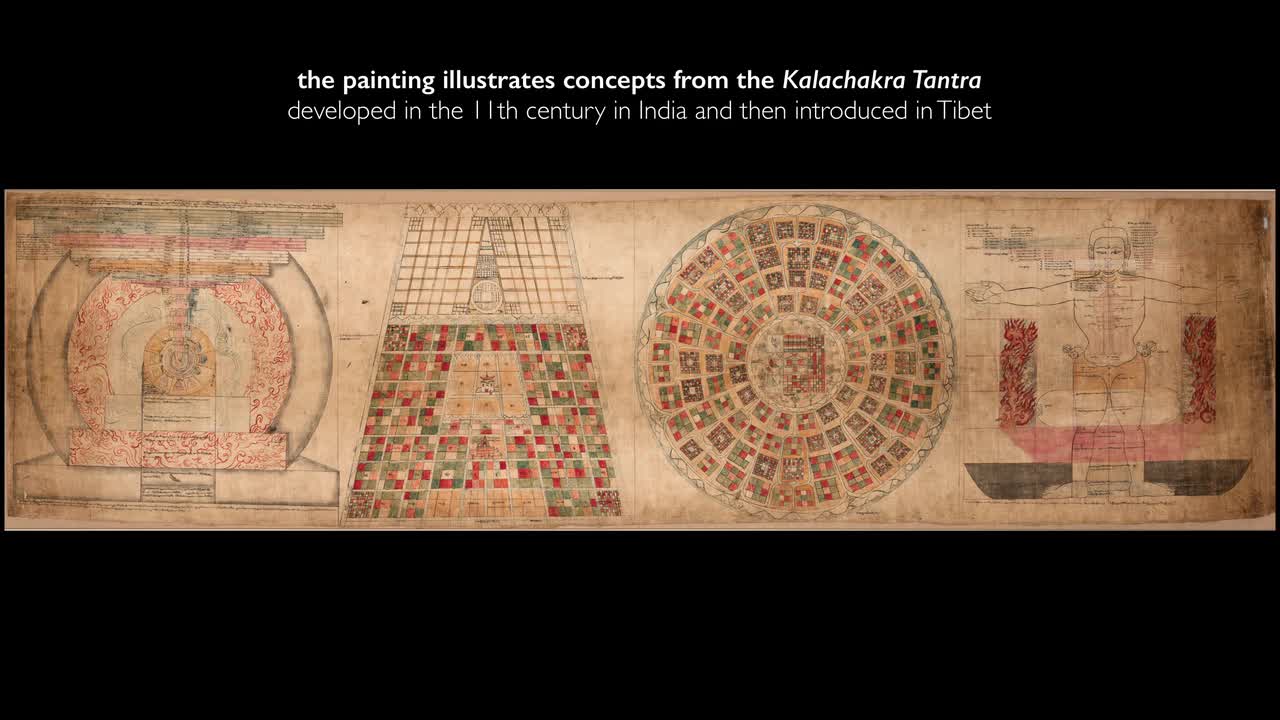
The Rubin Museum of Himalayan Art houses a remarkable double-sided horizontal painting that serves as a visual gateway into the Kalachakra Tantra. Developed in 11th-century India, this system—meaning the "wheel of time"—explores the cyclical nature of existence. This artwork functions as an instructional tool, mapping the complex relationship between the external universe and the internal human experience.
The Outer Universe: Spheres of Creation
The painting’s first section provides an artistic rendering of the universe's origin. It utilizes a series of spheres represented as circles, each corresponding to a fundamental element:
- Wind (Outer sphere): Depicted as a cosmic energy.
- Fire & Water: Represented by specific color-coded layers.
- Earth (Central yellow disc): This disc acts as the foundation containing various continents.
Crucial to this cosmology is Mount Meru, described as the "axis of the whole universe." The painting illustrates this mountain expanding upward, tapering wider to support the realms of the gods, ranging from the "desire" realm to the "form and formless" realms.
Geography and the Sacred Shambhala
The work zooms in on the "red triangle" continent—our own world—where specific regions are marked with inscriptions. Notably, the text identifies "Per" (Tibet) and highlights the "great river" leading north to the sacred land of Shambhala. The painting provides a detailed depiction of Shambhala’s main city, which features a palace that doubles as a temple, alongside a visible mandala, emphasizing the site’s spiritual centrality.
The Microcosm: The Human Body as Universe
A pivotal concept of the Kalachakra Tantra is the mirroring of the external universe within the human anatomy. The painting illustrates that the same elemental particles forming the cosmos exist within the body. By repeating the color schemes and details of the cosmic spheres—wind, fire, water, and earth—the artist demonstrates that the human spine and head function similarly to Mount Meru and the celestial realms.
Internal Networks: Chakras and Astrological Correspondences
When viewing the reverse side of the painting, the focus shifts to the internal energy systems of the body, specifically the "complex networks or knots" known as chakras. These are not merely anatomical markers but are linked to astrological correspondences. The painting details the six elements mapped across these energy centers:
- Crown: Space element.
- Forehead: Water.
- Throat: Fire.
- Navel: Earth (Yellow).
- Sex Organ: Awareness (Green-blue).
These 12 chakras, located at the main joints, are connected by lines of varying colors, representing the flow of elements between these junctions.
Celestial Mechanics: Mount Meru from Above
The final section of the painting features diagrams of interlocking circles. These represent Mount Meru viewed from above, illustrating the movement of the sun in alternating patterns. The narrator clarifies that these are not flat, static circles but "umbrella-like spheres" that suggest dynamic, three-dimensional movement over time.
Conclusion: The Philosophy of Interconnection
This painting is a masterclass in synthesis. By juxtaposing the macrocosm of the universe with the microcosm of the human body, the artists successfully visualized the core tenet of the Kalachakra system: that the external universe and the internal human universe are fundamentally interconnected. The work remains a profound testament to the ability of art to translate abstract, complex philosophical systems into a straightforward, cohesive visual language.
Deep Learning with ListenLeap


