Love Letters is brought to you by Chime.
The way we think about money is never just about money.
It's about our values, our goals, and how we engage in our relationships.
Money can make us feel very safe or very stressed, which affects everything we do.
Chime wants to make money feel like something that supports us as opposed to something that stresses us out.
And that goal resonates with me very much.
With Chime, you can get paid up to two days early with direct deposit, earn up to 3 APY on savings and even access up to 500 of your paycheck when you decide.
That kind of flexibility doesn't just help your bank account.
It helps you feel more in control.
They also just launched the new Chime card, which lets you build credit using your own money, with no interest, no annual fees and no stress.
Chime is not just smarter banking.
It's the most rewarding way to bank.
Join the millions who are already banking fee-free today.
It just takes a few minutes to sign up.
Head to Chime.com slash love letters.
That's Chime.com slash love letters.
Chime is a financial technology company, not a bank.
Banking services, a secured Chime Visa credit card and MyPay line of credit provided by the Bancorp Bank NA or Stride Bank NA.
MyPay eligibility requirements apply and credit limit ranges $20 to $500.
Optional services and products may have fees or charges.
See Chime.com slash fees info.
Advertised annual percentage yield with Chime Plus status only.
Otherwise, 1.00% APY applies.
No min balance required.
Chime card on-time payment history may have a positive impact on your credit score.
Results may vary.
See Chime.com for details and applicable terms.
February is supposed to be about love and friendship.
Celebrating your best relationships can mean flowers or fancy dinner plans.
But I just want pajamas and really nice bedding.
Which is why I'm here to tell you that Love Letters is brought to you by Cozy Earth, which has pajamas and bedding.
A gift for the ages, the Cozy Earth Bamboo Pajama Set.
It's soft, lightweight, and cozy.
They also have what is literally called a classic cuddle blanket.
It's plush, comforting, and it's for cuddling with others, a pet, or yourself.
Solo cuddling is very important.
Cozy Earth also makes it easy to try their products risk-free with a 100-night sleep trial and a 10-year warranty.
The only problem?
Once you feel this level of comfort, you might never want to go back.
Share a little extra love this February and wrap yourself or someone you care about in comfort that truly feels special.
Head to CozyEarth.com and use my code LOVELETTERS for up to 20% off.
And if you get a post-purchase survey, be sure to mention you heard about Cozy Earth right here.
The new year always makes me want to improve my living space, not in a dramatic throw everything out way, but in that calm, practical way where things feel clean and set up right.
Stylish, but also cozy.
Wayfair makes it really easy to get going on this because they genuinely have everything.
Big furniture pieces that transform a room.
Mid-century modern dining room sets that make you feel like the coolest person in town.
Small flourishes like a faux plant you'd never know isn't fully alive.
An accent pillow that changes everything.
And if you look, yes, they even have furniture to beautify a podcast recording area.
Wayfair makes it easy to shop by style and budget.
You can be intentional without getting overwhelmed and somehow still find things you didn't even know you needed.
Get organized, refreshed, and back on track this new year for way less.
Head to Wayfair.com right now to shop all things home.
That's W-A-Y-F-A-I-R.com.
Wayfair.
Every style.
Every home.
When I was in high school, my friends introduced me to the work of Alfred Kinsey and his Kinsey Scale.
The Kinsey Scale, made by Alfred Kinsey in 1948, is a rating system that describes a person's sexual orientation.
It basically says, you don't have to be just gay or straight to There's a whole array of middle.
Kinsey, the man, the researcher, was a sexologist, a biologist.
He founded the Institute for Sex Research at Indiana University.
Now, if you find Alfred Kinsey's studies as a teenager and you are me, and it's the late 1990s you get really into his work.
It kind of felt like homework reading, academic work. but it was all about sex and relationships.
And remember, it was the 90s, so this kind of stuff I could not Google.
I felt very adult and very bold reading all about the signs of attraction and how people wanted to have sex.
I was fascinated that there was an academic place, eventually called the Kinsey Institute, where people studied doing it.
By the way, in 2004, there was a movie about Alfred Kinsey starring Liam Neeson.
I treated its release like a Marvel movie.
Hello, I'm Dr. Alfred Kinsey from Indiana University, and I'm making a study of sex behavior.
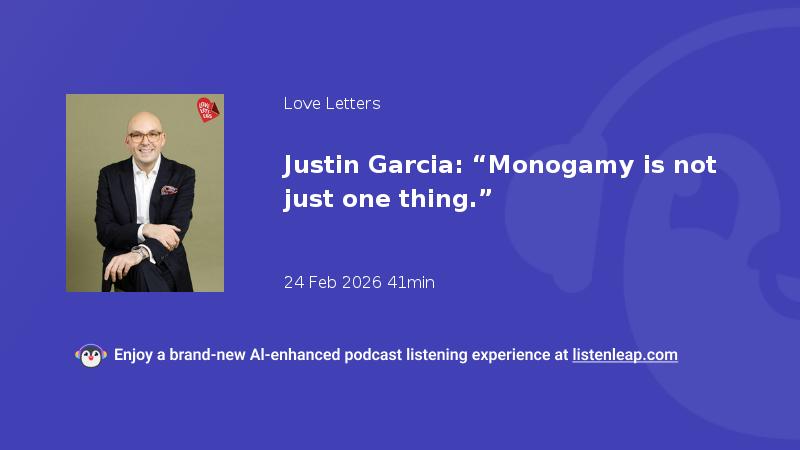
All of this explains why I was thrilled when I heard that Justin Garcia, the current executive director of the Kinsey Institute, had written a book about sex and relationships.
Justin, like Kinsey, is also interested in relationships and attraction through the lens of biology.
His new book is called The Intimate Animal The Science of Sex, Fidelity and Why We Live and Die for Love.
To me, after reading the book, I can say that it's about how two things can be true.
We're always told that humans are not meant for monogamy, that we have to do all this unnatural work to commit.
But humans are also animals that need emotional connection, and often for a very long time, with the same person.
The very beginning of the book is about Garcia going to a place where there are sex workers and him realizing that the most expensive thing on the menu didn't have much to do with sex at all.
But I'll let him explain.
Today is a conversation with Justin about his book and many other things we talk about on Love Letters.
I want to note, in addition to his Kinsey Institute responsibilities, Justin also serves as an advisor to Match, helping the dating app with its annual Singles in America study.
We'll get into that, too.
From the Boston Globe, this is Love Letters.
I'm Meredith Goldstein.
So the Institute was founded in 1947 by Dr. Alfred Kinsey, a zoologist, father of American sexology.
What happened was Dr. Kinsey was teaching the marriage course at Indiana University.
Particularly in the 1930s, we were seeing more of these so-called marriage sexual hygiene courses in the US.
And it represented to me what is really the absolute best of what the promise of higher education is.
Students had so many questions for the faculty in this course that Kinsey and the other faculty didn't have answers.
He said, we have to go do some research and collect data to answer these questions.
So he embarked on what is still to this day one of the greatest sex research studies.
They interviewed 18,000 people.
The interviews lasted about three to 18 hours, often over multiple days, and they were detailed sexual histories.
That formed then the basis of two landmark books Sexual Behavior of the Human Male 1948, and Sexual Behavior of the Human Female, 1953.
But Dr Kinsey was committed to a methodological point that he really maintained throughout the whole study.
That's everything we collect, we will share.
We will take the data, we will put it in these books and share it with the public, not just the academic community, but the world.
So there were things that the researchers sometimes learned that they didn't particularly endorse, but they wanted to make that data available to the world.
We know about the Kinsey scale.
Many people will fall between zero and six in terms of their sexual orientation.
In the original study, you were given a score.
You were assigned a score by the researchers depending on how many male sexual events and female sexual events.
Male sexual fantasies.
Female sexual fantasies.
It was a taxonomy.
Today we'll do a study where we'll ask people where do you self-identify on a scale of zero to six.
It's actually a very different methodological question.
One's about behavior.
The other is about identity.
And in fact, in our studies today, we often ask about three different aspects of sexual orientation.
What is your behavior?
What is your identity?
And what is your preference?
As it should, science is iterative.
We should learn and get better over time.
There's a lot of examples like that of how we've altered or built upon the way we ask questions.
You give people a sense of the kind of research you've done.
Listeners would probably really love to know the range of something researchers might look at.
Oh, sure.
In one of our studies, we do a project called Singles in America.
It is the largest, most comprehensive study of U.S. singles.
It's fully funded by Match.
I do it with my colleague, Dr. Amanda Gesselman.
We used to do it also with our late colleague Helen Fisher, the anthropologist who I started the project with,
So Singles in America, every year we collect a new sample of about 5,000 U.S. singles.
It's a new cross-sectional sample.
They're not people on a dating app or website.
It's a demographically representative sample.
And we ask questions about their singles attitudes and behaviors and dating and relationships and sex.
And we publish academic articles throughout the year.
It's a real deep dive into who are the more than 100 million singles in the United States.
That's a survey study.
It's done online.
That's one example.
Another example, we collected hormone samples in Las Vegas in a sex club in Las Vegas.
And it was a legal sex club.
We were in the reception area and I had a little cooler with ice and we were collecting saliva for hormone assays.
And we would do interviews.
So people would come in, often individuals or couples.
We would do an intake sexual history interview, get their saliva sample.
They would go do what they did and then they'd come back and say tell me exactly what you did and give me more saliva.
And we were looking at changes in testosterone and estradiol.
So we were looking at changes in sex steroids.
And you might say, well, why did you have to do this?
Couldn't you do it in a laboratory?
We want to do it in a non-laboratory setting because the academic literature is really inconsistent about what happens in sexual response with testosterone and estrogen.
And there's all these inconsistent studies.
So we were interested in when you don't have what's called a white lab coat effect.
When you collect hormones in a laboratory environment, you often get a stress response.
So you're not always clear what you're sampling.
And in a real life environment, what was happening?
And in fact, what we found, what we published in that study, was the part of the reason I think the literature is so inconsistent is there's a lot of variability in men and women, that some increase, some decrease, some increase a lot, some increase a little.
There wasn't a very consistent pattern of why based on specific behaviors people were engaging in.
On the one hand, you might say, like, you're collecting hormones in a sex club.
That's pretty far out.
And it was far out.
But we were really asking a pretty technical question about physiology in response to sexual activity.
I see that you've worked with so many people who are friends of Love Letters.
I really wanted to talk about Helen Fisher because I believe she was on one of our first episodes.
Ever.
And I felt very legit that I had her on and had the pleasure of having her on.
And from my memory, she was explaining to me why people get super horny when they are going through a breakup.
Like this idea that not only do some people want to have sex after a breakup to try to get over someone else, but also that it may trigger an actual chemical reaction, a fight or flight kind of chemical reaction that reminds them of sex.
I need to stop here to say that Helen Fisher, whom Justin worked with on that study of single people and on many other studies, she did come on the very first episode of the Love Letters podcast to talk about the chemical reaction in the body caused by being dumped.
Her saying yes to that interview somehow made me feel like we could make a legitimate podcast.
She was so smart and I will always be thankful she joined us.
Dopamine has a positive correlation with testosterone.
So, as you drive up the dopamine system, you're in a state of high anxiety, totally frantic, totally energetic.
It can trigger the testosterone system and just create the sex drive too.
But in the long run, it's just a distraction.
Helen died in 2024.
I wondered if you could speak to Not just about her, but about the people you work with.
It must be incredible to be around these minds.
When she died, I read her obit in the Times and I was just so grateful that she was someone who made a lot of things yet again safe to talk about, easy to understand.
Helen was a very dear friend of mine.
We published well over a dozen articles together.
She did something really remarkable as a scientist.
She really pushed for researchers to take seriously the role of love and including, when we think about sex, the science of sex, that there could be a science of love.
And that was no small task.
A lot of behavioral and social scientists felt love was squishy.
You couldn't really wrap your arms around real clear mechanisms, or what exactly are you talking about?
It feels and looks and is described differently in so many different places.
So helen really demanded that we have a science of it and and took seriously this role of pair bonds.
And she did something else as a scientist that i so admire that we don't see enough of anymore, particularly with sort of the new style of science.
She was really in the business of big ideas.
She came up with big ideas, would put them out to the world with evidence but then say well, maybe they're right.
Maybe they're wrong.
Let's test them.
And I think we see a lot less of that.
There's a lot more hedging and research now.
People want to really say, well, here's exactly what I found.
And I don't want to guess too much beyond what the evidence allows me to say.
And Helen said, let's think.
Let's have big, bold ideas.
And I mean, when she first published Anatomy of Love, her book, She had a lot of bold ideas.
And in the 20 years afterwards, so many of them came to pass.
But it took years and years of progressive research to show.
I want to talk about your book.
So for this book, where does that idea start?
Give me the origin story of the book.
So my new book, The Intimate Animal, it actually started for me in graduate school.
And in some ways it is very much related to being here at the Kinsey Institute with all these great colleagues.
When I first came here, my training was in anthropology and biology, and my dissertation dealt with issues of the evolution of monogamy social monogamy.
So I came in with a lens that, as a biologist, monogamy is not just one thing.
It was two different mechanisms.
There's social monogamy, which is the relationship structure, and sexual monogamy, which is sexual fidelity, exclusivity.
And they're different things.
They're different behaviors, and they're different mechanisms in the brain.
And there are different levers in evolution, meaning that there was different selection pressures.
There was selection pressure to maintain a long-term bond for mutual territory defense, mutual raising of offspring and a different lever for desiring sexual novelty and variation.
So I always saw relationships and sex that occurs in relationships or outside relationships.
Early in my career I wrote a lot about hookup culture, for instance.
It was always with respect to these two overlapping mechanisms for monogamy.
And that was the initial kernel for this book.
I wanted to really unpack what does that mean for our romantic and sexual lives today.
If we put on those glasses with me and say let's look at two different levers for monogamy social monogamy and sexual monogamy and we can understand when they're in conflict, when there's tension that can bring a lot of chaos and And trouble to our relationships.
When they're aligned, it can bring a lot of joy and satisfaction.
And how we navigate that.
Whether we're single, we're starting a new relationship, maintaining a relationship going through a breakup.
That was the impetus for me was really the fact that I came from a different discipline.
I came to the Kinsey Institute.
I wasn't a sexologist.
I wasn't in psychology.
I was thinking about this really in terms of what we see in the natural world and our evolutionary history.
You hear all these things as a person in the world, right like?
Oh well, humans are not meant to be monogamous.
These blanket statements about how our brains work, how our bodies work, and your entire book seemed to say to me many things can be true at once that we can want sexual novelty and we can also want to have someone who has the same inside jokes with us for 30 years, and one of the things i liked about it was that it seemed possible and that it's not that these desires are always in conflict with each other.
Another thing the book does that I think is important right now is that you know I'm a journalist, I'm not a scientist and I'm an advice columnist and a podcast host.
And people will say to me, well, I'm hearing a lot about polyamory.
Is everyone polyamorous now?
Or I'm hearing a lot about this.
What's the deal with that?
Right.
And you, In the context of talking about the need for sexual novelty, emotional intimacy, you also give a real baseline explanation of a lot of things that are being talked about right now that people may not understand.
How did you want to explain the status quo of the world in terms of how people have relationships to people who may not know?
Because so many of us know how we're living, but then we hear oh well, are young people not even dating, or people never going to have children?
Yeah you, you're exactly right and you are in a position that you're hearing it, and i'm fortunate that i'm in a position as well that people will share things about what's going on in their life with us and ask questions.
But how does you know, is it normal?
And a lot of us have moments that we struggle with it, a lot of us have moments we celebrate it, but there's just so much noise, there's just so much noise, so much misinformation, that it can be really hard to sort of cut through that.
So I really tried to curate to try and help us get through some of that noise and appreciate there are some consistent patterns.
When we understand our evolutionary biology.
There are some universal, consistent patterns, but there's also a lot of variation in the world.
As an evolutionary biologist, the bread and butter is variations, diversity of traits.
So how do we understand how our intimate lives respond to different moments, different ecologies?
So Justin's talked a lot about science and about traits.
When we come back, I'll ask him how the science plays out in real life.
He'll also explain a concept he writes a lot about in the book called slow love.
He says in the book, all the kids are doing it.
More when we come back.
Four taxpaying americans has paid the price of identity fraud.
What do i do my refund, though i'm freaking out.
Don't worry, i can fix this.
Lifelock fixes identity theft guaranteed and gets your money back with up to three million dollars in coverage.
I'm so relieved.
No problem, i'll be with you every step of the way.
One in four was a fraud.
Paying american not anymore.
Save up to 40 your first year.
Visit lifelockcom.
Slash podcast terms apply.
Boston, new england Maybe you're from here.
Maybe you went to college here.
Maybe you live here now.
It's a place rife with smart people and big ideas.
Every week at the Boston Globe.
Say More brings you the best thinkers and storytellers from around the region, like Dennis Lehane, author of Gone Baby, Gone.
I loved growing up in a working class town.
I loved the loyalty.
I loved the jokes, the sense of family bonds.
I don't find that in a lot of the rest of the world.
Expertise with heart from all around New England.
From the Boston Globe, listen to Say More.
We're back.
A lot of people I hear from want to know about younger people.
And by younger, I just mean younger than them.
That could be any age hearing about somebody younger.
Maybe it's that they want to better understand their children or grandchildren.
In some cases, it's people wanting to understand their peers.
And there are a lot of absolutes that are said you know, people don't do this anymore.
Or everybody's in a situation ship and no one's dating.
And you go through this concept in the book of slow love.
And I wanted to see if you could talk about that a little bit.
Can you explain slow love and how you define that concept?
I'm actually much more optimistic than I think some of the scary headlines about what's happening to relationships today.
Slow love is this idea that, Although we see changes in behavior, we're so-called sex recession, that people are engaging in less sexual frequency.
It's true in a lot of different data sets now that people are delaying relationship formation and marriage.
In fact, we see a generation of young people where not only just our deep evolutionary ancestors but our grandparents' generation that they went through pubertal maturation in the late teens on average.
And then first marital relationships were often in 20s, sometimes mid-20s.
Relatively short period between when one was sort of launching physiologically and then actually starting marriage and reproduction.
That gap has now gotten so large between we're seeing average age of puberty is close to 12 for girls in the United States.
Age at marriage and at first birth is getting older and older and older.
And these are unprecedented time periods.
So one question I had asked in some of our early studies was, what do we expect?
What do we think is going to happen?
We have these historically unprecedented periods of time that we're physiologically reproductive.
We have interest in sexual activity.
We have physiological capacity for sexual activity.
But we're not thinking about marriage or kids.
And as an evolutionist, this is a remarkable shift.
I could walk into a lecture hall on campus. to 500 students, and maybe one of them is married.
And just a few decades ago, when Dr Kinsey was lecturing, half of those students would have been married.
That's a big shift in a relatively short period of time, all things considered.
So when we think about young people, there's a lot going on.
They have a bigger window to explore their lives and their sexual lives and their relationship lives.
We don't have a lot of data on it, but I think that young people today are moving in and out of relationships more than their parents and grandparents, maybe having more heartache than their parents and grandparents.
But there's also things they're teaching us that are unique, which is reverse intergenerational transmission.
And that's about use of technology, integrating technology. technology.
We're seeing young people putting their parents and grandparents on dating apps.
And usually information travels down.
Your parents tell you this is what courtship looks like, this is what a relationship looks like.
But the young are putting older generations on these technologies.
And on this little love piece, what we see, what we argued is that this pattern that appears, I think a lot of people have suggested is problematic.
That young people seem not as interested in sex or not as interested in relationship formation.
Helen and I argued it's more a pattern of caution.
And when you look under the hood of what's going on and you ask young people what's going on, in a series of our studies we found that they still are looking for connection.
In fact, we have some new data we just collected.
Over 80 of people are saying that they're ready for a romantic connection and relationship of young singles.
But how they do it is different.
And where their parents or grandparents' generation maybe dated a short period and then got in a relationship, or got married and then embarked on a new adventure.
Young people today want to know everything about someone.
They want to hang out for a few months.
Then maybe they're hanging out in groups for a few months.
Then they're dating for a few more months.
Then they're maybe eventually boyfriend and girlfriend.
Then that could happen for years and they could be engaged for years.
So this is a slower process of courtship, a prolonged process of courtship.
And the idea of marriage for young people today, it's not the beginning of the adventure.
Marriage is the grand finale for young people today.
They want to know everything about someone first.
So it's a reordering of the process of really getting to know someone.
And I think it's a process of caution and a process of wanting to really trust the person you're going to be a copilot in life with.
There's a negative way to spin just about any shift in the choices we make.
But even calling it love, even calling it slow love gives it the benefit of the doubt of no, this is love.
And you mentioned caution, but there's also honesty, right?
Like younger people, are pretty worldly about even their own biology and what it means to feel.
The initial excitement of a crush does not mean you should marry that person.
And my late mother would tell me I kind of knew that whatever I felt about your dad probably wasn't going to be, for you know she was excited.
She was excited about the next social step she would make out of her own parents' house.
But you know, beyond caution, had she been able to be more honest with herself, she would have said oh, this is probably a temporary feeling.
So it just seems like people are also smarter and more honest about saying well, let me see if this lasts.
And it does, as you mentioned in the book, take out this.
I don't think it makes sex any less important, but it does make it a part of learning about someone and a part of bonding, as opposed to some old fashioned payoff that you get.
We still have a lot of people who comment on our advice column saying oh well, if you live together first or if you have sex too early, you're going to spoil spoil the magic of a relationship.
And there is no evidence that I see that that is true.
Yeah, that's right.
There isn't.
And people find different ways to connect.
And often you want, it's about gathering information, particularly for young people.
They want to really have a sense that they feel, they talk about vibes, right?
Young people, if you're around young people today, Gen Z, they're always talking about their vibe.
What are they vibing?
What are the vibes?
They want positive vibes.
They want to feel safe and comfortable with someone.
It doesn't mean they're not still interested in sex.
It doesn't mean they're not still interested in long-term relationship bonds.
But they want people they feel comfortable with, that the nervous system feels comfortable with.
In fact, in one of our studies we asked singles what is the top five things they're looking for in a relationship.
And attraction, it's up there.
It's important.
But the number one thing singles want in a romantic partner is someone they can trust and confide in.
And that opens up a deeper form of connection.
And so much of it, I think, is really the intimate animal within.
We want partners.
We can trust and confide in.
And then our sexual lives are couched in the context of that trust and that safety.
So much of the book is about these two concepts right of emotional intimacy and physical intimacy and how we can do this long term and tying these goals together.
And one underlying theme I got when you talk about different people you've interviewed and people from your own life is that it helps if people make an effort.
Many of the couples you talk about who are really into each other, make an effort to remain into each other.
What did you learn by examining these bonded people who made it work, especially over long periods of time?
When we think of relationships, particularly relationships we would characterize as healthy or highly satisfied, we know that there's a friendship dynamic that's there and that can be trust and that could be attachment.
But those that maintained the sense of passion or those that maintain that that sense of attraction to each other, i'm not convinced.
It takes work.
I think it does take cultivation.
It takes some effort um, that you recognize.
So in one of our studies with my colleague Dave Frederick, for instance, we found that looking at those that had high degrees of relationship satisfaction, high passion, after many years they had a suite of things.
There was communication, there was kissing, there were a host of things that were important.
Then there were these things like lighting candles and dimming lights and lingerie.
And that was all about intention.
Those people that are going out of their way to say, I'm going to prioritize our intimate life.
It wasn't about the particular smell of the candle or the size of the candle or how many.
It was about I'm going to go out of my way to make something special.
And there's a whole host of things that couples do that is about something special and unique with your partner, even pet names.
We did one study looking at when people use pet names for each other or talk and baby talk to each other.
A lot more couples do it for a lot more time than we think.
And we found.
And that is really about having these special moments with our partner.
And it's easy to stop cultivating that.
It's like having a garden that you spent a few years on and it bloomed and it was beautiful.
And then one season, you just couldn't bother to de-weed it or you didn't replant.
And it's just so easy to then not keep cultivating, not keep fertilizing and watering and weeding.
But I think we can get back to that when we're aware of it and we realize it.
Then we can say, OK, let's get back to doing those special things like sharing the bed every night.
Not that not that I think that everyone has to share a bed, but sharing another conversation.
But sharing a bed every night, it's so easy to say, yeah, we're in a good relationship.
We sleep in the same bed every night.
But are you really focusing on each other?
What are we cultivating?
Are you laying in bed asking questions?
Are you touching?
Are you cuddling?
Are you sharing your day and supporting each other?
So it's easy to be in a routine and forget.
Like you said, it's just so easy to fall out of the cultivation, fall out of being curious about each other and asking questions, doing things, finding things together.
But curiosity is such a powerful tonic for passion and connection.
The way I have been unable to multitask until my now late 40s, where I just felt like I had to do a bunch of stuff and create a lot of community, figure it all out and then I could entertain this idea of truly having an emotionally intimate relationship with a romantic partner.
But one of the benefits of that is that I had unknowingly set up a system of intimate trust and support with friends family, where no area was unfilled except for sexually right.
So when I started a more serious romantic relationship, not everything fell to that person.
In fact, there was a lot of space for nothing to fall to that person other than cool, fun stuff.
And you write about the role of romantic partner as everything in the past, versus now, where you know a lot of people who couple up have been single for a long time and don't need that person to be everything.
And that sounds I don't want to say it's better than the other way, but it just, it seems like it.
It opens up possibilities for maintaining some of this romance and curiosity and effort we're talking about.
Yeah, Eli Finkel, the psychologist, talks about what he calls the all or nothing marriage, or in academic papers it's called the suffocation model of relationships that many people today expect so much from our partners.
We expect our partners to be a whole family and community.
And that's not really sustainable.
I want this person who's going to be my best friend and take care of me and support me and love me, and I'm gonna love them and they're gonna want sex with me and I'm gonna want sex with them.
And then when I'm sick, they're gonna hold my hair back over the toilet and the next morning still want sex with me, and it's it's a lot to expect of a person, as opposed to having these wider friend networks and and social support networks that we can get some of that from other places and as we age, that's the great opportunity.
I think, as we get a bit older, that we can start to say like i really want a companion to travel with, to play tennis with to, or i really want to have kids and i'm looking for someone who's going to be a mom or a dad, or you get more clarity about what in that mix are the things that are the priority.
And sometimes those priorities change in different chapters of our life.
One of the last questions I asked Justin was about the first scene of the book, because it really kicks off the whole thing, this whole conversation about how we tie our biological need for sex with our want for intimacy and for someone to really know us.
I wondered if you might talk a little bit about that opening scene.
Why don't you just explain where you decided to start this narrative?
Sure.
So I opened up The Intimate Animal with a story.
We were in Nevada.
Actually, I was there because we were collecting hormones in Las Vegas.
And then, while we were in Nevada, we took a trip out to Pahrump, which is about an hour outside Las Vegas, where there are legal brothels.
And we were getting a tour.
It was a group of researchers were getting a tour of this legal brothel, trying to understand how does this work?
What are the dynamics?
And in the tour this woman was taking us through, there was a menu quite literally a menu on an easel and taking us through.
What are some of the options that are available?
And some of them you might think is illegal, although some are really specific sexual behaviors or kind of kinks, and there's rooms that have themes to them.
But then I noticed on the list, this item, it was called the white whale.
And I was like, what's that?
And it's the most expensive thing you can get in a legal brothel.
And at first you might think, well, what kind of sexual thing?
It was $20,000 at the time.
This was a few years ago now.
And you think, well, what kind of sexual thing is that?
It must be so intense.
And the most expensive thing you can purchase in a legal brothel was intimacy.
It was what was called the girlfriend experience.
That was where you would split a bottle of champagne.
And you would have a conversation, and it was like you were on a date.
Now, typically sexual activity would also happen, but you were couching that sexual activity in this relational dynamic, not just a 45-minute session where it's very transactional.
But sex was in the context of this date interaction and getting to know someone.
And in some cases, they didn't even end up having sex.
They were just turned into this more date and this intimate connection.
And I think that was so powerful to think where are people willing to spend the most money on an illegal brothel for the sexual activity that they could most desire?
And it was couching any kind of sexual activity in this relationship context, even if it's a make-believe relationship.
It was couching it in terms of feeling connected in some way, and so more of a social interaction.
And that, to me, was such a eye opening reminder of the intimate animal that's within all of us.
All of this is uplifting to hear that.
I am uplifted when I hear that people want connection, because so often we're hearing that they don't.
And it leads me to a question about algorithms.
I follow a lot of therapists because of my job.
I follow a lot of people who do research, but I also follow a lot of influencers who talk about relationships, and some of them are incredibly smart and do helpful work.
So I don't want to bash anybody.
But what I do get a lot of is here are the 50 ways that something terrible could be happening to you.
It begins to weigh on you, right?
I begin to look for problems where there aren't any.
You speak about technology and you write about the ways we can self-protect or use it for good.
What are we supposed to think about a lot of negative warnings that come to us and how to be cautious without seeing slow love, for instance, as no love?
Yeah, I'm so happy you brought this up because one of the things we know I use a framework in a lot of my work called polyvagal theory.
My colleague, Steve Porges, whose faculty at the Kinsey Institute has done work on how the vagus nerve helps interpret our environment.
And it means that our nervous system can regulate to our environment.
And when we get a lot of negative information, when we get so tuned up that we're afraid or anxious because there's all these ways that we think we can screw up our relationships, there's all these ways that our dates can go sideways.
What happens is the nervous system can be in a threat response.
And when we're in a threat response, that is not conducive for social interaction.
It's not conducive for mating psychology.
I've often said as an example, that you'll never see two gazelle mating in front of a lion in the natural world.
And you'll never see two people kissing in a burning building.
Now, those are maybe extreme cases of threat response.
But when we get ourselves just a little too tweaked out over some of the things that are stressing us, It could be really hard to engage in positive social interaction and really hard to start to establish a sense of romantic connection or a sexual desire for a person.
So I think that's right.
There's so many hot takes and it could be really hard to curate.
That was one of the goals of writing The Intimate Animal is helping kind of cut through the noise.
What does the research say?
What does the evidence say on how we navigate this landscape and today in this particular moment?
And you're right, there's lots of good information.
There's also a lot of things that experts don't agree on.
One of the benefits of leading the Kinsey Institute is I work with so many experts.
There are things that we don't always agree on.
We have different disciplines, different frameworks, different interpretations of evidence.
That's the cool thing about science and research.
So that I think is one piece of we have to be cautious.
The other is that sometimes In my arena I hear all the time of these hot takes on human nature and about evolution.
I was just giving a talk recently and someone said something about alpha males and the alpha and how do we think about if you're an alpha in a relationship?
And I started laughing.
I said, I'm not laughing at you.
I'm laughing at the framework of this, because where do you get this concept from?
Is it like an alpha wolf?
And he said, yeah.
And I said, you know what's interesting about wolf packs?
There's not an alpha wolf.
There is a pair.
There is a couple that leads at most wolf packs.
It's a male and female mated pair and most of the pack are their kids or their grandkids or their nieces and nephews.
So this notion that there's this dominant male, there's a pair and the female actually has quite a lot of control.
And there's so many examples of that.
Then they were asking something about men who are providers, and his argument was But historically men have provided food and nutrition for families.
I said, you know what's funny about that one also when you look at the evolutionary evidence?
There's the man-the-hunter hypothesis, but there's the woman-the-gatherer hypothesis.
And throughout human evolution, women brought in more calories to the home than males did through a meat hunt.
So again, we sometimes spiral with these ideas because we have this conception of the natural world or this conception of the way things are.
And it's often just not true.
So I'm always really cautious about where we're pulling these examples from, because they can really lead us astray.
Justin's book, The Intimate Animal, is out everywhere.
Love Letters is a production of the Boston Globe.
This episode was produced by Jasmine Aguilera.
Story edit by Veronica Chow.
Sound design by Jasmine Aguilera.
Special thanks to Linda Henry and Brian McGrory.
Remember, Love Letters is also an advice column.
Send any question about dating divorce marriage singlehood whatever, to loveletters at bostoncom.
When you send a question, you help people wondering the same thing.
And if you like the show, please leave us a review.
What an extraordinary privilege to hear these stories and to help people unpack them and situate where we are with some of the most important relationships of our lives our romantic and sexual relationships.
I'm Meredith Goldstein.
Thanks for listening.
Curious about the future of healthcare?
Tomorrow's Cure, the chart-topping and Ambie Award finalist podcast from Mayo Clinic, brings it to you today.
I'm Kathy Worzer and in this new season I sit down with researchers, doctors and industry experts who are leading the way in medical innovation.
From cutting-edge technology to breakthrough treatments, we'll explore how new solutions are improving and even saving lives.
Follow Tomorrow's Cure wherever you listen to podcasts.
What is healthy spirituality and how does it help us thrive?
We explore these questions on the new season of With and For hosted by me, Dr. Pam King.
With and For bridges psychology and spiritual wisdom to help you thrive, featuring conversations with experts like self-compassion pioneer Kristen Neff and author activist Parker Palmer.
So go ahead, follow With and For hosted by Dr Pam King, wherever you get your podcasts, including over 25000 cars under 25000.
Want to get started?
Head to CarMax.com for details and get pre-qualified today.
Want to drive?
CarMax.