Most software companies try to maximize your time on their app to juice engagement.
Ramp does the exact opposite.
Ramp understands that no one wants to spend hours chasing receipts, reviewing expense reports and checking for policy violations.
So they built their tools to give that time back, using AI to automate 85 of expense reviews with 99 accuracy.
And since Ramp saves companies 5, it's no wonder that Shopify runs on Ramp, Stripe runs on Ramp and my business does too.
To see what happens when you eliminate the busy work, check out ramp.com slash invest.
OpenAI, Cursor, Anthropic, Perplexity, and Vercel all have something in common.
They all use WorkOS.
And here's why.
To achieve enterprise adoption at scale, you have to deliver on core capabilities like SSO SCIM, RBAC and audit logs.
That's where WorkOS comes in.
Instead of spending months building these mission-critical capabilities yourself, you can just use WorkOS APIs to gain all of them on day zero.
That's why so many of the top AI teams you hear about already run on WorkOS.
WorkOS is the fastest way to become enterprise ready and stay focused on what matters most your product.
Visit WorkOS.com to get started.
Every investor should know about Rogo, because Rogo AI's platform is not just another generic chatbot.
Instead, it was designed to support how Wall Street bankers and investors actually work, from sourcing, diligence and modeling to turning analysis into deliverables.
For me, three key things differentiate Rogo.
First, it connects directly to your system, so it can work with your actual data.
Second, it understands your workflows, how work really happens across a deal or an investment.
And third, it runs end-to-end and produces real outputs the way the best people do.
Auditable spreadsheets, investment memos, diligence materials and slide decks that match your standards.
This all comes from the fact that Rogo is built by finance professionals for finance professionals.
And it's already being adopted by some of the most demanding institutions in the world.
To learn more, visit rogo.ai slash invest.
Hello and welcome everyone.
I'm Patrick O'Shaughnessy and this is Invest Like the Best.
This show is an open-ended exploration of markets ideas, stories and strategies that will help you better invest both your time and your money.
If you enjoy these conversations and want to go deeper, check out Colossus, our quarterly publication with in-depth profiles of the people shaping business and investing.
You can find Colossus along with all of our podcasts at colossus.com.
And do not reflect the opinion of Positive Sum.
This podcast is for informational purposes only and should not be relied upon as a basis for investment decisions.
Clients of Positive Sum may maintain positions in the securities discussed in this podcast.
To learn more, visit psum.vc.
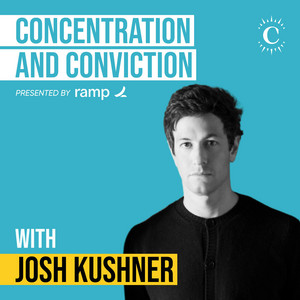
This is my second conversation with Josh Kushner, founder and managing partner of Thrive Capital.
I recorded this conversation with Josh back in October after we published the Colossus cover story about him and Thrive.
Given the overwhelming spread of that story, we decided to create some breathing room between it and this conversation.
Josh started Thrive in 2011.
The firm now manages approximately $50 billion with a very small investment team.
What makes Thrive different is how concentrated they are and how involved they get with the companies that they back.
In this conversation, we cover the iconic investments that define Thrive Instagram Stripe GitHub, and spend a lot of time on OpenAI.
Josh explains how Thrive thinks about investing today and the three categories that they are currently focused on.
Josh also talks about how he built the firm, why they keep the team so small and what he's learned from A24 about enabling artists to create their best work.
He shares the personal stories that shaped him, including his grandmother's experience surviving the Holocaust and what he learned from Stan Druckenmiller, John Winkle Reed and others at formative moments in Thrive's history.
Please enjoy my great conversation with Josh Kushner.
When we first did this, I think a lot of people knew you and a lot of people knew Thrive, but it's changed a lot since two years ago.
I saw a survey recently where some recruiter profiled, I don't know, hundreds of people that asked them where they wanted to go work, which venture firms, and Thrive was number one.
And it had more than two times the votes of the next highest firm, which was like Sequoia or something like this.
I know you hold this in two lights.
Tell me about how it's felt over the last two years and how Thrive itself has changed since we last did this.
A lot has changed and in many ways, so much has stayed the same.
We're building a company, that company just happens to be Thrive.
The company has a product and it is to invest and be the most meaningful partner to those that we're fortunate enough to partner with.
But with that dimension in mind, we are constantly pushing ourselves as far as we possibly can to make ourselves better.
External validation can distort even the most disciplined minds.
And just as we have ignored critics in the past, we guard ourselves against the lure of praise.
Having the types of individuals that we've had at the firm, that have had The capacity to truly think independently, is what has gotten us to where we are today.
But it's really important that we ignore the noise, keep our heads down and have a collective responsibility as an organization to make sure that anyone who joins is doing so with that same independent thought.
I think Thrive is a very small percentage of its potential.
I feel like we're just getting started.
What is it like to run an investing firm where entrepreneurship and entrepreneurial people define the culture?
It feels much more entrepreneurial of a culture than an academic investing type culture.
Maybe say a little bit more about why that's the case and why you cultivate that.
I remember vividly getting a call early on in the days of Thrive where a very prominent endowment pass on Thrive because they said that I was too much of an entrepreneur.
I think in the earlier days of Thrive, we felt shame in that.
We almost felt like we had to hide our ambition within Thrive.
I was told that investment managers building investment firms were not meant to be ambitious.
Do you think that that comment you hear that sometimes amongst allocators, LPs maybe is that the problem with ambition is that it means scale of assets, and scale of assets means eroding returns.
Is that the thing underneath that endowments comment?
The ambition of Thrive has never been around the scale of the assets that we have.
I think we're just very focused on on the input orientation of what we're doing every day.
Do we have the best culture?
Do we have the best process?
Are we creating the best possible product for our founders?
I think for us, focusing on a particular number will ultimately lead to the wrong outcomes.
We're not looking to write these very meaningful checks.
It was very much in service of the opportunity.
There will be moments in time where the opportunity does not exist to write very large checks.
And we won't.
The distortion you mentioned earlier of praise.
Now everyone wants to work at Thrive.
How do you protect against the inverse problem?
How do you make sure that you still select for the same kind of people that got you here?
One of my favorite books is Meditations by Marcus Aurelius.
And he has this incredible concept early on in the book about this idea of the same man.
You should be the same man in both good times and in bad times.
And one of the things that I'm most proud of of the organization that we have is that people were somewhat out, phased over really a decade and a half of being criticized for our strategy, the construction of the team, the size of the team, some of the types of investments that we made, the size of the investments that we made.
We feel very grateful that these things have worked out and people have paid attention to them, but also not to be taken away by these things and to continue to keep our heads down, have humility.
It's really important that, as an organization, we continue to be open-minded to the idea that some of our convictions might not be right.
Humility and self-awareness are the most important characteristics of any organization, any individual.
And I think it's important that We just continue to think of every single situation with an objective lens.
How do you interview people differently, if at all, to make sure you're not getting people that are there because it's Thrive, a cool brand, versus the type of person you love when you personally are doing the interviews?
We still look for the same things.
I really want to understand who people are, where they come from, what motivates them, what drives them, what they feel like they owe the world as a result of what their experiences have been, how grateful they are to be in the position that they are in.
I was interviewing a candidate about six months ago and they said to me why is everyone at Thrive so driven and so motivated?
And my quick off-the-cuff comment was people are either first generation at Thrive or Or from the most hated state in the country, New Jersey.
I think there's this incredible chip on people's shoulder at the firm.
Insecurity is the greatest driver of innovation.
It's the greatest driver of progress.
It's the thing that jumpstarts everything, but it can't be the end goal.
If that is the place that you're operating from in perpetuity, it's a very dangerous thing because it's a never winning game.
There can always be more.
We've done a very good job of building an organization of people who come from certain places or have certain backgrounds, who feel a sense of responsibility or gratitude for the positions that they're in.
But also, at the same time, if you're operating purely from a place of I have something to prove to the world.
Just at least speaking from personal experiences.
The world doesn't actually care.
To the extent that you have.
How do you help usher people from the Spark community of motivation that comes from insecurity to the more abiding source of motivation that comes from passion or joy?
Just from personal experiences, I've seen a couple of times, whether it be through some of my family's troubles or association with politics, that external validation can be very dangerous and it also can be very fleeting.
What is the point in trying to prove something to someone else or caring about what other people think?
In reality, If they don't really care that much at all.
A lot of the people that are at the firm, I think have made that transition.
They all started with this desire, feeling like they had to prove something to someone else.
One of the things that I've been able to impart on people is you'll never win if that's the ultimate goal.
Maybe a click more about the culture of Thrive.
It's so interesting that Miles was with you from the beginning went to one of the other great venture firms Benchmark, came back to Thrive.
I'm so curious about the ways that you can keep the culture to its most essential elements.
We've always believed that artists like to live in artist colonies and it's our job to ensure that we have the right people within the organization to that are constantly pushing us forward and pushing us to learn as much as we can.
The things that we look for in the people that are at the Ferb are very similar to the things that we look for in the founders that we hope to partner with, which is self-awareness humility drive, ambition.
One of the things that I'm most proud of within the organization is this incredible open-mindedness to the idea that we have just a tremendous amount to learn.
Many people view vulnerability as a sign of weakness.
But if you are willing to say I don't know the answer, That is actually the most extraordinary sign of confidence.
We've always had this orientation that the only way to have a team is to have a small team, and the only way to have A small team is to have a group of people that everyone mutually respects.
If you respect everyone else around the table.
The conversations are really oriented towards trying to get to the right answer.
It's impossible for us to make the right decisions every time, but we can ensure that we have the right conversations.
Why are small teams such a key concept for you?
Why do you think they're so powerful?
Why don't you have a hundred person investment team?
Since the early days, I really wanted Thrive to feel like a company.
I think there's always been this dynamic that has existed within investment organizations that the investment team is what matters and other people matter less.
Our core belief is we wanted every single person within our organization to be the best.
You need to give everyone incredible transparency around everything that you're doing.
Give them the autonomy and the responsibility to ensure that, even if they're not within the investment organization, they are helping us get to the right decisions.
The reason why we've been able to stay so small, not just as an investment team but as an organization, is because across every dimension of our business, we have these 10x people, whether it be in legal finance, compliance or engineering organization, our portfolio support and impact team.
I think people feel like they're responsible for every decision that we are making.
They feel pride and authorship around the decisions that we're making.
As your business scales up, everything gets more complex, especially your compliance and security needs.
With so many tools offering band-aids and patches, it's unfortunately far too easy for something to slip through the cracks.
Fortunately, Vanta is a powerful tool designed to simplify and automate your security work and deliver a single source of truth for compliance and risk.
There's a reason that Ramp, Cursor and Snowflake all use Vanta.
It frees them to focus on building amazing differentiated products.
Knowing that compliance and security are under control.
Learn more at vanta.com slash invest.
I know firsthand how complex the tech stack is for asset managers.
And seemingly every new tool and data source makes the problem even worse, adding more complexity, more headcount and more risk.
Ridgeline offers a better way forward.
One unified platform that automates away all that complexity across portfolio accounting reconciliation reporting, trading compliance and more.
All at scale.
Ridgeline is revolutionizing investment management, helping ambitious firms scale faster, operate smarter and stay ahead of the curve.
See what Ridgeline can unlock for your firm.
Schedule a demo at RidgelineApps.com.
I was having a conversation last week with a friend about the state of the venture ecosystem and which firms had differentiation.
My friend said that he thinks that there's only two firms that have true differentiation his firm and yours.
And that the reason that yours did was that there was no one else willing to make the size of bet, the conviction of the bet at the stage of the company, at a price.
By doing that early, you were the person that people called for this specific thing.
How much of that was deliberate?
Ooh, there's an opening here to be the only provider of capital in this specific part of the market, versus it just being a natural consequence of you doing you.
It was a natural consequence of the firm being intuitive around where we thought that the world was moving.
We think of ourselves as a service provider.
We were not looking to put meaningful capital to work.
The companies that we were partnered with needed to raise meaningful capital.
And in order to be the best possible partner to them, we needed to do whatever we needed to do to support them in that capacity.
But there wasn't some grand meeting of no one's providing a billion dollar checks to these big companies.
We should do it.
It was more bottom up.
It was more company specific.
Stripe needed to raise six billion dollars or else they had to go public.
And it was our job to find a way to get them that capital.
OpenAI is a very capital intensive business.
It was our job to get them that capital, same with Databricks.
We did not view it from an output orientation.
It was an input orientation, which was, Our job is to serve these companies.
I think it'd be really fun to review some of the iconic deals that maybe people scratch their heads about through Thrive's history.
It seems like when you tell the story of the business and of your investment arc, there are these hash marks of incredibly defining things that you've done.
The first one that really really caught my attention was GitHub, which I think was in fund four or something like that.
It turned out to be a huge percent of that fund and a very large return.
But probably at the time, people were scratching their heads about it.
Can you tell me that story in as much detail as possible since it seemed fairly formative?
We invested in GitHub in 2014.
We were fortunate enough to participate in the initial round with what was a big check for us at the time, which was 20 million.
Almost a month into our investment, Chris Wonstroth, who is the CEO, decided to move on from a disproportionate amount of his leadership team.
And Nabil had just joined from 3G running finance for Heinz.
Working on ketchup, as he says.
Yeah.
A lot of similarities to software.
Moved out to the West Coast and effectively became the CFO of the business.
The outside perspective of the business was considered to be troubled, but our general view is the only way to truly develop context on businesses is to spend meaningful time.
And that's why we have such a concentrated portfolio to really understand the every aspect of everything that we're a part of in a very intimate way.
The more time and energy that we spent, the more convicted that we became that a lot of the things that were happening were noise.
Some of the earlier founders associated with the business wanted to get liquidity.
Thrive was the only person who wanted to buy the shares.
And we feel very grateful for the outcome.
Thrive owned about 10% and no one knew.
What did it feel like to have that much concentration?
This deal is so interesting to me because it highlights two things that have driven a lot of your success, which is very concentrated and very involved.
And maybe in GitHub's case the nominal price as a multiple of revenue or something was high at the point of entry.
And then you're under a huge multiple on capital and relatively short order.
These ingredients have been very common to some of the important stories around Thrive's investments.
Was that the first one that you had that degree of inside understanding and concentration, And did that embolden you to do more of that kind of investing?
The authenticity of our desire to be the most meaningful partner is a very important construct for us.
Our desire to only partner with very few is driven by our core belief that, in order for us to truly deliver the full value of ourselves, we can only commit ourselves to so many things.
I remember we had just invested in Stripe at $50 billion.
We had led OpenAI's investment.
We had just got asked by Eric and Karim from RAMP to lead an investment in the company at a lower price than the round that was done in 21.
We were getting absolutely eviscerated by everyone in the ecosystem.
One of the people that I respect the most is Stan Druckenmiller.
I called Stan up and I said, Stan, I need to see you today.
And he says, of course, come by, drove uptown.
And I said to him, Stan, we've been doing the exact same thing for a long time.
We've always been concentrated in the businesses that we believe have the generational characteristics to compound on themselves for a very long period of time.
We sold a lot in 21 and we've leaned in very meaningfully in this moment.
And I feel like I'm running into a burning building taking my most favorite possessions and everyone thinks I'm crazy.
And his response, which I'll never forget, is, that's always the right decision.
You just better fucking pick right.
Concentration is core to what we do.
It puts a true burden on all of us to ensure that We need to be extremely disciplined and careful, both in terms of the fiduciary responsibility that we have to our limited partners, but also, at the same time, to the founders that we are committing ourselves to.
We want to ensure that everyone knows that we are 100% on their team.
We are in their corner.
There's only truth tellers and foxholes, and we try our best to be that person for the people that we work with.
I want to talk about the huge transaction that you led in Stripe at around 50 billion a couple of years ago.
Stripe, by any account, is one of the most interesting dominant franchises of this last cycle.
John and Patrick are some of the best entrepreneurs alive.
And yet, it was a really interesting time and round.
Back to our original premise of our conversation.
One of the defining shaping things deals investments that you've made.
Maybe just say a little bit more about that process and that experience, because it seemed to set the stage for Databricks and other deals like it that you've done since.
There are the details of how the deal happened.
But I think, more importantly, the experience for us in terms of learning about how other people think in certain moments was probably the most transformational thing for the firm.
So we had agreed to terms with John and Patrick at a 50 billion price, which was 50 discount to what they had done a year prior.
For us, it was very obvious.
It's much easier to predict what is going to happen in the long term than it is in the short term.
If there's one thing that I could predict between now and the day that I die, it's that people buy more stuff on the internet every year.
It was the largest check that we had ever written at that point.
I think we invested about $1.8 billion.
But as a result of the moment in the market, but also the size of check that we were writing, everyone asked to speak to us.
And I think what was most interesting was the fact that everyone was so focused on the now.
They were so focused on what audience multiple was.
They were so focused on what the margin structures looked like in that very specific moment post-COVID.
We've always had this idea of being long-term investors in what we believe to be category-defining businesses run by the most exceptional people.
But it was just really interesting to see how other people thought in that moment.
When you have a very product and founder-oriented investment style.
The capacity to have conviction is very much driven by people's ability to figure things out.
And there'll be bad quarters, there'll be bad years.
But if you believe in the people who are running the business, ultimately everything will end up okay.
Vince has this line that John and Patrick went into founder mode before founder mode was a thing.
The idea that anyone could ever doubt Patrick and John is blasphemy.
And a lot of people did doubt them in that moment.
They should never be doubted.
When it's tempted, after a deal like that 2 billion check.
I don't know what it's valued at now, probably back north of a hundred billion, at least in secondary markets, to pat oneself on the back.
Can you tell the Instagram story and the message that you got?
You doubled your money in Instagram in like days or something in your original Instagram investment.
Again, tempted to pat oneself on the back.
What was the fun story after that?
I feel very grateful to Kevin every time I see him or Mikey.
I thank them because I think in many respects they were huge contributors to Thrive being the firm that it is.
Them.
Giving us the shot to be a part of such a hotly coveted opportunity is something that I have enormous gratitude for.
Thrive was a no-name New York firm.
We were pushing this agenda of being this opportunistic vehicle that was agnostic to stage, sector and geography.
Instagram raised at $500 million.
We had a $40 million fund.
We put in $12 million between our fund and co-investment.
It sold two days later.
When the investment was announced, people were giving us a very hard time for investing in a company at a half a billion dollar valuation.
But when a billion dollars was a lot for a company to sell for, we were starting to get recognized.
And I remember vividly, I was standing in our office on a Sunday afternoon and John Winker Reed, who's now the CEO of TPG he was spending time with us after his time at Goldman Sachs called me.
I was a 26 27 year old who had just done a transaction that was on the cover of the Wall Street Journal.
I was expecting to get a congratulations.
And John said to me I'm going to give you the greatest lesson that you'll ever get from me, which is never believe your own bullshit.
And I remember how piercing that was in the moment, but taking a step back, it was the right advice.
I actually wrote it On Post-it notes, I think Thrive was only 10 people at that time.
And I put it on every single person's computer so that when they got into the office on Monday morning they saw it.
And we just talked about it.
We're going to be right.
We're going to be wrong.
But it's really important.
We recognize that in our world, we are trying to predict the future.
And anyone who convinces themselves that they are capable of doing so is not being true to themselves.
It's our job to have the right conversations around these things.
But intellectual honesty and self-awareness has been a huge part of the right decisions that we've made.
And I'm very grateful to him.
Can you tell the story of Isomorphic and the creation of deals, which is creating a company and a deal that you didn't necessarily start but which you created out of thin air, which I think is so interesting and creative?
The quote that I heard from Demis about the work you did with him to get Isomorphic as a standalone thing that you invested in out of DeepMind was that he should stop being so British about it and get a little bit more aggressive.
Maybe tell the Demis Isomorphic story.
We are very much oriented not towards transactions, but companies or ideas that we want to be a part of.
I've known Demis for quite some time.
After AlphaFold came out, I expressed to him that I would be very excited to support him in whatever way I could around his efforts within Isomorphic.
A lot of the products that are being created within the AI ecosystem, whether it be around robotics or coding, are going to lead to tremendous transformation in the world that we currently live in.
We view Thrive as an enabling technology for the world that we wish to see.
The idea of creating a company that's end goal is to cure disease is probably the most important thing that we could ever be a part of.
I feel very honored and grateful to have the opportunity to partner with him and the rest of the Isomorphic team.
You and I have talked a lot about the difference between the enablers and the artists themselves.
A24, and Dan Katz, who I'm an enormous fan of, is building something really interesting and really special that I think has some elements in common with how you think about Thrive.
Can you tell us about the relationship and why you made an investment and any parallels that you see that you think are useful?
It's really important that we understand our place within the ecosystem.
Our founders are our heroes.
We're not DaVinci, we're Medici.
And it's our opportunity to enable the artists that we're fortunate enough to support to create their masterpieces.
I've always been fascinated by A24 because there have been a lot of analogs to Thrive Story.
They have captivated Hollywood by being based in New York.
They keep to themselves.
They're very focused on the director, the actor, in the same ways in which I think we're very focused on the founder.
It's very input-driven around.
How do you create the best work?
How do you support the people who are actually the creators in this ecosystem?
I've learned a lot from him and the team, as they have gone on to make extraordinary art by supporting the people that are making it.
The notion of investing in Fifth Avenue and the very best assets in a given category is something we talked about a lot last time.
I want to expand upon that around OpenAI as a specific example.
It's such an interesting thing to me that so much of the power and the value can accrue to the number one player.
I heard Peter Thiel say recently if he was to go back and rewrite any part of Zero to One, he has that chapter on the four types of monopoly that he would maybe give scale its own chapter, separate from the other three.
And this notion of all the resources accruing around the leader.
Maybe say a little bit about that ongoing education you've had on that concept and then we'll use it to talk about OpenAI.
There's two things that we have historically focused on as a firm.
I think it's the products that companies are building and the people that are running them.
Our product first orientation and our people first orientation has led us to partner with these businesses that have the characteristics, that have the capacity to compound on themselves over very long periods of time.
Ultimately, at the end of the day, I think the beauty of our world is that you can put a product out into the market, but the universe ultimately decides as to whether or not they like it or not.
We've tried our best to intuit these things as much as possible.
But once these things start to have velocity, it's very hard for them to slow down.
And ultimately, those things become wedges into much larger opportunities over time.
So OpenAI, I want to go first back to the moment that you had your personal aha moment.
Speaking of products, most magical product of the last 20 years, probably.
What did you see?
What did you feel?
How did you think about it in those early days?
This is, I guess before the 29 billion valuation round that you led, which I think was your first investment in OpenAI.
Bring us in the room around how you came to it, how you were thinking about it and the moment you had of realization.
I feel really grateful to have the opportunity to partner with the company.
I've learned a tremendous amount from being in the trenches with them.
It's really opened my eyes to new things that I've had to learn in order to be the most supportive partner to them.
I believe that this was... the most important prize worth winning.
It was the best team going after something that we had always believed had the possibility of taking shape in the world.
But historically, we've always been excited about artificial intelligence and ML, but the only companies that truly had the capacity to build these models were those with existing distribution.
I originally approached Sam, who I had known for the previous decade because of his role in YC, about investing in OpenAI in March of 2022.
We had played with it quite a bit at Thrive and started to get excited about the concentration of talent, but also our core belief that in this moment, If compute and research was all that mattered, they were most set up to ultimately succeed.
A couple of months later, Sam gave me access to the Chatship Deep Review, which is all it was meant to be.
It wasn't meant to be the product that has captivated the world.
It was really meant to be something that could show the world what these models were ultimately capable of.
I just couldn't unsee it.
One night I was sitting at our kitchen table.
It was probably one or two o'clock in the morning and Carly had woken up, and she came to the kitchen and asked what I was doing.
And I showed her and I expressed to her that I thought that this was going to change the world.
The combination of research talent density, access to compute but, more importantly, a product that I thought could reach distribution, is what gave us the confidence that we should ultimately make the investment.
How did you get to that price at the time in the original round?
The hesitancy around the company had more to do with the fact that the idea of investing in private companies at these prices was not something that people in our industry were meant to do.
We've done things a little bit differently, in that we have tried our best to imagine the world in the way in which we thought it should be, as opposed to the way in which it had always historically been.
The criticism that we faced for a couple of years was predominantly around this idea that LLMs would get commoditized, the world would move towards open source.
All the value would get created at the application layer.
I think it was more the industry trying to fit in a narrative around the ecosystem that that would play to the way in which the industry was meant to operate.
Our general framing was we're living in a time in which there are multi-trillion dollar companies three, four trillion and those companies will likely, by the end of this decade, be seven to 10 trillion companies.
So the idea that there would be private companies today that could be worth half a trillion or a trillion dollars is not inconceivable, especially the most important category of finding companies within this ecosystem.
So it was more a mental shift for people to actually lean into the market in that way where it was very obvious to us, based on the fact that a disproportionate amount of value that has accrued in the public markets has accrued to less than 10 companies.
We believe that the same thing would happen in the private markets as well.
You mentioned that working with OpenAI specifically has taught you things that you didn't know before about, like what it takes and how to operate.
What does it tell you from working so closely with them?
It's been extraordinary to get exposed to the people who are operating at the company.
But I also think in many respects, it's been a fascinating human experience.
There is so much perception of power and value associated with this company that it's exposed me to how the world thinks around these things and how people act in certain situations.
And I've been very proud of how the company has handled itself, despite the many people not acting in as appropriate ways.
To use the Lord of the Rings analogy, Sam Greg OpenAI have the ring and everyone is willing to do whatever they can to take it.
Do you think power corrupts in some general sense?
Yes.
How have you felt that?
How have you avoided it yourself?
You're now in a position of quite a lot of power.
My personal experiences have taught me that everything can disappear very quickly.
Many people respond to these situations where they start to believe things about themselves or the situations that they're in in somewhat unrealistic ways.
The opportunity to make an impact is a privilege that people shouldn't take for granted.
And it's important to handle these moments with gratitude and humility.
True power doesn't shout.
It acts quietly and decisively.
There's this great line from Denzel Washington from American Gangster.
The loudest person in the room is always the weakest person in the room.
I was talking to Sam Ullman about your and his and Thrive and OpenAI's relationship.
And I said something to the effect of I know some of the big stories that we've told already, but I said, tell me like a really small story, like a tiny vignette.
And he said at one point he was recruiting an engineer, probably up against one of the other lab companies.
It was very competitive.
And then he called you at two in the morning and somehow you were awake or heard the phone ring or whatever, picked up and got on the phone with the engineer from two to three, 30 in the morning, just directly like an IC engineer.
And the guy signed.
I thought that was such an awesome story.
And it brings up a question for me, which is, can you describe just how hard you work?
I feel like it gets a little bit glossed over.
Some of these things look amazing in hindsight.
It just seems so incredibly intense.
And I'd love to hear how you might describe it.
If you have to pick between the most educated person, the most experienced person or the person who wants it the most, you always pick the person who wants it the most.
Thrive has built a culture of the people who want it the most.
We are willing to do whatever we need to do to be in service to those that we work with.
I don't think of it as work, because I love what I do, but it is my job to do whatever I need to do to support those that we're fortunate enough to be partnered with.
One of the operating principles is deriving joy from hard work.
Maybe say a bit more about what it's like and the joy aspect of pushing oneself to one's limits, which sounds like a white knuckle experience but I think can also be joyful.
What do you think about that idea?
If I were to reflect back On the history of the firm and the people at the firm.
We're constantly pushing ourselves to try to be the best that we possibly can be.
And I think sometimes these moments are stressful, but there's this concept of post-traumatic stress that people often talk about, which has devastated a lot of people.
But there's a very small N of people that are actually able to benefit from something called post-traumatic growth.
If you are thrown into a very complex situation and you're able to navigate through it, you're able to build a toolkit for the future.
I don't think we seek out these complex situations, but I do think, as a result of us being thrown into them either personally or professionally, we're able to deal with them.
But I think, in terms of pushing ourselves to our limits, it is amazing what one is capable of if they push themselves as far as they can.
When do you feel and how do you feel extreme duress or stress?
I've gotten to know you well now and seen you in a number of these moments.
It actually seems like you, on average, get calmer and better in the crazy moments.
Are you actually calm in those moments or are you freaking out?
And if you're not freaking out in those moments, what does freak you out?
It was funny.
Carly got acupuncture recently as she was pregnant.
The person who was there said to me, Josh, do you want to do it?
And I said, of course, I'm happy to do it just to lie by her side.
And he said...
Are you experiencing any stress at the moment?
And I said to him, I've been stressed so much for so long that I don't feel anything at all.
I've always fundamentally believed that every experience is training you for the next one.
There's this great line that I share with my family recently.
In order to become king, God didn't give David a crown.
He gave him Goliath.
And I think it's one of these true lessons that in life, every experience is meant to make you better.
Every experience is meant to push you further.
If you think of these moments as ways to learn and to grow and to become the best version of yourself, you don't wish them on anyone else, but also, at the same time, you wouldn't take them back because it's pushed you to the next level.
Coming back to the experience with OpenAI, because you work so closely with them, I'm curious whether that inside view has made you do certain investments that you wouldn't have otherwise or maybe, more interestingly, not do other investments that maybe you would have otherwise.
What does being inside that business teach you about where AI is and where it's going?
This industry is not just about the deals that you do, but it's also about the things that you don't do.
Being inside of the business and learning from the people that I was fortunate enough to learn from within the company helped us avoid a lot of things that are ultimately not going to be on the right side of history.
What these large labs weren't going to do, that we thought were going to be large opportunities, I think pushed us in certain directions as well.
When you think about AI just in general today, you've got one of the best views of it.
Does the market feel frothy to you, Stripe and OpenAI?
There weren't exactly lines of bidders out the door at the time that those companies needed capital from their partners.
The line was you.
Now, at least my experience of it is that AI for name anything cameras has seven bidders.
I'm curious if you experience that as frothiness, if you feel allergic to those situations where everyone wants to invest.
The first and most important fundamental view is this core belief that this paradigm shift is the most important of our lifetimes.
The internet was this incredibly democratizing technology in that it gave access to information.
Anyone with a mobile phone living anywhere in the world has more access to information than the president of the United States did at the turn of the century.
My view has always been that AI has potential to democratize access to intelligence.
And the capacity for everyone to really get insight and perspective on any topic in a very nuanced way and to be able to interact with that is something that has the potential to be very powerful.
I also think enterprise adoption will ultimately lead to businesses becoming more efficient.
And that also has the potential to benefit consumers in a very meaningful way, because The only way to compete in a decade from now will be are you a better product or are you a cheaper product?
There is going to be so much transformation, so much enterprise value created.
But naturally that will lead to a lot of people trying to chase the paradigm shift and ultimately capital loss as well.
It's very dangerous in moments like this to both be exuberant or of a more negative perspective, because the types of things that are getting created in this moment could make a fairly meaningful impact on the next decades ahead.
That being said, I've always viewed the best investors or leaders of investment firms as race car drivers.
You need to know when to drive at the speed limit.
You need to know when to pull over to the side of the road and change your tires.
And then I think, like we did over the last couple of years, you need to know when.
To look both ways.
Put your foot on the gas pedal and gun it.
You view the landscape today.
What kinds of investments are you most focused on?
Are there certain areas that you're tuning your attention, types of investments that interest you most?
Within the ecosystem?
We're predominantly focused on three different types of investments.
The first are ai native businesses.
The second is pieces of infrastructure within the ecosystem that we not only do not think are going to be disrupted, but are ultimately going to benefit tremendously.
And then the third is what we're doing in holdings, which is businesses that we think we can transform from an applied AI perspective.
With regards to AI-native businesses, the way in which we think about it is, first and foremost, a generalized lab.
And OpenAI is obviously the leading consumer company.
And we've always believed that at the enterprise level there will be somewhat of an oligopoly that exists at the hyperscaler level.
The second is domain specific models.
So the areas that we've predominantly focused on to date have been robotics and the embodied intelligence worlds, drug development and life science.
The third is the application layer.
We've done very few investments or orientation around those is.
You need to be extremely specific with regards to what you're doing, because we're living in this moment in which Apple has launched the iPhone and they don't know what applications they want to own versus what they're willing to let other people own.
The things that give us confidence with regards to the businesses that we're partnered with are these ideas of reinforcement learning memory with an application to understand user preferences, The second category that I described in terms of pieces of infrastructure.
The assumption that one can make would be that would be businesses like Databricks but things like Stripe that need to kind of power agentic commerce.
What happens in a world in which identity becomes more confusing in an agentic world?
So companies like Wizz become increasingly more important.
So the third category that you listed there is holdings.
But it's also a fantastic excuse to talk about one of my favorite topics from our discussions, which is the building of sustainable competitive advantage in an investing firm.
That is mostly people and decisions.
Let's talk about both those things.
But starting with holdings, what is holdings?
How did it start?
What are you doing with it?
And then we'll take it from there.
One of my greatest insecurities with Thrive is that we fundamentally look very different than the businesses that we try to invest in.
As you look back at the history of finance, there have been many innovations, but most of them have ultimately been arbed away.
Henry Kravis created the private equity firm.
Now there's thousands of them.
Venture capitals and industry was nascent.
Now it's not.
Whether it be Michael Milken creating the junk bonds, or Apollo creating Athene and private credit.
People innovate and then people copy.
If I were to look back on some of the things that we've done to get Thrive to this point.
At the times that we've done them, they were perceived as deeply provocative.
People made fun of us.
People passed on us.
But I would like for some of those things ultimately, over time, to enable us to create an element of true defensibility in a true mode.
The things that Stripe did or OpenAI did or SpaceX did were seen as provocative, but ultimately their escape velocity enabled them to create true defensibility around their products.
The North Star for the next decade of Thrive is if we are a company and we have a product, what are the products that we can create that make us look more like the businesses that we ultimately invest in?
The second part of the story is after we invested in OpenAI.
The business had 50 million of API revenue and several of us went bankrupt around New York City and started pitching a bunch of the private equity firms on this idea that they could use the API to create greater efficiency within their businesses.
We were somewhat surprised by the fact that we did not get meaningful traction around these ideas.
So Kareem, to his credit, said, let's just start doing this ourselves.
We had always been very interested in this idea of buying businesses, But the idea of creating greater efficiency within them from a technology enabled perspective was not something that we could ever imagine.
And this was really the opportunity to do it.
It's been really extraordinary to see the impact that we've been able to make, because it could enable us to achieve our North Star of creating a differentiated cost of capital at scale.
The North Star KPI for the holding company is to not just create efficiency within these businesses but really in many respects, to think of these companies as product and technology companies.
We've always looked at the world that we've lived in as one that needed to disrupt from an outside-in perspective.
If you were to think about the paradigm shift of reinforcement learning.
The things that you need are both the data that is proprietary to the company, but also the experts that exist at the company to fine tune the model.
So I think we are of the belief that on a go forward basis, disruption will happen from inside out.
We set up this permanent capital vehicle that enables us to buy these businesses and hold them in perpetuity, because if you actually have a differentiated, unique lens and cost of capital around these businesses,
And you're able to transform them in the ways in which you want to.
You ultimately want to hold on to them forever.
One person that I'm very grateful for that helped us create this structure is Alex Howman from Long Lake.
Alex is one of my best friends.
We were doing this for quite some time, but his insights and perspectives around the actual structure that it should exist in is something that I'm enormously grateful for.
I love the idea that the disruption because of data and internal know-how is happening inside out rather than outside in.
That's a totally interesting, different paradigm than in the past.
How do you relate to competition?
Back to the Thiel idea, he would say, you don't want competition at all.
The same way that SpaceX doesn't really have competition for Starlink.
There's just nothing else.
And that's better than fighting everyone and trying to beat everyone all the time.
VC adventure and private investing has massively proliferated since you started Thrive.
How do you think about your quote unquote competitors?
We think about competition in probably more of a positive some capacity than others.
We feel like we have a lot to learn from other firms.
We have deep respect for a lot of other firms.
We always try our best to be as collaborative as possible.
I view competition as a swim race.
When you are swimming, if you look to your left or if you look to your right, you're going to lose.
You just need to look straight ahead.
We are competing against ourselves most of the days that we are working.
And it's just fundamentally important that we don't look at anyone else in terms of how they're doing.
We just have to swim as hard as we can in one direction and don't save anything for the swim back.
Nonetheless, sometimes you're in your lane, someone else comes in and they swim into the lane.
There are competitive deals that you want to win, I'm sure, that other great firms also want to win.
How do you win when you want to?
The ethos of the firm is never sell against anyone else.
There are truly a lot of firms that we respect deeply, and we will never compare ourselves to anyone else.
What we like to do is just express to people that this is who we are.
These are the types of values that we represent.
These are the types of things that we can do for you.
Other firms can do other things as well, but we try our best to make it about ourselves and what we can do, as opposed to us versus anyone else, and just give it to the entrepreneur for them ultimately to decide.
Your finance team isn't losing money on big mistakes.
It's leaking through a thousand tiny decisions nobody's watching.
Ramp puts guardrails on spending before it happens.
Real-time limits, automatic rules, zero firefighting.
Try it at ramp.com slash invest.
As your business grows, Vanta scales with you, automating compliance and giving you a single source of truth for security and risk.
Learn more at vanta.com slash invest.
The best AI and software companies from open AI to cursor to perplexity.
Use WorkOS to become enterprise ready overnight, not in months.
Visit WorkOS.com to skip the unglamorous infrastructure work and focus on your product.
Every investment firm is unique and generic AI doesn't understand your process.
Rogo does.
It's an AI platform built specifically for Wall Street, connected to your data, understanding your process and producing real outputs.
Check them out at rogo.ai slash invest.
Ridgeline is redefining asset management technology as a true partner, not just a software vendor.
They've helped firms 5X in scale, enabling faster growth, smarter operations and a competitive edge.
Visit RidgelineApps.com to see what they can unlock for your firm.
Tell me about loyalty as a concept.
It's been very hard at times to see people act in ways that don't necessarily resonate with the ethics and values of Thrive.
And, as I've expressed to you sometimes before, perhaps Thrive will be less successful because we're not willing to do the things that other people are willing to do.
But it depends on how you define success.
We really try our best to be positive some, but also at the same time, if you're on our team, you're on our team.
And if you decide not to be on our team, that's fine as well.
What's something you'd be unwilling to do that you've seen others willing to do?
It's an example of that.
I believe that my word, the word of the firm is more important than anything else.
And if I commit to someone that I'm going to be by their side, I'm going to be by their side.
We don't invest in competitive businesses.
I've always fundamentally believed that that notion is more important than whatever the ultimate trade is.
I think it's important that We always think about the industry in a positive some capacity, but also, at the same time, I think it's fundamentally important that we also hold our ground.
And a line that I've used to the team before is kindness without toughness falters and toughness without kindness corrodes.
Do you think of the words that could be used to describe you that ferocious is a fair one?
There's a lot of passion in what we do every day and we want to be the best that we possibly can define it however you want.
Trust is something I'm always interested in.
Has it become harder or easier for you to trust people with your success?
I don't think we've achieved much, but I'm a trust by default person.
But if someone breaks that trust, throw out.
What's the best way to build it?
I really believe in humanity.
I really believe that people were created to be good.
People can grow and People can always aspire to be better.
So I think seeing people for who they are in the best versions of themselves, is the best way to build it.
And to be honest and to live your life in a certain way.
The only way to create trust with someone is to be trustworthy, to make sure that they know where you stand on something.
That doesn't mean we're not all human and that we don't all make mistakes, but I think that's the way in which I've gone about it.
You just had a daughter whose name is Ray.
Ray was your grandma's name.
And your grandma I did not fully appreciate until recently when I learned more about it led an absolutely insane life and story.
Maybe say a little bit about her significance in your life and the significance of that story in your life.
My grandmother... was a very special person to me.
She was an absolute hero in my eyes.
I feel so lucky to have the opportunity to honor her with the name of our child.
Her story is really one of impossibility and resilience and perseverance.
She grew up in a small town in Belarus, was put into a ghetto with a bunch of other Jews, dug a tunnel with other people in her town to escape with a spoon 600 feet.
After experiencing and witnessing her sister get murdered, her mother get murdered before her eyes, to escape into the forest to live with the Belsky partisans, to come to America with my grandfather.
And nothing with the exception of the shirts on their back.
The thing that my grandmother provides the most for me is just perspective, which is nothing I will ever go through in life will be as hard as what she went through.
To see her family murdered, to escape in the way in which she did.
To live in the Polish Belarusian forest for years, to live in a refugee camp for four years.
To have to start anew in this country.
There's no amount of pain that I can ever experience that will ever amount to what she has.
And whenever there's a difficult situation that I face, I always try my best to put it into perspective.
More importantly, in a very humbling way, There's nothing I will ever accomplish in life that will be greater than what she pulled off.
Most people would break in that situation.
I'm very proud of what I've done.
I thrive the personal life that I'm living.
And I hope she's looking down and is proud of me as well.
But nothing I will ever do will equate to what she has accomplished.
You sent me an article about this rabbi, Rabbi Teitz, in the continuation of that story, where he served as a bridge for people coming from Europe to America.
What did you learn from him, his story, and how it relates to the American dream?
Seems to be a little bit of a subtext of both Thrive and the companies that you back and the people you back.
There was this group of people that I grew up with.
They called them the Holocaust Builders.
This group of people came from nothing.
They all started at the ground floor.
My grandfather was a laborer on construction sites.
They were just able to build lives for themselves.
I feel so lucky because I grew up in and around these people.
They are such a huge part of my childhood.
And that's why I think I'm so attracted to a lot of the people that work at Thrive, because they're similar stories.
A lot of people at Thrive have come from very humble beginnings and they have their own versions of the experience that I had.
I don't know how I can teach what I experienced to my children, but I'm very determined to try and express to them that what we have living in this extraordinary country is not something that we can ever take for granted.
It's kind of wild to think about where things might go, since you couldn't have imagined being in this specific situation 15 years ago or whenever.
What 15 years hence might look like.
What inspiration do you draw from people totally afield?
I know you love Frank Ocean.
I know you love the Beatles.
I know you love James Turrell.
I know you love all these fascinating artists and creators that would listen to this and it would sound like Greek to them.
They don't know what the hell we're talking about.
Yet they're people you respect and have been inspired by, whether it's that list or others that come to mind.
Who else inspires you thinking ahead to the next 15 years?
I don't know what will happen.
I do know that if we're very output oriented, great things won't happen.
And I think the reason why I take so much interest in some of these people that you mentioned is because they're creating art.
Frank Ocean is an inspiration for me because he hasn't created an album in 13 years.
And if there's nothing for us to create, then we won't create.
But if there's something really extraordinary for us to create, we'll make sure that there's deep intentionality around it.
The thing that I love about the Beatles is we have a really special team.
We love working with each other.
All of the Beatles' music was created by a small subset of people over a seven-year period of time.
There's some of these songs that we know every word to like Hate You that were only performed live once.
The group that we have at Thrive.
Our ambition is just to make great art together for as long as we're able to.
I was walking through Jackson Square a couple days ago in San Francisco, which got me thinking about Johnny Ive.
What have you learned from Johnny?
Every detail matters.
And something that I've prided myself and something that I'm proud of the firm is it's just not what you do, it's how you do it.
It's important to take into account how you make people feel when you do certain things, when you create things for the world.
He's been an incredible role model for me in terms of the things that we put out into the world.
The things that we create, the things that we're a part of have to have deep alignment with our values.
I heard this really cool idea once that a product is how the person feels when the job is done.
Johnny may be the all-time great at that feeling.
I'd love to close this second conversation of ours with a question about an influential book and a story.
The book is Fountainhead in your office.
What about that book speaks to you and captured your imagination?
I think it is just an incredible portrayal of the world people who do for themselves, people who do for others, the concept of individuality versus collectivism.
While the view of Howard Rourke is somewhat unrealistic, he's just so deeply committed to his craft and doing things in the way in which makes sense to him.
One of my favorite parts of the book is...
When he's on trial, he's asked to defend himself and he refuses to.
He is just totally unwilling to compromise his values.
That is something to aspire to.
For my 40th birthday, my brother bought me an original copy of the book, and it's one of my most important possessions.
To finish off this great conversation, can you tell me the story of your watch?
I've worn the same swatch skin since college.
The story of it is I went to Latin America at the end of my freshman year.
I had a really wonderful time with my college roommate at the time.
We were riding in a car through Guatemala City.
Someone in a motorbike pulled up next to us and put a gun to my head.
My window was open and started screaming in Spanish.
My friend took off his watch, took his phone and handed it to him.
And he said to me, give him everything you have.
I took off my watch and I handed it to him.
And he looked at it and he handed it back and he drove away.
I'll never wear another watch.
Josh, so much fun to do this with you.
I'm very grateful to you, Patrick.
As always.
Thanks for your time.
Thank you.
If you enjoyed this episode, visit Colossus.com.
You'll find every episode of this podcast complete with hand edited transcripts.
You can also subscribe to Colossus, our quarterly print, digital and private audio publication featuring in-depth profiles of the founders, investors and companies that we admire most.
Learn more at Colossus.com slash subscribe.
You know how small advantages compound over time.
That's true in investing and just as true in how you run your company.
Your spending system is your capital allocation strategy.
Ramp makes it smarter by default.
Better data, better decisions, better economics over time.
See how at ramp.com slash invest.
As your business grows, Vanta scales with you, automating compliance and giving you a single source of truth for security and risk.
Learn more at vanta.com slash invest.
Ridgeline is redefining asset management technology as a true partner, not just a software vendor.
They've helped firms 5X in scale, enabling faster growth, smarter operations and a competitive edge.
Visit RidgelineApps.com to see what they can unlock for your firm.
Every investment firm is unique and generic AI doesn't understand your process.
Rogo does.
It's an AI platform built specifically for Wall Street, connected to your data, understanding your process and producing real outputs.
Check them out at rogo.ai slash invest.
The best AI and software companies from open AI to cursor to perplexity.
Use WorkOS to become enterprise ready overnight, not in months.
Visit WorkOS.com to skip the unglamorous infrastructure work and focus on your product.