This film looks as an artist not so well known globally.
If you have suggestions for lesser known artists, or indeed any artists I haven't covered, I would love to hear from you in the comments.
Sometimes a landscape painting is anything but a painting of a landscape.
This is a film about Jose Maria Velasco, an artist who specialized in incredibly detailed landscapes and was once a household name, but now is practically unknown outside the country of his birth, Mexico.
When thinking about Mexican nationalism and cultural identity, figures like Frida Kahlo and Diego Rivera often take center stage.
Their iconic works have become synonymous with Mexican art.
However, Velasco's landscapes, particularly the Valley of Mexico, are often overlooked in these discussions.
This is also a film about landscape painting itself, a genre which was once considered inferior by the European academies.
Yet landscape paintings are not just depictions of scenery.
They are visual narratives designed to reflect personal, cultural, historical and political ideas.
Whether celebrating nature, expressing emotion or making a statement about society, landscapes can be powerful storytelling tools of nationhood, ambition and resilience.
Mexican landscapes are no exception and serve as powerful symbols of Mexican identity at a time when that country was defining itself after gaining independence from Spain.
Velasco's landscapes were in fact an embodiment of a new Mexico.
By the start of the Mexican War of Independence in 1810, Spain had ruled Mexico for nearly 300 years.
The war was a prolonged struggle in which revolutionary leaders ultimately secured Mexico's independence on September 27 1821.
Before the revolution, much of the Eurocentric art in Mexico was designed to maintain the colonial system and to reinforce the caste social structure.
The newly independent Mexico faced the challenge of defining its national identity.
Having been under Spanish rule for so long, the country needed to distinguish itself culturally, politically and artistically from Europe.
This search for a unique Mexican identity set the stage for later artists like Velasco to play a significant role in shaping how Mexico saw itself.
Velasco would use the country's geography as a cornerstone of national character.
The land itself would tell Mexico's story.
By showcasing Mexico's natural beauty, unique and distinct from European vistas, Velasco's work would foster a sense of unity, patriotism and belonging.
It would also promote the idea that Mexico was open and ready for business.
Velasco was born in 1840 in Temazcal, Kingo.
He studied at the Academy of San Carlos in Mexico City under the Italian-born painter Eugenio Landesio, and he was schooled in the traditional compositional motifs of the great 17th century master Claude.
And although he would develop his own distinct style, Velasco would always retain that sense of classical order, atmospheric perspective, composition and the poetic interplay of light and space.
Like Claude Velasco, often framed his landscapes with natural elements, leading the viewer's eye towards a central horizon, creating a sense of depth and grandeur.
Here we can clearly see the influence on the young artist of his teacher Landesio, who put an emphasis on working outside, on plein air, and Velasco would sketch and paint flora and fauna obsessively.
He approached drawing and painting not only aesthetically, but also as part of a scientific process.
He also studied zoology, botany and geology at the Academy, and he had a passion for archaeology and cartography.
He began his commercial career creating botanical illustrations for various publications and then joined the Natural History Society in 1870, where he published his scientific drawings in their magazine Naturalezza.
But painting was his first love and in the early 1870s he began his series of paintings of the Valley of Mexico, which he approached with scientific precision.
Velasco quickly rose to prominence as one of the most celebrated artists of his era, gaining international recognition for his work and collected widely throughout the United States.
During his career, he was celebrated as a master, and he met artists, curators and heads of museums from all over the world.
He was also a commercially successful artist and received numerous awards and accolades, culminating in the highest award in France, the Légion d'honneur, after he had represented Mexico at the famous Paris World Fair of 1889.
And yet now, outside of Mexico, he is hardly known at all.
For centuries, landscapes in European paintings were seen primarily as backdrops for religious and figurative scenes.
And this persisted until the 16th century, when artists started treating landscapes as independent subjects.
Artists like Leonardo da Vinci and Albrecht Durer added detailed landscapes to their background.
But it really became an independent genre in the Dutch Golden Age, with painters like Jacob van Ruisdael and Albert Kuyp depicting vast skies and rural life.
In France and Italy, Claude and Nicolas Poussin painted ruins in idyllic settings, symbolizing nature's endurance.
Landscape as metaphor really came into its own in the Romantic era, late 18th to early 19th century, emphasising nature's sublime power as seen in these dramatic works.
Landscapes were also seen as a status symbol, a way of showing off how much land you owned, as commissioned records of one's estate.
Later, the impact of industrialization on landscapes became a subject in itself, contrasting tradition with modernity to show a sense of existential unease with rapid industrialization.
Velasco was particularly influenced by romanticism and realism.
However, he adapted these styles to highlight Mexico's unique geography, moving away from European pastoral or mythological landscapes and instead portraying the country's vast valleys, mountains and indigenous flora with a scientific eye.
Outside of Europe.
The Hudson River School in the US was operating at the same time as Velasco and similarly investigating national identity.
But while they portrayed vast, untouched wilderness, as a metaphor for American exceptionalism, Velasco integrated modern elements such as railroads and factories, portraying nature and progress as harmonious rather than in conflict, a reflection of the new nation's desire to demonstrate to the rest of the world its progress and its economic potential.
The Valley of Mexico, from the Santa Isabel mountain range, is the most well-known of several versions of the same view by Velasco.
It is a perfect representation of how he meticulously studied the landforms, mountains and valleys of Mexico and incorporated scientific accuracy into his paintings, which are still used as a visual source for environmental historians today.
But it is also a complex history of Mexican identity.
We see the remains of Lake Texcoco, where the Aztecs founded their capital city Tenochtitlan, on an island on the lake.
The legend states that it was because they saw an eagle on a cactus eating a snake on this site, fulfilling a prophecy which we see referenced in this painting by Velasco and featured on the national flag of Mexico.
Today that city is called Mexico City and the entire lake basin is almost completely occupied by 20th century development.
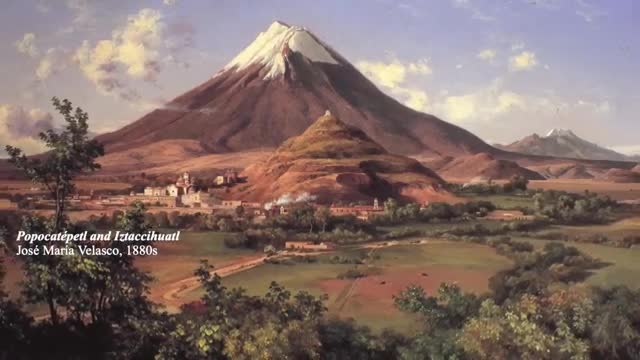
If we look at these two peaks here, they are the famous volcanoes Iztaccíhuatl and Popocatépetl, which are associated with a romantic Aztec love story.
It tells the tale of a brave Aztec warrior who was promised the hand of a princess if he returned victorious from battle.
But on his return, he found her dead from grief.
And in order to be together forever, they were magically transformed into these two volcanoes which Velasco incorporated into his paintings regularly.
The legend remains deeply ingrained in Mexican culture and national identity and is seen both as a powerful metaphor for the country's enduring strength and as a romanticized connection to its indigenous past.
The human figures in the foreground of the painting are dressed in a form of indigenous clothing.
Later, of course, Frida Kahlo would use indigenous clothing to connect to revolutionary ideals.
And Velasco does the same.
He uses the figures symbolically to reinforce a sense of national identity centered around the land and its people.
As a response to Mexico's post-independent search for identity, shifting away from European influences and embracing its own heritage.
Visually, they are there to emphasize the vastness of the landscape, but also as a way to connect Mexico's past in the foreground to its future in the distance.
Their inclusion reinforces the idea that the land is not just a passive background but an active part of everyday existence.
Unlike European painters, who often place dramatic human narratives in the foreground, Velasco lets the land tell the story, making people secondary yet essential elements of the scene.
Velasco includes the site of the 18th century church known as the Old Basilica of Guadalupe, built on the hill of Tepeyac.
In Velasco's time, it was out in the countryside, but is now very much part of the city.
It was built on the site where a local man, Juan Diego, saw four apparitions of the Virgin Mary in 1531.
She would be known as the Virgin of Guadalupe.
But she is not just a religious figure.
She is also a national icon, a symbol of Mexico.
Unlike the European Virgin Mary, the Virgin of Guadalupe had mestizo, or mixed features, and spoke Nahuatl, still the most widely spoken indigenous language of the Americas, making her more relatable to the indigenous population.
She also played an important role during the revolt against Spanish rule in 1810, when Miguel Hidalgo, the priest who started the independence movement, promoted her as the patroness of the uprising.
Her image appeared on the rebels' banners and their battle cry was The Zapatistas and other revolutionary movements have also used her image to fight for social justice.
You can also see Plaza del Zócalo in the distance, once the main ceremonial center in the Aztec city of Tenochtitlan and still the main square in Mexico City.
We can just make out the towers of the cathedral in the painting.
And let's take a few moments to just take in these clouds in the distance.
Another example of Velasco's masterful handling of colour brushstroke perspective, depth and light.
So beautifully rendered that we can almost hear the oncoming rainstorm.
In the West, we think we have a very clear idea of what Mexican art is and even what it represents.
But it is so much broader than we think.
José María Velasco's command of landscape painting not only captured the natural beauty of Mexico, but also played a crucial role in shaping the nation's artistic and cultural identity.
His meticulous attention to detail and his ability to blend scientific precision with romantic idealism reflected the broader aspirations of 19th century Mexico, a country trying hard to define itself during a period of rapid modernization and political change.
Through his works, Velasco transformed the Valley of Mexico into a symbol of national pride, influencing generations of artists and reaffirming the deep connection between art, nature and identity.
Viva la independencia!
Viva Josefa Ortiz de Domínguez!
Viva Ignacio Allende!