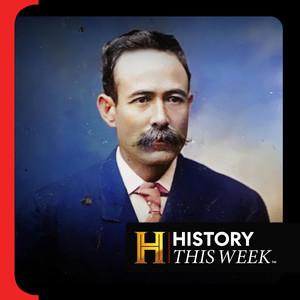
The History Channel original podcast. History This Week.
August 28th, 1920. I'm Alana Casanova Burgess.
It seems like everyone in Tequila is gathered in the town's central plaza.
Over the last 10 years, Tequila's residents have seen the Mexican Revolution upend their lives and their industry, tequila.
The liquor is named after the town. And finally, after years of war, the region seems on course for some form of stability.
And tonight, with electricity recently restored, it's time to celebrate the anniversary of Mexican independence.
But Malaquías Cuervo is about to disturb this rare sense of peace.
For years, Malakias' older brother, Jose, has sought to bring sophistication to the family's name. and tequila business.
Cuervo Tequila has survived drought, floods and revolution through a constantly evolving web of allies, and political maneuvering.
But Malakias Cuervo, named for his father Malakias, decides, well, Maybe there are more direct ways of campaigning.
Malakias ambles through the square. drunk on his brother's supply.
In recent years, the family business has maintained a delicate truce with a rival family in the town.
The cell says that truce is about to be shattered.
Malakias draws his gun, fires it in the air, and in Spanish yells, Death to the Sousas.
To me, it's a story of intervention and interference, one of innovation and what will happen when you take everything to It's extreme.
Today, the careful calculations of Jose Cuervo. a man whose life story has remained hidden behind a liquor label.
How does he rebuild a family business on the brink of collapse?
And when faced with civil war, how does José Cuervo, the man and the company, survive?
40 years before his brother fires a gun into the air, Jose Cuervo isn't exactly dominating the tequila industry.
He's out in the fields. Through much of the Tequila Valley, you'll see these sprawling agave fields.
They're planted in these long, very straight rows.
And the agave itself is called the blue agave because it has this kind of ashy appearance Ted Genovese first came to know the agave fields of the Tequila Valley through his father's work as a biologist.
Today, he's an author of a book about Cuervo's history.
In 1896, José might be near the bottom of the tequila food chain.
But his family once dominated this entire valley.
The Cuervo family had been cultivating agave on this land since the 1750s.
The Cuervo family has this incredibly old history with the town of Tequila.
They had been given land to raise agave and to distill the agave brandy. that we now know as tequila by the Spanish crown.
They had really been the rulers of the Tequila Valley for a century before Cuervo was even born.
As a young man, José Cuervo leads a blessed life.
While his father, Malakia Sr., runs the business, Jose's worries include riding horses in the valley by day and socializing with aristocrats and industrialists by night.
But years of economic stagnation in Mexico start to take their toll on Cuervo Tequila, As Jose enters his early 20s, the family business is in decline.
It had been an extraordinarily rough run of years for Cuervo.
Jose is about to find out inheritance is great, as long as there's something worth inheriting.
As José's father, Malakías Cuervo, attempted to expand in the 1880s, he had gotten himself overextended.
He had purchased a lot of land with loans and had gotten himself to a fairly precarious financial situation when he was then diagnosed with cancer and died.
And not long after that, Jose's mother was also diagnosed with cancer and died.
He... went from assuming that he was going to be sort of a scion of this empire to suddenly finding himself orphaned, drowning in debt, and then most of the lands that he had expected to inherit along with his brothers were sold off at auction Jose strikes out on his own, but he has to start from the bottom.
I think it would have been really quite easy to just settle into a kind of despair.
Things have not worked out for me as I hoped they would, and this is the end of the line.
In 1896, he's back in the agave fields working for his uncle, Jesus Flores.
When he starts work as this kind of low-level field manager for his uncle, There's this wealth of knowledge of the place and process and agave farming that Cuervo was born into.
Rising to general manager of his uncle's fields, Jose oversees the rapid modernization of the whole estate.
El Arenal. Fire pits and oxen-powered mills are replaced by steam ovens and belt-driven mills.
With Cuero's help, El Arenal produces more than 300,000 liters of high quality tequila per year.
But soon, death marks Jose's life again.
This time, though, it comes with opportunity.
In fall of 1897, Cuervo's uncle, Jesus, dies at the age of 72.
His much younger widow, Anna, holds a Gregorian mass for him in Tequila, She has just inherited an estate worth an estimated 1.5 million pesos.
On his deathbed, Jesus left Anna with a suggestion.
If you want to keep the business going, consider marrying my nephew.
Ana, who comes from an aristocratic land-owning family in the valley, is 12 years older than Jose.
She isn't sure about the whole marriage thing.
However they do start to run this business Both the government and his fellow tequila makers regard him not as an equal, but as somebody who is merely a mouthpiece for Ana Gonzalez Rubio. this becomes enough of an obstacle that Ana finally seems to return to the advice that had been given to her by her first husband on his deathbed,
And she calls Jose Cuervo to her mansion in Guadalajara and said, you know, We've been running into all of these problems and I believe that it's best for us to marry.
It's kind of presented to him as this business decision.
I mean this is one of the richest women in all of Mexico.
Her beauty is commented on all the time in the society pages of the Guadalajara newspapers. by any measure.
She's a catch. But Jose, who is sort of cautious by character, says I'll get back to you.
Let me think about it and goes back to tequila and goes back to work.
José is more occupied with convincing the government to build a railroad to tequila.
A month passes with no response yet. Ana summons him back to Guadalajara. and says you've been busy with your work and you haven't had time to consider my offer so I've considered it for us.
And at that moment, the Justice of the Peace enters the parlor with his Bible and marries them on the spot.
I mean, she wasn't leaving anything to chance.
The marriage enters the official record on March 3, 1900.
In the years that follow, there's a kind of remarkable partnership that exists between them.
Cuervo is an excellent businessman, but he's extremely shy, cautious, and calculating.
Anna, on the other hand, is incredibly outgoing.
Gregarious, she's interested in throwing parties where strategic alliances can be forged.
Their relationship is a romantic and strategic success.
Within a year, Cuervo has acquired large parcels of land in Tequila and Guadalajara. on either end of the rail line he wants so badly.
But he still hasn't gotten it built. Cuervo recognized that the US and Europe would be important markets, that there's just a larger population, larger class of people who can afford high-end spirits and so you can sell it at a higher price That's where the market is.
To Cuervo, bringing a railroad to tequila is absolutely imperative.
But building it isn't going to happen without the cooperation of the other major distiller in the valley.
Tequila Salsa. The founder of Tequila Salsa is Zenobio Salsa.
He arrived in the Tequila Valley as an orphan in his teen years. and got on as a field worker at the Agave Estate, partially owned and managed by Jose Cuervos.
Father. Zenobio worked his way up from a field worker to being an estate manager and eventually then Salsa saved enough money to rent a distillery in the town of Tequila where he could make his own tequila. and finally bought his distillery and started buying neighboring distilleries to combine and increase his production.
Like Jose, Zenobio Sousa worked his way up from the agave fields.
But unlike Cuervo, he never had the advantage of a family name.
There's not just this kind of competitiveness, but this this kind of difference in worldview that exists because the Cuervos are this very old family with a lot of money, whereas Sonobio sees himself as this scrapper who has to force things to happen.
José tries working with Zenobio to bring the railroad to Tequila, Turns out, the valley isn't big enough for two mega-rich distillers.
The project fails. But Jose is learning.
For Jose Cuervo himself, his skill seems to have been seeing everybody's particular talents and orchestrating them and then using his skills connections to be this kind of orchestrator of all of the necessary resources for the industry to thrive. and to build his business and identity for the tequila industry as a whole.
Putting the railroad on the back burner by 1902, Jose turns to another new technology.
He negotiates the deal that gets the electricity brought into the valley, which means giant towers have to be erected and power lines that are run.
I mean, it's this massive undertaking. His efforts don't go unnoticed.
The Cuervo name is on the rise. By 1904, José has the ear of Mexico's president slash dictator, Porfirio Díaz, And Diaz decides to send Cuervo to the World's Fair in St.
Louis, representing his country. and company in front of an international audience.
Just imagine Cuervo at the 1904 World's Fair as he's walking through these pavilions and seeing all of these changes that are coming.
I need machine-made bottles. machines that fill the bottles and seal the bottles.
I'm going to have to be able to load this onto rail cars and I've got to be able to communicate with customers via telegraph and telephone and and I've got to be advertising in newspapers and like this is a modern era.
After the World's Fair, José's drive to bring his company into the future goes into overdrive.
He lobbies President Diaz to finally build that railroad to the town of Tequila he's wanted for so long.
And Diaz is on board. It pays to have friends in high places.
In February of 1909, the railroad is finally completed.
Cuervo hosts the inauguration of the line at its origin in Guadalajara.
Dignitaries are treated to food, music, and entertainment before piling into a single train car bound for tequila, Thank you.
This railroad won't just benefit Cuervo, but all tequila manufacturers in the town, including his rival.
Sousa family. But shockingly, just days before the railroad's unveiling, The family's patriarch, Zenobio Sousa, had fallen ill and died. leaving his business to his sons Luis, Leopoldo, and Eladio.
With this power vacuum, Jose Cuervo has a temporary advantage in the tequila business, but it won't last long. having worked his way into Diaz's inner circle, Cuervo started to realize somewhere around 1908, 1909, that not only is the dictator aging, and losing his air of invincibility.
But also, there's a kind of growing restlessness in the country that people are... wanting some change and wanting new leadership José works the system and manages to get himself elected to the country's legislature.
If his ally, the President Diaz, falls, at least he'll have some political influence of his own.
But the forces working against the dictator will soon consume the entire country. that starts to unravel.
At a certain point, it kind of took on its own momentum and became its own unpredictable.
And within a matter of years, What Cuervo was doing, what everyone was doing, was just trying to stay alive.
Abercrombie denim is everything right now.
Denim should feel like this. Confident. Easy.
Like your butt has never looked better. If you didn't know, Abercrombie's Curve Love denim went viral in 2019 for eliminating waist gap. and it's still a game changer.
Between that and their classic fits with a straighter line from waist to hip, the perfect denim does exist.
Shop Abercrombie denim in the app, online, and in store.
Obsessed with true crime cults or conspiracy theories?
Conspiracy Theories, Cults and Crimes is a weekly podcast from Crime House and Pave Studios, that dives into the darkest corners of human behavior.
Every Wednesday, cover the true stories behind the world's most shocking crimes, deadly ideologies, and secret plots.
Follow and listen to Conspiracy Theories, Cults and Crimes, an Odyssey podcast in partnership with Crime House.
Available now wherever you get your podcasts.
Out of her life Boring money moves make kind of lame songs, but they sound pretty sweet to your wallet.
BNC Bank. Brilliantly boring since 1865.
Even for a calculated planner like Jose Cuervo, Chaos at the beginning of the Mexican Revolution is nearly impossible to navigate.
In 1910, President Porfirio Diaz jails his main political opponent, and wins reelection through massive fraud.
Like, so much fraud. Diaz wins what he calls the first free election of his presidency, with 98% of the vote.
Despite being so popular, Diaz flees to France.
His successor is toppled within two years by a coup, installing Victoriano Huerta as president.
The revolution is in full swing. and rebel forces are gathering in mountains and valleys away from the eyes of federal troops.
And Cuervo starts to provide funding for weapons and for saddles and horses to that revolutionary movement.
As ever, Jose Cuervo is threading the political needle.
What he didn't anticipate, but I don't think anyone could have anticipated, is that the revolution escalated to the point that no one could control it.
In 1913, war is spilling into the Tequila Valley.
Agave plants get uprooted, the train tracks that Jose had worked so hard to get built are blown up.
He appeals to the fractured government in a letter co-signed by the other tequila producers in the region.
They write, quote, Our estates are burned and destroyed.
We have no authority to protect workers. no weapons to arm them.
Huerta responds, by levying a 25% sales tax on tequila. and placing Cuervo under surveillance.
By 1914, conditions around the town of Tequila are rapidly deteriorating.
As the revolution starts to arrive in Jalisco and the attacks on tequila intensify, There's this tense, agonizing waiting for a moment to escape.
Anxiety blankets tequila as information trickles in.
Rebels inch closer and closer. It could be days, hours, minutes.
Finally, Corvo just decides that the only solution is to flee the city and... go into hiding.
Likely concerned that he'd be a target, Cuervo says goodbye to his family, to his wife, Ana. and ascends to the top of his home.
He hops from roof to roof, slides off into the darkness, and walks to his nephew's house, where he borrows a horse. and rides out of the city headed for a barranca, one of the valleys north of Tequila,
A barranca is a steep narrow gorge. Cuervo steals the nerves of his horse before making his descent in the dark.
There's not time to water the horses and let them rest before continuing on a long journey.
Instead, they fill their mouths with tequila. blow that mouthful into the nostrils of the horses.
And that this is meant to get the horse... just drunk enough that the pain goes away in ankles and hooves and that they can descend down the cobblestone path into the valley.
Cuervo hides out, where else, in a tequila distillery on the valley floor.
Soon, he's joined by a handful of other fleeing tequila entrepreneurs.
They were housed in this kind of cluster of adobe huts that are right along the stream that runs through the floor of the valley.
Safe from violence, but isolated from information, Cuervo and his industry companions hide out for months.
And like any summer camp, they forge some unexpected friendships, even between bitter rivals.
In that time, Orville became good friends with Luis de Osa.
They seemed to sort of share the kind of intellectual outlook, but also had a shared sense of humor. and really became good friends.
José enjoys Luis Sousa's habit of quoting the classics. reading from a book of art history he had carried with him into exile.
Whatever beef José had with Luisa's father, Zenobio, seems to be put in the past.
What Cuervo starts to argue for is this idea that they're going to have to keep this friendly bond that they've all developed once the threat has passed.
Jose returns to society in the summer of 1914.
President Huerta has fled, the federal troops are dissolving, and revolutionary forces are on the verge of power.
It's a new dawn, but the Tequila Valley is in rough shape.
By that point, the Salsa distillery had been burned and really badly damaged.
A number of Cuervos fields had been burned.
The railroad in and out of tequila had been blown up.
To get the industry back on its feet, Cuervo floats an idea born from the friendships he made in exile.
We're going to have to pool our resources while we're trying to get back up and running.
You have agave, I have a distillery. We have to put these resources together and work together.
This was the notion. And the German word for this was cartel.
That's cartel with a K and two L's. Cuervo introduces that idea to his fellow tequila makers.
We need to be in agreement that we will work together as a single body, as a tequila cartel.
The idea is simple. Work together to re-establish supply and distribution systems standardize pricing, and make tequila a central export of the new Mexican state.
When we talk about this as a cartel, it's not speculative.
They put it all down on paper, the way that the territory would be shared, the resources that would be shared.
The prices that they would all agree to, that whole arrangement was put in writing and they all signed it.
Five family distilleries signed the cartel agreement.
The Cuervos, Rosaleses, Ontiveroses, martineses, and sausas. the companies that they represented three of them are still among the largest tequila brands in existence today.
Many of their competitors who decided that they would go it alone You've never heard of them because they did not survive.
At Capella University, learning online doesn't mean learning alone.
You'll get support from people who care about your success.
Like your enrollment specialist. who gets to know you and the goals you'd like to achieve.
You'll also get a designated academic coach who's with you throughout your entire program.
Career coaches are available to help you navigate your professional goals.
A different future is closer than you think. with Capella University.
Learn more at capella.edu. The critical alliance brokered by Cuervo, the cartel, proves to be key to sustaining the tequila industry.
And as far as Mexico's revolution is concerned, fighting has slowed, but the government is still in flux.
In 1919, yet another acting president, Venustiano Carranza, announces that a year of national rebuilding will be followed by free elections.
And then he announces that he's going to effect this rebuilding by taxing businesses. rather extensively. including the tequila industry, which is just hanging on by a thread.
At the same time, Cuervo learns of the pending passage of prohibition in the United States, a huge market.
But where others might despair at the loss of a major customer base, Cuervo sees opportunity.
The US had just passed the Volstead Act, which was going to have one year to be implemented. and was going to make prohibition into a national policy.
But prohibition wouldn't go into effect until January 16th, 1920.
It's still 1919. Once again, threading the political needle.
So, Eladio Souza and Jose Cuervo go together to Mexico City to meet with the president and to try to persuade him not to impose the tax on tequila in 1919.
They were like, look, There's going to be a period here of two or three weeks, maybe a month where we can ship massive quantities. of tequila to the US for people who are going to want to stock up before it becomes illegal.
Cuervo and Eladio Sousa are asking for short-term relief from taxation. in order to exploit this narrow window of opportunity, steady the industry, and return tequila production to a sustainable level.
But President Carranza doesn't go for it.
And to make matters worse, Cuervo has been placed on the US's enemy trading list.
He has some family ties to German nationals, not seen super favorably during World War I, Plus, a snowstorm is ravaging the agave fields back home.
Moving the existing stock is now of critical importance for all the tequila manufacturers.
So they make this decision while they are all together to aim their operations toward trying to move product toward the US border.
And the only way that he can move his product to market is through illegal means.
Cuervo organizes a Junta de Mezcaleros with his fellow tequila makers, to exploit this narrow window of opportunity in US law.
They agree to fix prices, share transportation and normalize supply across all their factories.
And once prohibition begins, Cuervo starts building a distribution network near the border.
Cuervo Rail Cars sell product all along the Mexican side of the Rio Grande, with the unspoken expectation that the bottles will be smuggled into Texas.
And if Cuervo was ever right about one thing, it's that Americans love their liquor.
There's an incident at the International Bridge in El Paso in March of 1920. where this convoy of trucks rolls up headed south to Mexico. and their cargo beds are all covered with tarps.
The inspection agents stop them and throw back the tarps. and what they find is that the backs of all these trucks are filled with empty bottles of Jose Cuervo tequila.
Their estimate is that there's 25,000 bottles in these trucks that have been collected by kids on the streets in El Paso to take back to be refilled on the Mexican side.
In March 1920, the El Paso Times reports, The stuff manufactured by Jose Cuervo is becoming one of the most popular beverages in El Paso.
But as Cuervo has come to understand throughout his life, a storm is never far off on the horizon.
The thing that happens at the same time period is that the cuervos recognize that they need to get back into politics in order to have this kind of control over taxation and all of these issues of enforcement.
In May, President Carranza is assassinated following yet another coup. the tenuous alliance of the major tequila families begins to fray. as they all seek a favorable position in the evolving political landscape.
The Cuervos are running for office at every level, running for mayor of Tequila, running for governor of Jalisco running for the Mexican Congress.
While Cuervo backs his relatives, the Salsas throw support behind an opposition candidate.
Jose Cuervo holds this giant celebration.
There's a bullfight. This is declared to be illegal campaigning, that it's buying votes, and one of Cuervo's brothers Malachias Cuervo, named for his father Malachias, decides maybe there are more direct ways of campaigning Maraquias Jr. wants to take a shortcut to defeat the Sauces.
On that warm night in August of 1920, veins coursing with Cuervo tequila He draws his gun and attempts to intimidate a Salsa voter.
It's a stain on their family name. And much to José's dismay, invites greater scrutiny of the cuervos.
As that tension rises, there's a particular kind of strange moment where One of Cuervo's brothers, Carlos, who's been elected to the Mexican Congress, starts getting contentious over these taxation measures and making a lot of speeches on the floor of the Mexican Congress, and José goes to Mexico City to try to kind of tamp him down a little bit. and the two of them have dinner together in Mexico City and the next day both of them fall violently, violently ill.
And this is the end of José Cuervo. On January 12, 1921, he passes away from his illness.
His brother Carlos recovers. but the family is left without their center of gravity.
It was rumored at the time, it is still family lore, that they were poisoned.
Difficult to say for sure, but what definitely happens is that Without Jose as a kind of stabilizing force, the two families really go to war.
Between the Cuervos and the Sauces, business rivalry had become political rivalry.
But after Jose Cuervo's death, it turns to outright violence.
When the dust settles on this tequila war, Malakias Jr. is arrested for what authorities believe to be a premeditated triple murder of members of the Salsa family.
There's eventually a brokered piece that essentially says, look, These two families are going to stay out of politics.
And through that brokered piece, we end up with Essentially, the industry as we know it now, this industry that is with the Cuervos and the Souses, at the top.
Today, Jose Cuervo's name is largely confined to liquor store shelves, but in his life, The Cuervo name is synonymous with political, industrial, and familial power.
Ted Genovese thinks that reputation comes from Cuervo's habit for showing up at crucial moments in Mexican history. which comes from Cuervo's knack for sensing the tightest windows of opportunity. a kind of hallmark of his career to me. that he may be slow or cautious about making a change,
But once he realizes this is the new direction, he goes hard in that direction.
In some ways, it's poetic that the traces of Cuervo's story have evaporated, like the liquor in his bottles.
But Genoese says in recovering some of those traces, we can find lost moments of his country's history. the guy's name on this bottle, how long this is aged, All of this comes from somewhere.
There's a history behind this. That's the thing that I love is being able to have reconnected some of the things that we think of as just commercial products. back to their history and restore these things to being the sort of cultural artifacts that they are.
Thanks for listening to History This Week, a Backpocket Studios production in partnership with the History Channel.
To stay updated on all things History This Week sign up at historythisweekpodcast.com And if you have any thoughts or questions, send us an email at historythisweek at history.com.
Special thanks to our guest, Ted Genoways, author of Tequila Wars.
José Cuervo and the Bloody Struggle for the Spirit of Mexico.
This episode was produced by Jonah Buchanan.
Produced and sound designed by Ben Dickstein and hosted by me, Alana Casanova-Burgess.
For Backpocket Studios, our executive producer is Ben Dickstein.
From the History Channel, our executive producers are Eli Lehr and Liv Fidler.
Don't forget to follow, rate, and review History This Week wherever you get your podcasts.
And we'll see you next week.