Welcome to Spotlight Advanced.
I'm Roger Bassack.
And I'm Katie Blake.
Spotlight uses a special English method of broadcasting.
It is easier for people to understand no matter where in the world they live.
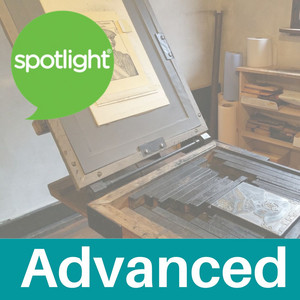
A man is working on a machine.
The machine is made of wood.
It looks like a table with a case on the end.
Inside the case is a press.
The man is fitting it with metal letters.
When he is finished, he paints the letters with black liquid.
He places a piece of paper under them.
Then he lowers the press onto the page.
When it comes up, the paper has writing on it.
The man removes the page and places another in the machine.
He repeats the process over and over again.
By the time he is finished, he has printed a whole book.
It has hardly taken him any time at all.
The man's name is Johannes Gutenberg.
His machine is called the Gutenberg Press.
It is the first of its kind.
It lets people create books in a very short amount of time.
We do not know much about Gutenberg.
We do not even know what he looked like.
But his invention is one of the most important in history.
In just a few years, it would change the world forever.
Today's Spotlight is on Johannes Gutenberg and his amazing invention.
Johannes Gutenberg was born around 1400 in the city of Mainz.
Today, the city is in Germany.
Gutenberg was probably trained as a goldsmith.
He worked with metal, not letters.
But as he grew up, Gutenberg noticed a problem.
During this time, there was a lot of demand for books, especially the Christian Bible.
Most people in Europe were followers of Jesus.
The Bible has his teachings in it.
Christians need Bibles to worship.
Many people wanted copies of the Bible.
But making a new copy of any book took a long time.
And it was very difficult.
To copy a book, a person needed to write it down by hand.
They had to make it readable, so every letter had to be made carefully.
And people making these books would often draw beautiful pictures too.
The book was a piece of art as well as something to read.
But this meant that only a few people could do it.
Gutenberg was also a Christian.
He wanted more people to have Bibles.
So he set his mind on making Bibles faster and for less money.
He decided to try printing.
Gutenberg was not the first person to experiment with printing.
The idea first came from East Asia, probably from China.
There, people would carve pages of a book into wooden blocks.
They would cover the blocks with black liquid.
Then they would place the block onto paper.
Over the centuries, Asian printing became more complex.
Like Gutenberg, they invented letters that could move.
This meant that one press could make many different books.
But these presses did not catch on.
The Chinese language has thousands of characters, so movable presses were very hard to operate.
Most people in China like to use the old way.
Gutenberg may have known about these presses, but he had never seen them.
He had to work the idea out on his own.
It took him 15 years.
And by the time he had finished, his machine was very different from these presses.
He worked to create a way of making letters that cost less money.
And his letters were made out of a special alloy.
This combination of metals held the printing liquid better than other metals.
The metal letters would also last longer than wood.
Bill Kovarik is a historian.
He wrote about Gutenberg in his book, Revolutions in Communications.
The secret of movable letters may have been discovered somewhere else in Europe around the same time.
For example, Lorenz Koster of Holland used wood letters.
He was experimenting with lead letters before his death in 1440.
But it was Gutenberg who put together all the necessary parts.
His workshop could quickly produce thousands of books.
Gutenberg's first large project was the Bible.
And he took great care with its printing.
He chose letters that looked very much like writing.
And he thought a lot about how the final book would look.
He even included empty space in the edges.
Buyers could draw or take notes on the edges.
Gutenberg knew that people would not accept a new technology quickly, so he tried to make the product as similar as possible to what they were used to.
Gutenberg's Bible was an immediate success in Europe, but it did not make him much money.
Gutenberg had decided to use very costly materials.
But over time, people saw how important his invention was.
And soon, others began making presses using Gutenberg's ideas.
Often, they printed small things such as announcements.
But soon, they began to print new books.
They printed books of science.
And they printed thousands of Bibles.
Gutenberg did not live to see his machine's success.
He died before printing spread widely in Europe.
But his invention would soon shake the world.
Before Gutenberg, most people in Europe could not read or, if they could, they did not have books.
Gutenberg's press changed this.
It made spreading information much easier.
More people began to read and understand the world.
They began to question old ways of doing things, and they began working to change them.
One of these people was called Martin Luther.
Luther was a Christian priest, but he disliked many things about the way the church was run.
In 1517, he wrote down his disagreements. and others began to print them.
Soon, Luther's ideas had spread all over Europe.
They caused people to change the way they worshipped.
This was called the Protestant Reformation.
But Luther was not the only one.
Gutenberg's invention helped science spread.
It let people talk about their ideas freely.
It encouraged new forms of art, literature, and government.
Without the printing press, ideas were hard to share.
With it, these different ideas could spread quickly and far.
Gutenberg's press ushered in a new age of information.
Like the Internet today, it completely changed people's lives.
Elizabeth Eisenstein was an American historian.
She wrote about these changes in her book, The Printing Press, as an agent of change.
These new tools completely changed mental and spiritual life in Europe.
The tools let books be printed quickly.
The communications shift changed the way Western Christians thought about their holy book.
It changed the way they saw the natural world.
It made the words of God appear more complex.
But it made God's creation appear more orderly.
As with today, these changes were both good and bad.
The printing press created a global desire for the latest news.
A library of books became a possibility for a medium-sized town.
A person could even find a library in the house of every wealthy merchant family.
Ideas like Luther's could spread across Europe in less than three weeks.
After the printing press, it became impossible to stop new or dangerous ideas.
If leaders presented a list of banned books, then those were the books people wanted to read.
And printers were ready to print.
The rise of a reading public led to challenges and changes for those in power.
But it also led to the Renaissance, a period of great art and scientific knowledge in Europe.
The printing press caused great progress and great destruction.
Despite everything, the world would not be the same without Johannes Gutenberg.
His work took a lifetime.
But it changed the world forever.
What do you think?
How has creating easier access to information helped people?
How has it hurt people?
You can leave a comment on our website at www.spotlightenglish.com.
You can also find us on YouTube, Facebook, Instagram and Twitter.
You can also get our programs delivered directly to your Android or Apple device through our free official Spotlight English app.
The writer and producer of this program was Dan Chrisman.
The voices you heard were from the United States and the United Kingdom.
All quotes were adapted for this program and voiced by Spotlight.
This program is called Johannes Gutenberg's Famous Invention.
We hope you can join us again for the next Spotlight program.
Goodbye.