
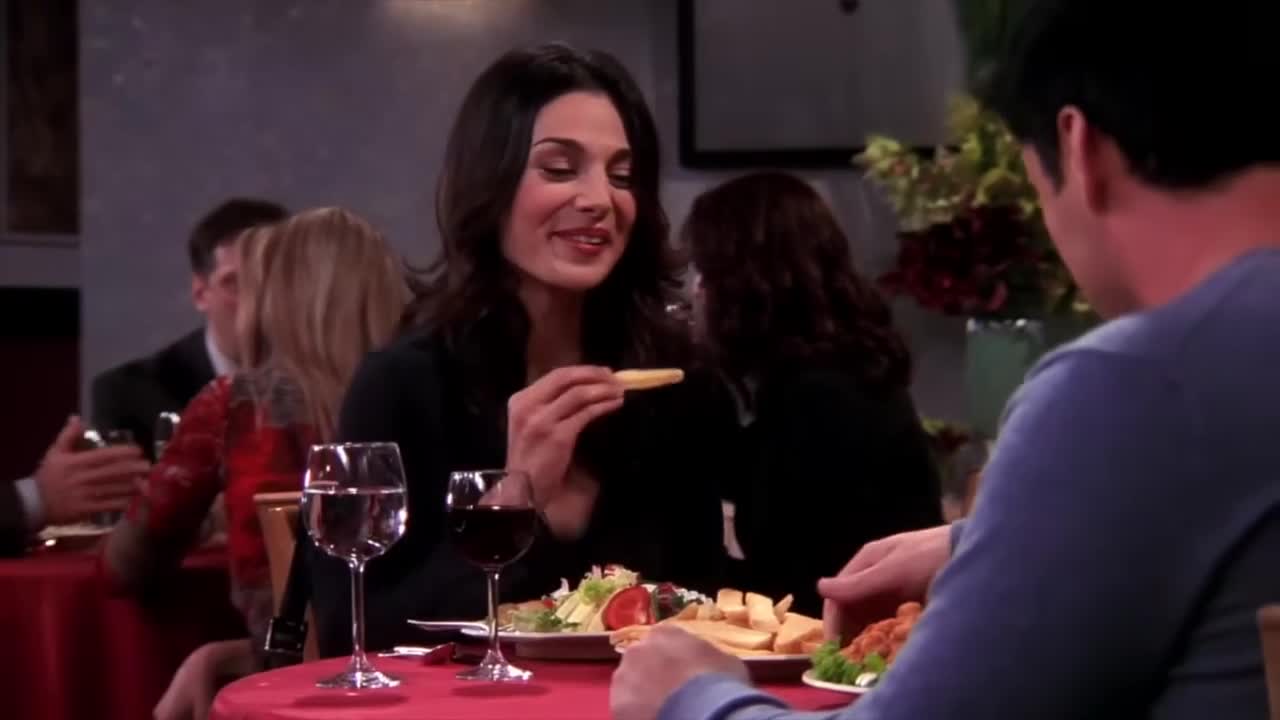
[The Unspoken Rules of Dining: A Study on Boundaries and Reciprocity]-[Joey Gets Caught Eating His Date’s Dessert | Friends]
📋 Summary
The Boundaries of Shared Plates: A Study in Relational Dynamics
The Illusion of Generosity
The interaction begins with a seemingly magnanimous gesture: "What's mine is yours." This phrase sets a precedent of open boundaries and shared resources. When one party offers French fries with the invitation to "help yourself," it establishes a social contract of generosity. However, this initial harmony is fragile, resting on the assumption that such openness is limited to specific, low-stakes items. The conflict arises when the lines between "shared food" and "personal property" become blurred.
The Conflict of Ownership
The core tension erupts when a party reaches for the "stuffed clams." The immediate shift in tone—from sweet flirtation to sharp confrontation—reveals the underlying territorial nature of the diners. The aggrieved party exclaims, "What is the matter with you?" and explicitly states, "I don't like it when people take food off of my plate." This highlights a fundamental misunderstanding of social boundaries; while the phrase "what's mine is yours" was offered, it was clearly not intended to be a blanket policy. The retort, "Well, I didn't mean it!" serves as a classic example of cognitive dissonance, where the speaker retracts their own stated values the moment they are inconvenienced.
The Principle of Reciprocity
As the situation evolves, a new dynamic emerges: the "two-way street." When one party attempts to assert control over their food while simultaneously violating the other's, the dynamic shifts from simple sharing to a transactional power struggle. The realization that "if I can't have your clams, you can't have my dessert" introduces the concept of tit-for-tat reciprocity. This is a critical point in the dialogue; it transforms the interaction from a casual meal into a negotiation of respect and fairness.
The Breakdown of Self-Control
The conclusion of the interaction is marked by a comedic but telling failure of restraint. Despite the promise that "I can control myself," the temptation proves too great. The final act—taking the dessert—is accompanied by the defiant statement, "I'm not even sorry." This ending underscores the inherent human difficulty in maintaining boundaries when faced with immediate gratification. The playful hostility throughout the conversation ultimately reveals that, for many, the concept of sharing is less about altruism and more about the power to dictate what is permissible.
In summary, this dialogue serves as a microcosm of interpersonal relationships, illustrating how quickly a relaxed atmosphere can dissolve into conflict when subjective rules regarding property and respect are not clearly defined. The transition from "what's mine is yours" to "I'm not even sorry" maps the journey from social performance to raw, unfiltered impulse.
Deep Learning with ListenLeap


