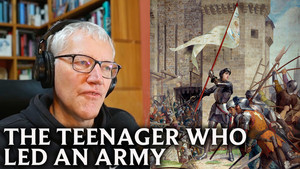
King of england, and you, duke of bedford, who call yourself regent of the kingdom of france you, william paul, count of suffolk, john talbot, and you, thomas lord scales, who call yourselves lieutenants of the said duke of bedford.
Make satisfaction to the king of heaven.
Surrender to the maid who is sent here by god, the king of heaven, the keys of all the good towns which you have taken and violated in France.
She has come here by God's will to reclaim the kingdom for its rightful king.
She is perfectly ready to make peace if you are willing to grant her satisfaction by abandoning France and paying for what you have held.
And you archers, men at war, gentlemen and others who are before the town of Orléans, get going back to your own country, in the name of God.
And should you not do so, then expect tidings from the maid who will come to see you shortly, to your very great arm.
King of England, if you do not do so, I am a captain of war and in whatever place I meet your people in France, I shall compel them to depart, whether they want to or not.
And if they refuse to obey, then I will have them all put to death.
I am sent here by God, the King of Heaven. to drive you out of France.
So that's one of the most remarkable letters in history.
And it was dictated, not written dictated on the 22nd of March 1429 by an illiterate peasant girl to the King of England and his captains who were in France.
And these captains, since the previous October 1428, had been laying siege to to the city of Orléans on the River Loire, the lynchpin of the front line between the English and Dauphin held possessions in France.
Now, by the spring of 1429, the city of Orléans seemed about to fall.
And if it did fall, then the English would be able to drive a stake into the heart of their enemy's holdings and possibly bring an end at last to the noble crusade of the Hundred Years' War.
But this peasant girl, Tom, had other ideas.
Now, who on earth is she?
Who are we talking about?
Well she is.
Of course, it will stun our listeners to learn Joan of Arc or, as she called herself, Jeanne Lapucelle, the maid.
And in our previous episode, we described her background, we described her childhood.
She'd been born in a village called Domremy on the war-torn eastern margins of France.
She's a peasant girl.
And so by definition, she hasn't learned to ride a horse.
She's not practiced in the handling of arms.
But then at the age of 13, she hears a voice that she says has come from heaven.
And these are soon to become voices in the plural language.
And by 1428, these voices are telling her to lead an army to Orleans and to break the English siege.
And so she obeys.
And she sets out on this mission in February 1429.
She has a horse.
She's riding it.
And she sets off on what is a very long and dangerous journey through territory infested by bandits and men at arms, partisans of the hostile Duke of Burgundy.
And it's an astonishing mission.
And the one thing we've not done is to describe Joan, to make her come alive for our listeners.
So give us a sense of how she looked, what you'd have seen if you looked up from your job, as you would undoubtedly have been doing, Tom.
You'd have been tilling the fields had you lived in the Middle Ages, because you're a man of the soil, horny-handed son of toil.
You're not cut out for life as a cleric.
So you'd have been working probably quite near the bottom of the social spectrum.
And you'd have looked up and you'd have seen this person passing.
What would you have seen?
The descriptions of Joan are kind of scanty and not entirely reliable.
But she seems to have been dark haired and she has cut this hair, cropped it short in the style of a knight.
Someone who knew her well, her future squire, described her as being beautiful and well formed.
And she does seem to have been attractive.
But she is not dressed as a woman.
She is dressed as a man.
And specifically, she is wearing hose.
She's wearing britches.
And these are both tightly knotted into a kind of a grey doublet.
And this is obviously to guard herself against sexual assault.
And over this doublet, she wears a black tunic and she has a black cloak.
She also has a hat.
It's made of wool.
Again, it's black.
And she's pulled this over her hair.
As we said, she's riding a horse, even though she had never ridden one before.
And it seems that over the course of this journey, she becomes actually a very good horsewoman.
She's got a sword by her side, the marker of a knight.
And in her train, she has two pages and four men at arms.
I mean, it's a long old journey, 250 miles.
And they ride mostly by night, presumably to avoid detection and to avoid bandits and Burgundians.
And they cross the Loire.
And it takes them 10 days.
And then finally they reach a shrine, Saint Catherine de Fierbois.
And what's the point of this shrine?
Why this shrine in particular?
Well, it's sacred to Saint Catherine, who we know from later records is very important to Joan.
But Saint Catherine at Fierbois is also very important to prisoners of war who have escaped from the English.
They see the Saint Catherine in this shrine as their particular patron.
And so there are all kinds of fetters that they've hung up to mark their liberation.
And so it's a very Joan place to make a halt.
And at this shrine, she dictates a letter to the man who she has come to see, the man that she acknowledges as being the rightful king of France.
And this is Charles of Valois.
So he is the son of the previous king, Charles VI.
He is the heir to the ancestral dynasty that has been sitting on the throne of France and which has been replaced by the House of Lancaster, the English dynasty.
And he's not Charles VII yet.
I mean he should be Charles VII, but everyone calls him the Dauphin because they think the English have the upper hand and that he's basically, you know, he's doomed to fail, right.
Well, I mean, legally, if you're a supporter of Charles, he is Charles VII.
But he is widely called the Dauphin, I think, for a number of reasons.
He doesn't have a kingly air.
He's physically unprepossessing.
People who've seen the first series of Blackadder, he looks a bit like that.
More germinely.
He lives under the shadow of a terrible crime, notorious crime, which is the murder, at a peace summit in back in 1419, of John the Fearless, the Duke of Burgundy, who had been the most powerful nobleman in France.
He's got holdings that are not just in the east of France, but in the low countries as well.
And it was this murder that had driven the son of John, the Fearless Philip, who soubriquet is the good, to enter his alliance with the English.
And as you said, the Loire is the marker between these kind of two rival zones of influence.
South, the Dauphin Charles VII, as he legally is.
That's where he essentially still can draw on support.
But north of the Loire, northern France is effectively now an Anglo-Burgundian condominium.
Right.
So one other important point about the Dauphin, though, the Dauphin hasn't been crowned, has he?
No.
So tradition holds that French kings should be crowned in the cathedral in Reims.
But Reims is in English territory.
And until he can get to a house and be crowned, people will not accept him as the rightful king of France.
That's about right, isn't it?
Correct.
And this is a big problem to which Joan has a solution.
And she wants to meet the Dauphin so that she can present this solution to him.
Right.
And Charles at this point is in a great castle called Chinon, which is south of the Loire, not far.
It's about 20 miles from Fierbois, where the Shrine of St.
Catherine is, and when he receives the letter from this illiterate peasant girl, he says okay fine, i will meet you, despite the fact that plenty of his advisors are advising against it, saying you know what if she's a crank?
What if she's a fraud?
You know what if she's worse?
What if she's a sorceress?
Because the news has come that this girl is dressed as a man and this is strictly against biblical injunctions.
So You know, to people who are worried about the possibility that Joan might be a sorceress, the fact that she's wearing male clothing is a kind of warning sign.
But Charles overrules this advice and agrees that, yeah, I will see this extraordinary person.
And part of this presumably is because he's really up against it.
He has nothing to lose.
If Orléans falls, this is a disaster for him.
The English will pour across the River Loire into the south.
So there's that element to it.
But also, am I not right in thinking that there are people at his court, not least his mother-in-law, who we talked about last time, who's called Yolande, who is a very impressive woman, who are very keen on Joan, who think that Joan might actually be sent from God?
Yeah, so Yolande she's the dowager duchess of Anjou and her son, René of Anjou, had his power base in the very region from which Joan is coming.
And so I think it's easy to see we talked about it in the previous episode how, between them, they might have evaluated Joan and decided that she was worth taking a punt on.
But why would they have thought that her mission might in any way be plausible?
And I think there is an explanation for this, and it's to do with the fact that for decades, even before the arrival of Henry V in France to resume the Hundred Years' War, There had been a swirl of prophecies in France foretelling that the kingdom would be redeemed by a virgin sent by God.
So back in the dying days of the 14th century, there had been this visionary, Marie d'Avignon, who had foretold that an armed maid would emerge to save France in her hour of need.
And there were other prophecies, too.
And these were cited by Christine de Pizan, who we mentioned in the previous episode, this poet who wrote this great eulogy to Joan
And in that poem, Christine listed some of the prophecies.
So to quote her, over 500 years ago, her coming was foreseen by Merlin the Sybil and Bede.
They wrote of her as someone who would put an end to France's troubles, prophesied she would carry a banner in the French wars and described all she would achieve.
So that too, I think, is part of the context.
But I think, above all ultimately, what enables Joan to secure her meeting with the Dauphin is her own energy, her own charisma.
So she has what Marina Warner, in her wonderful book on Joan of Arc, sums up as an astonishing ability to compel credence.
Somehow, Joan has a genius for making people believe the most extraordinary things.
And it had won over her feudal overlords, say René of Anjou and the Duke of Lorraine as well.
It had won over Yolande, who's a very kind of hard-boiled, sensible woman.
And in due course, when she comes to meet the Dauphin, it wins over the Dauphin as well.
So they meet in the great hall, the audience chamber at Chinon.
And the dauphin kicks off, doesn't he, by asking Joan her name.
And she says, I'm called Jeanne Lapucelle.
And then comes the great bombshell.
Yeah.
So Joan goes on.
The king of heaven has commanded that, through me, you are to be consecrated and crowned in the city of Reims.
On behalf of our Lord God, I tell you that you are the true heir of France.
And then again she gives the Dauphin her promise, not just that she's going to save Orléans, but that she is going to secure for him the consecration that he desperately craves, that he desperately needs if he is going to be accepted by the mass of French people as the legitimate king.
And so she says to him again, God has sent me to take you to France.
Well, this doesn't seem terribly difficult to explain.
I mean, she's basically just telling him what he wants to hear.
And in an age when people are interested in prophecies and saints and stuff like that, to have this girl who seems a bit weird turning up and saying I'm sent by God and I know everything's going to work out all right.
I mean, of course he's going to love that, right?
Well, he is.
But I mean, again, he's not stupid either.
He's a very smart guy.
He is. you know, he needs to be on his guard.
You know, she's come from the region where the Burgundians are very rife.
What if she has been sent as a Burgundian agent?
So the fact that he is kind of prepared to take a punt on her, I think is tribute to certainly Joan's powers of persuasion.
And it's not just the Dauphin who is persuaded.
There is also another guy who is massively smitten by Joan.
And this is a guy who also is desperate to believe that God might be sending a virgin saviour to redeem France.
And this is, again, a guy we met in the previous episode.
And he is the Duke of Alençon, Jean.
And by now, this guy is 20.
So his father had died at Agincourt.
He'd been captured in 1424.
The Duke of Bedford the English regent had appropriated all his lands.
The Duke of Alençon had had to kind of mortgage everything to raise his ransom.
So basically, he's completely skint and he is known at the court as the poorest man in France, even though he is a Duke of the realm.
So you can see again why Alençon would be desperate to believe in Joan.
And in fact, he starts taking his meals with her.
He joins her meetings with the Dauphin.
They become great pals.
Right.
And he, too, he can sense this sort of conviction in her, this intensity.
It's this intensity actually, that will make her a military leader, right that she will carry into battle.
And I think that's a reason why Alonso and perhaps the Dauphin also believe in her is that they sense that this sense of conviction is something that will inspire their men.
And the French armies at this point are demoralized.
They have zero morale.
So perhaps this girl with her absolute sense of conviction, perhaps that's just what they need.
And the fact that she is a girl.
I mean, as we said in the last episode we did a previous episode about Catherine of Siena this sort of mystical figure who claimed to have married Christ.
The fact that she's a woman. you know, that doesn't make her implausible as a messenger from God.
In fact, it enhances it, right?
Because women have a special place in the, you know, a unique place in the medieval Christian sense of the world.
Women obviously can't be priests, but there is a sense that perhaps that gives them a kind of a more intimate relationship with God, that God will sometimes bypass the structure of the church and speak directly to women in a way that he tends not to do to men.
And Joan, as you said, is absolutely not the first female visionary to be granted interviews with the powerful and the mighty on the basis of their claim that they have been spoken to by the saints and by God.
So Catherine of Siena is exactly such a woman, because she had ended up a counsellor and advisor to popes.
It was Catherine of Siena who had persuaded the pope in Avignon to move back to Rome.
So it is possible for women who claim a kind of direct access to God to play a striking role in the affairs of Christendom.
But against that, to repeat, there is an enormous risk in relying on such people.
Because what if joan is a fraud?
What if she's been set up by the burgundians?
What if she's delusional?
And even if her voices are real, you know, what if they are not from god?
What if they are from hell?
Yeah, so the first thing to test, i suppose, is whether or not she is who she claims to be.
So, for example, is she a pucelle?
She a maid?
So they actually get two women at court, don't they, to examine her and to see whether or not she is in fact a virgin.
And they say she is.
So that's good news.
That is good news.
So they've checked out her physical condition and now they have to check out her kind of moral and spiritual condition.
This is called the discretio spirituum.
And they send her off.
Basically, they send her off for a viva, a PhD viva.
They do.
Well, it's kind of like a debrief, I guess.
So she's sent to Poitiers, not far from Chinon.
And Poitiers.
In Poitiers there are all kinds of scholars and doctors from the University of Paris, which has always been the kind of the leading center of theology in Christendom.
But lots of these scholars are refugees from the English.
And so Poitiers is their kind of base.
And among the scholars and doctors there and the prelates is the Archbishop of Reims, who is Charles's chancellor.
And so he puts himself at the head of the investigation into Jones.
And they, more than anyone, even more than the king, is alert to the risks.
So, to quote Helen Castor, friend of the show, author of a wonderful book on Joan of Arc, female visionaries in the church's recent history had experienced their revelations when they were already under the care of a spiritual advisor.
So this was true of Catherine of Siena, a confessor perhaps who could testify to their morals and the nature of their claims.
Joan, by contrast, had appeared alone apart from her escort of armed men.
And rather than simply conveying a message from heaven she, a teenage girl, wanted to lead the king's troops into battle.
And so this does make her exceptional.
Nothing really like Joan has been seen before.
Right.
To repeat, she's wearing male clothes and that she absolutely insists on wearing them.
And then on top of that, there's the styling of these male clothes.
They're not drab.
Joan clearly is a bit of a fashionista.
She loves exactly the kind of expensive male clothing that moralists at the time are very down on.
So this also is a cause of anxiety.
But the people in Poitiers say, no, she's OK.
She has conversed with everyone publicly and privately, but no evil is found in her.
Only goodness, humility, virginity, piety, integrity and simplicity.
I have to say they're making it sound absolutely awful.
And her clothing.
They say that's fine too, because actually Christ has kind of superseded Deuteronomy.
And actually Deuteronomy doesn't really apply to a woman who's been sent by God to lead men in war to recapture Orléans from the English.
So it's kind of fine.
Yeah, because basically the scholars, too, want to believe in it.
You know, they're desperate to see the English thrown out.
And also, of course, they know what the Dauphin wants.
And so essentially they're serving it up to him.
So this is their verdict, which they send back to the Dauphin.
The king should not prevent Joan from going to Orléans with his soldiers, but should have her escorted there honorably, placing his faith in God.
So essentially they're saying, you know, take a punt on it.
Let's see what happens.
And this is the point when Joan dictates the letter that we began with to the English, basically an ultimatum.
I'm on my way.
You'd better watch out.
Yeah.
Although she doesn't at this point send it, she will send it later on, but it's there waiting to go.
And so then from Poitiers, she rejoins the Dauphin who has moved from Chinon to Tours.
Tours is on the Loire.
And here, in the full gaze of the court and therefore France, the seal is set on her status as the potential redeemer of France.
And this happens in three ways.
First of all, she submits to an intimate inspection, this time by Yolande.
There's a lot of inspections.
Then there's a kind of mad pantomime at court where Joan arrives and she gets directed to a captain and told this is the Dauphin.
And then to someone who has just returned from Orléans and told, well, this is the Dauphin.
And she says, oh, no, no, no, it's not.
And she goes up to the real Dauphin.
But hold on, she's met the Dauphin, hasn't she?
She has.
So it's a pantomime.
It's staged.
It's clearly designed to illustrate both the inherent regality of the Dauphin and the ability of Joan to fathom it.
That's the maddest thing in this story so far.
An identity parade when she's already met him.
No, it's not mad because it's a kind of pageant.
It's a display making public to the court that role that both the king and and joan are going to play.
And then something very weird and mysterious does happen, which is not normal at all.
He asks joan for a sign convince me, reassure me that you have indeed come from, from god.
And joan gives it to him, but what this sign was remains veiled, it's not publicized.
Oh, And in due course Joan will be asked about it at her trial and she will talk about it.
But we will come to that later on.
Oh, my word, that's tantalising.
Isn't that exciting?
It is tantalising.
It's a complex issue.
But I think it's clear that the sign is accepted by the Dauphin.
The green light is given.
Joan is ready to go to war.
So it's now late April, and...
As she rides off, she is a magnificent sight.
So she is wearing a full suit of white armor that has been handmade for her by the king's own armorer.
She has a new sword which had been found behind the altar of the church at Fierbois and which Joan later would say that her voices had said would be found there.
So beautiful.
She had then sent messengers and they had discovered the sword.
And the sword is very mysterious.
It's covered with rust, which magically falls away as soon as it's touched.
And it reveals five crosses along the blade.
And on the edge are inscribed the words Jesu and Maria.
This, of course, is absolutely part of medieval romance.
It's very Lord of the Rings. yeah you know sword that was broken kind of thing a great hero has to have a magical sword and joe now has a magical sword and she's got a very nice banner as well people are often like a kind of magic banner don't they i mean you say very nice this is a magnificent banner so it's made out of white silk it's covered in in golden fleur-de-lis um again the words jesu and maria are stitched into it um and they appear alongside an image of christ flanked by two angels so it's a really splendid sight she's on a black horse which is a gift from the duke of alensoir who absolutely loves her we've said that he'd seen her practicing in the lists that she nor had been so impressed that he gave her the best charger that he had in his stables and again i mean how joan had made herself so proficient at horsemanship is a kind of puzzle it's a it's a mystery and she is at the head of a um an entire military retinue now um and this is led by man who will serve her as her squire a guy who's a very experienced soldier called jean dolan and he's basically there not just to serve her but to look after her and protect her to make sure she doesn't get captured and what's going on in orleans well this has been happening because the orleans has been besieged all this time so presumably the people there are getting increasingly desperate well the news from orleans is very grim the garrison is depleted uh the supplies are running out both ammunition and food and people are starting to starve and so joan's mission is to ride with a convoy of some 3 000 men that the dauphin has has scrabbled together he's found ammunition he's found food he's put them in wagons he's got a kind of herd of cattle and joan is going to accompany this train and hopefully get to to orleans and um relieve the siege in that way and so they set off She's taking her role as God's messenger very seriously.
So all prostitutes have been banished.
There are priests singing hymns at the head of the convoy.
Soldiers who are marching are urged to offer confession daily.
And I can see from your face Dominic, that you were thinking this is not the way to build Ben's morale.
No.
But actually, it seems that it does.
It seems to have inspired the men.
And as they ride, their morale drops. is palpably higher.
Okay.
Well, I'm glad I'm not in that army.
That's what I'll say.
Well, you know, horses for courses, Dominic.
Yeah, of course.
You know, this is the 15th century.
They approach Orléans and they reach it on the evening of the 28th of April.
But when they get there and Joan can see Orléans for the first time, she makes a terrible discovery, because she and her fellow warriors and the wagon train are on the south side of the Loire And Orléans is on the north side of the Loire.
And that is where the vast majority of the English are as well.
And Joan feels that she has come to attack the English.
So what's she doing on the wrong side of the river?
How has this been allowed to happen?
Has she been deliberately deceived by the French captains?
Golly, what a cliffhanger.
I can't contain myself.
I'm so excited.
Come back after the break and we'll find out what's gone wrong and why she's on the wrong side of that river.
Welcome back to The Rest Is History.
Unbelievable tension.
And, of course, it's been mounting during the break, while those of you who are not members of The Rest Is History Club have been listening to the adverts.
Now, while you've been listening to the adverts, Joan of Arc has been steaming with rage.
It's the evening of the 28th of April, 1429.
She's on the bank of the Loire, which is broader than it is now, fast-flowing river.
On the other side, she can see Orléans and the English.
She can see the citadel, the spires of the churches, the city walls.
So, Tom, she can also see the ruins of a bridge, can't she?
And this is going to play a very important part in this story.
Yeah.
So the arches have been demolished.
So you've just got the kind of the pillars of the bridge.
And this had connected the city to an Augustinian priory on the south bank and also to a great fortress called Les Tourelles, which directly commanded the approaches, the roads from the south leading over the bridge into the city of Orléans.
And the defenders of Orléans had demolished it, for obvious reasons, in the early days of the siege, because the English had gathered on the south bank and had captured the citadel of Les Terres and the Priory.
And Les Terres is now the major English stronghold on the south bank.
So directly facing Orléans.
It's under the command of a guy called Sir William Glasdale who, even though he is a knight, had begun his career as an archer, very proficient and formidable warrior.
And he has turned Les Tourelles into a kind of massive platform for artillery.
And this artillery?
It's firing across the Loire, it's battering the walls of Orléans, on the north bank.
And Glasdale is able to hurl abuse at the defenders of Orléans, kind of threatening them with you know he's going to slaughter the lot of them when he captures the city.
He's a notorious figure.
So there's Glasdale in Les Terres and it's a significant target, but Joan isn't really interested in it because she knows that the real action is on the north side.
That's where the English have focused most of their efforts.
On the north side they've got three fortresses along the length of the Loire, kind of blocking off attempts to relieve the city by the river.
And they've also got a great screen of fortresses on the western side of the city that runs from the Loire up to a great forest north of Orléans.
So that basically is kind of blocking off access from there.
Now, on the eastern side of Orléans, things are open.
So that is an opportunity, perhaps for the French to, And so this is what they decide that they will do.
They decide that they will go up river, maybe six miles north of Orléans, and there they will make a crossing and they will then come back and they will try and get into Orléans that way, because there aren't that many English siege works blocking them.
And the guy who comes up with this strategy is the guy who has been in command in Orléans and who has been rowed over to meet Joan and the relief force.
And this is a very, very impressive man.
He is called Jean.
And he is also more impressively known as the bastard of Orléans.
And he's called this because he's the half-brother the illegitimate half-brother of the Duke of Orléans, who's in captivity in England, isn't he?
Yes.
And this guy, the bastard, he's 27.
He's very formidable.
He's a serious person.
He's a very experienced commander.
He's the Dauphin's cousin.
And actually one reason for his prominence is that he's the last man standing of the House of Orléans who's in a position to fight for the city of Orléans.
Yeah, and there's an incredible painting of him.
People could look him up.
I mean, it's such a realistic portrait.
You look at it and you can absolutely imagine what he's like.
Not the kind of person that you, I think, would want to get into an argument with, but also clearly very smart.
But Joan, it has to be said, is not impressed.
Despite the fact that the bastard of Orléans is the cousin of the king himself, she roundly bollocks him.
Was it on your advice?
She demands that I've been brought here on this side of the river, instead of going directly against Talbot and the English.
And John Talbot is the most feared of all the English commanders.
And the bastard of Orleans, you know, he says, yeah, it's absolutely my decision.
And Joan is very angry.
She's very hurt.
She says I have brought you the best reinforcement that any soldier or city ever had the support of the king of heaven.
And I think Dominic, that at this point you can imagine the bastard of Orleans pulling the kind of face that you, even now, are pulling.
Not wrong.
But they have another council war the next morning, don't they?
And once again.
She starts ranting and raving about how she wants to go on to the attack straight away.
She's very basketball about it.
You know, let's just attack.
But again, she's ignored because the priority is to get the supplies across to the city.
And so the bastards plan that they will go up river.
This is now everyone apart from Jones says, yes, this is a great idea.
And so that's what they do.
And so the plan is that they will go there and they will load the supplies onto barges and then the barges will go back and take the food to Orléans.
But when they get there, absolute disaster.
The current is obviously against the barges, but so too is the wind, which is very, very strong, almost gale force.
And it's preventing the barges from reaching the French supply force.
So what does Joan do?
She kneels down.
She prays to God to change the course of the wind.
And Dominic, miraculously, The wind changes.
Yeah, that is a miracle.
I mean, winds never change otherwise, right?
The bastard of Orléans is convinced.
And from this point on, he is persuaded that Joan has indeed been sent by God.
So the supplies are loaded onto the barges.
They're then sent back to Orléans.
And 200 men at arms, with Joan, now cross the River Loire to the north bank, but not the rest of the expedition, not the rest of the 3000 men.
They instead turn around and head back to Blois down river from Orléans, which is their base.
And the reason for this.
And again, Joan is upset about this because she had imagined that these soldiers had been sent to take on the English, but this turns out not to have been the case at all.
So again, she's absolutely steaming.
However, Now she's on the north bank.
She is able to ride back the six miles and get to Orléans because, as we said, there aren't really many English fortresses in the way.
So the English have not been able to cut it off completely.
So they've left gaps in the east.
They haven't got enough men.
Yeah, and she's able to just ride straight in, basically, isn't she?
Yes.
And so she makes a triumphant entry into the city.
She's got her page preceding her, carrying her great silken banner.
She's flanked on one side by the bastard of Orléans, but also on the other, by one of the most formidable of all the French captains, a guy known by the English, and indeed by the French, as La Hire, who is a man of very humble origins.
He's lame because he had a spectacular accident when the chimney of a pub fell on his legs.
Oh my God.
It hasn't stopped him from forging a very impressive reputation for himself.
And in fact, his name Laia, seems to have come from the Latin Ira Dei, the wrath of God, which is the nickname that the English give him.
Yeah, like the friend of the show, Lope de Aguirre.
Yeah, he's a menacing figure as well.
And there he is by the side of Joan.
Joan, of course, is delighted by the reception she gets.
She's being cheered and saluted as the saviour of Orléans.
But she knows that she still has lots to do, chief of which is persuading the bastard of Orléans and L'Ere that they should go on the offensive and attack the English.
The bastard and L'Ere say, we can't because we haven't got enough men.
We still haven't got enough men.
And the people of Orléans seeing Joan's escort, how few it is in number, only 200 men rather than the thousands they've been hoping for.
They also, like joan, are very downcast and despite their delight at getting food supplies and, you know, extra ammunition, they almost immediately plunge back into a deep despond.
And there's a sense that, barely hours after joan has arrived, morale is in a sense even worse than it had been before joan arrived.
And joan and the bastard of orleans respond to this crisis in their own distinctive ways.
So joan's approach is to send a letter to talbot and the english commanders, and of course she had already sent talbot a letter, that letter dominic, that you uh, read out at the beginning of the show.
Yeah, The herald who had taken that letter had been held captive by Talbot, which is very powerful.
And that's not the kind of thing that you should do with heralds.
And so Joan is very angry about this.
And she.
In the second letter she demands that he release the herald, that she give up the siege and that he and all the rest of the English retire from Orléans and go back to England.
Talbot, when he gets this letter, says, all right, I'm going to release the herald.
But he also sends Joan a message with this herald saying, you are a whore.
You should return to herding livestock.
If you don't, you are going to be burned as a witch.
And Joan, of course, is absolutely outraged by this.
And so she climbs up onto the battlements, overlooking the Loire, and she shouts out to the English in Les Tourelles, the great fortress on the south side, telling them to surrender.
And they also reply with insults.
And specifically they say, well, why would we surrender to a whore and her pimps?
You are all toast.
Right.
So that's Jones approach.
Yeah.
The bastard of Orleans approach.
He decides actually maybe Joan has a point.
Maybe there is no point in just trying to kind of string the siege along.
Maybe we really do have to stake everything on a single throw, because if we don't, then the city is going to fall.
And so on the 1st of May, he leaves Orléans and he rides to Blois as fast as he possibly can.
And when he gets there he persuades all the various captains who were gathered there that they need to return with him to Orléans, because unless they do, then the city is definitely going to be lost.
And this time he decides he's not going to go along the south bank.
He's going to go along the north bank.
So directly towards the English siege positions where they're strongest.
In other words, he basically has adopted Joan's plan.
And this plan, of course, because the English siege lines are at their strongest means that he is probably going to have to fight his way through.
So on the 3rd of May, the bastard leaves Blois.
He's got another huge train of wagons full of ammunition and food and stuff.
And the following day he approaches the English lines on the western flank of Orleans, their kind of fortresses, siege positions and so on.
Simultaneously, as he approaches the siege lines, a squad of 500 horsemen led by Laire and accompanied by Joan with her splendid banner sally out from Orleans to meet them.
They are, of course, absolutely expecting that the English will be there and that there will be a battle.
But in the event, The English don't try to stop them.
The bastard of Orléans and his men are able to pass through the siege lines.
They meet up with the horsemen, led by La Hire and accompanied by Joan, and together, in a mood of absolute triumph, they head to Orléans.
They enter the city and there they are.
They haven't had to fight.
And the reason for this is basically because and we've touched on it before the English don't have quite enough men to make the investment of Orléans absolute.
There are about 4000 of them, and these 4000 men have to occupy a series of fortresses that are scattered all around Orléans including, of course, Les Tourelles on the South Bank.
I have to say, Tom, it's really striking you make this point.
So the siege of Orléans, the relief of Orléans is often seen as this sort of miraculous underdog victory against all the odds.
But actually, if there's only 4000 English, I mean when you think of all the battles we've done in the rest of history I'm not talking about the World Wars and so on, but I don't know the Great Northern War or something.
You know, these numbers are pretty small, aren't they?
I mean, by the standards of some wars, this is a skirmish rather than a battle.
Not by the standards of the Hundred Years' War.
I mean, 4000 is a really substantial force and it would certainly be a substantial force in a pitched battle.
But Orléans is a large city, so...
There just aren't quite enough.
And also there is a kind of a backup force that had been stationed by the English for just such an eventuality.
But the messengers don't reach it in time.
And so that's a kind of that's that's a piece of luck.
And the consequence of this is that.
Basically, the French numbers now match the English.
The French now have about 4000 men as well.
Yeah.
And the English fighting on foreign soil as well.
So they've really got it all to do.
Well, but also they're scattered in all these fortresses, whereas the French are concentrated in a single place.
And so this is this is a key moment.
And so now, Joan, when she says to the bastard of Orleans here, come on, let's have a crack.
Let's get on with it.
They say, yeah, fine.
OK, let's.
And so that same afternoon that the bastard of Orleans has arrived in Orleans, they decide to attack the softest English target available to them, which is a very isolated fortress east of Orléans, on the north bank.
So basically there aren't any kind of other English soldiers ready to hand.
The garrison in that fortress is on its own.
And so the French launch a full-scale attack against this fortress, and it falls after three hours of very hard fighting.
The English, you'll be pleased to hear, put up a very good show.
Of course they do.
And this is Joan's first experience of battle.
She doesn't actually fight herself.
You know, she never actually draws a sword.
She never kills anyone.
But she is absolutely in the battle line, brandishing her banner, urging the French on.
And at the end of the when the fortress has been captured, blood is flowing.
You know, she sees this for the first time.
And so she broods on it that evening, I think.
And the next day she makes yet another call on the English to surrender.
So, again, she writes her third letter to them.
You, men of England, who have no right to this kingdom of France.
The king of heaven orders and commands you through me, Joan the maid, to abandon your strongholds and go back to your own country.
If not, I will make a war cry that will be remembered forever.
I am writing this to you for the third and last time.
I will write no more.
And she ties the letter to an arrow and has it fired into the English camp.
And the response is the familiar one.
Basically, piss off, you whore.
Yeah.
Armagnacor, they call her.
Interesting.
A reminder that there is an element of a civil war to this, as well as a war between the French and English right.
Burgundians and Armagnacs.
Yeah.
So the English clearly are not going to withdraw.
And so Joan and the French captains decide, well, we're going to continue attacking them.
And so on dawn the next day, which is the 6th of May, Joan makes confession.
She hears mass.
And then she joins hundreds of French soldiers who are clambering into boats, crossing the Loire in a great flotilla to an island in the middle of the river.
And then from that island a pontoon is made out of the bridges and soldiers start crossing it onto the south bank.
And the goal of this operation is to flush the English out of the great Augustinian priory and the tower of Les Tourelles, so that they will then be cleared pretty completely from the southern bank.
And Glasdale the ex-archer, the captain of Les Tourelles, will no longer be able to menace Orléans with his artillery.
Joan is on the southern bank, isn't she?
She's with all her cronies.
So there's the bastard.
There's that bloke, La Hire, the wrath of God.
And there's a third guy.
Now, I always think you should judge somebody by the company they keep.
And this is a lord from Brittany.
And he's got quite a reputation, hasn't he, for all kinds of activities.
And he is called Gilles de Ré.
Well, at this point, Dominic, he has a reputation as a very proficient guerrilla leader.
Yeah.
In due course, he will have a reputation for other things.
And we may come to that in due course.
But at this point his reputation, like that of the bastard of Orléans and La Hire, is as a very proficient captain of men.
And so these three men, with Joan, are leading the attack on the English positions in the Priory and Les Tourelles.
When the captains reach the Priory, they're right up against it.
And they think, oh, actually, I don't know.
I mean, this looks a bit quite a tough nut to crack.
And they think, oh, maybe we should delay.
Maybe we should try and get some more reinforcements.
But Joan, she's not having any of it.
She says, we've got this.
We're ready to do it.
And Leir agrees.
And so the whole mass of the French forces gathered in front of the priory, they surge towards the walls of the priory and they break over it.
And even though the English fight bravely, the French are able to sweep them aside.
They pile into the priory itself.
The English withdraw and they retreat into the great tower of Les Tourelles.
And Joan, again, despite the fact that she has just trodden on the spike of a cow trap.
So those are those kind of weapon, you know those, those kind of booby traps that they put to stop horses.
So she's limping.
But she doesn't care about that.
She's all for launching a massive attack.
But she is in pain.
And so she's kind of they say the captain say well look, I think you should maybe retreat.
You know, go and have it tended to have a few plasters or whatever.
And so she, Jane says, yeah, all right.
And so she withdraws to the camp.
But once she's gone, the remaining captains they hold a council of war and they agree that they don't actually have the numbers to attack Laeterelle.
They may have taken the Priory, but Laeterelle is just too formidable.
Mm hmm.
You know, it's the largest, it's the most heavily defended fortress the English have.
And therefore it would be insane to launch an attack against it.
That's fair enough.
But Joan doesn't like that, does she?
Because when she finds out about it that evening, she goes absolutely ballistic.
And she says, come on, God wants us to do this.
What are you thinking?
You need to change your mind.
Yeah.
And she says, you know, you captains, you've conferred among yourselves.
But I, Joan, I have conferred with God.
Yeah.
So the next morning there's another council of war and Jones succeeds in persuading, you know, changing their minds.
They say, yeah, all right.
OK, let's go for it.
And to quote Huizinga, the great Dutch historian we quoted in the previous episode.
It is clear, I think, that it's tempting to think this is kind of a lunatic approach.
He's just kind of saying attack, attack, attack.
But I think it does seem touch something deep in the hearts of the French captains.
You know, they sense a kind of a quality of heroism to it.
So, to quote Heusinger, her courage and her confidence, these are the most immediate elements of her nature and the ones that give the most tangible explanation of her success a greatness that manifests itself in a superior, irresistible and infectious bravery.
And I think that infectious bravery, the captains pick up on it.
As a result on the 7th of May, 1429, the fateful decision is taken to attack Les Tourelles.
And this is a decision that it may be determines the course of the hundred years war.
Okay.
So waves after waves of French attacks are launched on the great keep of Les Tourelles.
The goal is to bridge the ditch that surrounds the tower with brushwood and then to bring ladders to put them on the side of the walls and to climb up.
Joan is with an attack party.
There's a ladder.
She climbs up the ladder and as she does so, she's hit in the neck by a crossbow bolt.
She's knocked backwards off the ladder and she drops her banner into the mud that's being churned up by all the men at arms.
And so there's a great cheer goes up from the English.
And obviously the morale of the French is pretty badly dented.
Joan is led away.
The French attack flags.
The bastard of Orléans decides, well, I think this attack isn't going to work.
We should call it off.
We'll wait for the morning.
We'll bring over artillery from Orléans.
We've got all this ammunition.
We'll have a crack again the next day.
But Joan's squire, Jean Doulon, who is a big fan of Joan by this point, he picks up her banner.
He begins climbing up the ladder, still brandishing it.
You know, war cries left, right and center.
All the other soldiers see this.
They start following Jean up his ladder.
They start putting up their own ladders.
They're all piling up.
And Joan, who is standing on the edge of the ditch, yelling encouragement.
She urges the bastard.
Come on, we've got this.
Let's renew the attack.
And the bastard of Orléans is persuaded.
And so. the attack continues.
And meanwhile, on the far side of the river, the townsmen of Orléans have got these great wooden planks and they are laying these planks over the gap in the bridge that they demolished so that the arch is bridged.
And their aim is to cross this kind of makeshift bridge and attack Les Tourelles from the opposite side to the attack that's being launched by Joan and the bastard of Orléans.
So that effectively the English in the keep will be completely surrounded.
And the English defenders recognizing this begin to panic.
And their commander, this much feared, much hated, incredibly intimidating ex-archer, Sir William Glasdale.
He loses his footing.
He plummets into the river.
And of course, he's weighed down by his armor.
And so he sinks to the bottom.
Oh, no.
That is the end of him.
And with the loss of their commander, the English effectively give up and they are massacred by the victorious French.
500 men in all are slaughtered.
And so by the evening, the Tower of Le Torel, the Priory, both of them are in French hands.
And the victors, rather than return to Orléans by boats, are able to return to the city across the wooden planks that have been laid across the river.
And of course, you know, there's an absolute mood of ecstasy.
Bells are pealing, crowds are cheering.
Joan is the heroine of the moment.
And what about the English?
So the English back out in their kind of siege, their encampments and whatnot.
So you've got Suffolk and Talbot and Scales, all these kind of hard-bitten captains.
And they're pretty downcast now, aren't they?
Because they've lost a lot of men.
They've lost their principal sort of forts for prosecuting the siege.
They've also crucially lost control of the bridge and the river.
So Orléans can now get supplies and reinforcements from the south.
And basically, the game is up for them in Orléans, right?
Yeah.
They've got no prospect of success.
And the English commanders recognize this.
Obviously, they're anxious to save face.
And so Suffolk, the guy who's in overall command.
He draws his men up in formation, essentially challenging the French to a pitched battle.
But of course, you know, I mean, the French don't need to do it.
They came here to relieve Orléans.
They've relieved it.
So why would they risk losing it all again by taking on the English bowmen?
So an hour passes.
The English give up.
They turn around.
And they start marching northwards away from Orléans and the siege is over.
So the siege had lasted for six months, but in four days Joan and the French had been able to relieve the city.
And to the Dauphin and to those who support him.
This seems like you know, she's delivered on her promises.
The miracle from God was foretold and it has duly arrived.
Yeah.
I mean, it absolutely strikes the Dauphin and everybody who supports him as a miracle.
This victory seems to have come from nowhere.
Soldiers whose morale was at rock bottom now seem, you know, possessed with an absolute confidence that God is on their side and that victory for them is inevitable.
And they attribute this miracle to one person, to Joan the maid.
And this is the news, for instance, that brought to Christine de Pizan, the great poet.
In the abbey, in seclusion, in silence, she's been so despondent it's it's what inspires her to start writing poetry again.
Christine writes about joan.
The beauty of her life proves that she has been blessed with god's grace.
How clear this was at the siege of orleans, it is my belief that never was a miracle more evident, crikey.
Well, the story of joan of arc is, of course, not yet over, because she has promised that she will lead the Dauphin to Reims for his coronation and drive the English out of France.
And we'll discover whether or not they do that.
And we will also turn to the question that is now on the Englishman's minds.
Is Joan really sent from God, or is she, as the trial will prove, a witch?
Now, if you're a member of the Restless History Club, you can hear those episodes right now.
You don't need to wait.
If you'd like to join our club members and enjoy all the amazing benefits that they take great pleasure from every day, then just head to therestishistorycom.
But we will be back to find out what happens next in this extraordinary story and to examine exactly what was going on in Joan of Arc's head.
So on that bombshell, Tom, merci et au revoir.
Au revoir.
So what's really going on between Donald Trump and Venezuela right now?
I'm Gordon Carrera, national security journalist.
And I'm David McCloskey, author and former CIA analyst.
And we together are the hosts of The Rest Is Classified in our latest emergency episodes.
We go deep into the inside track of what's really going on in the spy war in Venezuela.
And we're looking at how, with the help of the CIA, Donald Trump has managed to oust Venezuela's leader.
So get the full insider scoop by listening to The Rest is Classified wherever you get your podcasts.