From The New York Times, I'm Rachel Abrams, and this is The Daily.
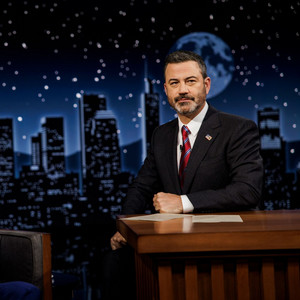
The aftermath of Charlie Kirk's assassination and the suspension of late-night host Jimmy Kimmel are sparking concerns and conversations about the state of free speech in the United States.
Today my colleagues Jim Rutenberg, Jeremy Peters and Adam Liptak on the story of Kimmel's removal and why it is provoking both fears and applause from different camps of a polarized country.
It's Friday, September 19th.
Okay, there are like three phones and six laptops in the room.
Is everybody's phone off?
I think my phone was off.
I can, like, hear typing.
I can hear clicking.
Looking at you, Jeremy Peters.
Sorry, I'm just adding this one paragraph.
No, you're finishing up a story that we are literally here to talk to you today about.
So, no, this is good.
This is good.
Multitasking.
This makes it very real.
All right.
Jim Rutenberg, Jeremy Peters, Adam Liptack, thank you, all three of you, for joining me.
Thanks so much for having me.
Thank you for having me.
It's great to be here, Rachel.
So we're gathered here today to talk about the indefinite suspension of Jimmy Kimmel and everything that that entails.
And so, first of all, Jim Rudenberg, you are a longtime media reporter.
Can you just tell us first what exactly happened with Kimmel?
Well, on Monday night Kimmel came out to do his monologue on his show on ABC and decided to launch into a commentary about basically the aftermath of the assassination of Charlie Kirk.
You know what?
Let me just play that tape for us.
We hit some new lows over the weekend with the MAGA gang desperately trying to characterize this kid who murdered Charlie Kirk as anything other than one of them, and doing everything they can to score political points from it.
The criticism started rolling in that there was not sufficient deference to the sorrow of Charlie Kirk's fans.
They found it disrespectful.
Found it disrespectful.
But the key thing that happened that changed everything really, it seems, is on Wednesday the FCC commissioner, who basically holds sway over television licenses across this country, Brendan Carr, makes a pretty strong but implicit statement, threat that this kind of language what Jimmy Kimmel said was a lie and stations may need to be held accountable and pressures the stations to break from the networks.
And I'm just going to inject here because people don't all know how this works is that the major national networks are conveyed into homes by local television stations.
And maybe I'll just play that tape too.
Frankly, when you see stuff like this, I mean, look, we can do this the easy way or the hard way.
These companies can find ways to change conduct and take action frankly on Kimmel or there's going to be additional work for the FCC ahead.
So he's not being very specific here, but it sounds like a veiled threat, basically.
Well, he is being very specific.
And this is well known.
And so in the TV industry, there's no question what he's saying.
So a major television station group, Nexstar which, by the way, is seeking a merger with another television station group that's going to need the FCC's approval says that it is suspending Kimmel from its airwaves.
They just take him off right there and then.
They take him off.
And that is followed by ABC says, we are indefinitely suspending him nationally.
And what justification did they give for that?
They don't really give one.
They do not elaborate on this decision.
That was it.
But the thing in this instance that really caught people's attention was the use of government power to address what is an editorial or speech issue, or what has traditionally been so.
We haven't seen it a lot.
We haven't really seen an attempt like this since Nixon.
I don't remember what Nixon did.
I wouldn't expect you to.
But what Nixon did was his administration was very frustrated with coverage in the national network, which at that point were most of media.
We were the newspapers obviously here doing our thing, but they were the big national outlets.
And the Nixon administration began – putting pressure on their stations, because the stations are what are licensed.
When we hear President Trump say NBC has to lose its license, he's not really talking about NBC that you see in primetime or in the national news.
He's talking about their stations.
The stations that carry them around the country.
They carry them.
They're the ones with the licenses.
They're the ones who Nixon, by the way, said a lot of these stations are in red states, because These are our people and we can bring them to our side and put pressure on the national networks.
And the Nixon administration was starting to do this.
Watergate happens.
It doesn't get very far.
And really we have not seen anything like this of using FCC.
Threats of power in terms of content in ages.
I mean, that was over with Reagan more or less.
Right.
And right now what it looks like is that it's not just some theoretical idea that people are concerned about, or something from a bygone era that was discussed.
This is a material threat from a government official, it seems, who holds quite a bit of power over them.
And Adam, our resident legal scholar.
I'm curious is what we are seeing happening here with Kimmel.
Is this legal?
So there's a constitutional line here, Rachel.
The government is free to use its bully pulpit to persuade people.
But the Supreme Court has said, when that bleeds over into coercion, to leverage the government's power and force people to do things, that violates the First Amendment.
And there are maybe three important cases in this area.
And I think collectively they suggest that Brendan Carr is at least testing that line.
Back in 1963, a Rhode Island commission, which was set up by state lawmakers, upset about kids having access to what they thought were obscene books, empowered this commission to go to the local distributor and say you know what?
We're not crazy about these books, and we'd hate to have to, like, refer you to a prosecutor.
And there was no direct power there.
But still a threat.
Yeah, and the Supreme Court says you know, even if it's implicit, even if it's indirect, that's a violation of the First Amendment.
You cannot use government power to achieve the suppression of speech.
And that case, called Bantam Books, was just recently last year powerfully reaffirmed in a second case where the NRA sued a New York State insurance official who, after the Parkland school shooting, told these insurance companies don't do business with the NRA, we don't like them, or at least that's what the court record suggested.
And the Supreme Court again unanimously says if what you say is true, That is a grave violation of the First Amendment also.
And then they looked at a much bigger case.
You probably remember Rachel, that during the Biden administration conservatives were quite upset that the administration was jawboning social media companies and urging them to delete materials.
They said the Biden administration said was disinformation about COVID and about election fraud information.
And the Supreme Court doesn't reach the issue.
But the music of that decision also is If it's backed by a threat, if you're saying you know you really should think about taking down that post because we might try to withdraw some kind of immunity you have or we might like to come after you on antitrust grounds.
That would also similarly cross the line from persuasion to coercion.
And the statement that you played from Brendan Carr is pretty darn close to coercion as the Supreme Court would see it.
Well, Jeremy, let's talk about the social media example that Adam was telling us about.
Because with social media, there's no FCC license, right?
But conservatives were angry during the Biden administration about the pressure that the government was exerting on these social media platforms.
And you have long reported on the right.
You've reported on free speech issues.
So remind us what those specific complaints were from these conservative groups.
Right.
So before the 2020 election, you had COVID as the major issue of contention, information that the Biden administration said was inaccurate about vaccines, about the origin of the virus and how deadly it was.
And the Biden administration asked Twitter and other companies to take posts down, which they did.
Conservatives were furious about that and have held congressional hearings and called for investigations into that.
Then you had the censorship of a story about Hunter Biden's laptop, which you will probably remember.
It fell into the hands of conservative activists, including Steve Bannon.
And it contained some quite unflattering images and information about the former president's son.
And it did not reflect well on the Biden family in general.
The social media companies did. told stories about the laptop from appearing on their sites.
Conservatives were furious about that, saying effectively that it was election tampering.
Then after January 6th, when President Trump is banned from Twitter.
Conservatives were furious about that as well.
So there is, as they see it, a conspiracy of being, you know, just too favorable to Democrats and not willing to publish unflattering information when it comes to the left.
I remember this moment as a moment where people and posts are getting pulled off of social media.
The right, as you said, is saying this is obviously censorship.
And I also remember this moment as sort of an important marker, where it really created what feels like these free speech absolutists that became louder and louder and louder including, by the way, Elon Musk, who then buys Twitter and says now this is the public square.
Everybody gets to come here and say what they want.
Right.
Yeah, and I think we sort of lose sight of this when we talk about this and it's that anyone can go on their phone and blast out information to audiences literally of millions.
It's brand new.
Mm-hmm.
Previously, information was in this FCC world we were talking about earlier, with certain standards and rules.
And here was the Internet, with no rules, and the society was grappling with.
How does this look?
What does this mean?
Mm-hmm.
But back in the pre-Internet era, conservatives came along and said, we shouldn't have any of this.
You're basically saying that conservatives have always hated the idea of government intervention in social media and broadcast via FCC or frankly, anything else, at least since Reagan?
And when Jeremy was talking about this era of the internet and Biden fights and legal cases around COVID and the election, et cetera, Brendan Carr was among those who said government should not be doing this.
This is a threat to free society.
And it's very interesting that with this Kimmel issue He's actually saying well, the FCC made a mistake in backing off.
He actually says that to Sean Hannity.
I think the FCC went too far the other way, which is basically repudiating Republican orthodoxy since Ronald Reagan.
So, Jeremy, why did conservatives have this point of view?
Why did they traditionally hate this kind of intervention?
Conservatives, in the sense that we understood them before President Trump came along, have always prided themselves on being small government, on resisting any type of regulation into private enterprise.
And that's what they saw any type of effort to control what social media companies could or couldn't say.
Obviously, they've changed their tune.
Obviously that's right, because Carr here is not subtly threatening to have the government pull licenses right.
I do wonder whether there's been any acknowledgement from these free speech absolutists that we just spoke about, the ones who were so outraged about the censorship that you described on social media.
Is there any acknowledgement of this apparent contradiction or sort of reversal in position about the role of government in censoring speech that they don't like?
You get the sense that there is a real chill right now over any kind of speech from the right and the left.
That would appear to point out that people are being inconsistent when they talk about who deserves free speech and who doesn't.
Well, there is one area in which the right has been consistent.
When Attorney General Pam Bondi suggested that people could be prosecuted for hate speech for things they said about Charlie Kirk, there was a substantial backlash.
And that seems to be an area where the right continues to hold the view that so-called hate speech is protected by the First Amendment.
And I would just add there that conservatives are only objecting to part of the idea there on hate speech.
Right.
They have said they don't believe speech should be illegal, meaning that the law should not regulate.
Quote unquote hate speech.
However, many of them, in the wake of Charlie Kirk's assassination, cheered as private corporations were firing conservatives employees who had said disparaging things about Kirk on their social media accounts, and there were many conservative activists who were leading these type of cancellation campaigns.
Even if they maybe didn't call it that, they were very happy to see those people get punished exactly.
And that has led to recriminations from the left saying hey, wait a minute, you guys have been invading against cancel culture so-called for years and this looks like cancel culture.
And that has introduced a new argument from those conservatives and people around Trump who are doing this, calling for what they say are consequences.
That's the word we're hearing now.
Consequence culture.
Consequence cancel culture.
So that seems to me like a new argument, because the people who were on the other side of the cancel culture debate on the left for the last few years I imagine there would have been a different answer if they had said well, there are consequences to what you say.
I mean, I thought the campaign against cancel culture was that these consequences are out of control or not right?
And you're hearing it almost in a chorus of consequences.
That's sort of the word of the day.
We're going to talk more about the consequences and some of the debate around what those consequences should be.
But we have to take a quick break.
So we'll be right back.
I am curious at the height of COVID, at the height of Me Too.
It felt like there were some people, mostly on the right, who were saying that the left was turning into a lynch mob, that some of this cancel culture was going too far.
And I think...
At least it was my impression that there were some on the left who might have more quietly agreed with that assessment, but were too scared or, for whatever reason, did not say anything.
And I'm just wondering is there anybody on the right that is kind of saying whoa whoa whoa, like do we need to pause for a second here?
The patterns there are very similar.
The commentators who have dared to say that the right might be overreaching here are few and far between.
So far, about as close as you get are people like Matt Walsh and Tucker Carlson, who has said that it would be besmirching Charlie Kirk's legacy to start policing speech.
But apart from those handful of voices, you don't really hear anybody who's very willing to criticize inside the tent at the moment.
I think the emotions over Charlie Kirk right now are just still too raw.
So basically, there are very few voices that are the ones saying hello.
You guys are abandoning the case for free speech now.
I thought we were the free speech guys.
Well, here's the thing.
They like what they're seeing.
For the most part, the conservative activists and commentators are saying, yeah, let's get them.
I talked to Steve Bannon today, who has been one of the fiercest critics of the so-called woke left.
I mean, let's not forget attacking wokeism and cancel culture was a central part of the Republicans' message.
And I said to Bannon, doesn't this risk looking hypocritical?
What did he say?
He assured me that, don't worry, I would not be going to the gulag myself.
I would be going to a nice low security prison.
Are you serious?
It was a joke, but yes.
Was it a joke?
He was joking.
But I said that you know, this looked to me eerily similar to the kind of purge that conservatives have long criticized the left for.
And he said this is an inflection point.
And his aim, the goal of the MAGA movement is not to unite, but to win.
Right.
I mean, Bannon might have joked to you about the gulag, but in a very real sense he is echoing something that is coming from the vice president in a very serious manner.
I mean the vice president J.D.
Vance very recently went on a podcast and basically said if you are hearing people speaking disrespectfully about Charlie Kirk, you should report them to their employers.
Right.
I think one thing that is consistent here is that conservatives and MAGA Republicans are being very clear that whatever they may have said about the excesses of the progressive left does not apply to them in this situation.
Adam, we talked about the legal definition of government coercion, and part of that is related to what levers the government can actually wield against somebody.
But what Jeremy is talking about here is a kind of cultural pressure, right?
It's like the ability to sick the mob on somebody.
It's about doxing or attacking or somebody losing their job.
But if it has a similar chilling effect on the person or company that you are trying to target, does that start to become coercion?
I think it's definitely coercion in the colloquial sense, the sense that we understand it, that people don't feel free to talk candidly where neighbor is spying on neighbor and turning people in.
And, it seems, powerfully un-American, at odds with coercion what, not long ago, most serious people thought the First Amendment was meant to do, which is, if you disagree with something, you don't prosecute the person, you don't fire the person, you debate the person.
And consider that we're talking about a late night comic And the president of the United States, who has the bully pulpit, who has the ability to say I think what Kimmel said was wrong for the following three reasons.
And people will hear that and be persuaded by whomever.
And we've completely lost that American idea.
But isn't it so interesting to think about the fact that both the left and the right would both argue that, like we're the ones trying to protect free speech.
It's the other guys trying to silence it.
And if you think about it, free speech as a concept should be something very simple to understand.
And yet it feels like, for many different reasons, both sides cannot seem to find a lot of common ground.
And right now it does feel like we are in a moment where the people in power at least— feel like the unifying principle is in fact not protecting free speech but quashing speech they do not agree with.
But again, in this case, what you veer into is this flirtation with the use of government power.
And there's another thing going on in this story that we haven't mentioned in terms of Kimmel and ABC is ABC's an actor here too, and his parent company Disney.
And they quickly folded.
And aside from that you had this big station group, Nexstar.
They immediately say we're getting rid of this program.
And again, they are pursuing a big stations merger.
They need FCC approval.
And this FCC chairman, Brendan Carr, has not been shy either about saying that, in terms of deals that we need to approve, private business deals that they are saying your politics are wrong here.
They're wrong in such a way that it's against the public interest.
That's another new wrinkle in all of this.
Right.
Jim, you're making the distinction, basically that a woke mob is not the same as the FCC chairman saying they better shape up or else.
Well, and the spirit of both things are very similar.
But the First Amendment of our Constitution is written about government abridgment of speech.
I have to bring up a third scenario to discuss, which is that the president has filed a lawsuit against The New York Times.
It's obviously not the FCC trying to do anything to us.
They can't do anything to us at The Times.
But I do wonder what we should be making of that in this context.
Well, so President Trump has sued The Times and several of our reporter colleagues, basically arguing that our coverage and a book failed to give him the due he believes he is entitled to for his business acumen, and that this was politically motivated as the election was approaching.
I just want to read the statement from The New York Times company in response to this suit.
The statement is this lawsuit has no merit.
It lacks any legitimate legal claim and instead is an attempt to stifle and discourage independent reporting.
The New York Times will not be deterred by intimidation tactics.
We will continue to pursue the facts without fear or favor and stand up for journalists.
First Amendment right to ask questions on behalf of the American people.
And I just want to add to this.
I have detected no fear here at The New York Times as a result of this lawsuit.
And I guess I wonder, though, if you are a smaller media company, does this kind of thing scare you?
Well, can I say – I'll get to the smaller.
But can I make one note about larger media companies in relation to our suit?
There was one – thing in our suit that really stood out to me.
Please.
What was it?
And that was President Trump's lawyers writing in this lawsuit that ABC News and CBS News had each paid him multimillion-dollar settlements.
And the lawsuit used language basically to say that he's vindicated that because they folded in many people's view or they settled in their view to avoid costly litigation, that Showed that his lawsuits were meritorious.
And so just think about that when you talk about the smaller outlets.
Because ABC and CBS are gigantic.
They do have, as we've said a lot now today, regulatory matters before his government.
He has the power to make life difficult if he chooses to use it that way.
But think about smaller outlets, places that don't really have money for this kind of litigation to defend themselves.
And what's hard to get a handle on, which I'd really like to get a handle on, and if anyone out there in media land is listening and has experienced this, how many stories are not getting done or are getting watered down that wouldn't have with any other president heretofore.
And so what journalism isn't happening because people are fearful?
How much self-censorship is there right now that's almost impossible to quantify?
And I would even wonder whether some larger news organizations, if they were to come into possession of say, Donald Trump's current tax returns, whether they would take the risk of publishing them, although newsworthy, although illuminating.
And if you're a small outlet and maybe in a red state, I think you want to be nervous about the jury you're going to face, even as the legal standards have not changed.
People in the United States have been told over and over again that the media is not to be trusted.
And a jury might well believe that you consciously, deliberately lied when you wrote something about a political figure.
In other words, juries are made up of people, and people may be primed because of all of this rhetoric that there was some kind of intentionality here.
And that makes, in your mind, news organizations more vulnerable to these kinds of attacks.
Right.
And let's say you lose an enormous verdict.
You probably will win on appeal.
The law is very protective.
But it might take a long time.
It might put your bottom line at risk in the meantime.
So a lot of people will make rational calculations and say, I'll cover a different story.
I mean as much as conservatives, will resist this comparison to what the left did in trying to police speech and make it unacceptable to say certain things.
That's exactly the effect here.
They are trying to get more and more Americans and media outlets to censor themselves.
Guys, thank you so much for this discussion.
Thank you, Rachel.
Thanks.
When you have a network and you have evening shows and all they do is hit Trump, that's all they do.
On Thursday, President Trump told reporters on Air Force One that regulators should consider revoking licenses of networks critical of him.
They give me only bad publicity.
I'm oppressed.
I mean, they're getting a license.
I would think maybe their license should be taken away.
It'll be up to Brendan Carr.
I think Brendan Carr is outstanding.
We'll be right back.
Here's what else you need to know today.
On Thursday, a vaccine advisory panel voted against the combination shot for measles mumps, rubella and chickenpox for children under the age of four.
The federal panel at the same meeting did not change the guidelines for giving vaccines separately to prevent those same infections, which is the more common practice among pediatricians.
Still, the revision is seen as the first of more to come from this panel, with many new members appointed by Health Secretary Robert F Kennedy Jr, a vocal vaccine skeptic.
And Charlie Kirk's widow, Erica Kirk, was elected the new chief executive and chair of the board of Turning Point USA, the conservative political organization founded by her husband.
In her first public remarks after his death last week, Kirk pledged that she would carry on his legacy.
This weekend, a heads up that we'll be sharing some shows that we think you'll enjoy.
First, as always, the interview with Lulu Garcia Navarro, who travels to Nashville to talk with the actress and producer Reese Witherspoon.
And then our Sunday special series continues.
Gilbert Cruz talks with food writers Priya Krishna and Brett Anderson about the Times' list of the 50 best restaurants in America.
Today's episode was produced by Claire Tennis-Getter and Caitlin O'Keefe.
It was edited by Paige Cowett, Mike Benoit and Patricia Willans, with research help by Susan Lee, and was engineered by Alyssa Moxley.
That's it for The Daily.
I'm Rachel Abrams.
See you on Monday.