This podcast is supported by Comedy Central's Emmy Award winning series, The Daily Show.
Jon Stewart and The Daily Show news team are covering every minute of every hour of President Trump's second first 100 days in office with brand new episodes every weeknight from the lowest lows to the lowest highs and everything in between.
They'll be there to break it all down.
Comedy Central's The Daily Show, new weeknights at 11 on Comedy Central and streaming next day on Paramount Plus.
From the New York Times, I'm Michael Bobaro.
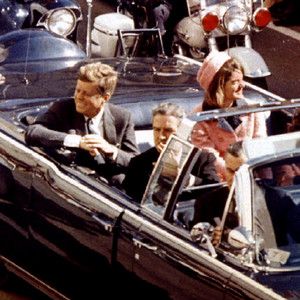
This is The Daily. For the past three decades, when the US government has released documents related to the assassination of John F.
Kennedy, an overriding goal has been to dispel conspiracy theories.
But as my colleague Julian Barnes explains, President Trump's motivation for releasing the latest batch is far more complicated.
Today, what we learned from those new documents, and why they may actually fuel even more conspiratorial thinking.
It's Thursday, March 27.
Julian, you're the intelligence reporter for The Times.
So I'm curious what your relationship has been to arguably the biggest and most enduring conspiracy theory about the agency you cover.
that the CIA was behind the killing of the president.
The assassination of JFK.
Yeah, that one. Yup.
Well, like all Americans, it's loomed really large for my entire life, right?
I mean, this is something that everybody talks about, generation in, generation out.
I never realized Kennedy was so dangerous to the establishment.
That movie JFK came out when I was in college and… Please be seated.
In that movie, Oliver Stone posits that there is a dark conspiracy behind the Kennedy assassination.
President Kennedy was murdered by a conspiracy that was planned in advance at the highest levels of our government, and it was carried out by fanatical and disciplined cold warriors.
That it was the CIA, that Oswald didn't act alone.
Y 'all got to start thinking on a different level like the CIA does.
Now we're through the looking glass here, people.
White is black and black is white.
And I remember, I was like, wow, this could be true.
Maybe the shadowy agency could have done something like that.
This infuses so much, you know?
Why was the CIA covering up what they knew about Oswald, what was the CIA doing in the 1960s into the 1970s.
This is the kind of foundational myth of the CIA and the CIA's relationship with Kennedy is hugely important in the history of the agency and how we understand the agency today.
Suffice it to say, young Julian Barnes, and now modern day Julian Barnes, sounds very primed for the moment just a few days ago when the United States government, at the direction of President Trump, releases thousands and thousands of pages of these super secret documents related to the JFK assassination.
So what, given that history, was your first impression when you finally had a chance to really make sense of them?
Well, not to spoil the episode, but the CIA did not kill JFK.
We have not learned that there's a second gunman.
There is no significance to the grassy knoll.
Oswald acted alone.
But that doesn't mean this release is not important, right?
There are interesting, new details about spycraft, about how the CIA operated, and how they operated outside the guard rails put on by a democratic government.
How they exceeded their charter and that's what's important about this today.
And that's kind of why these documents are coming out.
We have a president who has consistently questioned the role of intelligence agencies in society.
He's constantly attacking forces arrayed against him.
And by putting this out, by exposing this old history about the bad acts of the CIA, one could reasonably argue that he's trying to reinforce the idea that there is a threat from something he would call the deep state.
Well, we're gonna get to that and get to how the documents that were just released may or may not reinforce that concept.
But just to start, can you tell us the backstory behind this document release?
As you've hinted at, there have been releases of JFK documents throughout the last half century or so.
So where did these specific documents come from?
What's that story? So it starts at the time of the assassination itself.
Americans have a lot of questions.
How could one solitary gunman do this?
How could one bullet hit the President and the governor of Texas.
You know, there were breadcrumbs and hints.
people knew about the tensions between Kennedy and the CIA over the failed Bay of pigs invasion of Cuba.
Right. Which the CIA had overseen and botched, right?
So the public wants answers and the clamor leads to a government commission, the Warren commission, which investigates the killing of John Kennedy and comes to a conclusion that few Americans accept, which is that Oswald acted alone.
And so the questions persist and there are more and more commissions, congressional investigations, each of which generates a lot of documents.
Some about the Kennedy assassination, some about other programs, but in the course of these investigations, we learn about all kinds of other CIA abuses.
Like what? Project Mockingbird when they were tapping the phones of journalists.
MK Ultra, where they were putting LSD into the drinks of unsuspecting Americans to find out whether they could practice mind control on the Soviets.
These were limited programs, but they were wrong, they were outside the CIA's mandate and they became part of the public consciousness of an agency that was a little out of control, that was spying on Americans and not operating within limits.
So in the public imagination, all of this kind of comes together, whether it's the abuse of a CIA mind control experiment, or a wiretap of a reporter in Washington, it all comes merged with the original questions about was the CIA involved in Kennedy's assassination.
but more and more information is accumulated, some of which is released, and much of which is kept locked in the CIA's vault.
And they're all kept locked away until Oliver Stone makes his movie JFK, the one I saw in college.
And the movie ends with a message about how the Kennedy assassination records are locked away for decades, and it serves almost like a call to action.
So people start calling Congress and Congress passes a law that mandates the whole trove of documents about the Kennedy assassination But also about broader CIA activities gets released and it lays out a timetable to push the documents out to the public and The timetable for the law is 25 years and so across various presidential administrations documents are being released right and and the deadline to declassify and release these documents from all these government inquiries basically ends up in the first Trump administration.
The final final deadline.
The final deadline for the last of the documents.
But at that time, Trump listens to the CIA and they ask him, can you withhold the names of officers, the names of sources, protect some of our tradecraft?
And he has cede to those wishes and the documents released in 2017 had many redactions.
So just explain how we get from the Trump who is compliant with the CIA and agreeing to all the redactions to the Trump of this past week or so who oversees the release of this final batch with no redactions, and I'm guessing part of the answer is the extraordinary souring of Trump's relationship with the intelligence community since his first term.
So just to say, there's a super tiny tranche of documents that are still under court seal.
But yes, the vast, vast majority of the documents have no redactions and are now public.
But to answer your question, part of it is Trump's antipathy to the intelligence agencies, his worries about the deep state, which have become much more central to his messaging over the years.
Well thank you very much. Thank you.
Thank you very much. We won.
And right before his second inauguration, he vows to do something.
he says he'll order the release of the remaining documents about the assassination of President Kennedy.
As a first step toward restoring transparency and accountability to government, we will also reverse the overclassification of government documents, and in the coming days we are going to make public remaining records relating to the assassinations of President John F.
Kennedy. his brother, Robert F.
Kennedy. He frames this as a way to restore public trust in government, but part of it is also his new alliance with Robert F.
Kennedy Jr. Hm. We need to have more transparency in our government and he's keeping his promise.
R .F .K. Jr. is the son of Kennedy's Attorney General, the New York Senator and Presidential Candidate, Robert F.
Kennedy. And throughout R .F .K.'s life, The day that my uncle was killed the first phone call that my father made after J Edgar Hoover told him that his brother had been shot was to the CIA desk officer and my father said to him, did your people do this?
The questions about what the CIA did, what role the CIA had in his uncle's death have loomed large.
It was somebody who very much believes the CIA was involved in his uncle's death.
There's millions of pages of documents.
There's a 60 -year cover -up.
And he is a very strong voice in this administration pushing for a much grander release of information.
And of course, he's kind of pushing on an open door in Trump given his relationship with the intel community.
That's right. A lot of people are waiting for this for a long...
for years, for decades.
Trump is ready to push out these documents.
And everything will be revealed.
And he signs an executive order ordering the JFK documents to be released.
And then, last week, they make public a huge trove, 77 ,000 pages.
almost all the digitized on the web.
And gone are most of the redactions.
No white boxes, no black boxes.
Now it's finally out there for the public to see.
We'll be right back.
At Schwab, how you invest is your choice, not theirs.
That's why, when it comes to managing your wealth, Schwab gives you more choices.
You can invest in trade on your own.
Plus, get advice and more comprehensive wealth solutions to help meet your unique needs.
With award -winning service, low costs, and transparent advice, you can manage your wealth your way, at Schwab.
Visit Schwab .com to learn more.
What's my subscription to The New York Times have me doing this week?
preparing a strawberry pretzel pie, solving spelling bee with no hints, planning a trip to one of the 52 best places to go, getting to the bottom of the big pants trend.
And I'm finally replacing my vacuum with a recommendation I can trust. What will your subscription to the Times have you do?
Why not find out? With our best offer, go to nytimes .com slash subscribe.
So Julian, tell us what we learn when these redacted boxes are wiped away, and everything that had been previously hidden in these JFK documents suddenly is revealed.
Well, some of what had been hidden was hidden for good reason, like the social security numbers of hundreds of congressional staffers.
Huh, who had worked on previous investigations?
Yeah, who had been on the committee in the 70s or the House Committee on the Assassinations.
One of the church committee members was Joseph De Genova, a Trump campaign lawyer, and he was hopping mad that his social security number was out there.
I mean, it was a huge mess.
The administration immediately had to say they were going to take the really unusual step of issuing new social security numbers, something they very rarely do, to the affected people.
This is an example of, you know, stuff that didn't need to come out there, doesn't serve any investigator, but the speed of which they were moving and the directive remove all the redactions, you know, lead to some second -order effects.
So when it comes to the central question we have been exploring here of what new information is in these formally redacted spaces and these documents, beyond Social Security numbers, what did you find?
Well, one of the most interesting documents, which was titled CIA reorganization, was from Arthur Schlesinger, a key aid to John Kennedy.
This document had been out before, but what was hidden from view, and is now apparent, is the pure depth of the CIA's spy work in France.
You know, half of the embassy in France was CIA officers, not diplomats.
So people you would think are working for the State Department in a diplomatic capacity are actually just spies for the CIA. Yeah, and this is the larger point of this memo, which is that the CIA is taking over U .S. foreign policy.
It's out of the control of the President and the Secretary of State, because the CIA's role has grown too big." This is the kind of information the CIA keeps secret even today.
How many people they have overseas, where they're stationed, how many officers are in each embassy.
And so you can see why when President Trump in his first term released these documents, this information was redacted, even though it was old.
This goes to how they operate.
And they really like to keep those secrets out of the view of the public.
What seems fascinating about this, not only is that it reveals the reach of the CIA within what we think of as the civilian corners of our government, like the State Department, but it reminds me of what you had said earlier in our conversation about the tension between Kennedy and the CIA. That would seem to fuel the idea that in this period, there is a conflict between the spy agency and the president.
That's right, Michael.
This is a piece of evidence about the tensions between the CIA and the Kennedy administration.
They did not like this idea of unchecked intelligence power, and that becomes the kernel of many conspiracy theories about why the CIA had it out for Kennedy mm -hmm from the beginning here you can see the origins of this Deep State idea that there is powers within the government that are operating without the regular checks and balances without the direct control the direct knowledge of the president that makes any president nervous and we can see that blossom generations later with President Trump.
What else do we learn from these unredacted documents about the CIA?
Well there's another document that was written for William Colby, who was the CIA director in the 1970s.
He asked an aide to look into activities the CIA was up to that quote exceeded the charter.
Hmm just translate that.
Yeah what he means there is the CIA is not supposed to operate in the United States there are specific guidelines in terms of what the CIA does overseas, if the president doesn't directly authorize it, you're not supposed to do it.
And there's clearly a belief by some around Colby that the agency had gone too far.
And so this document again had come out before but had redactions.
Now what we see is new material again about spying on the French this time in the United States.
We learned that the CIA not only was doing the eavesdropping, but they actually broke into the French Consulate building.
Yeah. And it is kind of an example of the CIA out of control.
Right. And beyond that, in these documents, we have other examples of the CIA going beyond that charter.
We have them listening to the phones of journalists in Washington.
Now, remember we knew that before these documents came out, but now we know more and we have the another name of a Washington Post reporter we did not know whose phone was being tapped, that the CIA was listening to.
So what these removed redactions are really showing us is just a deeper version of what we had already understood, Which is just how out of control the CIA was in this period, rather than these documents telling us anything really new or revelatory related to the conspiracy theories around Kennedy's death.
But it's also true that this additional information feeds other conspiracy theories that have developed over the years.
Take the eavesdropping on Washington journalists.
That was part of a real program the CIA called Project Mockingbird. Right, you mentioned that before.
But Robert F. Kennedy Jr. often talks about something called Operation Mockingbird, which he says is an effort by the CIA to not just listen to journalists, but manipulate them, control them.
So, he's taken a kernel of a real form thing, this real abuse of listening to Washington journalists, and morphed it into an entirely different conspiracy theory.
So, in theory, a revelation like the one you just described of a CIA reaching into the phone lines of journalists in the 1960s could further fuel that unsubstantiated theory that Robert F.
Kennedy Jr. subscribes to, that the CIA is trying to control journalists.
Yes. And look, in the past, we've had releases of documents that have been meant to dispel conspiracy theories, to try and bring more rationality and logic and information into the debate.
But now, maybe for the first time, we have people who are invested in the conspiracy theories.
And they have a very different set of interests.
Robert F. Kennedy is pushing this transparency, in part because he believes there's new information about these conspiracy theories that he's pushed for years.
Hmm. So those putting out these docs now, they are not interested in dispelling them as their forefathers in disclosures like this have. They're putting them up because they're believers in conspiracy theories.
Do you think it's fair to put President Trump in that category?
Not completely. He may not believe every old conspiracy theory, but he definitely believes there's a conspiracy to get him today.
He definitely believes the deep state is out to undermine his presidency.
He blames them for the Mar -a -Lago classified documents investigation.
– he blames them for undermining his foreign policy.
So if something comes out that undermines the credibility of the intelligence agencies of the FBI, Trump does not oppose that.
Well, that gets to a question that I think is going to be on a lot of people's minds as they get to this point in the conversation, which is are all the revelations that we have just been discussing, especially around the CIA, in any way strengthening the one conspiracy theory that Trump subscribes to the most still about a deep state, or is the reality that what's in these documents is so old that it's quite irrelevant to today's debate over government and the deep state that Trump talks about?
Now, how should we think about that?
Objectively, I would say, the old history has very little to do with how the CIA operates today.
There have been years of reform.
There's far more congressional oversight today than there was in the 1960s but that may be a minority view.
A lot of people, they look at these old stories and they see proof of what they think is happening today and so even if we know that the CIA operates very differently, people use evidence of past mistakes to argue that there is a deep state that today is undermining the president.
So in that sense, the foundational conspiracy theory that the intelligence community played a role in Kennedy's death and that the government spends all this time releasing documents to dispel ends up ceding newer, different conspiracy theories all of which seems to tell us that transparency, or efforts at transparency when it comes to something like the Kennedy assassination, it didn't really solve conspiracy theories, it helped them, I think the word you used was blossom.
Which isn't necessarily the best case for transparency, does that mean we just have to accept that the more you release, the more conspiracy theories there will be?
That's just a reality of it?
That's a totally depressing thought.
I really hope it's not true.
But, I don't really know what the way to counter that is but through more transparency and more objective looks at the information, more analysis that brings in the full context that pushes back against conspiratorial thinking.
But conspiratorial thinking has been very sticky in America.
I mean, go back to just the short time after the Kennedy assassination, only 30 percent of the people believed Oswald acted alone.
Almost 50 percent believed there was a conspiracy.
Now, those numbers have fluctuated some.
After that JFK movie, only 10 % of people believed Oswald acted alone, but today, years later, after all these revelations, Decades later, yeah.
Decades later, 60 years later, we're back where we started, right?
It's like 30 % of people believed Oswald acted alone, 65 % of people believed there was a conspiracy to kill Kennedy.
Wow. Kind of unchanged or even worse.
Yeah, this is not a case against transparency.
This is not an argument that we shouldn't be releasing this information.
But it's just a reminder about how powerful the idea of conspiracy is, how much of a hole that has on the American mindset.
And we can't think that another release of documents, another revelation, is going to dismiss those conspiracy theories.
It's just as likely that they'll give them new life.
Well, Julian. Thank you very much. Thank you, Michael.
We'll be right back.
Here's what else you need to know today.
Pete Hegseth needs to resign.
There needs to be accountability right now.
Secretary Hegseth must resign immediately.
The Secretary of Defense should be fired immediately if he's not man enough to own up to his mistakes.
On Wednesday, a growing number of congressional Democrats called on Defense Secretary Pete Hegseth to resign or be fired after it emerged that texts he inadvertently shared with a journalist over a commercial messaging platform contained detailed information about an upcoming U .S. military attack.
The texts from Hegseth, which were released by the journalists who received them, cast doubt on claims by the officials involved in the text chain that nothing in their messages was classified.
Hegseth is doing a great job.
He had nothing to do with this.
Excellent. How do you bring Hegseth into it?
He had nothing to do.
Look, it's all a witch hunt.
Asked about Hegseth's future during a news conference at the White House, President Trump defended him and called the growing political furor over the text another coordinated attack against his administration.
And President Trump said he would impose a 25 percent tariff on all cars and certain car parts that are imported into the United States starting next week.
In doing so, Trump would make good on a promise long feared by automakers across the world.
The tariffs could encourage carmakers to open up more U .S. factories, but will disrupt supply chains and most likely result in significantly higher car prices for American consumers.
Today's episode was produced by Olivia Knatt, Mary Wilson and Sydney Harper.
It was edited by Liz O 'Baehlen, contains original music by Alicia Butte Itoob, Dan Powell and Rowan Nimisto, and was engineered by Chris Wood.
Our theme music is by Jim Brudberg and Ben Lansford of Wonderly.
That's it for The Daily.
I'm Michael Boborro.
See you tomorrow.