This message comes from NPR sponsor Capella University.
Interested in a quality online education?
Capella is accredited by the Higher Learning Commission.
A different future is closer than you think with Capella University.
Learn more at capella.edu.
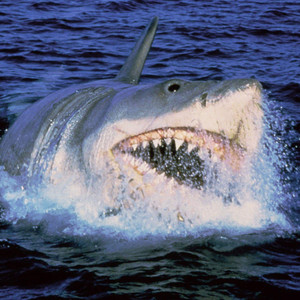
Jaws.
It's been called the perfect movie.
It's been called the first blockbuster.
It's been called the film that changed why we go to the movies.
But look, it's 50 years old.
It's been called pretty much everything you can think of by now.
But what does it still have to say half a century later?
What do you see if you bring fresh eyes, lifeless eyes, black eyes, like a doll's eyes, to a film that's become a beloved institution?
I'm Linda Holmes.
And I'm Glenn Weldon.
And just when you thought it was safe to go back in the water, we're talking about Jaws.
This is Pop Culture Happy Hour from NPR.
You can pay with a simple tap of your iPhone the wallet you never forget at millions of places worldwide, including websites, apps and anywhere you see the contactless symbol.
Security is built in with Face ID, so you don't have to worry about your cards getting lost or stolen.
And the best part, you still earn the card rewards, points, and cash back you love.
So say goodbye to the bifold.
Add your card to Apple Wallet and start paying the Apple way.
Terms apply.
This message comes from Schwab.
Everyone has moments when they could have done better, like cutting their own hair or for getting sunscreen, so now you look like a tomato.
Same goes for where you invest.
Level up and invest smarter with Schwab.
Get market insights, education, and human help when you need it.
Learn more at schwab.com.
This message comes from NPR sponsor, Capella University.
Sometimes it takes a different approach to pursue your goals.
Capella is an online university accredited by the Higher Learning Commission.
That means you can earn your degree from wherever you are and be confident your education is relevant, recognized and respected.
A different future is closer than you think with Capella University.
Learn more about earning a relevant degree at capella.edu.
This message comes from Moises, proud supporter of NPR music and the 2025 Tiny Desk giveaway.
Win a trip for two to see a Tiny Desk concert live at NPR's headquarters.
Enter for free by September 12th and boost your odds by donating to the NPR network.
And follow where the music takes you with Moises, your AI powered studio created by musicians for musicians.
Learn more at Moises.ai.
No purchase or donation required for entry.
Must be 18 years or older to enter.
Links to the entry page and official rules can be found at npr.org slash tinydeskgiveaway.
Joining us today is fellow host Stephen Thompson.
Hey, Stephen.
Hello, Glenn.
Also with us is writer Chris Always Brings a Bit, Klimek.
Hey, Chris.
Mr. Mayor, Chief, ladies and gentlemen.
Hello.
Hey.
Oh, here's what you already know about Jaws.
It's a movie about a fish and the importance of tourism to a seaside economy, and three very different men.
There's Brody, played by Roy Scheider.
He's the new chief of police of Amity Island, a charming New England community that depends on its summer beachgoers.
There's Hooper, a marine biologist.
Brody calls in to help him deal with a series of deadly shark attacks.
That's Richard Dreyfuss.
And there's Quint, the crusty old shark hunter with calloused hands and an even more calloused liver.
That's Robert Shaw.
You already know that director Steven Spielberg went over budget and over time filming the movie, but was vindicated by its record-breaking box office.
You already know it became a cultural phenomenon.
And you already know that every time you go into the ocean or pool, or the bathtub.
Somewhere down in the deepest recesses of your mind, you hear John Williams' iconic score.
You know all of this, so instead of talking about the film's legacy, we wanted to watch it again and see if we noticed anything we had not before.
So fresh insights, that's the mission.
Linda, did you have any fresh insights on this latest rewatch?
There are a lot of people who receive blockbusters and big action movies and summer movies and stuff like that with an attitude of it doesn't really matter whether it's good or how it's made.
The point is it's supposed to be fun.
Don't think about it so hard.
I think when you watch this movie now, at least for me, what sticks out is how – very, very carefully and artfully it was done.
In some cases that had a lot to do with dealing with the conditions on the ground.
It's sort of famous for how long it takes to really see the shark.
There's a documentary called jaws at 50 that's now on hulu and some other places.
It is partly, I think, because they had a lot of trouble getting the shark to actually work and to look right.
But it's also the philosophy of the movie, because one of the things I noticed watching it this time is that when Richard Dreyfuss first comes to town, one of the first things they have him do is look at what is left of the first victim of the shark.
The enormous amount of tissue loss prevents any detailed analysis.
However, the attacking squalus must be considerably larger than any normal squalus found in these waters.
Didn't you get out of boat and check out these waters?
No.
Well, this is not a boat accident.
It wasn't any propeller.
It wasn't any coral reef.
First of all, you notice that, rather than seeing like a body on a slab, you're basically seeing a bin, like you would at the TSA.
Yeah. containing what is left of this person.
Other than a very quick shot of her hand.
Mostly what you get in that scene is just his face reacting to seeing, And so it's kind of the thing of the whole movie that it is withholding of various things.
When you first see, when Roy Scheider first sees her washed up on the beach, there's a very kind of oblique way of approaching, showing you her body so that it's gross and terrifying.
But you get a lot of that from reactions.
So I think one of the things that I got from it this time is just understanding how much care went into it and how much that has to do with how really really freaking scary I think this movie still is.
It remains so.
Steven, longtime listeners will know you have a very fraught history with this property.
You were terrified as a young man on the Universal Studios ride when Jaws came out of the water.
So did that inform your most recent watch?
Not really.
Not as much as I kind of expected it to.
I expected that trauma to have imprinted on me to such a point that, almost 50 years later, I would have this same kind of visceral reaction to it.
I was just able to appreciate this time kind of, as Linda mentioned, the restraint of this film, how slowly this film kind of meets out the action, certainly how sparing it is in meeting out the gore, kind of building to a an extremely climactic and very traumatic death.
And what has really seared in my memory from past viewings of Jaws is how traumatic that climactic death remains, in part because because the film up to that point has been so careful in how it meets out those scenes.
As Linda said, you're seeing bodies, you're seeing parts.
You know, at one point there's a corpse kind of jump scares out from the underside of a submerged boat.
And it looks so cheap.
It just looks like a mannequin head.
Yeah.
It's interesting.
You know, there's just this endless impulse to make sequels anytime a film has success.
And it kind of, you find yourself just going back to the same well over and over again.
Jaws 2, Jaws 3D, Jaws the Revenge.
But the plot of this movie really just boils down to, like, shark.
Yeah.
That's the plot.
And how do you build on that?
To me this just feels like a perfectly contained movie that, as inevitable as the sequels were, they just weren't in any way necessary.
Right.
Well, speaking of, now, Chris, you wrote about this film and its sequels for The Washington Post.
We don't want to go too deep on the sequels here, but I have to imagine that that exercise helped you understand why this film works, and maybe those didn't.
Yeah, like it is really, really hard to reboot this because it's so primal.
It's so elemental, like the ingredients of it are in absolutely everything.
To an extent that I see the DNA of this in subsequent franchises that have meant so much to me that I've talked about here before, both Die Hard and Alien.
Yeah.
The Die Hard connection is that Chief Brody Roy Scheider's character is such a relatable kind of everyman type and has that clearly stated vulnerability.
You know, we learn in the opening frames of Die Hard that John McClane is terrified of heights hates flying.
So guess what's going to happen before the end of the movie?
Brody has somehow ended up as the chief of police on an island, and he's terrified of the water, which is so key to why this movie works so well.
Drowning.
I would have wondered, will Chris get us to die hard first or James Cameron first?
And I'm delighted.
One, two, punch.
You know, hang on a second.
You know, hour number two is I'm saving myself.
We talk about meeting out the glimpses of the shark very judiciously and keeping the gore kind of very minimized and withheld for strategic impact.
But I think the character stuff in this movie does that too.
And I feel like if this movie were coming out now, if it were being developed now, like one of the notes on it would have been like well, we have to know what happened to Brody.
Clearly something happened to make him leave New York.
He's clearly traumatized.
He's a New Yorker.
He hates being in Amity.
And I'm so glad we don't get that, because when we get Quinn's backstory it's like the greatest monologue in movies, right.
So like, how can you possibly top that three hours later a big fat pby comes down and start to pick us up?
You know that was the time i was most frightened, waiting for my turn.
I'll never put on a life jacket again.
I find it hard to believe that.
That monologue and that that long scene of those guys on the boat I can't imagine that that scene would survive modern expectations about pacing.
I could be wrong, but I find it hard to believe.
But it is so crucial.
Oh, of course it is.
I agree with you.
And one thing that I really appreciated rewatching it if you watched the first Alien part of the appeal is that that ship is just a hunk of junk.
The film is contained to this kind of crappy ship and that's part of the story.
And it's like...
Quince ship is a hunk of garbage.
It's visibly rusty and cruddy.
And that gives you this kind of scrappy, lived in quality that you wouldn't necessarily get if you were telling the story today, maybe on a bigger budget.
Absolutely.
If they went out on Hooper's boat, which is this sleek state of the art yacht, you wouldn't have the same movie.
Here's what I noticed going back through it this next time.
Roy Scheider's a snack.
Not literally in this film, but never noticed that before.
Don't know why.
Maybe I'm just getting of a certain age.
Second thing.
He's a bronzer man than you tend to prefer, Glenn.
He's almost orange in this.
Absolutely.
And also, can we agree, non-zero chance that Brody is an alcoholic, right?
I'm not wrong here, right?
Yeah, I mean, it was the 70s and I feel like everybody was.
Yeah, I don't know.
He's enabled by his wife at one point, who at one point pours him not a double whiskey but a quintuple whiskey to help him go to sleep, which is not how that works, unless you want him to wake up at 230 in the morning.
There's a generous pour of wine as well.
He pours himself a tumbler full of wine.
A full pint glass, yeah.
And in that scene.
One of the other things that I really noticed about this is that Spielberg had then and I think has now, a feel for scenes that are small and slightly weird in a way that helps them feel like real people.
And so in that scene that involves that tumbler of wine Hooper, played by Richard Dreyfuss, comes to Brody's house And sits down at the dinner table and starts eating off of Brody's plate, because he kind of notices nobody's eating it.
Is anyone eating this?
No, which is a really weird thing to do.
And they don't really comment on it.
As Brody is talking to Hooper, he's picking the label off the wine bottle, which is the kind of thing that you do.
When you're having a conversation that's a little bit stressful.
There's a lot of text about how kind of stressed and anxious Brody is.
But there are also these moments where you feel his anxiety and fidgetiness and nervousness.
It's one thing to appreciate the character stuff, like that monologue and like some of those things, but I think those really little things.
It makes the movie feel a little bit more loose.
It makes the movie feel a little bit, even though it's so carefully choreographed.
Shaggy.
I think what you're talking about here is, if you are just thinking about this in retrospect, Remembering this movie, you'll remember it was a blockbuster.
You'll remember the action scene.
So you might think to yourself oh, this is a lean propulsive film that cuts through the water like a shark.
It's not.
It's shaggy in the beginning.
That's because of the time.
Mm-hmm.
When it was made.
Yes, it's got Hitchcock all over it.
You don't see the shark.
But it also has a lot of new Hollywood in it.
Altman, Robert Altman.
Not just because of the overlapping dialogue, but because that scene in the town hall makes you think this could be Nashville.
If the camera chose to follow any of these people home, you'd still have a movie.
Whether it be...
The lady with the glasses and the really unsettling tan.
I don't think that's funny.
I don't think that's funny at all.
Or the guy who, when he gets told they caught a tiger shark, goes.
A what?
A what?
That guy.
Oh, wow.
The harbormaster.
We get a lingering shot of the harbormaster.
There's a lot of untapped comic potential in that deputy or the hot guy who does not go swimming with the girl at the beginning.
People talk about the sense of place in this movie.
Yeah, sure.
It is a very lived in, grubby, sandy sense of place.
Yeah.
That Spielberg made himself miserable trying to capture, but he captured it.
Yeah.
I mean, I think there are two things there.
And I want to say, like if this movie launched the blockbuster which you know, seems to be received wisdom right.
Maybe this kind of detonates the auteur theory.
Everything else that's so great about this movie developed in an iterative way.
Like to go back to the Quint monologue they brought in.
Howard Sackler came up with the idea of having him survive the sinking of the Indianapolis.
And then John Milius did his version and then Shaw cut it in half because he thought, you know, this is going to be eight minutes of.
Yeah, this is a clear note of like each one of these cooks made it better, which is not usually what happens.
Yeah.
I came up with something when I was watching it.
Oh, this has a lot of interesting things to say about masculinity.
And then just for fun, I typed Jaws masculinity and got a couple hundred thousand thesis papers.
But here's what struck me freshly this time.
You've got these three archetypes of masculinity who don't slot very neatly over id ego superego, but they don't.
And Quint is the simplest to talk about because he's, as you say, the most elemental, the simplest, the most traditional man, like a charismatic bully, very swaggering, very aggressive.
Also and this is exactly the kind of thing that would need to get unpacked over several scenes if this film were made today just kind of weirdly passively hostile to women.
The film's only woman with a real speaking part, Ellen Brody, reacts when she sees him with something like horror.
She flees in a way, and something's going on there.
But Quint is not your audience surrogate, right?
That is meant to be Chief Brody.
Chief Brody is in 1975.
He's written to be a tough guy like he was a New York cop.
That's shorthand in 1975 for tough guy.
But as you talked about, he's not in his place of comfort.
He's not in his place of power.
He's on the back foot throughout this film.
And what he's doing constantly is. is mediating conflicts, something Quint never could or would do.
He's asking for help.
That's another thing Quint never could or would do.
That's his character.
We've got to call the Coast Guard.
We've got to hire Quint.
We can't do this alone.
We're not equipped.
That's right.
I think he is Spielberg's vision Of the 70s.
I don't know.
Evolved man self-reflective?
Probably in therapy?
The Alan Alda.
The Alan Alda.
There you go.
You nailed it.
Yes.
Yeah.
I mean the first like 10 minutes of this movie.
It does kind of establish him as basically a film director where everyone in town is coming up to him with their little problems, like this is his job.
But he's also someone who is trying to do the right thing and is coming up against one of the other figures that I think has aged most interestingly, who is this incredibly... reckless, foolish mayor who is determined to go ahead with the Fourth of July... Newly topical.
It feels like, on the one hand, Brody, because he's the cop...
And on the other hand, he can't really get past the mayor, who has a much more detached kind of thinking about things in such a sort of money forward, voter forward, doesn't want to really deal with what's happening.
And so Brody has sort of the urgency to. of trying to convey that action must be taken.
And the mayor wants nothing more than to demonstrate that no action needs to be taken.
And so he's really the person who wants to act and is being held back by someone who does not really represent a particularly strong person, but a person who has a position to thwart him.
You know what I mean that every character in this film behaves perfectly rationally, but that every character in this film behaves according to a clear internal logic.
And so you're not left watching this film the way I often am watching certainly horror movies, where it's like why did you do that?
That's not even consistent with what you were saying 10 minutes ago.
You know that mayor played by Murray Hamilton.
Like you, understand why he wants this problem to just go away and why he's willing to be in denial.
Like, okay, they caught a shark.
Good enough for me.
Open the beaches.
Well, I mean, everyone in this movie is a shark.
They're driven by their own needs, and they're not troubled by empathy.
Right.
And the thing is, he's wrong.
Obviously you know the mayor is wrong, but you do actually understand what he's thinking, why he's thinking it, how much he wants this problem to go away.
And he changes over the course of the film based on the facts on the ground.
And I just really appreciated that enough thought was put into these characters so that they're not just devices.
They don't just feel like plot devices to get this character to do this.
You understand what each character in this movie is trying to accomplish and why.
Right.
The summer is over.
You're the mayor of Shark City.
These people think you want the beaches open.
I was acting in the town's best interest.
That's right.
You were acting in the town's best interest, and that's why you're going to do the right thing.
That's why you're going to sign this, and we're going to pay that guy what he wants.
Martin.
Martin.
My kids.
Well, that means too much.
And that's where you see the distrust of government manifesting in this film, because this is of the time.
Vietnam and Watergate shaping the culture, shaping how we tell stories.
So the mayor wants people on the beaches, right?
He wants the beaches open.
Here's where I –
I kind of disagree with you Stephen, because I think he starts out as a character that becomes a plot device, because there's a point where he gets exactly what he wants.
The people are on the beaches.
They are thronging the beaches.
They are at the arcade.
They are buying ice cream.
But that's not enough for him.
He wants them in the water.
Why?
There is no monetary incentive to get people into the water.
You don't spend money in the water.
You spend money on the beach.
So that felt to me not like a character motivation, more like a plot motivation.
I think he's looking at it like it's not quite picture perfect.
It's not quite like what it's supposed to be.
And my job as mayor is to make sure that it's picture perfect.
The Amity billboard shows the girl in the water.
It doesn't show her on the beach.
Right.
I also really noticed this movie kills a child. gruesomely, fairly early in the movie.
That to me is the effect that actually looks more cheesy than the other ones.
It is like this fountain of blood.
Sure.
What would make a body do that?
But at the same time, that is the kind of thing that I do not expect from contemporary Hollywood movies.
I would expect to see the kid in danger.
I would expect to see the kid need to be rescued.
I would expect to see the kid...
Oh, he's attacked and then he ends up in the hospital, but he's going to be fine.
I think having a kid devoured in a movie like this it all adds to the weight on Brody in a very effective way.
You knew there was a shark out there.
You knew it was dangerous, but you let people go swimming anyway.
I think it adds very effectively to the feeling that you get that he's just being dangerous, pressed from all sides, and he feels desperate to fix the situation in a way that gets you to yes, maybe he would actually go out on a boat with these two other guys and try to personally participate in getting rid of the shark.
Yeah, but those two other guys.
The third in this masculine triptych is Hooper, who a lot of folks identify with Brody.
I've always identified with Hooper, who brings this kind of...
Fussy masculinity, an entitled, an intellectual masculinity, because he thinks he's the smartest guy in the room.
Absolutely.
And makes a thing of how frustrated he is, but you can tell he relishes it.
He loves that position of being the smartest guy in the room.
What I noticed this last time is how that bravado, that entire sense of self, how fragile it is.
It crumbles the minute Quint calls him out for having city hands.
You got city hands, Mr. Hooper.
You've been counting money all your life.
All right, all right.
Hey, I don't need this.
I don't need this working class hero crap.
That sense of self doesn't exist on its own the way it should.
It only exists in relationship with other people, with other men in this film.
The moment I noticed that was really what we talked about earlier.
He goes over to Brody's house.
Brody is sitting there traumatized.
He's drunk.
But Brody has also started to do some research.
And the entire dynamic of that scene is Brody asking, is it true that sharks do this?
Is it true that sharks do this?
And the look of delight that crosses Hooper's face as he sees oh, this guy is coming over into my domain of science and facts.
He's the student and I am the master.
As soon as he's with Quint, he reverts to being the feuding little brother, looking to Brody, looking to the parent to do something to fix it.
I think Hooper is the character that I came away with most fascinated by in this movie.
Mm-hmm.
He's a high status person, right?
I mean, we're told he comes from wealth.
I mean, that's why, like you said, Linda, it's a very expensive boat.
I mean yeah, that's why, like it's so notable that he just comes over to the Brody house and just helps himself to their dinner.
I mean, he's, you know, he's been raised in polite society.
He knows that's bad manners.
You know, he just he just doesn't care in that moment.
He craves Quint's approval in a way that Brody doesn't.
Yeah.
It's really, it's a really scary movie.
And it's like, how can you possibly think it's interesting to say Jaws is scary after 50 years?
But like Jaws, is really scary.
It's a really scary movie.
Even at home, even on your TV, it's a scary movie and I think, like the cultural penetration of how scary it is is the other thing, that Again in that doc they show all of the merch and the stuff that came out of Jaws.
The grip of this movie was so tremendous that it even reached beyond, I think, itself as a movie.
100%.
Which makes it, for me...
Interesting to go back and actually watch the movie and engage with it directly and not just with the idea of it right.
The idea of like sharks and jaws and it's all scary and shark week and all that garbage.
This film changed the culture, it changed movies.
It also changed individual people's lives, and I know them, okay?
Because this film came out in 1975.
I went to undergrad for marine biology in 1986.
My classmates were all people who had seen this film too young 8 9, 10 years old but but who had spent the intervening years watching it on VHS over and over and over again.
They could lip sync every scene.
My graduating class was nothing but Matt Hoopers.
Denim, the glasses, the beard, the bucket hats.
Every dorm room had this poster.
This film takes me back not to 1975, but to 1986 through 1990.
So just in time for Jaws the Revenge.
Just caught that in the summer of 87 as it was waning.
I think we have come around to the conclusion that Jaws is a good movie.
Yeah.
I don't know.
I don't know.
I think it needs more sharks.
What if there were like 20 sharks?
It would be 20 times better.
What if there's just kind of NATO of sharks?
I mean, when James Cameron came along and was like, what if we called the sequel Jaws and made bank?
Exactly, with a dollar sign.
Well, listeners, have you watched Jaws recently?
And if so, what'd you notice?
You can let us know on Facebook or Letterboxd or Carrier Pigeon.
It's up to you.
We'll have links in our episode description.
Chris Klimek, Linda Holmes, Stephen Thompson.
I would tell you how much I appreciate you, but I would need... a bigger boat.
Oh, thank you, buddy.
I love you.
And just a reminder that signing up for pop culture happy hour plus is a great way to support our show and public radio.
And you get to listen to all of our episodes sponsored free.
So please go find out more at plus.
NPR.org slash happy hour, or visit the link in our show notes.
This episode was produced by Liz Metzger, Janae Morris and Mike Katzeff and edited by our showrunner, Jessica Reedy.
And Hello Can In provides our theme music.
Thank you for listening to Pop Culture Happy Hour from NPR.
I'm Glenn Weldon, and we'll see you all next time.
One purchased equals one donated.
Go to bombus.com slash NPR and use code NPR for 20% off.
Upfront payment of 45 for 3-month 5GB plan required.
New customer offer for first three months, only then full price plan options available.
Taxes and fees extra.
See Mint Mobile for details.
This message comes from Warby Parker prescription eyewear that's expertly crafted and unexpectedly affordable.
Glasses designed in-house from premium materials, starting at just 95, including prescription lenses.
Stop by a Warby Parker store near you.