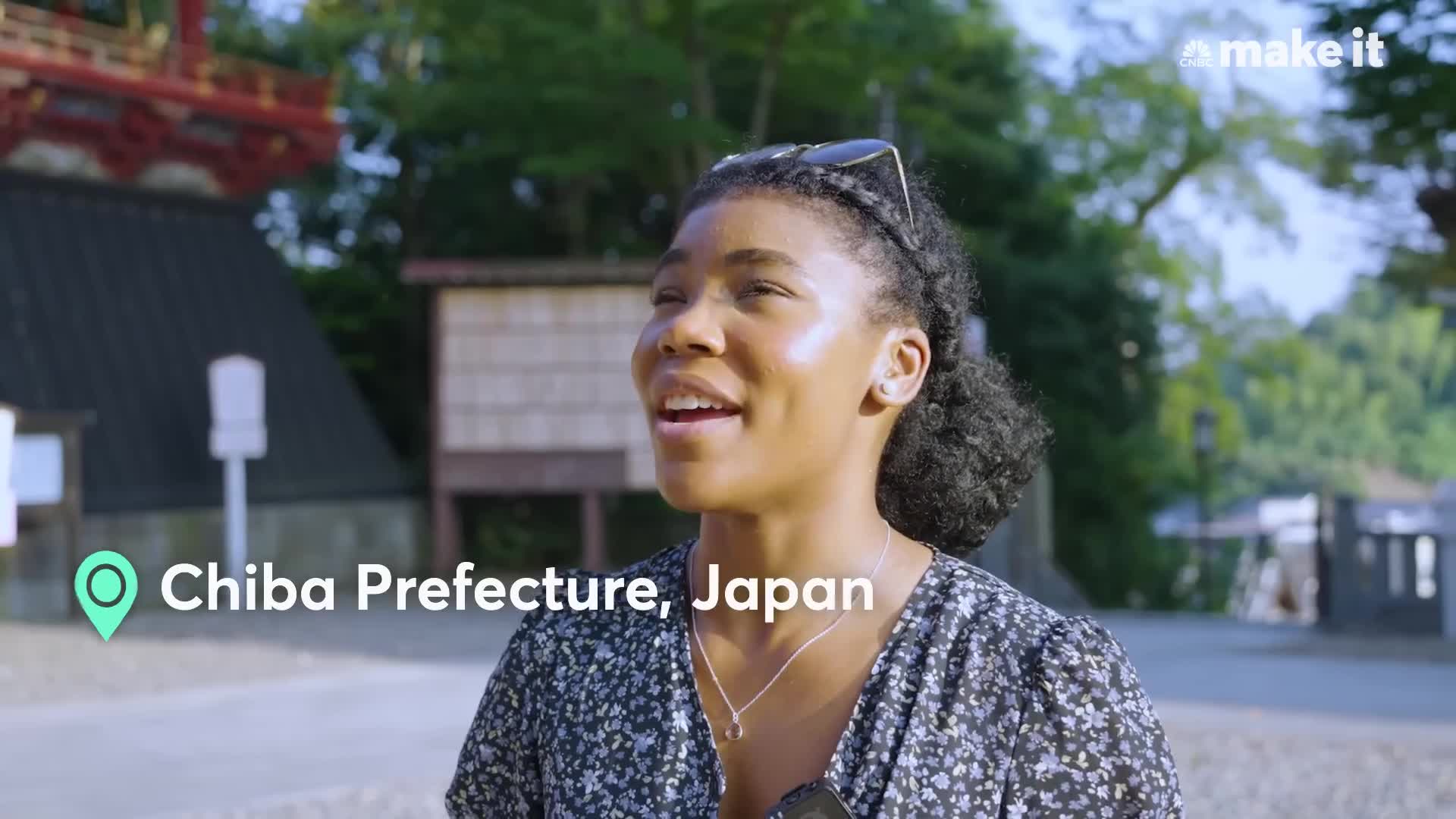
This is like part of Japan that I came here for, so I can experience all of this culture.
From the dragons to the people conversing, it's just so magnificent.
Every little aspect had thought going into it.
I really did move here by myself without knowing the language or anyone here.
Living in the countryside is a lot different than living in Tokyo.
There's a really respectful, kind culture out here.
It's peaceful.
There's a lot of rice fields and more traditional homes.
Really, I find it quite simple since I've created my life the way that I have.
Which means, only in Japan.
My name is Lexi Smith.
I'm 24 years old, and I'm an English conversation teacher.
My rent is about $238 per month, living in the Chiba prefecture of Japan.
At my job, I speak 100% English.
It's sort of like an immersion method of language learning.
I actually really enjoy being a foreigner in Japan.
When people in my countryside see me coming, they always welcome me.
They ask, oh, do you teach at that school?
You're so cool, thanks for being here.
I was already a teacher in the States and I wasn't quite loving the school system.
So when I found out that I could teach abroad for a much easier life and the ability to see more cultures, I had to jump on it.
I knew that I needed to get certified to teach abroad.
So I did that.
I got some experience teaching foreigners back in America.
I got my job through a guaranteed job program for Japan through a company called Explore Asia.
My interest in japan began with anime, like a lot of other people out there, and i'm a big foodie, so the opportunity to eat ramen and sushi and things like that was something that i had to go after.
Plus, the culture is so respectful here.
Teachers are well respected and just in general, people are just so kind to each other.
This is so good, the best.
Getting to Tokyo from my place can take up to three hours.
It's two trains.
But I still find it a really rewarding experience.
When I first came to Japan, my first few weeks were a lot smoother than I thought they'd be.
My employer was able to get me my apartment before I even landed, so I had a place to stay.
Then upon landing, they also helped me to get a car and do all of the work with City Hall.
My biggest adjustment as a foreigner is the fact that I don't speak Japanese.
My life here is mostly in English.
My coworkers are English speaking, and my friends all speak English as well.
However, when needed, I will use Google Translate or some other app to help me if I'm at the post office and I need a box or something like that.
Come on in.
My rent here for my space is 35,000 yen, or about $238 per month.
This is my bedroom in Japan.
This is actually a yukata that I got at a small business.
I wear it to festivals, but when I'm not, it's decor.
I also like to collect decorative fans, which is so Japanese, right?
And one of my favorite pieces of art is my ukiyo-e, or bamboo wall hanging.
And here's the living room area.
When I have my friends over, we take down all the beanbags and we have a sit and chat together.
I don't have a TV, but I have a projector that takes up this wall for when I want to watch movies and anime.
And I have a walk-in closet.
I have quite a lot of clothes, but it's only a portion of what I had in America.
And I also use my closet for storage.
I have a spare bed in here and three suitcases.
I like collecting bags from my travels.
This one's from Barcelona and this one is from Mount Fuji where I climbed last month.
Come see my kitchen.
Here's my microwave.
My pantry is these shelves here.
My fridge, full size.
A trash can and my three burner stove.
I don't have an oven, but I do have a grill.
This is my garbage collection schedule.
There's like eight different kinds of trash and you have to pick them up on the right day.
You have to put it in the right bag on the right day in the right place or they won't pick it up.
Japan's organization level is top tier.
Here is the main part of the bathroom where I get ready in the day, my washing machine, and shower.
Here's one of the crafts that I've worked on here.
I strung paper cranes and hung them on my wall because paper cranes mean good luck in Japan.
Out here is my balcony.
The balcony is good for hanging laundry since I don't have a dryer.
I also have stuff for outdoors because we love picnicking and stuff like that out here.
This is my gear for emergencies.
Whether it's an earthquake or a tsunami, I am well prepared.
My employer covers certain things for me, like key money.
I also didn't have to pay for first and last month's rent, and they also cover fire insurance, which is a need for Japan.
My car note is $100 a month for my K car, and my employer actually pays for my car insurance.
My water bill is $6 a month.
My electricity bill is around $30 a month.
My gas bill is around $20 depending on how much I cook that month.
My health insurance is only about $12 a month.
I only have to get gas about once a month, which comes out to about $18.
My grocery bill is $200 a month.
And my other taxes altogether come out to about 90 a month to include for pension, health insurance tax, employment tax and other things like that.
I would generally say that I'm pretty good with money.
I had a pretty healthy savings account before I came to Japan.
And I try not to spend any of my savings now that I'm here.
JJJ?
I'm here in Japan on a one-year work visa that is for workers in humanities and English teachers.
My students are ages 3 to 73 years old, so I get a full range of all kinds of learners.
Our focus is on communication, so I try to have conversations with the learners.
We do worksheets.
We even play games like Uno to help my students learn colors and numbers.
My commute to work is unbeatable.
It's literally walking distance from my apartment, so I don't even have to get in the car.
In my typical workday, I'll go into work around 3 p.m. and I'll leave around 8 p.m.
In that time, I'll have somewhere between five to seven classes.
Each class is 30 or 40 minutes long.
I teach one-on-one or two-on-one classes so it's almost appointment based in a way.
In the mornings, I really have them to myself.
I can do my grocery shopping, have lunch with friends.
It feels like I have almost two days in one because of that.
I love my work-life balance here in Japan.
I'm really only at work for maybe five hours, and usually about one hour of that is break time at that.
And I have full flexibility to do what I want in my classrooms.
So it doesn't feel like such a high pressure environment.
Whereas in America I would be there for 10 or 12 hours a day working very hard, sometimes skipping my breaks.
It was rough.
Plus, I would work extra jobs just to kind of get by in the States.
Whereas here, I get by on just my full-time job teaching English.
I decided to start documenting my experience living in Japan three months ago.
I feel that Tokyo gets a lot of viewership, but all of Japan isn't Tokyo.
A lot of us live here in the countryside and live regular lives, and I wanted to share that with the world.
And for other people who look like me.
They're in their early 20s, they're people of color in the States.
They also feel empowered, that they can do it too, and that it's going to be a fun and acceptable experience.
Making friends in Japan actually came really easy to me.
I had already met my coworkers via Zoom, so we had a decent relationship, already texting a lot before I even landed.
Then they introduced me to other English teachers at different schools.
So pretty immediately after I moved here, I was already going to movie nights and going to cherry blossom viewings.
And the more events that I went to, the more people that I met.
And now I have more friends than I even have time to hang out with.
Most people who move to Japan come for a much longer time than one year.
However, I'm going back home to Atlanta.
I do miss a couple of things from the States.
The number one is my family.
We're really close knit, so it's hard to be 7,000 miles away from them.
Living in Japan, I've really grown a lot as a teacher, learning more patience, learning new ways to help make English adaptable for others.
I'm not quite sure what my game plan is when I get back to the States, but I'm excited to take whatever path it has.