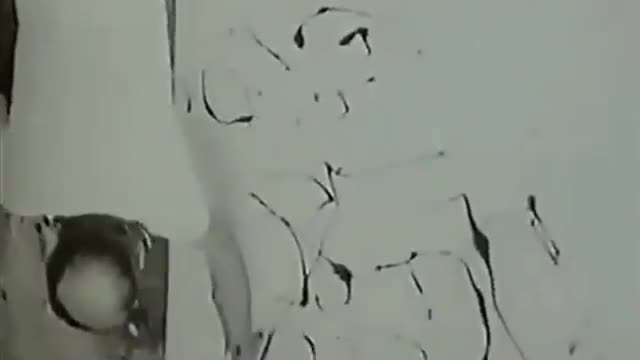
The story goes that in 1947, Pollock threw his brushes and palettes aside, grabbed some sticks and started flinging paint directly onto a canvas on the floor, instinctually inventing a new kind of energetic artistic expression and changing the course of contemporary art.
Except he didn't invent it.
Pollock's signature style wasn't his invention at all and the drip painting technique already existed.
One of the earliest proponents and a major influence on Pollock was the forgotten woman of art history, Janet Sobel, a self-taught Ukrainian-born artist who also happened to be a grandmother when she first took up painting.
In 1945, Sobel was already exhibiting her drip paintings in New York when the influential art critic Clement Greenberg, who would become one of Pollock's greatest supporters, described her work as the first all-over compositions with abstract rhythms that span the entire canvas.
In 1946 she was given a solo show at Peggy Guggenheim's gallery and we know Pollock visited the exhibition and even admitted her work had made an impression on him.
Shortly after that, he produced his first drip painting.
There were other lesser-known artists who used the drip technique even earlier.
But it's important to state that Pollock's achievements weren't just in the technique that he employed, but in the radical nature of the works he produced with those techniques.
Well, methodism seems to me a natural growth out of a need.
And from a need, the modern artist has found new ways of expressing the world about him.
In 1945 Pollock and Krasner had moved to East Hampton where he created that first drip painting in a converted barn behind their farmhouse.
Pollock finally had the studio he'd always wanted.
The space, the quiet and the distance from the bars of New York gave him the freedom to go further than ever before.
Now he had the room not only to work on a much larger scale, but also to place those large canvases on the floor.
Without that barn, there would likely be no number one 1949, no autumn rhythm, no drip period.
Thanks to Krasner, Pollock had his drinking sort of under control, at least for now.
Whilst not entirely sober, he was less erratic, and these years proved to be his most productive.
During this time, he would produce some of the greatest works, thanks to a unique combination of physical space, emotional calm provided by Krasner and creative freedom.
All of which he desperately needed after years of chaos, instability and urban distractions.
In the summer of 1950, at the height of his career, Pollock created one of the most iconic paintings of the 20th century.
One, number 31, 1950, is vast, over 8 feet high and 17 feet wide.
It dominates the room and sucks you in.
The work is sometimes described as the result of accidents, but Pollock bristled at that word.
In fact, he poured enormous energy, both mental and physical, into creating unique paintings that held meaning for him.
If we compare two paintings of his, for example, this one from 1948 and this one painted two years later, the contrasts are striking.
Both use similar materials and methods, but each has a distinct tone.
Technique is just a means of arriving at a statement.
I want to express my feelings rather than illustrate them.
By the time he came to paint one number 31, he had already abandoned the easel for the floor.
Having the canvas on the floor, I feel nearer, more a part of the painting.
This way I can walk around it, work from all four sides, and be in the painting.
He used oil, enamel and aluminium paint, dripping, flicking and pouring it directly from the can or off the end of a stick, squeezing it directly from tubes and even using a turkey baster.
Pollock also used his hands to lightly smear colour across the canvas.
There are no figures, not even veiled ones as in earlier works by Pollock, but the painting still feels composed.
A series of strong black lines dances across the surface, creating a sense of rhythm and order that holds the flurry of marks together.
The quality of Pollock's lines was shaped by a range of physical and material factors, which he could adjust in countless ways.
These included the thickness and flow of the paint, which he manipulated by adding thinner, the angle and speed at which he poured it, and the physical gestures of his body, particularly the motion of his wrist, arm and shoulder, which functioned like a seismograph capturing the emotional and physical energy of the artist's gestures.
Pollock also enhanced his compositions by flicking, splashing or dabbing secondary colours onto the primary network of lines.
He orchestrated every element.
His all-over style defied traditional composition.
There's no focal point.
Your eye doesn't know where to settle, but that is the point.
You move across the surface, treating every area as equally important.
The result is immersive.
Pollock embraced the physicality of his materials.
Paint sits thickly on the canvas.
Bits of sand, cigarette butts, enamel and wood shavings.
We can even find an unlucky housefly embedded in the surface.
Some areas he just left bare.
The whole thing crackles with energy and texture and life.
In 1950, Time magazine published an article describing Pollock's work as chaos.
He was infuriated and wired back, no chaos, damn it.
And he was right, it's not chaos, and it's not random.
Some people say it's easy to fake a Pollock painting, but it's not.
In person, his drip paintings have an emotional pull that's hard to reproduce.
Scientists think the reason might lie in fractals complex geometric patterns that repeat at different scales.
They're often seen in nature, in tree branches, coastlines and snowflakes.
Studies show that looking at fractals activates areas of the brain linked to aesthetic judgment and emotional regulation, making us calm.
In 1999, a peer-reviewed scientific paper revealed that Pollock's seemingly chaotic compositions actually contain the same fractal patterns.
His brushwork has a hidden order, one that mimics the natural world.
Forged Pollock's by contrast tend to lack this quality.
This might explain why his paintings can evoke the same sense of awe and introspection we often feel in nature.
Seen in this light, Pollock's statement from 1946, I am nature, makes perfect sense.
The artist was at the height of his fame, a denim-clad, camel-smoking poster boy for the abstract expressionists.
His growing reputation caught the attention of photographer Hans Namuth, who had taken photos of Pollock already but now wanted to make a film of him at work.
The artist was hesitant.
He worried about performance interfering with authenticity.
Painting for him was a private process, not a show.
In the end, he agreed to be filmed by Namath.
It is one of the most important films in art history and it was said by some to be the end of Pollock.
Under the protection of our freedoms, American labor, management and capital the greatest production team in the history of mankind.
By the late 1940s, the Cold War between the United States and the Soviet Union was hotting up.
The Soviet Union was already using art and culture to promote communism worldwide, with state-sponsored socialist realism.
In contrast to the rigid propaganda used by the Soviets, the CIA, through covert programs, wanted to show that America fostered freedom of thought and creativity, key democratic ideals.
And abstract expressionism, with its non-conformist, avant-garde style, became the ideal symbol of American cultural freedom.
These explosive emotive canvases spoke of a society where artists were free to explore, to rebel and to show individuality.
You may not like abstract expressionism, but it really didn't matter, because it was sending a clear signal that in America, everyone is free.
This was a sharp contrast to what was being produced in the Soviet Union.
The paintings were unpredictable, wild and deeply personal.
Everything that would not be allowed under communism in the Soviet Union.
And so, in a strange quirk of art history, it came to be that the CIA quietly supported the international promotion of abstract expressionism as a weapon in the ideological battle between the US and the Soviet Union.
Institutions like the Congress for Cultural Freedom, secretly funded by the CIA, helped showcase the works of Pollock, Mark Rothko and others around the world by funding institutions like the Museum of Modern Art's international program.
It was ironic, as the great majority of Americans in the 1950s disliked or even despised modern art and many of the artists were politically left-leaning, anti-establishment and in some cases outright hostile to US government's authority, and had no idea their work was being used as propaganda.
And it wasn't just fine art.
The CIA supported a whole range of activities.
They financially supported a literary magazine, modern dance performances and other forms of avant-garde artistic expressions to further demonstrate the diversity and freedom of American culture.
Let's finish this strange chapter of art history by making it clear that Abstract Expressionism was already established as the most exciting and influential art movement of its time.
The CIA didn't invent it, but they recognized its power as a propaganda tool and helped amplify its reach.
If anything, it complicates the story.
But for me, that contradiction is part of what makes it so compelling.
Abstract Expressionism became part of the story of how America didn't just grow into a military and economic superpower, it became a cultural one too.
Pollock's fame exploded in the late 1940s and early 1950s, especially after a 1949 Life magazine article asked is he the greatest living painter in the United States?
This publicity turned him into a household name almost overnight.
I had to say to him, Pollock, never listen to what's written about you.
There were many great painters around at the time of Pollock's rise, but in an era of great patriotism, the myth of a so-called self-taught cowboy painter from the Midwest was the perfect fit for the great American artist.
The image of Pollock as a rebellious macho, hard-drinking genius, aligned with post-war American ideals of individuality and innovation, turning him into an embodiment of the new American avant-garde.
Hans Namuth's 1950 film of Pollock painting was a pivotal moment in his career, but a deeply destructive one on a psychological and emotional level.
Although it helped to cement Pollock's status as a modern art icon, it also played a role in his creative and personal unravelling.
The film visually solidified the myth of Pollock, the tortured genius, but also turned his private intuitive process into a spectacle.
Pollock had always seen his studio and practice as sacred and solitary, and by turning his art into a public performance, he felt it had alienated him from the very act of painting.
He worried that he had become a parody of himself.
The fallout from the film contributed to his resumption of heavy drinking, and his personal life and artistic output deteriorated quickly.
His relationships suffered, and his work lost its earlier energy and confidence.
In the end, Pollock's fame immortalized his contribution to modern art, but also intensified the personal struggles that would ultimately lead to his tragic death in a car crash at the age of 44.
After Peggy Guggenheim left New York in 1947 for Venice, Pollock began exhibiting at the Betty Parsons Gallery, where he first unveiled his drip paintings.
His early shows were well received, both critically and commercially.
But after 1951, things began to unravel.
The sudden fame brought on by Life magazine and Hans Namath's documentary unsettled him and he lost the therapist who had been helping him manage his alcoholism.
That year's solo exhibition at Parsons was a financial failure.
For Lee Krasner, life at home became increasingly difficult.
As her own work started to get the attention it deserved, Pollock's resentment grew.
He became angry, destructive, and emotionally abusive to Krasner.
He was involved in several car accidents, often driving in drunken rages.
Then in 1956, Pollack had begun an affair with a much younger admirer, Ruth Kligman.
Krasner, the woman who had supported, loved and promoted him for 15 years had had enough and flew to Paris.
On the night of the 11th of August Pollack, drunk and agitated, said he would drive Kligman and her friend Edith Metzger to a party.
Pollock and Metzger were killed instantly.
Kligman was thrown from the car and survived.
Krasner was visiting friends in Paris when she received the call.
Clement Greenberg phoned the apartment, but she didn't need to hear the words.
The look on her host's face as he heard the news told her everything.
Before anyone could speak, she said, Jackson's dead.
Unless you lived through those days, you can't imagine how alone these people felt.
It doesn't make much difference how the paint is put on, as long as something's being said.
After his death, the myth of Jackson Pollock solidified.
The media image of the rugged all-American cowboy painter took hold, a man of instinct and action, seemingly inseparable from his wild gestural canvases.
But the reality was so much more complex.
He was a fragile, volatile man, plagued by self-doubt, driven by an intense need to express, but terrified of being seen too closely.
His vulnerability, his fear of failure, his brittle masculinity, all these have been overshadowed by the legend of the tormented genius flinging paint in a heroic frenzy.
Ironically, that story, which is often narrated through the lens of masculinity, is a story built on the labor and support of women.
His mother encouraged his creativity from a young age.
Peggy Guggenheim provided critical financial and professional support.
Janet Sobel, often overlooked, pioneered techniques Pollock would later make famous.
And Lee Krasner, a great artist in her own right, tirelessly supported his work, managed his career and ultimately preserved his legacy.
Without them, there may have been no Pollock as we know him.