Okay, I have my water bottle, my notepad, and my lucky corn on the cob.
I think I'm ready to tape today's episode.
But where's Joy?
She should be picking me up any minute now.
Lilica, your ride has arrived.
Joy, what are you doing driving a neon green school bus?
And are those flaming lightning bolts painted on the side?
This little baby's all mine.
I sold off part of my pet rock collection to buy it.
Come on in.
Whoa.
This isn't just any regular school bus.
It looks like a podcast studio.
Welcome to the Roaming Recording Rover Trademark Pending.
Now, forever ago can be wherever ago.
This has been my big side project the past couple months.
Converting school buses is all the rage now.
I watch so many YouTube tutorials.
Want a tour?
Do squirrels like nuts?
You bet I want a tour.
Okay, so we've got the waiting area here for guests.
Nice armchairs, fridge full of bubbly water and snacks, a fruit bowl, the latest copy of Thumb Wrestlers Monthly the essentials, you know.
Spiffy.
Then, if you step through this door...
We've got the recording studio.
Adjustable mics, headphones, and comfy vibrating chairs that give you a back massage.
Great for lower back pain.
Terrible for audio.
True.
And I've even soundproofed this entire studio, see?
I put big wool blankets all over the windows.
Great for audio.
And terrible for visibility.
But I've got great side mirrors, so it's A-OK.
The bathroom is back there, my dressing room, a secret snack drawer, and that concludes the tour of the Roaming Recording Rover.
Trademark pending.
It's awesome.
What do you say we get the show on the road?
Let's roll.
Cue the theme song.
You're listening to Forever Ago, the show where we explore the before.
I'm your host, Joy Dolo, and today I'm joined by my co-host, Lilica.
Woot, woot!
Co-host in the building?
Well, actually on the bus.
Beep, beep.
Toot, toot.
That's right.
We're recording live from our roaming recording rover, trademark pending.
And much like toasters, lightning bolts and Bradley Cooper and Lady Gaga's on-screen chemistry, it's electric.
Zing!
You mean electric green?
This rover is the same color as a tree frog who only drinks Mountain Dew.
Hmm, good point.
The Roaming Recording Rover trademark pending does have an electric look and feel, but it's also literally electric.
It's powered by electricity.
Well, that's perfect, because today we're talking about electric cars.
Yeah, most of the cars you see on the road today use gasoline for energy.
That's why you have to go to the gas station.
But some cars use electricity instead.
Just like your cell phone or laptop or Nintendo Switch, they run on a battery.
Except these electric car batteries are a lot bigger.
On average, they weigh at least 1,000 pounds.
That's the same weight as 1,500 cans of soup.
Or a polar bear, which makes sense because an electric car is big and uses lots of energy, so it needs a big battery.
Instead of filling up the car with gas, you just charge the battery.
Right.
To charge it.
You can plug the electric car into a public charging station in a parking lot or rest stop.
Kind of like a giant electrical outlet, but for your car.
Some people even have chargers at their houses so they can charge their electric cars at home.
Have you ever been in an electric car before?
Yes, actually.
Do you remember being in an electric car if it felt different from being in a regular car?
I remember it was creepily quiet, but in a good way.
Oh, yeah, because I heard that those electric cars are super silent.
Yeah.
So quiet.
What do you think of when you hear electric cars?
Like what conjures come to your brain?
I listened to a lot when I was little.
That was like in this thing of a bunch of songs about various science-related things.
And it's just like electric car.
And it's very catchy.
And so that song gets stuck in my head whenever anyone says electric car.
I feel like I have to Google this later.
It's like electric car, the new machine.
And it just goes on like that with different verses.
And it's really catchy.
It's like, let's take a ride in an electric car.
And it has facts about how electric cars work.
And it's really funny.
Oh, wow.
That's so cool.
Like, have you ever heard that song?
It's electric.
It's electric.
Does that sound familiar?
No, I don't think so.
But that's very catchy.
Yeah, thank you.
To hear that, radio stations.
If you had a dream car, what would it look like?
Probably dark blue and kind of shimmery.
Oh, you know like those mood ring paint things and the changes to temperature?
Yeah, yeah, I do.
Like one of those paints that changes temperature but all in shades of blue.
Oh, that's such a great idea.
That's what I would want my car to look like.
That's like my dream.
So what would your dream blue car run on?
Like what would it need to get going?
Magic.
Magic.
Like a blue, like a Patronus from Harry Potter.
Those are blue.
I don't know.
Probably it would actually, I don't know.
I like the idea of having it be an electric car.
Yeah.
I don't know if I could have it run off of everything.
Biofuels intrigue me.
So probably.
Oh, yeah.
So either magic or biofuels.
Yeah, either magic or biofuels.
You know, they're basically the same thing when you think about it.
They pretty much are, you know.
But that's a whole other episode.
When I think of electric cars, I think of the future.
Zip, zap, zipping around in speedy, sleek, super modern cars.
This actually sounds a lot like your car, Lilica.
They seem like new technology, but they've actually been around since the late 1800s, when cars were first invented.
Oh, yeah.
Before cars, most people got around using carriages, which were pulled by horses.
But as cities started to grow, those horse-drawn carriages started to cause big, stinky problems.
What kind of problems?
Problems of the P-O-O-P variety.
You mean poop?
Poop's a totally normal thing, Joy.
What's the big deal?
Oh, this poop was a big deal.
A very big deal.
But why just tell you when I can show you?
I've been wanting to try out this feature.
I just need to push the button, then pull this lever twice, rotate this crank counterclockwise 37 degrees and release and presto.
Time travel mode activating in 21 seconds.
Please keep all hands, feet, and butts inside the bus for the duration of our journey.
Complimentary barf bags are located under your seat.
They have a lovely floral design, Enjoy your trip back in time.
Oh, that rhymed.
Ha ha ha.
You have arrived in New York City.
The current year is 1890.
Remember the- Wait, wait, wait.
Did the roaming recording rover, trademark pending, just say 1890?
Whoops.
Did I forget to tell you this thing can also time travel?
Ahem.
As I was saying, remember, there are no cell phones or TVs.
Radios have not even been invented yet.
And you will need to do something about your clothes.
Wait, what's wrong with our clothes?
In the 1890s, people wore fancy suits with top hats or long flowing dresses with puffy sleeves.
Don't worry, there's a walk-in closet with historical outfits from every era right next to you.
No expense was spared.
I love this top hat.
Ooh, and the suit.
Spiffy.
Time to go check out New York City in 1890.
What is that smell?
I might need one of those perf bags after all.
Ah, yes.
That is the smell of fresh horse poop.
A lot of horse poop.
To be exact, let's see.
Carry the two.
Three million pounds of horse poop.
Per day.
And about 40,000 gallons of urine.
Which is... About two swimming pools worth.
Splashing into the streets every single day.
Let's hear it for New York.
These streets are covered in horse poo.
Electric streetlights are brand new.
Trademark pending.
Aha.
So this is the problem we were talking about.
As more and more people started to get around with horse-drawn carriages, the uh waste problem started to get out of control.
Exactly.
Parody poop pop songs aside, this was a serious problem.
In big cities in Europe and the United States, the manure piled up at dumps and around stables, which attracted hordes of flies.
And these flies spread disease, which meant lots of people got sick and some even died.
This was a big reason why people rushed to invent the horseless carriage.
Today, we call them cars.
And people had a lot of different ideas about how to power these new vehicles.
Yeah, people had been experimenting with horseless carriages for years, long before horse poop started piling up in New York City.
About a hundred years earlier, in the late 1700s, a French inventor came up with the world's first automobile.
It was basically a giant tricycle powered by steam.
But steam engine cars didn't really catch on.
Mostly because the water took forever to heat up and turn into steam.
These cars could take up to 30 minutes just to start.
People kept working on steam technology through the 1800s, but weren't able to improve it all that much.
That left two main contenders, electric cars and gas-powered cars.
Lilica, idea alert!
Should we take the roaming recording rover trademark pending to check out an early car dealership?
Is Mississippi fun to spell out loud?
M-I-S-S-I-S-S-I-P-P-I.
Yes, it is.
Woo, let's hit it.
Just going to twist this dial.
Six pulls on the old brake.
Shift left, shift right, and presto!
Time travel mode activating in 17 seconds.
Do not forget to keep all hands, feet, and butts inside the bus for the duration of our journey.
If you haven't already used them, your barf bags are still located under your seat.
Did you know they are scented with fresh organic lavender?
You have arrived.
Still in New York City, but the year is now 1897.
Still no TVs, but the radio was invented.
The first subway system in the US just opened in Boston.
And Jell-O, everyone's favorite jiggly fruit dessert, was also invented this year.
I have even prepared some for you.
Wow, this roaming recording rover, trademark pending, really has it all.
I know.
Ah, 1897.
What a year.
Yeah, 1897 was also the year that an electric vehicle called the Columbia Motor Carriage became the best-selling car in the US.
That's right.
Come on Lilica, let's grab our microphones, put on our reporter hats and head down to the car dealership.
That's your reporter hat?
Isn't it a little much?
What do you mean?
Put it on your head.
No offense.
Oh, none taken.
That's exactly what it looks like.
Hats like these were all the rage in 1897.
The more bows, frills, flowers, and feathers, the better.
If we're going to be doing on-the-spot interviews, we need to look the part.
Here, I brought one for you too.
Oh, wow.
Is that a stuffed bird on top?
Looks great.
Let's hit it.
Don't worry, Lilica.
I speak late 1800s English.
Hello there, good sir.
We are in the market for an automobile.
Well, you've certainly come to the right place.
Welcome to Archie's Autos.
I'm Archie.
What are you two in the market for today?
Can you show us an electric model first?
You betcha.
Follow me.
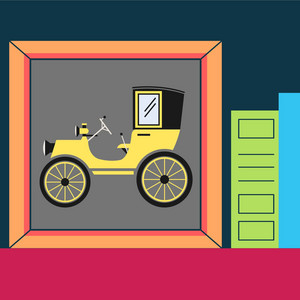
This beauty has a wide bench seat and a retractable canopy so you can feel the wind in your hair on warm days.
Wow, it looks just like a carriage, except without the attachments for a horse.
But it's a much smoother ride.
It won't jolt or vibrate and it's so quiet.
Your passenger can take a nap while you parade them around town.
I'm telling you, this is a fantastic vehicle for the urban American.
Wow, I bet I could really tear it up in this thing.
You sure could.
This little beaut can go 15 miles per hour.
That's lightning fast.
Wait, did you say 15 miles per hour?
Oh, yes.
But that's not a problem here in the city.
The streets are so jam-packed with horses, carriages and people that it's safer to drive slow anyway.
Plus, this new electric car is so easy to start with the push of a button.
Much simpler and safer than the hand-cranked gas-powered automobiles require.
Oh, right.
Back in the 1890s, you needed to turn a big crank to start the engine on gas-powered cars.
They were really hard to use.
And sometimes, they spun backwards so suddenly they could break your arm or bop you on the head.
Hmm, okay.
The electric starter does sound like a big improvement.
How far can this electric car go on a single charge?
I have a very busy lifestyle.
Trips to the beach, my bi-weekly pie-eating contest, not to mention bringing Kevin Bacon, my soon-to-be-famous guinea pig, all over town for his auditions.
Trips to the groomers, playdates the list goes on and on.
Well uh, Early electric cars could only make it about 30 miles before they needed to be charged again.
You know Archie, I think I'm going to stick with my roaming recording rover trademark pending for now.
But thank you.
What in heavens is that monstrosity?
It's like the color of a tree fog that only drinks Mountain Dew.
Whatever that is.
It's podcast magic.
Don't worry about it.
Bye!
Oh, uh, Ruh-Roh, it looks like we need to charge up soon.
I forgot how much energy you use when you time travel.
It's true.
But lucky for us, it looks like there's a power station just up there.
While we wait for the Roaming Recording Rover trademark pending to charge, let's play a round of...
That's the game where we try to guess the order things came in history.
Today's items are three-point seatbelts the ones that go over your lap and your chest three-way traffic signals meaning stop, go and slow down and windshield wipers.
Okay Lilica, which do you think came first, which came second and which came most recently in history?
Hmm, this is a good one.
This is a really good one.
I have no idea.
I know windshield wipers.
I can't remember when they were.
See, what's really annoying is I can remember a little bit about the history of their invention, but I can't remember who invented them or exactly when.
I guess seatbelts would be before...
Windshield wipers.
I feel like windshield wipers are most recent.
And then stoplight.
I feel like whichever one is least safe came first.
Least safe?
Yeah, because I feel like we ever like in history.
I feel like, if you, we have some wacky ideas before we find the right ones when it comes to safety.
That is so true.
Like I feel like we have to go through some stuff and then we figure it out and then we invent something you know.
Yeah.
So I feel like stoplights, seatbelts with like the three point and then windshield wipers.
All right.
Okay.
So just to rehash, the oldest is three-way traffic signals.
And then we get to three-point seatbelts and then wipers.
We'll hear the answer at the end of the episode, right after the credits.
So keep listening.
Welcome back to Forever Ago.
I'm Joy.
And I'm Lilica.
And we're coming to you live from the roaming recording rover, Trademark Pending.
We're all charged up and ready to rock.
We can go wherever we want.
Or whenever.
Major shout out to the time travel button.
Wow, I love a sound effects machine.
Okay, okay, Joy.
I think we get it.
One more.
Okay, done.
For now.
Okay, really done.
We mentioned earlier that some of the earliest inspiration for electric cars was poop.
Right.
People needed lots of horses to pull their carriages, and those horses made a lot of poop.
So inventors started coming up with new ways to get around, including the electric car.
There were a few different models for early cars, and one of them was electric.
People, especially in cities, liked them because they were quiet, clean, and easy to drive.
But today, most cars on the road are gas-powered, and we think of electric cars as new.
What happened?
Well, for one thing, you couldn't really have an electric car if you lived in a more rural area.
Remember, in the early 1900s using electricity for energy was still a pretty new thing, and electric power plants that made enough energy to power these cars only existed in cities.
Plus, they couldn't go very far without needing to be charged.
Oh, right.
And these early electric cars weren't very fast.
Like Archie said, they could really only go about 15 miles an hour.
But gas-powered cars could go up to 45 miles an hour.
That's a pretty big difference.
Yeah, for a while, early electric cars were marketed as women's cars.
You mean because the people selling these cars assumed women would just want to drive really slow and stay close to home?
Exactly.
It's one of the many ways that people discriminated against women back then.
We call that sexism.
That's when someone treats a person unfairly or assumes things about them because of their gender.
But it turned out that most drivers, no matter their gender, wanted to be able to go fast and far.
Yeah, and buying a can of gas from a store or filling your tank at a gas station only took a few minutes.
Charging an electric car battery back then took hours.
So over time, gas-powered cars started to win out.
What looked like the nail in the coffin came in 1912, when the companies building gas cars got rid of those dangerous hand cranks and replaced them with electric starters.
By the 1950s, the gas-powered car had completely changed the United States.
This seems like the time to break out the time travel button.
Let's check it out.
You know the drill.
Twist that dial.
Pull the brake.
Shift right, left, and slightly southwest.
And presto!
Time travel mode activating in 12.5 seconds.
Do not forget to keep all hands, feet, and butts inside the bus for the duration of our journey.
May I remind you that the barf bags are still located under your seat.
Go ahead.
Don't be shy.
They are fresh, just for you.
I'm feeling fine.
This robot is really pushing the barf bags.
Everyone has their thing, I guess.
Thank you, Roaming Recording Rover Trademark Pending, but we're both feeling just dandy.
That is great.
I am not upset or disappointed at all.
Ha.
Ha.
Ha.
You have arrived.
The current year is 1956.
The television has since been invented and more and more people have them in their homes.
U.S.
President Eisenhower has just signed a bill to build highways across the country.
And the first McDonald's opened just last year.
Huh, looks like we got transported to a parking lot.
Easiest parking ever.
Whoa, Joy, look out the window.
Check out all the gas-powered cars.
They're so long and stylish.
There's so many different colors.
Pale blue, lemon yellow, even bubblegum pink.
Mmm, like candy.
Come on, let's go explore.
But put on these cat eye sunglasses first.
It's part of the look.
I dig it.
Whoa, you speak 1950s?
What can I say?
I'm pretty nifty.
Oh, let's go talk to that woman in that cherry red convertible.
Don't worry.
Just follow my lead.
Hey there, cool cat.
That's a nice set of wheels.
You're pretty hip yourself.
Nice shades.
My name's Betty.
Nice to meet you.
Thanks.
Is this your car?
You bet.
It's my pride and joy.
My convertible.
I take it everywhere.
To work, the diner, or to catch a flick at the drive-in movies.
Ooh, I love drive-ins.
You know, gas-powered cars not only change the way we get from place to place, but they created whole new businesses like drive-in movies, fast food chains and gas stations.
And with so many more gas-powered cars on the road, we started to build a lot more highways, too.
Soon, there were thousands of miles of interstate highways crisscrossing the US, And cars became a big part of US culture around this time too.
People wrote songs and even entire books about being out on the open road.
Yeah, cars are the bee's knees.
My car gives me independence and a community.
Not to be a party pooper, but I promised to meet my girls at the hamburger joint, so I got a jet.
Nice meeting you, though.
Bye, Betty.
What do you say we head back to the future?
Or the present?
Let's go!
Cars really did transform America.
But using gasoline for energy also comes with a lot of disadvantages.
Right.
Gasoline is made of oil pumped from deep underground, and it's a type of fossil fuel.
We burn this fuel to create energy, which powers our cars.
When gasoline is burned, it releases a gas called carbon dioxide into the air.
Carbon dioxide traps heat, kind of like a big blanket over the Earth.
And over time, it's made our planet warmer and caused the Earth's climate to change.
Gas-powered cars also release air pollution, which can make humans and animals sick.
But because electric cars run on batteries, they don't directly release carbon dioxide and other harmful chemicals into the air.
And that's a big reason why lots of people are trying to build better electric cars today.
Early electric car batteries were heavy and bulky and couldn't hold a charge for very long.
Nowadays, electric cars use lithium-ion batteries, the same kind of technology that powers computers and cell phones.
They're smaller and they store a lot more energy than old batteries.
That's what's powering the roaming recording rover, trademark pending and most electric cars on the market today.
And electric cars are only becoming more and more popular today.
Some studies predict that by 2050, most new cars will be electric.
And as electric cars become more popular, they're becoming cheaper to build, which means more people can afford to buy them.
But electric cars aren't perfect.
Even though the cars themselves don't release any carbon dioxide, they still need energy to run.
And sometimes that electricity comes from burning fossil fuels, like coal.
Right.
But research shows electric cars are still much better for the environment overall than gas-powered cars.
Electric cars are also just one part of the solution.
There are lots of different ways to get around, from buses and trains to mopeds to bicycles.
You can scooter, roller skate, walk, or even better, skip.
Speaking of Lilica, what do you say?
We park the roaming recording rover trademark pending and skip to the creek.
I really want to find some new pet rocks.
I miss my old collection.
Okay, but we have to sing the rock song.
Say less and sing more.
We will, we will rock you.
Sing it!
We will, we will rock you.
Whoa, there are so many good rocks.
It feels nice to be outside.
Yeah, it's good to take a break from all that time traveling.
We had a big day, and we learned so much.
Like how people used to get around in horse-drawn carriages, but there was horse poop everywhere.
Objectively, too much poop.
And that's a big reason why cars were invented, to solve the poop problem.
In the late 1800s, all sorts of cars were invented, from gas-powered to steam-powered and, of course, electric.
And at one point in history, electric cars were the most popular kind of vehicle.
But eventually, gas-powered cars took over because they could go faster and farther.
Over time, gas-powered cars really shaped America.
Highways were built, and businesses like gas stations and fast food took off.
But electric cars are becoming popular again.
As technology advances, we're turning more and more to electric cars, especially because they're better for our planet.
They're not perfect, but they're part of the solution.
Ooh, look at that pebble.
It's perfect.
I'm naming it Ann Peebles the Pebble.
New pet rock!
This episode was written by Ruby Guthrie and Nico Gonzalez-Whistler, with production help from Molly Bloom, Anna Goldfield, Rosie DuPont and Anna Wagle.
Our editors are Shayla Farzan and Sandon Totten.
Sound design by Rachel Breeze.
Theme music by Mark Sanchez.
Beth Perlman is our executive producer.
We had engineering help from Derek Ramirez, Anna Haverman, and Home Planet Productions.
The executives in charge of APM Studios are Chandra Kavadi, Joanne Griffith, and Alex Schaffert.
Have a topic that you really want to know the history of?
Send it to us at foreverago.org slash contact.
Yeah, we love hearing your ideas.
Okay, Lilica.
Ready to lurk at the answers for First Things First?
Yes, let's lurk at them.
Yes.
Thank you for giving in to me.
Oh, just a recap.
Let's do a recap.
You said that the oldest was three-way traffic signals, and then it was three-point seatbelts and then it was windshield wipers.
Yeah.
And the answer is...
Okay, so listen to this.
The first one was windshield wipers.
No!
I know, it's crazy.
1903.
In 1902, a woman named Mary Anderson was visiting New York City.
She went for a ride in a streetcar during a snowstorm and noticed that the driver kept having to get out to wipe the windshield.
So when she went back home to Alabama, she immediately got to work designing a blade that could be operated from inside the vehicle in bad weather.
Whoa!
She patented her invention in 1903, but never was able to sell it.
Windshield wipers didn't become standard on vehicles until 1920, after her patent ran out.
She did live long enough to see her invention become adopted, though.
And even though she didn't make any money from it, she was inducted into the Adventurers Hall of Fame in 2011.
2011!
That took so long to get her in there.
I was alive!
Isn't that great?
You're alive during history.
I was alive.
No, that's nuts.
Okay, so first up was windshield wipers, and then next up was three-way traffic signal.
No!
I just wanted to get one of them right.
Just one.
So, yeah, second up was three-way traffic signal, and that was invented in 1923.
So in 1922, an inventor named Garrett Morgan witnessed an accident between a horse-drawn carriage and a car at an intersection, and he wanted to think of a way to prevent accidents like this, which happened all the time back then.
One reason why was at the time, traffic signals only had two positions, stop and go.
Oh my gosh, that's like playing red light and green light without the yellow light in the middle, so not the slow one.
You're just like running and stopping.
Very dangerous.
Extremely dangerous.
Morgan knew that if drivers had a warning they could stop before traffic started coming the other way.
The options for his signal were stop, go, and stop all directions.
The ancestor of the yellow light we use today.
Look at that.
Both of morgan's parents had been enslaved and, like many black people of his generation, he didn't get to finish school.
He got interested in machines and how they worked after he took a job as a sewing machine repairman.
Come on, black people making three-way traffic signals.
We did it on them.
We had the windshield wipers, invented by a woman.
We got the three-way traffic signal, invented by a black guy.
And now finally, last but not least, we have three-point seat belts, and that was invented in 1959.
I wasn't alive yet, So the three-point seatbelts, like the ones we use today, were invented by a Swedish engineer in 1959.
Before, if cars had seatbelts at all, they used a lap belt like the one we were talking about on airplanes.
But these weren't very effective at preventing the types of injuries that happen in car accidents.
The inventor was hired by the car company Volvo in 1958. to be their first ever safety engineer.
Within a year, he had designed the three-point seatbelt.
In the interest of safety, Volvo made the design available to all other car manufacturers for free.
And by 1968, all new U.S. cars were required to have them.
Look at that.
What a nice person making sure everybody can have them.
That's really cool.
What do you think of those answers?
They were surprising, and I am disappointed that I failed them all.
Fail is a hard work.
You've got to give yourself some credit.
First attempt in learning.
We'll be back next week with an episode all about the history of the birthday song.
Thanks for listening.