Hey, it's Christopher Kimball from Milk Street Radio.
Sounds like I'm bragging and I am.
We're the number one most downloaded food podcast in America.
You know, Milk Street Radio travels the world in search of the very best food stories.
You'll hear about smuggling eels on the black market, the secret intelligence of plants and insider tips to eating in Paris.
And every week, listeners call in with their toughest culinary mysteries.
Discover a world of food stories by searching your podcast app for Milk Street Radio.
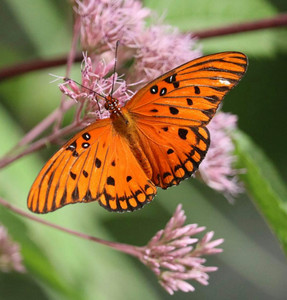
A while back, our producer Christine and I went to Butterfly Hollow.
Butterfly Hollow sounds like a place in Narnia, Lord of the Rings, or some wizard situation.
But it's actually just down the street from my house at the Franklin Park Zoo.
It's literally where the butterflies live.
They're kept outside in a screened-in area from Memorial Day to October-ish.
Christine and I were there to meet Ed O'Brien, a curator at the zoo and an expert in all things butterfly.
He's worked at the zoo for more than 30 years.
On the day we arrive, Ed looks so happy to be there, not sick of the zoo at all.
He meets us on a path outside, like we're going to be led into a secret world.
And then he walks us into Butterfly Hollow.
And it's like magic.
Oh, hello, darling.
Like Disney princesses, with monarchs hovering all around us.
They're so beautiful.
Yeah, they're so beautiful.
There are Pokedani ones, those huge ones, the tiny ones that I fear stepping on, and the recognizable ones.
This time of year, you can see all the monarchs up there on the screen.
It's a nice, cool place to come through and see and be comfortable.
Butterfly Hollow is a perfect spot for having a moment, for reflecting.
It's covered by mesh to let air in and keep bad things out.
There is beauty everywhere.
And so what better place to reflect on this season than here, with Ed a caretaker of the fragile and gorgeous?
Because we've been speaking about change all season.
Can we change for the better?
How do we change at all?
How do we change because the people we love have changed?
And all of this makes me think of a popular metaphor, the caterpillar that turns into a butterfly.
Like growing and evolving is what makes us beautiful. if we're open to it.
But frankly, all the time, I use that metaphor without truly understanding it.
I don't actually remember how caterpillars turn into butterflies, because I learned about that in probably third grade.
So to fully put some closure on this season, I want to talk about what happens literally.
Then we can figure out what happens figuratively.
Just remember, as I did this interview, there were butterflies flying all around me.
My first question to Ed is pretty basic.
Tell me the process of a butterfly becoming a butterfly.
So they will breed.
The female will lay eggs on the underside of a leaf.
The egg hatches after 12 days or so.
It chews and eats its egg case first meal and then they go and start eating the leaf that they're on.
They start out as caterpillars.
They eat leaves, solid food.
And they will grow and they change.
They pupate. into a pupa, or a chrysalis, and they stay there.
And inside, their whole body changes.
It's like a magic trick.
When they enter into the chrysalis stage, their whole body breaks down.
They dissolve, and they reform with a completely different digestive system.
So they come out.
They'll change into the butterfly.
And when they're ready, they start breathing in air.
They expand their abdomen.
Pupil case splits, they crawl out, their wings are soft and not expanded and they actually have to pump their blood through the wings.
If you look at a butterfly's wings, it has veins in it like a leaf.
Those are actual veins.
The blood pumps through, fills up the wing and eventually, when they're full up, they harden and they're ready to fly.
So all this happens in three to four weeks.
This thing goes from being a tiny green worm thing all the way into a butterfly, a totally different being, in like a month.
Is there any other creature that goes through this kind of evolution and change like this?
Any insect really goes through a metamorphosis.
This is a complete Metamorphosis, so it's one body form and changes into another.
Another type would be a ladybug, something that people are familiar with.
They may not know the larva of them.
They look like little bugs that are crawling around and they're voracious and they will pupate and they'll change into a completely different beetle form.
So if insects like the butterfly and the ladybug can change drastically, naturally to metamorphosize completely, change their entire insides.
Well, is it so impossible to think that we might be able to do that too?
But so often we use butterflies as the metaphor, right?
Of becoming something better, of changing into something better.
Why do you think that is?
I think because butterflies are non-threatening.
They're beautiful because they flutter around.
They're graceful.
They look very delicate, but they're tough.
People see them a lot.
You've been working at the zoo a long time.
Do you ever become inspired by the adaptability of the animals and insects in the zoo, like are there human lessons in it?
I mean, animals just do stuff and they do what they're supposed to do without.
It seems like a ton of resistance, or maybe I'm generalizing, I don't know.
Yeah, they animals are.
It depends on what species something like a butterfly or an insect.
They're mostly instinct and they react and they do what they do.
That's why they can be harmed by changes in their environment.
And some animals are like that.
They're so restricted.
So that could be a lesson there for people.
Now maybe it's not fair to ask Ed to wax poetic about such a big philosophical love letters question.
Butterflies don't lead the complex lives that we do.
But still, he had some gems.
If you're unwilling to change and your environment changes, you could be at risk.
So there we have it, going from literal to figurative here.
If we open ourselves up to being different and notice how we need to be different, maybe we can change and be safer, maybe more resilient.
And those butterflies, they make it look so easy, those jerks.
Maybe.
I have to ask about how easy it actually is for them.
Taking the metaphor one step further, like when you think about butterflies, like they're just like programmed to change, which makes it look easy.
But is it easy?
Is that a fair question?
Well, they don't have an easy life, for sure.
The act of changing seems like it's extremely traumatic.
Their whole being changes, really, it seems.
So it's difficult, but that is their plan and they've been able to adapt and come out on the other side better or as being able to reproduce.
It's really all about procreating and Passing on the next generation.
This is when Christine asks a very Love Letters related thing.
So my quick question is, how often do caterpillars from in their chrysalis fail at changing?
Do they ever?
They do.
Yeah, there are times when they don't, they die in the chrysalis.
It's not very good.
And what's left is just a bunch of goo.
Christine and I decide this is a very good metaphor incentive for change.
If you're open to change, you can become more beautiful and fly.
If you're not open to change, you become emotional goo.
You might remember that season nine last year was all about finding help in unexpected places.
And we had an episode where we talked to a researcher about about what she learned from animals and mate choice and how her studies helped her take animal lessons and apply it to her own dating life.
We called that episode, I'm Like a Bird, because she wanted to date like a bird.
Thinking about that episode, it made me wonder, if Ed could be an animal, what would Ed be?
My standard answer is the otter, just because if you see an otter in the water and they're just having a great time swimming around,
But As far as here, we don't have any otters here at Franklin Park.
I would say our kangaroos, they have a pretty nice life.
If you go out, go through the Outback exhibit, they are lounging around.
If you've ever seen your dog lay on their back with their legs all splayed, it's a lot like that.
They sit there in the sun, roll over on one arm and eat, chew on grass and they have a pretty nice life here.
At the Stone Zoo they have what's the animal?
And they're nocturnal and they pace back and forth.
Are they big or little?
They're big, it's like a big cat kind of thing and they're like.
I took a tour once and they're like this animal is nocturnal and just and he's just like moving at night.
He's just like going, like this pacing yes, or jaguar it might be, and i was like, oh what, we have a jaguar.
I was like that's, it looked like an anxiety animal.
He was like all night long.
He's like me listening to a podcast at night, like i'm pretty sure that's our jaguar.
But i'll get back.
Think about that animal that paces back and forth all night long, looking worried all the time.
So when we get back, no more metaphors.
We'll just get into lessons and some information about what's coming next season.
The holidays sneak up fast, but it's not too early to get your shopping done and actually have fun with it.
Uncommon Goods makes holiday shopping stress-free and joyful, with thousands of one-of-a-kind gifts you can't find anywhere else.
They're exactly what the name sounds like.
Unique products that feel personal.
Uncommon Goods has actually been a go-to for me, especially for friends who need something crafty and special.
I bought one friend a succulent clay craft kit to work on while he was recovering from a surgery, and I bought another friend a DIY Dream Library bookend kit to build when she had to be housebound for a bit.
Uncommon Goods really has something for everyone.
Parents, kids, teens, foodies, sports fans, gardeners, bookworms, you name it.
Shopping there feels like less of a chore and more of a treasure hunt.
And I love that when you shop at Uncommon Goods, you're supporting small businesses and independent artists.
So shop early, have fun, and cross some names off your list today.
To get 15% off your next gift, go to uncommongoods.com slash loveletters.
That's uncommongoods.com slash loveletters for 15% off.
Don't miss out on this limited time offer.
Uncommon Goods.
We're all out of the ordinary.
There's a battle playing out right now over who should control American universities.
We're going to bankrupt these universities.
In season one, we were guessing what was to come.
Now we know.
We want nothing less than $500 million from Harvard.
From the Boston Globe and on the media, it's season two of The Harvard Plan.
This time, it really is personal.
Listen wherever you get your podcasts.
We're back.
So thank you for indulging me and going to the zoo with me.
And now for the real lessons of the season, because I want to do a little recap.
I went into this season asking whether people can change for the better, probably because I wanted to know if I could change for the better.
I wanted to know how.
And almost immediately I got to the bummer answer of maybe none of us can change if we're over a certain age.
A brain scientist, Dr Hyman, told me that once we're in our 30s, it can be harder to become different.
Once you are in your late 20s, early 30s, after synaptic reorganization and myelination, people tend to change, maybe in details, but not so much wholesale.
But that's not the whole story.
From Fumi in our first episode, we learned that we can change by letting go of our routine.
Fumi took a clown class and just laughing and falling down and being silly as an assignment made her start to laugh and be silly all over her life.
That was a real and massive change for the better.
I'm a totally different person.
Like I never thought I would be this way again, meaning like someone who can hang around people and have fun.
In the case of other guests, external change meant more self-acceptance, which made it easier to feel good.
Kelly, for instance, moved from Australia to Italy.
And while maybe she didn't change much, she was happier.
And that made it easier for her to be good company.
Suddenly I could just open my mouth and speak.
I could just be utterly free to be me.
Some of my favorite episodes of the season not that I'm picking favorites involved diagnosis and self-understanding, meaning the second Heather in South Africa realized she might have an addiction.
She never understood.
She was able to get help and change her life.
That's why every 12-step meeting starts with, hi, I'm Heather, I'm a love addict, I'm whatever.
Because you always are.
Once you realize that part of yourself, it doesn't go away.
You don't change it, you just learn to deal with it.
And, in the case of Sadie, figuring out that she was face-blind and without visual memories helped her become a better friend to people in her life who remember every moment in a breakup with striking detail.
That is one side of the human imagination spectrum called hyperphantasia.
People on that side of the spectrum tend to be in the arts and have trouble getting over breakups with their boyfriends.
And also their brain sort of will just bombard them with like moments from their past.
And, of course, for me, my sister's episode was really personal.
In that episode i talked a lot about her changes, how she altered her priorities and her way of doing life in part by getting a divorce, but her willingness to change was inspiring to me.
I think i've long been afraid of new priorities.
She actually says in that episode that she wanted to make it easier for me to be in a happy romantic relationship.
Even though i'm so close with her, i think i felt selfish, feeling like i wanted that too.
Recording her episode helped me change to say okay, I love her.
I love my friends and family.
But I also love someone else, romantically.
And sometimes I want to be alone with him and watch 14 episodes of The Americans in a row and eat ice cream bars.
That's okay.
I can change my attitude about that.
By the way, one of the things we cut for time on Brett's episode was her commitment to making a vision board when you want change.
I started making little vision boards and I really started getting clear because now I'm...
I rolled my eyes at this as her sister.
I'm not a vision board kind of girl.
But that changed too.
I will admit that I thought about what a changed life for me would actually look like.
It involves the outdoors and vacations and plants.
Honestly, thinking about what a new changed life would look like made me start to just do it.
Basically, I want to thank our guests this season because they were all caterpillars who made a choice.
Instead of turning into goo, they changed. and I started to change as I did the interviews.
Maybe not in my core and in my cells, but absolutely in my daily state of being.
Practically, I started hydrating more.
That was one effect of the Katie Milkman episode called A Spoonful of Sugar.
I started doing better habit things.
Also, I started riding a bike, which truly came from the clown episode.
Just an openness to try something fun.
As we all know, I did start playing video games, which I hope to continue.
I also started thinking that one day I will try psilocybin, inspired by that Shroom with a View episode, but one thing at a time.
This is a short episode, a wrap-up if you will.
We love closure at Love Letters.
But some announcements.
If you're listening in real time.
We are still taking stories for next season, which we've already started recording.
It's already quite good.
If you have a relationship or single person story, email it to loveletters at bostoncom with my story in the subject line.
Also, we are an advice column.
So send anonymous questions about issues you're facing to loveletters at boston.com.
And also you can get the Love Letters newsletter by signing up at bostoncom.
Slash Meredith, all lowercase.
That's where we give away free stuff sometimes.
Over the next few weeks, you'll hear some older episodes with updates and thoughts attached.
I've been catching up with former guests, and it's really fun to see where people are now.
Not to be cheesy, but I'm just very grateful for this podcast audience all the time.
May we all be butterflies together.
See you soon.
Love Letters is a production of the Boston Globe.
This episode was produced by Christina Honitou, Jasmine Aguilera, and Anne Lee.
Our executive producer is Kristen Nelson.
Maddie Mortell is our audience engagement manager.
Special thanks to Nancy Barnes and Linda Henry.
Our music is from APM.
Remember, Love Letters is also an advice column.
Send any questions about dating divorce marriage singlehood whatever, to loveletters at bostoncom.
If you like the show, please leave us a review.
We love those great ones with all of the stars.
There's a caterpillar that we don't have right now, but we do have it in the summer.
Giant Swallowtail.
The caterpillar looks like bird poop.
So you can go from being bird poop and feeling like bird poop to being gorgeous.
Yes.
I'm Meredith Goldstein.
Thanks for listening.