Squiz Kids acknowledges the traditional owners of the lands on which we podcast the Turrbal and Combermeri people.
This is a Squiz Kids podcast.
Your fresh take on what's happening in the world around you.
Each fortnight, we give the world globe a spin and see where we land.
Then we take the kids of Australia on an audio excursion to visit that country and its people.
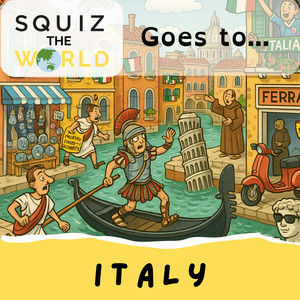
I'm Christy Kidgerina, and today on Squeeze the World, we're visiting a country that is shaped like a boot, where legends tell of twin brothers raised by a wolf, Where pizza and pasta were born and where you can still float along canals in a gondola.
Can you guess?
Of course you can.
Strap yourselves into the Squiz Kids Superfast Supersonic Jetliner as we take off and take a squiz at Italy.
Just the facts.
Italy is in the south of Europe, shaped like a boot kicking a ball into the Mediterranean Sea.
If you flew from Australia to Italy, it'd take about 20 hours in the air.
That's almost a full day of travel.
Italy isn't just one big landmass, it has two large islands.
Sicily, the biggest island in the Mediterranean, and Sardinia, plus hundreds of smaller ones.
The country has about 59 million people and its capital city is Rome.
Italy's government is a parliamentary republic, meaning that they have a president and a prime minister.
And unlike Australia, where two big parties dominate, Italy has lots of smaller parties.
That means politicians often need to team up in coalitions to form a government.
The Italian landscape varies from north to south.
In the north are the Alps with snow-capped peaks and ski resorts.
The centre of the country has rolling hills and farmland, perfect for olives and grapes.
And down south, the land gets hotter and drier with golden beaches and rocky coastlines.
Altogether, Italy is divided into 20 regions, each with its own traditions, food and festivals.
And underfoot.
Italy is fiery and sometimes shaky because it sits on the edge of the Eurasian and African tectonic plates.
The plates push up against each other, which is why Italy has earthquakes and famous volcanoes.
Mount Etna in Sicily, Vesuvius near Naples and Mount Stromboli out at sea.
And if you want to take some special pictures, Italy has more UNESCO World Heritage Sites than any other country on Earth, including lots with ancient ruins.
And speaking of ancient ruins, let's do some... Time travel.
Strap yourselves in, we're heading way, way back to the very beginning of Rome.
Legend says the city was founded by twin brothers, Romulus and Remus, who were raised by a she-wolf.
Romulus went on to give his name to the city and the Roman Empire was born.
Over 2,000 years ago that empire stretched across Europe, North Africa and the Middle East.
The Romans were brilliant builders.
They constructed roads, aqueducts to carry water and huge public arenas.
The most famous of which is the Colosseum where up to 50000 people gathered to watch gladiator fights, animal hunts, and it was even flooded for mock sea battles.
The emperors called it bread and circuses, giving people food and entertainment to keep them happy.
And you can still visit it today.
Some of the emperors they're a bit like kings were remembered as great leaders, while others became famous for their quirks.
Nero was rumoured to play music while Rome burned and the emperor Caligula supposedly tried to make his horse a politician.
The Romans also left us their language, Latin.
Lots of English words we use today come from Latin, like aqua meaning water, lunar meaning moon and terra, meaning earth.
That's T-E-R-R-A.
And how do we know so much about the Romans?
Well, that's because writers like Pliny the Elder, Cicero and Suetonius recorded what they saw and heard, stories that historians still study today.
After Rome's empire faded, Italy entered a new golden age, the Renaissance, when artists and thinkers like Leonardo da Vinci and Michelangelo changed the way people saw the world.
And that's the perfect place to head to next.
Let's get cultural.
Fast forward to the Renaissance, a time when Italy exploded with new ideas in art, science and music.
The city of Florence was the centre of it all.
And leading the charge was Leonardo da Vinci.
Sure, he painted the Mona Lisa, but he also filled notebooks with amazing inventions.
A flying machine shaped like a bat, an early helicopter and even a design for a tank.
Then there's Michelangelo, who carved statues like David and painted the Sistine Chapel ceiling in Rome, masterpieces that still inspire visitors today.
Speaking of the Sistine Chapel, religion has also shaped Italian life for centuries.
Most Italians are Catholic.
And the country is home to more than 60,000 churches, including St.
Peter's Basilica in Vatican City, the centre of the Catholic Church.
Away from the solemnity of the church, Italians are famous for worshipping something else soccer, or calcio as Italians call it.
Italy has one of the strongest soccer traditions in the world, with four World Cup victories, legendary players and fierce rivalries between clubs like AC Milan, Inter Milan and Juventus.
Stadiums fill with colour, noise and singing fans whenever a big match is on.
Italy also gave the world opera, a mix of music and theatre that began more than 400 years ago.
You might not know the names Verdi and Puccini, but chances are you've heard some of their tunes.
And then there's Venice, one of the most unusual cities in the whole world, built on more than 100 islands in a lagoon.
Centuries ago, the Venetians drove millions of wooden stilts into the muddy ground to create solid foundations for their buildings.
Instead of cars and buses, people travel by boat along winding canals, with gondoliers rowing passengers under stone bridges.
How romantic!
But Venice is also sinking slowly, and rising sea levels mean that it has to be carefully maintained to protect its historic buildings.
But what's everyday life like for kids in Italy?
Beyond the gondolas and ancient buildings, let's find out in... Time for school.
Imagine having to put your backpack on on a Saturday morning.
What?
In some Italian towns...
Kids still go to school on Saturdays, although most of the country has now switched from a Monday to Friday week.
The school year runs from mid-September through to mid-June, with a long summer holiday of almost three months.
School is compulsory and free until the age of 16.
And kids move through three main stages.
Primary school from 6 to 11.
Middle school from 11 to 14.
And high school from 14 to 19.
The subjects are much like in Australia.
Math, science, history, geography, but with an extra focus on art, music and languages.
All children learn English from primary school and sometimes another foreign language also.
One unusual feature is that kids often stay with the same classmates and teach for several years, which helps to build really close relationships.
The school day usually starts around 8am and often finishes by about lunchtime.
Some children go to the canteen for a hot meal, while others head home to eat with their families.
After all that studying, I'm feeling hungry too.
It must be dinner time.
Remember i said italy had 20 different regions.
Well, every region has its own favorite dish.
That's italy, a land where food is fresh, regional and also the heart of family life in naples was born.
In the north, creamy risotto is the star, and on the coast, seafood dishes shine.
And of course, there's pasta with more than 300 different shapes.
Some are pretty funny too, for Fale is shaped like bow ties or butterflies.
Orochete is shaped like little ears.
And then there's Strozopreti, which means priest stranglers.
I've stuck a link to a pasta dictionary in the episode notes so you can take a squiz at what all these varieties look like.
And here's something that's a bit of a surprise.
In Bologna, you won't find spaghetti bolognese.
The real dish is tagliatelle al ragù.
A rich, meaty sauce served on flat ribbons of pasta that hold that sauce perfectly.
Spag bol is actually an Italian-American invention.
Italians also have a wonderful tradition called pizza sospessa suspended pizza, where you pay for an extra slice so someone in need can enjoy a meal too, like paying it forward.
And of course, for dessert, there's gelato with flavors from pistachio and rose petal, and even gorgonzola cheese in some adventurous shops.
Italy is as colorful and creative as its history, and it continues to delight the world, one delicious plate at a time.
Time for the quiz.
This is the part of the podcast where you get to test how well you've been listening.
Question number one.
If you said a boot kicking a ball, you would be right.
Question number two.
According to legend, who raised the twin brothers Romulus and Remus before they founded Rome?
Was it A. A she-wolf, B. A pizza chef or C. A friendly giant eagle?
Music Nice work.
If you said A, it's a she-wolf.
Question number three.
What language did the ancient Romans speak, which gave us words like aqua, luna and terra?
Music Congratulations if you knew that it is Latin.
Well, that's all we have time for today.
Thanks so much for staying curious about the world and joining me on this incredible trip to Italy.
Now get out there and have a most excellent day.
Over and out.