Thank you. Hello, and welcome to the NVIDIA AI Podcast.
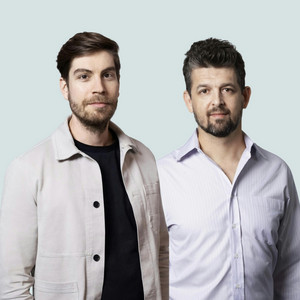
I'm your host, Noah Kravitz. My guests today are Max Yoderberg and Sergey Yaknin.
Max is the Chief AI Officer at Isomorphic Labs and Sergey is the Chief Technology Officer.
Isomorphic Labs is the company building a world-leading AI drug design engine to transform drug discovery and usher in a new era of of biomedical breakthroughs.
I'm here with Max and Sergey Live at GTC25 in San Jose.
Gentlemen, thanks for taking time out of the week to join the podcast.
No, thank you. It's great to be here. Yeah, it's a pleasure.
So why don't we start with a little bit, if you would, about yourselves, your background, and how you wound up at Isomorphoclapse.
You want to go Max? Yeah, sure. So, um, I've actually been in, in field of AI for about 15 years now.
This is, you know, long before it was cool.
Right. Back then, I was working a lot on computer vision, so applying early days of AlexNet, how we use this for ImageNet, how do we scale up for know object recognition text recognition during my phd we had you know we had the best image recognition models in the world actually we had a company in this space that ultimately got acquired by Google to join DeepMind, and that's how I ended up starting to work with Demis.
Demis Hassabis spent a long time at DeepMind, working on early days of generative models and then called the reinforcement learning bug, worked a lot on these challenge domains of AI for games, I'm trying to beat the top professionals at Starcraft and Go, all this sort of stuff.
But really at the core, you know, deep learning was the thing I loved.
It's this amazing technology. and i want to see it have real fundamental impact on the world and positive impact on humanity right and so as we started to see alpha fold there was this incredible opportunity to create this new company, Isomorphic Labs, and this was just such a brilliant opportunity to apply all of this amazing deep learning and machine learning toolbox that we've been developing over time to really try and transform the drug design space.
And that's what brought me over to Isomorphic to really head up AI in this space.
Right, so to hit that cross of the technology you love so much and continuing to push the frontiers but applying it to something that's meaningful to you.
Exactly. I've always loved the application of AI as well as the fundamentals.
And just to see it have that really positive impact, that's really key for me.
Absolutely. That's great. Sergei? Yeah, I've also been at this since way before it was cool, I want to say, to borrow from Max's words.
I was living in Toronto attending U of T. We had this guy, Jeff Hinton, kind of godfather of AI.
I've heard of him, yeah. Some may have heard of him.
It was really great. I mean, he used to teach courses at U of T and we all learned about neural networks.
And, you know, back then these were not deep neural networks, these were very shallow, couple of layers, and everybody was trying to solve handwritten digit recognition problems for a very long time.
I went into the industry and worked in a number of different technology companies, working in industries like FinTech, or telecommunications, ended up working at Amazon for a little while, building their Canadian software engineering organization.
After about 10 or 12 years working in the industry, I sort of got really interested in healthcare.
This was around 2012, 2013, people started generating DNA sequencing data as a routine.
And I realized that folks were really struggling to actually analyze these data sets because they were quite large.
And so I took the opportunity to join a cancer research institute to help them with this really ambitious global project of unifying the world's cancer DNA sequencing data. and processing it uniformly on the cloud and making it available to researchers worldwide so that everybody could make use of this data. you know, to me, this kind of opened the door to how technology actually enables healthcare.
And this set me down this whole path where After working on this project for a little while, I decided to do a PhD in the field. came to Europe to Germany to do my PhD at the European Molecular Biology Laboratory, I kind of thought, you know, as a computer scientist who doesn't really understand biology,
I should just immerse myself in an environment where I knew the least about what was going on.
And so it was this incredible eye-opening, sort of journey through this PhD, learning about molecular biology.
Coming out of the other side of this I actually decided to jump right back into the industry.
I just felt like this is where velocity was highest.
And so I joined a company called Sophia Genetics where we did molecular diagnostics, which is sequencing DNA of cancer patients to try to better help diagnose the types of cancer that they had.
And we had a great time building out this company, but I noticed right around sort of 2021, 2022, there started to be this real uptake in the interest of using AI in drug discovery.
And at first, started bubbling up with different pharma companies and different Silicon Valley startups sort of starting to speak about using this technology.
And then I heard from Demis' team who were looking to start Isomorphic Labs.
And I was just... completely enthralled by the idea of building this company from the ground up this was you know before isolabs was even announced and so it was an opportunity to be part of this founding team of this organization together with Max and a couple of other folks.
And as soon as I heard about all of the different factors that were gonna make this company possible, it just became a really easy decision to say, yeah, sure, I want to work on this.
I want to really spend my time to give this a shot. you know, never look back.
Amazing. So let's talk about the company a little bit.
The Isomorphic Labs mission is to reimagine drug discovery from first principles with an AI first approach.
What fundamental assumptions about traditional drug discovery are you looking to challenge?
I think one of the key things that you see in traditional drug discovery is you work really, really hard on a particular drug design problem.
So you're going after a particular disease, particular indication.
That means probably a particular protein the target that you want to try and modulate with your drug.
Teams work really, really hard on solving that one problem.
And that design process can take years. It's really difficult.
Then you have to go into the clinic. But after you've done that piece of design work, none of that transfers to the next drug design problem.
So you've got the next disease, the next target, the next protein.
And this is where... we can think about things very, very differently with machine learning, with AI, because we're building models, models like AlphaFold that generalize across the whole of the proteome, the whole of the protein universe, the whole of chemistry, which means that we have techniques and we can think of ways of doing drug design against these models that work for one target, one protein, one disease over here,
And exactly the same models, the same techniques can work for another one over here.
And so we get a very generalizable drug design engine.
And so then that changes even the DNA of the company.
Instead of just thinking about a single disease, single disease area, we really think about how can we be solving all disease and how can we build a company around that?
Maybe one more assumption to talk about is this assumption that you need to continuously do wet lab experiments. to ground yourself in some measurable scientific reality.
All of current conventional drug design relies on these design make test cycles where as a chemist, you're going to hypothesize that, well, if I take this particular molecule, it might bind to a protein target, it might have these properties, and then I'm going to make it and test that assumption and most of the time I will learn that actually it doesn't have those properties.
If we were really great at predicting properties like that, well, this would be a solved problem right now.
And so what we can do when we have these general models, as Max says, that are as good as experiment, we can actually run many of them in combination, and we can just take the output as truth, which is a incredibly liberating way to do drug design.
Our drug designers often talk about the fact that they can make bigger and bigger and bolder changes to these molecules, which is just not how you operate conventionally since you don't have a lot of confidence in the predictions you're making.
Conventionally, you make small changes because you don't want to destroy what you've already built, and you're trying to eke out little incremental changes one by one.
Whereas when you can trust these models' predictions, you just... design freely and this has been really great and kind of leads us to our North Star as a company where we're aiming to get our models to the stage where we can run an entire drug design program in this single design round where we basically continue designing in silico only validate once at the very end using experiment but here's the crazy So even if we create these amazing models that are perfectly predictive, of this experimental technique.
So we have this perfect model. And we've had some significant breakthroughs in this.
Still, the space of potential drugs is something like 10 to the 60.
That's such a huge space that even if you have this perfectly predictive model, you can't exhaustively search every single design.
So you need something more even than just these predictive models.
You need actual... generative models or ways to search agents that can actually explore chemical space and come up with these designs to be able to navigate this massive 10 to the 60 space.
And that's completely different to the way that traditional biotech or pharma would do this early hit discovery.
Where there, what you're doing is you're taking a library of molecules, maybe it's a million, maybe it's 10 million, if you're lucky, it's even to the billion scale, and you're screening them experimentally. that barely chips away at the surface of that 10 to 60 space and that's really the difference in potential that exploration of the full chemical space that we can start to do Can you describe or kind of explain what it means when you talk about biology as an information processing system?
Kind of unpack that, but then relative to your approach to model building?
Yeah. When we think about cells, cells exist in this environment that throws information via different chemical signals at them, throws different challenges and the cell needs to be able to process that and do something with it you know the cell is trying to survive and it's trying to proliferate right and so we see a lot of parallels between how cells act and they use the tools that they have at their disposal. the arsenal that the cell has at its disposal is really encoded in this genome.
So anything a cell can do is encoded in this genome, which then the cell makes proteins to actually do what it needs to do.
We see this as an ultimate opportunity for us to really model those cellular processes, to really understand how the cell deals with its environment and be able to replicate some of this in a machine learning model that would allow us to do that in silico in this AI analog of a cell.
When this is all realized, when the vision down the road, comes to full fruition.
What does it look like? What does our world look like in this new paradigm of drug discovery that you've just been detailing.
How does it affect the way that we take care of ourselves, medicine, healthcare, preventative care, everything.
What does the vision look like? Well, let me try to paint one vision and In my mind, it's actually, there's going to be stages of this in some sense.
And we're at an early stage where we're still trying to kind of shed some of the older generation tools, these non-scalable processes, as Max has talked about, and build a real technology approach.
Technology is scalable. This is what it's done to disrupt so many industries.
And so this first step is about how can we build these models that will bring scalability to this? that will bring these general approaches where I don't have to have a whole army of disease specific scientists to focus on a particular disease instead I have a general model that allows me to do this.
And so to me, you know, stage one, is just how do we do this in a tech forward way?
But further stages actually get us much closer to how can we do this in a way that will start convincing regulatory bodies that these models are predicting things with such a high degree of accuracy that maybe we don't need to spend five or seven years in clinical trials in the future because we can prove mathematically that the molecule we design is going to work.
And so that's a really important next stage because I think it's going to really change how the entire industry works.
When we think about this industry now, the FDA approves about 50 drugs per year on average.
It's been that number for probably three decades.
And so there's a real limitation to how many drugs, even if we had, you know, incredibly powerful models, that would allow us to design many, many more drugs we currently have these limitations.
And so being able to overcome that together as humanity is going to be a key accomplishment.
But what this opens up is this future of a precision medicine that we talk about often, but actually are nowhere near today. where we should be able to very, very precisely diagnose what is going on with somebody.
Imagine they have a particular kind of cancer.
There's a million different types of cancer depending on the molecular signature, depending on the mutations within the genome of the patient.
And we should be able to then design a very bespoke combination of compounds that will be best for that patient or for that very small group of patients.
And so we need to follow kind of the stages to get there.
But to me, you know, that's the next waypoint on the road.
And then ideally the last waypoint is, rather than waiting for somebody to get sick so that we can cure them better, we should be getting ahead of that disease.
And so we should be actually trying to detect when a certain biomarker in a healthy individual starts going in the wrong direction so that we can design interventions that will prevent them from getting sick in the first place.
And I think that will completely change this industry.
Yeah, absolutely. The approach that you're taking, I'm wondering, how the old guard looks at you and responds to this approach, and then also wondering how it shapes recruiting and team building.
And if when you're bringing people onto the team, how much of an open mindset, a willingness to look through the glass the other way, what have you.
How much does that go into your approach to building out your team?
Yeah, so... ai for drug design we've actually seen maybe a first wave of companies and and pharma companies actually start to dip their toes into this space for maybe five, six, seven years now.
But I think that's a slightly different wave to what we've been building.
This first wave of AI for drug design has really been how do we just use some of these machine learning tools in the traditional drug design processes and That often comes out as building these local models where you're doing drug design around particular target you've got some data and you're fitting small local models so that to help inform you on that next experimental design make test round right right and that's a very very different paradigm to what we have been building which is Let's create very general models, models that we actually can apply to any different part of space.
And a lot of people, I think, at least when we were starting out, didn't think that was probably the right way to go.
But what we've just seen, again and again, is we can actually build these general models, not just the alpha falls of this world, but many other sort of predictive capabilities, generative capabilities. we see the potential to apply these on literally the hardest problems in the industry.
So for example, our collaboration with Novartis, I think it's no secret that they've thrown some of the hardest targets in the industry to us.
These are sort of drug design problems that people have spent 10 years there can you give an example we can't give an exact example at the moment but you know these are these are genuinely targets they've been working on for over 10 years not making progress so The targets that chemists come up to our leads and say, this is impossible.
Don't try it. And at the same time, we see that in just months were able to make traction on this, creating novel chemical matter, finding novel ways to modulate these targets, literally blowing the minds of these chemists.
So I think there's still a long road for the whole of the industry to really fully understand what's happening here like it this understanding is happening the way i see it in in five years time AI for drug design is going to be across the entire industry.
Doing drug design without AI is going to be like trying to do any type of science without maths.
It's just going to be a fundamental... part of science, and particularly this science.
Listening to the two of you talk about it, it sounds...
So simple in a way, but in a way that brings all the power that you're talking about behind it.
But I would imagine if you've been doing it the other way for, you know, a 50-year career or what have you.
I don't know, just the mental resistance to it might be an issue.
Yeah, and don't get me wrong. It sounds really easy to say these things.
In reality, these are really, really hard modeling problems.
Yes, I can't even imagine. These are holy grail modeling problems, things that people have been working on for decades.
Right, but I mean, I'm imagining just the, the resistance that people have to change new ways of doing things and if you've been you know you and your team have collectively been pounding on these problems and then there's this new technology that solves it going all around, I want to say.
I think actually it can be really challenging if you're inside one of these pharma companies because they have coalesced in a particular structure as a result of how you would normally do drug design. organize themselves often by disease.
You'll have a whole area that is just focusing on oncology and another that is focusing on ophthalmology.
And so you have these whole structures and the types of models that we're creating, they span across all of this.
Imagine trying to nucleate this kind of initiative inside a company that is organized by these disease areas.
Where would you put them? And if you put them outside, how would they actually permeate that structure and be able to institute change.
So I think there's significant barriers within big pharma itself, which you know, in a way is great for ISO.
But what's been really heartening actually is seeing some of the transformation in the eyes of, some of the chemists and biologists that have joined ISO itself, many of who have also joined with a healthy degree of skepticism.
Right. Over time, we've really convinced with data, with proof of the working of these models, to really embrace these.
And we have something that we call the ISO way, which is essentially how do you do drug design in this AI first approach?
And all of our chemists are part of this wave of how do we actually invent this iso way together with all of the scientists and engineers? that are building the technology.
And this has been really transformative.
In some sense, I have this kind of old school, Amazon principle of working from your customer backwards where you want to really understand who your customer is and then you want to work backwards from that.
And that will guide you in your product design.
And we have this dream situation here where actually the customer are our peers, our buddies that are working together with us at Isomorphic Labs.
And so at ISO, By contrast, by construction, we have actually meshed all of our teams.
All of our teams are sitting together in common spaces.
It's not like, you know, a technology team sits over here and a chemistry team sits over here.
We're sitting interspersed and we're working very collaboratively on these projects and now And that cuts both ways in the sense that we're getting incredible value and insight from these long-term career domain experts that are helping us make sure that our models are really grounded in the knowledge of their trade.
But similarly, when we're doing drug discovery projects, We are doing that in this tech forward way.
And so I feel like this melting pot has been really amazing in transforming how chemists do their jobs and are helping evolve this next generation of chemistry that is doing drug design in a completely new way, and it's being invented. that iso on a daily basis.
Our guests are Max Yatterberg and Sergey Yaknin from Isomorphic Labs.
And we're talking about their really revolutionary approach to drug design, building world models and kind of taking a tech forward approach.
But Sergey, as you were saying, the collaboration, you know, really at the core of it.
But I want to ask you about the technology and ask you about AlphaFold.
AlphaFold 3 is the current version. And in my understanding, it was a big breakthrough in predicting biomolecular structures. can you talk about and even go back to the beginning and kind of maybe just briefly explain what AlphaFold is and then talk about how we got to AlphaFold 3 and how important it is.
Yes. So maybe going back in time, AlphaFold actually started as a hackathon project in DeepMind.
This was like a two-week hackathon project.
Can we throw a conf net? on protein structure prediction.
And crazily, there was like signs of life there.
And that snowballed into AlphaFold, the project.
AlphaFold 1 was a big... step up in terms of accuracy but AlphaFold 2 this was in 2020 was that first moment that people started to see experimental level accuracy of protein structure prediction from a neural network and ultimately our fault too and went on to win the Nobel Prize just last year.
But Alpha 2 just predicts the structure of proteins and proteins coming into contact with other proteins.
But there's lots of other different types of biomolecules in addition to proteins, that are particularly very important when we think about designing drugs.
So proteins are part of these molecular machines that work by interacting with other proteins, but also things like DNA, RNA, small molecules, and these small molecules could be things like something like caffeine that you consume, or it could be drugs that we consume as well.
And so really, we want to create a drug.
And what is a drug? A drug is something that comes in and modulates these molecular machines.
So we want to actually design that really rationally.
We want to be able to understand the structure of this protein, with these small molecules, maybe also together with DNA as these molecular machines form.
And so that meant we needed a completely new capability beyond AlphaFold2
And that led us to the creation. This was a piece of work with Isomorphic Labs and Google DeepMind of AlphaFold 3, and this was a big breakthrough for us.
This came out last year, and this was the first time that we could predicts the structure of all of these molecules coming together at unprecedented accuracy.
And this now is the thing that together with other models, allows our chemists to make changes to these molecule designs and literally in a second see the result of that.
That's a completely different way of working.
Where traditionally, if you made a change to a molecule design and you wanted to see how that changed the structure, it would take literally months to get that structure back at best.
So that completely changes the game. Absolutely.
Sure. And I didn't want to interrupt you, but I don't want to undersell the fact that Alpha Fold.
It was Alpha Fold 3 that won the Nobel Prize?
Alpha Fold 2 won the Nobel Prize. I didn't want to cut in, but I didn't want to let that go by.
So are you now building additional models?
Are you tuning AlphaFold? What's the process like from here?
Yeah, we go... quite a bit beyond the capabilities of AlphaFold3.
If one thinks about the overall drug design problem, you need to solve quite a lot of challenges on the way to making a molecule that's going to be in the pill that you're going to buy from the drugstore.
And this has to do with ascertaining not only how is the molecule going to interact with its intended target, but actually how it's going to behave in the body.
You know, we want these molecules to both make their way to where they need to.
We want them to stay around for as long as they need to.
And we want them to safely break down and exit the body.
And so when we think about drug design, we need to solve this whole series of challenges and solve them simultaneously.
And so when we think about the different models that we need to build, we start from this incredible structure prediction problem And then we go on to solving other problems, such as predicting if my potential drug binds to this target, how strong will it bind?
I want it to bind. strongly but not too strongly potentially not forever right and then i wanted to be able to go inside a cell and I want it to be able to exit when it needs.
So all of our models are basically solving this whole wide variety of problems.
Then a key challenge for us is to actually how to make all of them work in concert all together, so that we can have this holistic drug design engine that allows us to do this end-to-end.
How big of a part does infrastructure and compute, for that matter, play in in this whole process and you know along the way how is your access to the right kinds of infrastructure and compute help you advance, I'm assuming faster than you would have otherwise, but help the whole process evolve?
Can you talk a little bit about the importance of that infrastructure.
Yeah, it makes a huge difference, to be honest with you.
And in some sense, this really sets the stage for how ambitious you can be as a company.
In the current world of AI being everywhere, there's huge contention for resources, for graphics accelerators.
And if you're not able to really have access to, or be effective at commandeering these large machine learning fleets, you're at best going to be able to make use of model somebody else created and you may be able to adjust these models to your particular use case, but you're not going to be able to do foundational research and what Isomorphic Labs really prides itself on is actually really moving the needle on this foundational ai research for drug discovery we're able to create completely new methods that are general and that are scalable And this is predicated on having access to massive amounts of infrastructure.
And so we're very lucky to be partnering with Google Cloud on this. and we work very closely with them on hosting our entire platform, our machine learning research and production inference platform.
And so this is a huge part of what we do.
How do we make sure that this kind of massive machine learning research and engineering team can have the least amount of resistance the highest research velocity possible so that they can try lots and lots of ideas because you know ml research is a very empirical science we end up trying and training models over and over again And so access to this hardware and the ability to do it efficiently is really, really important.
And one of the really exciting things is to start seeing that actually we're seeing really analogous scaling laws in our model development. of things you might see in the llm space we're starting to see in okay modeling biomolecular systems in understanding this biochemical world and that's really really exciting yeah both actually on the training side, just how large our models should be, but also really excitingly on the inference side as well, how we can scale with inference time compute.
So there's a huge amount of opportunity to actually scale the accuracy and the efficacy of these models with the amount of compute.
Right, right. And what about data? Data wrangling, synthetic data, what's your approach to data?
And I don't know, best practices maybe? Yeah, gosh, we could just spend an entire podcast talking about data, but let's make a start at least.
Data is very important for any machine learning problem.
It is especially important in science And it is especially difficult to work with in science for the simple reason that you can't just eyeball it and verify yourself as a human that it makes sense, that it's any good.
You know, we're very used to data in the traditional natural language processing or imaging space where I can look at an image that is generated by a model and be like, no, that's garbage.
Oh yeah, that's really great. You cannot look at a structure unless it's really terrible and be able to say, oh yeah, that's a great structure.
We need to be very careful with how we work with this type of data.
And well, there's never enough of it, truth be told.
There are some great resources, of course, that are publicly available.
Protein Data Bank made AlphaFolk possible.
You know, the amazing thing about that is That's a resource that's been available to scientists for decades.
And, you know, there's real proof point than that, that actually with the right algorithmic advancements, you can create incredibly new, powerful systems using data everybody has had access to forever.
And so that's really, really important. But when we think about the entire drug design landscape and the complexity of the systems that we need to model, if you think about there's this kind of stack of different problems and we've been talking so far a lot about the molecular modeling the chemistry side of this but diseases experienced by humans and so when we go up the stack we reason not just about molecules but about cells and not just about cells but about tissues and not just tissues, but organs and then humans and then even how humans interact with the environment around them.
And so if we want to solve this problem holistically, we need to be thinking about data at each layer of the stack and those data sets simply don't exist today.
And so a big problem that we need to contend with is how can we create the right data sets and be very very principled about it There is a bit of a meme out there around the fact that maybe pharma has the data and haven't shared enough.
And we will always welcome more sharing from our partners or from other organizations.
But The truth is a lot of that data is not machine learning ready in the sense that it has been generated as part of past projects. that were drug discovery projects or other types of scientific projects and that data does not have the necessary diversity to actually train the types of general models that we're interested in creating.
So while that data might be interesting for other purposes, it might be interesting in improving performance on a particular subspace of the problem, most of the time it's not going to be helpful or as helpful as one might hope. for these general models.
And so something that we contend with at Isomorphic Labs is how do we generate these datasets in a principled manner that will enable continued progress of the models.
The great thing about it is we can lean on our current generation models to help advise us where to look in this massive data space. where to generate new datasets.
And so we have this really virtuous cycle.
If you have already, an excellent state-of-the-art model, you're gonna get great state-of-the-art advice on where to focus next.
And so this helps us continue actually improving on the edge that we have by continuing to generate data train new versions of the model.
And this is a really virtuous cycle. Yeah.
You've talked about this a little bit in the conversation, but kind of to put a point on it, the future of drug discovery, is it ai end to end is it what is it i shouldn't be positing things i should ask you guys what do you see down the road?
And how will it ultimately, and you talked about this a little bit, I think, Sergey, you were talking about preventative care and precision medicine.
What's the, I don't know, what's the end game for humanity?
What is it that this new paradigm of drug discovery could ultimately help humans become?
When I think about where we're going, it really is this north star of being able to do all of drug design on a computer, what we call in silico. and to actually remove that experimental bottleneck that currently exists.
Any time you have to go out into the real world, actually make some molecules and then test it out this just adds so much overhead so much time and And ultimately we do see a track to genuinely solving a lot of these problems, getting to experimental accuracy. for some of these models, creating agents and generative models that can explore this space.
Where this leads is, okay, we can get any target coming our way, any protein that we want to start modulating, And we can very, very quickly come up with chemical matter that if we did go to a lab, we'd see positive results there.
And in the near term, as we go along that path, what that does is it means that it opens up new targets.
So these sort of age old targets or industry, you know, really really challenging things that people that people use the term intractable we we try and not use that term just call them challenging challenging But yeah, you know, opens up disease areas, opens up targets that previously people couldn't approach. but now we can, and we start seeing that.
When you're doing more and more of this work in Silico on a computer without going into the lab, and you're reducing those design-make-test cycles, you're doing things faster.
And so that means just the time it takes from, hey, we want to go after this, or we really see that there's this patient need, to actually starting to get into patients starts to reduce.
And then also as we understand much more about how these molecules work, how they interact with these targets, how these targets themselves interact with the whole network, all of these pathways that constitute disease, how these molecules interact with the body, where they get taken up, how they get broken down.
We know so much more about how this works, the safety profiles of this, that when we do go into people, and start testing these molecules out, they're much safer.
They have higher efficacy. And that actually changes quite radically the economics as we talked about a little bit before you know if you're you know, God save for molecules, they have a higher chance of having efficacy, then your failure rates are going down and the ultimate like amount of you have to invest as a company. drastically reduces.
And then that changes the economics of producing these molecules and R&D in this space.
So you can think about getting molecules to patients from potentially much lower cost.
That can even open up new indications, things that traditionally wouldn't be commercially viable to go after where the patient populations are too small or the end market is too small for traditional pharma to go after. with this new technology, we actually can open up these markets.
So that's a really exciting spot to get to.
Maybe just to add, I feel like It's really important for us to be as ambitious as possible on this endeavor.
And something that's really unique about ISO Labs is this really huge ambition for what we could get to as an end game.
But it's also important for us to not get ahead of our skis and sort of be completely disconnected from reality.
Where we stand today is there's no currently AI design drug that has been approved.
And so I think there's a lot more to prove.
And one of the things I appreciate the most is We're not just there to create these technologies in isolation.
We're there to make the drugs and to prove stage by stage that this technology is working. and that it's making a difference.
And so to me, this balance between having huge ambition that points us directionally, towards the future, but actually being very execution focused so that we can improve on every program, the key parameters, is going to be really necessary to get us there in the long term.
That's amazing work you guys are doing. For folks listening who want to find out more, about isomorphic labs?
I assume the website. Is there a technical blog, social channels?
Where can we direct people to go online?
I think the website is a great starting spot.
We've got some great articles on there, including some of our releases, interviews with people as well.
On our socials, you know, we'll have podcasts like this and yeah, other material coming out.
If you want to really geek out, read the Alpha Fold 3 paper.
Including the appendix. Exactly. That's where all the secrets are, is in the appendix.
Where all the juicy goods are. Excellent.
Max, Sergey, thank you so much for taking time out of GTC to talk with us.
Just incredible work you guys are doing.
Really kind of a pleasure for me to listen to you talk about it for the audience, I'm sure.
And it goes without saying, but all the best of luck and fortune as you go forward with Isomorphic Labs.
Thank you, Noah. It's been a real pleasure.
Yeah, thank you so much. Thank you.