You're listening to Roundtable.
I'm Steve today with Yushan and Yushun.
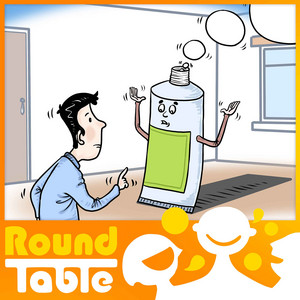
Coming up, what if your toothpaste could actually regrow your teeth or maybe fill your cavities?
Brands are claiming they can, turning our bathroom cabinets into mini dental clinics.
But how much of it is real and how much is just slick marketing?
We'll separate the fact from the flashy foam before your next brush.
Our podcast listeners can find us at Roundtable China on Apple Podcasts.
Don't forget, we love to hear your voice.
Send your voice notes our way.
Roundtable Podcast at QQ.com.
Once again, Roundtable Podcast at QQ.com.
And now, Toothpaste.
You use it every day.
Actually, you use it every day multiple times a day.
But it's one of those things that we barely ever think about, until you realize how big some of its promises have become.
Lately in China, the gap between promise and reality is turning into real controversy.
From so-called gum band-aids to toothpaste that claims it can regrow teeth or fill in your cavities.
The marketing hype has gotten out of control.
But here's the reality check.
Many of these miracle medical and financial or functional claims may amount to little more than surface-level protection.
What is actually going on here?
Toothpaste.
It gets a good name for cleaning our teeth.
It gets a bad name often, internationally sometimes too, for the claims that it makes.
Yeah, and what's going on here in China is that this January, just not long ago one Chinese toothpaste brand attracted controversy and is under regulatory investigation for exaggerating its functional claims.
So the brand has promoted its toothpaste as repairing enamel through remineralization, which we'll explain later what that is and why that could be a problem.
Basically, regulatory filings from the company list its approved functions only as cleaning and relieving dental hypersensitivity, which had attracted customer complaints.
And people were just questioning oh, you sewed yourself so flamboyantly on social media.
But the truth is the filing for your product is not matching all the way with how you're selling it.
And this particular brand is very popular.
As of this January, this toothpaste has already racked up More than 75 million units in cumulative sales for a single product, primarily on Douyin.
So it's priced not really that high, but it can be high depending on the product you're buying.
So it ranges from about 41 to 71.
That's roughly 5 to 10 US dollars.
$10 is expensive for Tuesdays.
Totally.
And it has surged among the top of his niche category, driven largely by the traffic-fueled marketing on social media platforms.
This is under investigation now.
We should say allegedly exaggerating their claims.
All right.
So, following the claims one of the claims on this particular brand it increases your enamel hardness by 36 times.
And it was after that that Shanghai's district market regulator, or one of them, opened an investigation.
That investigation started in the beginning of December last year, I think.
Yes.
The brand responded that all of their products have completed compliance followings, adding that unresolved complaints are typically referred to regulators.
So far, there hasn't been fresh news on the result of the investigation.
And, as of late January, the toothpaste product attracted also controversy, is still sold via the brand's social media or streaming video streaming platforms.
So we haven't really seen an outcome yet, but this had indeed brought people and also regulators attention onto just something that we thought we know too well but perhaps not that well misleading claim yeah, over advertisement on toothpaste.
Have we finally arrived uh, at toothpaste now?
Because, you know, in the past the advertising law did like roll out new rules, for example banning vague Or misleading terms, like the best.
Or the mysterious high technology that you cannot use them.
But those rules seem to mostly target some products like electronic products.
But now toothpaste.
Some always get a pass.
I've seen advertisement like whitening once you brushed it or something.
We kind of know that it cannot be true.
But we just got... attracted by these kind of advertising.
Well, and that's the issue, isn't it?
What was the word that you used before, Yushan?
Tooth remineralization?
Yeah, they talk about this in Western dental culture. as well.
What exactly is that?
That's slowing down your tooth decay, right?
Yeah, that refers to the process of slowing tooth decay instead of repairing damage as it ages.
And experts warn that merely brushing teeth cannot fix such a structural problem such as our aging teeth.
And any remineralization effect is only superficial.
So what's known as remineralization is about stopping dental damage, stopping your teeth from getting worse.
And this is explained by Director Wang of a clinic center of a top-tier class, A hospital here in Beijing.
So he mentions in one of the recent reports from China Daily that when the consumers hear claims of how toothpaste are able to repair teeth, we're often being misled, and solving loose or broken teeth simply by brushing teeth is something completely impossible.
As, quoting from Dr Wang,
And that term gets used quite a bit, remineralization.
So that's an issue as well.
Yeah, it's about being misled.
And I have an example I want to share in a little while that kind of speaks to that issue too.
And it's related to toothpaste as well.
Okay, so then if remineralization is a problem, it doesn't do what it claims it can do the toothpaste.
What kind of science is actually behind this?
Well actually, it do offer a certain level of protection, but it's very limited to the outermost layer of our of our teeth.
And it's usually only visible under a microscope.
So, so, so, so it's not, it's not completely false in its claim.
Right.
And I'll get to the misled part right now.
This is why it's misleading to consumers.
They make these types of claims like repair damage or something like that.
But if you look under a microscope you can see like 000001 of your tooth.
Actually that part is repaired.
But it's about the marketing.
It's misleading people into thinking all your teeth are going to be completely back to the way they were when you were 17 years old, or something.
Or the elements in these kind of toothpick.
Of course they can be functional or they can be useful for repairing or remineralize your teeth.
But the thing is that imagine how long we use that tooth bait to be applied on your teeth.
And also you need to like rings and spit them out right there.
They will not stay on your teeth for very long.
You probably will stay on like two minutes yeah, max.
Yeah, so that's the thing.
If it, we don't talk about the amount, the time that you use it, it's not just the fact that we were talking.
Yeah, nobody brushes their teeth and then walks around town for four hours without rinsing out your mouth and just to understand just how Big of an impact it might have on consumer and just normal people.
I actually talked with Dr Wang Yingge, the founder of Beijing Zhongxinkang Dental Clinic, who helps me to explain just what are the potential harms of over-promoting toothpaste claims effects.
这些夸大其词的广告真的是会害了我们消费者。
Overhyped advertising like this can genuinely harm consumers.
We all know that dental diseases are chronic and progressive.
They worsen gradually over time.
When toothpaste claims promise more than they can deliver, they can delay proper treatment.
A minor cavity can progress into a deeper one, even reaching the nerve and requiring root canal treatment.
Mild periodontal disease can also advance into moderate or severe periodontitis, which is irreversible.
These are serious consequences.
So here's my call to action.
Stay alert, and don't be too easily swayed by exaggerated livestream sales pitches.
If you truly have a dental problem, the best choice is a dentist who can actually help.
Yeah.
Yeah, exactly.
But here's the thing with a lot of us, isn't it?
When we have dental issues, we just try to fix it ourselves and only go to the dentist when it cannot be delayed anymore, to a point that we can't bear it anymore.
I see so many people around me even me myself included sometimes just afraid of sitting on that chair.
You know, being examined.
I'm terrified of it.
I totally understand that.
They put that paper over your mouth, so you can't see anything, and they force your mouth open.
It's actually kind of a traumatic thing for me.
For a lot of people, indeed.
And this is not really the only case, the one Brandon mentioned earlier.
There are other common issues that can come with complaints regarding toothpaste, including vague or unclear description of a product's intended use.
For example, in November last year, another domestic online bestseller toothpaste brand was fined 48000 yuan by the same bureau, the Shanghai's Changning District Market Regulator, for false advertising.
And also there are many other cases too.
So many brands would use eye-catching keywords and image in their advertisements to draw in attention and say that you can repair your teeth from the root within 28 days or promote tooth growth in young children by using our products stuff like that.
So yeah, these are, I would hate to say this, but apparently there are brands doing this.
I think it has something to do, well, I think there's two things at play here.
One, from the business's point of view, the toothpaste industry is very competitive.
There's a lot of brands and the consumer I think it's safe to say doesn't really know what's the difference between toothpaste A, B and C.
Do you think that's a fair statement?
I think so.
Right?
So if the—Yushan, you're disagreeing.
No.
Oh, I thought you were kind of shaking your head.
So if the consumer doesn't really see a clear difference between toothpaste A, B and C— then they don't really have any particular preference.
So in a very competitive industry where the consumer doesn't have one particular preference over the other, toothpaste makers need to do what they can to differentiate themselves from their competitors.
That's my point here.
Yeah.
And I think another thing is that what we just mentioned, that people will have that kind of natural fear of going to dental hospitals.
And just because of that fear and most of the time, you know, making an appointment or having a treatment on your teeth or even just in your mouth can be quite or relatively expensive.
And that's when people may try to find a much affordable way to maybe get a wider teeth or a better Fix up a hole in my teeth.
It's one of those products, isn't it where?
Or at least for me, this is how I feel about toothpaste.
If I see a higher price tag, $10, like you said before, 69 yuan.
Mm-hmm.
I'm assuming it's doing something better for the inside of my mouth than something that costs 99 cents.
So I probably want the higher price tag one.
The other point that I wanted to make, one was about the competitiveness of the industry.
The other point that I wanted to make is that this is one of the products out there.
Okay, let me say it like this.
If an energy drink... makes a claim about being good for my heart health.
I'm going to look at that and think, hmm, I'm going to be speculative about that.
When a toothpaste claims it can make my teeth whiter or remineralize my tooth, even though I don't really understand what that means, I'm more likely to believe what it's telling me.
Yes.
And that's the misleading danger here.
The health notification threshold seems to be lower somehow when we talk about toothpaste.
What did I break into?
Nothing.
That just reminded me of that.
Another mindset of people may have, and also I had before is that okay if this kind of toothpaste, they have that additive?
Um, functions for my teeth, even though I have nothing wrong with my teeth.
But with these new functions I may.
I would like to try that because that's just, they pay no harm on my teeth.
Yeah.
Yeah.
Um, but is it doing what it says it can do?
And this is.
I want to give the example now.
This is from the um.
The company called Colgate uh toothpaste maker colgate.
A few years ago i don't know if two three, four years ago, i think it was in the united states um, they were facing a case against them.
It was a class action lawsuit and it was all about their recyclable toothpaste tube.
Now colgate acknowledged at the time they called it by the way, they called it a first of its kind, recyclable tube.
That's how it was advertised to people.
Now Colgate at the time acknowledged that the tube recycling success would require a critical mass of tubes on shelves that meet recycling standards.
Huh?
Wait, what does that mean?
Okay, so the lawsuit's plaintiffs.
They reported purchasing the toothpaste thinking that they could recycle the tubes just outside their house.
Just like you recycle a bottle of water when you're finished with it.
They said, if we had known the truth, we wouldn't have purchased the toothpaste.
We bought it based on that recyclable message that Colgate told us.
Now the truth is...
Yes, the tube is recyclable.
But here's the problem.
The municipal recycling programs in California didn't accept the toothpaste tube to be recycled.
See the little tiny loophole here?
This is where it's misleading.
So I didn't know this before this morning.
Toothpaste tubes are notoriously difficult to recycle.
There's a lot of different layers and a lot of different chemicals and plastics inside, because you have to keep it fresh from moisture and things like that.
But also, they need to be squishy, right?
They have to be pliable.
So it's really almost impossible to recycle.
So the issue there was when Colgate said, this is a recyclable tube, it was misleading.
People thought they could take care of it simply.
And the reason I wanted to bring that up is I think that's what we're talking about here.
It's not that these claims are always entirely false.
It's just they're making the customer think something that isn't entirely true.
And indeed, as customers, we just need to know what this product does.
And The bottom line here, I think, is that toothpaste is a cleaning tool.
It's not a medical treatment and it can't compare to any miracle repair, or you just can't simply buy into it.
And also, this is agreed by Dr. Wang, too.
And also he gave me some tips on just how consumers can choose toothpaste products, and also a tip from himself.
Let's hear that.
The definition of toothpaste is straightforward.
It's a paste designed to clean the surface of your teeth through friction.
But today, advertising is everywhere, and the flood of so-called miracle claims to be overwhelming.
When choosing toothpaste, labels like stain removal, cavity prevention, antibacterial or anti-sensitivity are generally safe choices.
These functions are already scientifically recognized, which is why brands confidently print those keywords on the packaging.
That said, if you are dealing with cavities, loose teeth, pain or red swollen, bleeding gums, no toothpaste on the market can truly solve those problems.
At that point, the real decision isn't which toothpaste to buy, it's which dentist to see.
In the end, proper brushing techniques and good oral hygiene habits matter far more than the toothpaste itself.
There's no need to chase expensive options.
Just choose a flavor and texture you enjoy and make brushing something you actually look forward to.
Yeah, the dentist's advice is see a dentist.
That's what the advice always is.
And doctors always say, see a doctor.
Doctors always say...
Don't go on the internet and search for medical advice.
When you think something is wrong with your body, go to a doctor.
But in some ways, I think that's correct.
Because online you always get similar answers of oh, you're potentially getting cancer or stuff like that.
Oh, yeah, I have a headache.
Oh, you must be dying.
So it makes sense when the dentists say...
If you have something wrong inside your mouth and you feel like something's wrong, go to a dentist.
There's no magical cure for sale on Billy, Billy or Doyen or whatever that's going to fix your serious dental issue.
But people just cannot obey that.
Because of what Yushan said before, nobody likes going to the dentist.
We're looking to fix the problem ourselves for 69 yuan.
Oh, geez.
But eventually back in November 2025, that is.
We do have national regulations where the National Medical Products Administration proposed limiting toothpaste claims to eight categories.
That involves sensitivity relief, gum problems and that's kind of giving a threshold, a line for brands to how to put their wording in advertisement.
So this, like I mentioned earlier, is put in the regulators' attention for the markets too and for the entire industry to really pay attention to how they're selling their product and, of course, what their products really do.
Yeah, I mean, it needs to be regulated.
There's no question about that.
I do understand the point that I made before.
I understand the pressure from the marketing departments of these toothpaste companies.
How do we compete?
There are almost 2,400 toothpaste-related companies in China.
And nearly 5% of those 2,400 companies have been penalized for misleading claims.
This is why it needs to be regulated, because if you don't regulate it, then they're going to keep pushing the bar further and further and further to try to compete with each other.
It's better that not only the brands but also us day-to-day consumers who used to believe in whatever we see in the advertisements we have a clearer understanding of what toothpaste can do eventually before we buy.
I like it when my toothpaste has multiple colors of lines.
I don't know why, but that makes me feel like there are more players.
Do you pop it with your finger too?
I'm impressed by that.
I don't even know what it is.
There's been experiments online showing that how you squeeze your toothpaste, they will come up with different colors.
Awesome.
A lot of play.
All right, that's it for today's roundtable.
Thanks for sharing your time with us today.
For Yushan and Yushan, I'm Steve.
Hope you enjoyed the show, and we hope you come back next time.