Cognitive disorders are common among criminal defendants.
Many of them would struggle with a basic explanation.
And it wouldn't even be, did they do it or not?
It would just be like, where were you that day?
Hear about one pioneering effort to address the needs of those with cognitive disabilities in the criminal justice system.
The Sunday Story from the Up First podcast.
Listen now on the NPR app.
You're listening to Shortwave.
Hey, sharewavers.
Regina Barber here with Michael Ruprecht.
He's the Stanford Global Health Media Fellow embedded with us here at NPR.
Hey, Michael.
Hey, Gina.
Michael, welcome to the show.
I hear you are bringing us a story about one of my favorite things, TV.
Yeah, it's a medical drama.
Awesome.
But can I admit something to you, Gina?
Definitely.
I'm not a huge fan of medical dramas because I'm a med student in real life.
I'm studying to become a doctor and I feel like most medical dramas like ER or house, they aren't super accurate.
House, really?
Yeah.
But last year all of my medical school friends literally all of them were talking about this one show.
And they told me that this one was different.
This one, like I had to watch it.
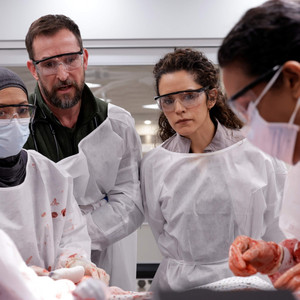
It's called The Pit.
Yeah, I just started watching that one.
It's the one about a fictional emergency room in a hospital in Pittsburgh, right?
Yeah, season one came out last year and the show just won two Golden Globes, including the prize for best TV drama.
Yeah, I thought it was a really cool concept that each episode is a single hour of a 15 hour shift.
So it's like one season is one day.
Yeah, you know it's pretty fast-paced and that means there's no time for deeply romantic subplots or even the sometimes far-fetched storylines that usually dominate those other medical dramas.
The Pit is by far the most medically accurate show that I think has ever been created.
And I'm not the only one to share that opinion.
I hear that a lot from my colleagues.
That's Dr. Alok Patel.
He's a pediatrician at Stanford Medicine Children's Health.
And he's obviously a fan of the show.
Yeah.
I mean, I'm a fan, too.
I'm not in the medical field.
I'm a different kind of doctor.
But I found it really resonated with me, like especially the way they portray political division and mistrust in science, which we've definitely talked about in shortwave.
Yeah, totally.
Not to mention even the corporatization of healthcare.
On the whole, it's pretty realistic.
Patients, they check in for registration here.
A nurse eyeballs them, makes sure they're not dying.
If not, they're moved to one of two triage rooms for vitals and a quick chair exam where you can do labs and your x-rays.
And then they come back to the waiting room until bed opens up.
Is it always this busy?
Uh, no.
It gets a lot busier.
And the new season, it just started.
Michael, I heard you got to watch it early.
Yeah, Gina, it was so cool.
And the show's new season is streaming on HBO Max now.
So we're here to discuss whether it really holds up to the last one.
Today on the show we dive headfirst into the pit, the medical drama that's breaking barriers on how hospitals are portrayed and why health care workers are obsessed with it.
Plus a sneak peek at what season two has in store, from AI to misinformation and the realities of health care insurance.
You're listening to Shortwave, the science podcast from NPR. and many more delicious and lean protein options.
For wellness when you need it.
Shop Smart Meal Shortcuts to stay motivated, like Ready to Eat Salad Kits.
Shop all things wellness at Whole Foods Market.
This is Tanya Mosley, co-host of Fresh Air.
You'll see your favorite actors, directors, and comedians on late-night TV shows or YouTube.
But what you get with Fresh Air is a deep dive.
Spend some quality time with people like Billie Eilish Questlove, Ariana Grande, Stephen Colbert and so many more.
We ask questions you won't hear asked anywhere else.
Listen to the Fresh Air podcast from NPR and WHYY.
OK, Michael, we're going to dive into season two of The Pit.
But before we do that, let's get a quick recap of season one.
Totally.
So the first season centers on the main character and veteran attending physician, Dr Michael Robinovich, also known as Dr Robbie.
He's played by Noah Wiley.
OK, I remember him from ER, but what's an attending physician?
Yeah, that can get pretty confusing.
So attendings are doctors who have finished years of training and they manage the students, residents and fellows on their teams.
They're basically the boss, just like Dr. Robbie is the boss in the pit.
Plus his right hand man, a woman.
That's the charge nurse.
This makes sense to me.
You've got your attending and the charge nurse.
They go hand in hand.
It's the blonde lady that I remember attending.
But you had mentioned, you know, med students, fellows, residents.
What do those terms all mean?
Like, who are these people?
Yeah, totally, Gina.
It's a lot to keep track of.
So let's start with med students.
That's me.
I'm in my fourth year and med students typically start working in the hospital in their third year of school.
Their job is to examine patients on their own and learn how to start diagnosing them.
Okay.
Yeah.
Next up on the totem pole, we've got residents.
They're doctors who've just finished med school, and they're training in some kind of specialty.
And that training lasts for several years.
And then we have fellows.
Those are doctors who already finished residency training, and they want to specialize even further.
Finally, there are the nurses, the physician assistants, the social workers, and other people.
They're just as vital to the ER and how it functions.
Yeah, I'm still in season one right now, and I was very surprised.
And I know I shouldn't be, but there's like a social worker that's there all the time.
Yeah, and speaking of season one, to finish the summary, Dr Robbie's struggling to cope with some pretty traumatic memories while also treating patients and managing all those members on his team who themselves are also going through some personal struggles.
Yeah, it sounds like so much.
Plus, he has to remember all the patients he's like working with all day.
It was kind of boggling my mind.
Yeah.
And Dr. Patel told me that that's one of the most realistic parts of the show.
The reality is, if you're working a busy shift and you have things happening in your personal life, the line between personal life and professional life gets blurred and people have moments where And The Pit highlights that
Episode 11 was the climax of season one.
In the last few minutes of that episode Dana, the charge nurse played by Catherine Lanassa, talks with Dr Robbie outside the ER.
And she has this big bruise around her eye.
Oh my gosh, what happened?
Like, I haven't gotten to that part yet, but it's okay.
You can spoil it for me.
I mean, basically, she got assaulted by a patient just two hours ago.
And she tells Dr. Robbie... that she feels like she's at her rock bottom.
People are angrier, tempers are shorter, and we're still just trying to help.
I don't know.
Maybe what I want and what the patients need isn't what's best for you anymore.
Yeah.
I just honestly don't know what I'm gonna do without you.
That's so heartbreaking.
It is, Gina.
And it's also the reality for a lot of people in the medical field.
Up to three quarters of health care workers have reported experiencing violence.
Whether that's verbal abuse or physical threats or even outright assault, it all takes a toll.
The new season of The Pit still has some of that tension between patients and healthcare professional.
And sometimes it's completely projected or misdirected.
People are misunderstanding.
They're frustrated.
They get pissed off.
They can't see a doctor in time in the ER and they may act out.
That whole concept of having to suppress anxiety.
And then the frustration that there's not enough protection for health care workers.
That's a very real issue.
Yeah, it's something I hadn't really thought of until I started watching this show.
Michael, can I ask what other aspects of the pit are like, similar to what health care workers have to deal with in real life?
Like, do they go into any new issues in season two?
Yeah Gina, you know, the second season gets into some new themes like insurance AI, and it even gets into the weeds of charting.
Okay, let's take a step back.
Let's talk about the first episode of season two, which aired last Friday.
Yeah, episode one opens with that same busy and crowded ER that we're all familiar with from season one.
But this time around it's July 4th and we meet a new doctor in the first few minutes of the episode.
Wait, I haven't started it yet.
Is Dr. Robbie gone?
Oh, no, no, no, no, no, no.
He is still there.
Don't worry.
But there's another physician joining him.
Her name is Dr. Al Hashimi.
She's played by Sepe Demoafi.
She's some sort of clinical informatics expert.
When she started talking about AI, I started thinking about robots and kind of stopped listening.
That sort of captures the head-butting between her and Dr Robbie.
That kind of becomes evident as we progress through this first episode.
Her take on using AI in the ER, she actually encourages the residents to use it to take notes.
I just got a new family doctor and she used AI.
She recorded our exam and she was like, there's going to be a transcript so I know what we talked about.
Yeah, totally.
This is something that's on our radar and people are excited about it.
But there are some real concerns like patient privacy and accuracy.
And they talk about that in the show.
Yeah.
Another interesting aspect of the season is how it gets into disability and access.
What do you mean?
Well, there's this scene in the first episode where we see a patient sitting in the waiting room and this waiting room is super busy.
But as the camera pans over to her, it all goes silent.
And we quickly realized that this patient is deaf, which really impacts her experience in the hospital, how the doctors interact with her, the type of care that she gets.
And that's unfortunately true in the real world as well.
What do you mean the type of care she gets?
Like, can you give me an example?
Well, when a patient, like in this case, needs an interpreter who can sign ASL, the doctor-patient relationship can thin out.
And later in the season, we see this patient's first interaction with the doctor.
Instead of making eye contact with the patient, the doctor faces the ASL interpreter during the interaction.
And while it's subtle, you know, it can leave patients feeling pretty sidelined or even invisible.
Yeah, that makes total sense.
How else does disability make its way into this season?
You know, later in the season we also meet a doctor who uses a wheelchair to get around, which is just a reminder that medical experts are not a monolith right.
And there are both disabled and non-disabled people working in the ER.
Yeah, that's a really powerful message.
You'd mentioned earlier that insurance was a theme in season two as well, right?
Yeah, and we don't quite get into it in the first episode, but viewers will definitely notice in later episodes that insurance takes a big role.
You know, it's almost like a character itself, which seems pretty apt for this moment when many Americans are facing a really sharp rise in costs.
And in real life, this unfortunately happens pretty regularly.
While patients shouldn't have to worry about insurance, they do.
Like sometimes my patients only get what their insurance will reimburse.
And, you know, that treatment they do get, it's not always the best or even the standard of care.
Yeah.
And along these slightly depressing lines, there's growing misinformation that doctors are battling in the real world right.
Yeah, you'll find it in the pit too, unfortunately.
And I don't want to spoil anything here, but it does involve someone getting their information from social media.
My doctors have actually mentioned this.
Yeah, I mean, it's a pretty accurate representation of how misinformation can spread.
I still remember this moment from my pediatrics rotation when I was counseling a parent on immunizations.
Okay.
And I could tell the parent really, really loved their kiddo, but they ultimately declined to vaccinate their child because they were worried about a debunked myth.
And while I think it's incredibly important patients do their own research and are empowered in their care, the sources they turn to are equally as important.
Yeah.
Did Dr. Patel or other experts you talked to say what was less accurate to real life in this show?
Like, was there anything the show got wrong?
Not everything is totally accurate.
For instance, med students can't order meds.
You need that MD after your name to do that.
That makes sense.
And another thing that is unlikely is for OneShift to have so many complex cases.
These cases definitely happen, but usually not all in one day.
And one common complaint among all medical dramas is how inaccurate CPR is.
Really?
How so?
Well, CPR is pretty violent, actually.
Rip fractures occur in a majority of patients who undergo CPR, and other trauma can happen, too.
Well, it is a show.
They can't be too violent with their actors.
Michael, thank you so much for talking to me about all this.
I'm excited to watch the second season.
Thanks so much for having me.
This was such a blast.
If you liked this episode, follow us on the NPR app or whatever podcasting app you're listening from.
Also, you might want to check out our episode on the history of tuberculosis with John Green, or our episode on the closest thing we have to a cure for allergies.
We'll link to them in our episode notes.
This episode was produced by Hannah Chin.
It was fact-checked by Tyler Jones, and it was edited by our showrunner, Rebecca Ramirez.
And Maggie Luthar was the audio engineer.
Beth Donovan is our vice president of podcasting strategy, and I'm Regina Barber.
Thank you for listening to Shortwave from NPR.
On NPR's wildcard podcast, comedian Tig Notaro.
It always makes me laugh when people say she had her sense of humor to the end.
And I always thought it would be so funny to put in my obituary that I lost my sense of humor in the end.
Watch or listen to that wildcard conversation on the NPR app or on YouTube at NPR Wildcard.
NPR's podcast Trump's Terms is your source for same-day updates on big news about the Trump administration.
Short, focused episodes, one topic at a time, about five minutes or so.
We carry out reporting from across all of NPR's coverage, so you are always getting the biggest, most urgent stories.
Listen to Trump's Terms on the NPR app or wherever you get your podcasts.