Discussion keeps the world turning.
This is Roundtable.
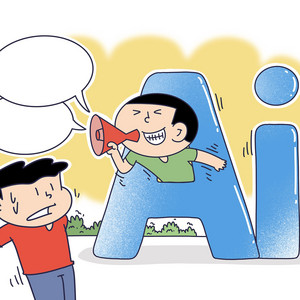
Do you agree AI is turning the internet into a digital landfill and we're all living in it?
Generative AI is creating a flood of spam, fake news and images, and shallow copycats.
Are we witnessing the birth of a new era of digital pollution?
And if so, can we hit the reset button before it's too late?
And Motivational Monday is here to turn MEH into MAGIC.
Tune in for stories and songs that will light a fire under your week.
Coming to you live from Beijing, this is Roundtable.
I'm He Young. For today's program, I'm joined by Steve Hatherly and Yu Sun in the studio, first on a day's show.
In today's digital age, artificial intelligence, or AI, doesn't just generate content, it multiplies low -quality noise at an alarming rate.
The more AI scrapes from the web, the more it learns to churn out shallow, clickbait -driven junk.
As this garbage floods the internet, it gets recycled and fed back into the system, creating a dangerous feedback loop of digital pollution.
Also, finding something real on the internet is becoming increasingly difficult.
While the web is hardly ever a perfect space for genuine connection and knowledge, at least the content was rooted in reality before genitive AI.
Now it often feels like a digital landfill where bad content breeds more bad content, further distorting the information landscape.
So here's the real question.
Are we programming our own content apocalypse?
And I have to say, I've adopted more of the dramatic tone here.
And guys, what happens when AI, which was said to streamline and innovate, starts flooding the internet with all this fake content and observers are warning the danger, but how would you guys say how bad it is?
Yeah, so advancements in AI technology have made it incredibly easy to generate text, images and videos and other types of content that we need or search, leading to a flood of low quality AI generated material on the internet.
And these contents have, like, boost every corner of the web, including news, social media, e -commerce platforms and more.
And the quality of these AI generated contents often subpar.
And for example, they may be inaccurate, unreliable and lack depth, or even contain false informational errors.
Yeah, and this has led to something called data degradation.
And that's where you have these models when they are iterating and training on AI generated data that causes the output quality to decline with each generation, ultimately risking collapse.
This is from nature .com.
You know, I've never thought about this before.
But this is exactly where we are in terms of AI and the content that it's putting out onto the internet.
And that's why these types of questions are starting to be asked.
This is what it says from nature .com.
The development of LLMs, large language models, is very complicated, and it requires large quantities of training data.
Yet, although current LLMs include, you know, for example, chat GPT, they were trained on predominantly human generated text.
And this may change, and this is the problem.
If the training data of most future models, as these models continue to come out and improve, if they're also scraping, as you mentioned in the opening, if they're also scraping from the web, then they're going to be inevitably training on data that was produced by previous LLMs.
So what happens when text produced by a version of GPT forms most of the training data set of following models, it happens in the sense that the information that was learned before from previous LLMs may be false, as Yushin touched upon, it may be unreliable, but that's the data that's going to be teaching
the new LLMs, which could cause a collapse in the future.
Right. And LLMs, if we're looking at words, I guess the impact is less visible.
But when you search the internet for images right now, immediately you'll get a taste of what we're talking about here, about AI polluting the internet and data degradation.
And Yushin, before the show, we chatted about looking up some images of the Chinese Long, the Chinese Dragon, for example, or some of these other well, also Long is a mystical creature.
So there's no photo of it, obviously.
But explain to us why is it so odd what we get now when we look up these images?
Yes. The thing is that when you're searching these kind of topics or keywords, and then the results will come up with very AI -like results.
And these images are often so far, as I said, with these kind of oily, repetitive styles making it very difficult for users to make it really useful, reference materials.
And as an example, as when you're searching a picture of Long or just magnolia of flower or snake animation, the results you're getting like 90 % will be just, it is very obvious, and you can see it's AI -generated content.
And if you go with the option of filter out AI -generated images, you can select that, right?
Even doing that, the search results will show an overwhelming number of AI -generated images, and the quality is low, and of course, that affects the user search experience.
Right. And it's really interesting.
Like on our show, we touch on cultural differences and also just this concept of the dragon, which looks a certain, which has claws and have really sturdy thighs and have this, I would say, almost like a lion -like body.
But the Chinese Long, for example, is more, the body looks more like a snake, but a really robust snake.
And I'm really not doing the mystical creature any justice, I'm sorry, but I'm trying to describe that there are these really obvious differences, but with this generation of AI -generated graphs and pictures you see online, you see this weird, nuclear version of a combination of those two, and that's
under the label of the Chinese Long.
And for Chinese people who have this background knowledge, you see this and you're like, this is false.
This is not what a Chinese Long should look like.
But if you don't have this preconceived knowledge and impression, then you might think, okay, that is what it is.
But so this is only one of the very vivid examples of how fast generative AI has already, if I may say, polluted the internet.
And also some game fans, they're complaining about, I don't know why this is making news on social media.
Apparently the game guys in this country are crappy now because of generative AI.
Is generative AI really the culprit here?
It's very specific, isn't it?
Yeah, if you know what happened, I think you'll feel the same with them.
The thing we discussed is the images that these generative AI created and they will also create these kind of false texts or even some time news.
Game guides are being polluted by AI as well with a large number of incomplete, inaccurate, or even false guides.
And many of these guides are AI -generated with empty content that says nothing, absolutely nothing.
Like when you're searching, how can I get through these traps?
And then they will guide you like, oh, now you're going to this in this game and now you open your something, blah, blah, blah, and you go back and now, oh, we can see this is the game you're playing.
That's basically talking nonsense and you're going through everything trying to get a clue or just a guide and you're just wasting your time.
Yeah, now that might, you might listen to that information and think, well, who cares?
It's just about game guides, right?
But it's just another example of the internet steering us in the wrong direction.
There was a research report by the New Media Research Center of the School of Journalism and Communication here in the country and they said that since 2023, the overall situation of online rumors has been stable.
But AI -generated rumors in total have seen a 65 % increase in the past six months.
And among AI -generated rumors in recent years, economic and business related rumors account for the highest proportion.
That's over 43%. And in the past year, the growth rate of economic and business related AI rumors has surged by over 99%, almost a full 100%.
Now, game guides may be not as serious, but when we talk about these things, then all of a sudden it becomes very real.
And NewsGuard is a news website rating company and they discovered 49 fake news websites and using AI -generated content in early May 2024.
And by the end of June, this number had risen to 277.
Goodness, in a month, basically, a month and a half.
Yeah, and we know fake news can spread online.
There were examples from here in China where fake news was being spread online.
Yes, for example, in 2023, a fake news claiming a bloody incident at a Zhengzhou meat shop, which is in central China, but it's all fake, of course, where a man killed a woman with a brick or another news.
A train in Gansu crashed into road workers resulting in nine deaths.
And all of these were generated using AI tools and fake.
And actually, they lead to some of bad results where people think it is actually real.
I don't know what the irony is here.
If fake news sometimes sound like real news or… Well, there's a reason, there's a way that fake news is being generated.
That is, it's often modeled off real news and also it often is created.
Is it to manipulate people?
To… sometimes it's hard to exactly pinpoint the purpose of it.
Yeah, because it's done for different reasons, I think, right?
For example, last year on Halloween in Dublin in Ireland, someone used AI to generate a fake Halloween parade of information for it.
And hundreds of people saw that and hundreds of people gathered on the street waiting for a parade that didn't exist.
Now that's not so serious, right?
You might see that as kind of a funny practical joke.
But imagine if that was for something serious and all of those hundreds of people, if not more, showed up for something… Something else.
Yeah, right? Now back to the original point about why this is becoming a problem.
If the internet is doing this now, if AI is doing this now and future LLMs are scraping from websites, then they're just… the problem with content is going to be… Exacerbate.
It's going to get bigger and bigger and bigger as the years go by.
Yeah. Maybe like one year later when you're searching like severe accidents, these can be the examples that AI tell you but actually they're not real.
And sometimes AI can tell you in a really, really authentic tone telling you that, oh, this is really happening.
Right. So is this the Hallucination 2 .0?
Remember when AI… well, generative AI first became a big thing that was in late 2023 when chat GPT was dropped into this world for consumer use.
And sometimes it and other large language model tools would spew crap in a really serious tone.
And then back… well, that's called Hallucination.
And then now with this exacerbation of bad content, looping back into bad content is a sort of… it's not Hallucination anymore, right?
It's just the system might be broken or let's say one loophole has been exploited, and so it can't refer… it can't verify real information.
And this leads to a decrease in users' trust in online information.
Do you remember when we did the story, I think it was about an Indian tech company and the CEO was introducing all these new AI tools and thinking it was going to really be a helpful thing for his office and then the employees were complaining about it.
And one of the major complaints was the employees were spending more time working because they had to double check or triple check the information that the AI tools was giving them because they couldn't trust that what they were receiving was accurate.
And this is going to be a problem with the trust of the Internet.
When the Internet started, I mean, we didn't even think about trust as an issue, right?
We just assumed that the information we were getting was reliable, but now users' trust in the Internet has gone down.
There are percentages that show that and it's only going to get worse as this problem becomes bigger.
There have… we are already seeing some of the results showing on like search engines or communities, online communities, the online tech community, Stack Overflow, temporarily disabled answers and responses generated by Chet GPT after a large number of incorrect answers were submitted and also the American science
fiction magazine, Clark's World, paused accepting online submissions after receiving a flood of AI -generated story submissions.
So these are the actual results or they are not very, as we can see, because these organizations have stopped it timely.
But if we are… if they didn't do this, the results can be seen as maybe a whole magazine are full of like content generated by AI.
Yeah. You also kind of alluded to and I bet everybody still remembers, you know, the great benefits that generative AI could bring to us.
And now, well, we're in 2025, only, is it less than two years since the drop of Chet GPT and you know, generative AI becoming such an integrated tool for everyday use.
What do you make or how do you make of the situation we're at right now?
Because already we're seeing, oh, so much garbage has already been created in the digital sphere.
Well, the content farm model is on the rise and that's where AI is used to generate large volumes of low quality content.
And they do that to gain traffic and gain revenue.
And that model harms the healthy ecosystem of content creation, making it hard for high quality content to stand out.
Yeah, content farm, it's an interesting term that we should know.
It's a company or an organization that produces a large amount of low quality videos or memes or social media posts or online articles on many different topics.
And then they'll use keywords and algorithms so that this content is placed prominently in social media feeds or on Google, for example.
And sometimes this high quality content is being turned into videos, forcing users to spend more time watching videos where they may encounter low quality video content.
And again, that lowers the search efficiency and it lowers that, again, to use that term, the overall user experience and trustworthiness of the Internet.
And sometimes these videos can be fake as well, you know, they're generated by AI.
So that really annoys me.
One example is that I've came across a lot of trailers for sequels to well -known movies on video platforms.
I like to watch these trailers.
And, you know, when you're watching these, the voice overs, the special effects and everything was like so complete and they look so real.
And then after watching them for like two minutes or even I finished it, I realized that it is a fake trailer.
It's good that you realize that is fake because and also you're shown as somebody who's pretty tech savvy and is on top of these new developments in the tech world.
Just think about the tons of people, you know, every day people realize that you don't spend so much time thinking about tech and the development of it and then you encounter something like this is really difficult for the average person to tell the difference.
Yeah. And that's that's no slight on the average Internet user.
That's not to imply that they're stupid or that they should be able to distinguish the real from the not real because these are becoming indistinguishable.
The fake versus the real.
And I got fooled, too.
This isn't AI, but it was an example of fake news.
This is maybe, I don't know, eight or nine years ago.
There was a story on the Internet.
I read it right before I was doing my radio show in Seoul and it was about David Getta, the the DJ.
I think he's from the state.
No, he's from France, I think.
Anyway, the story said David Getta doesn't DJ.
He just goes on stage and presses play on a button and just stands there with the crowd.
I was blown away. I went right on my show and I said, I can't believe David Getta and me speaking to, you know, a couple of hundred thousand people sharing this information that was fake.
I found out after it was fake.
But at that time, I didn't even know that there was fake versus real on the Internet.
I just trusted everything I saw and everything I read.
Those fake news websites look incredibly authentic.
These fake videos look incredibly authentic.
So how can we clean up this mess before the bad use of A .I.
destroys the web? We know the world.
What can we do? First of all, of course, these A .I.
companies, you know, they should develop more powerful security filters to block the generation of these inappropriate content such as violence, pornography or false information.
And these security measures should be continuously updated and improved to address these emerging technical vulnerabilities.
For example, methods could be explored to embed hidden signals or distort pixels in images and making it harder to produce deep fake content or just label the content that was generated by A .I.
very, very clearly and making them not use it as a like, generate a Gantt source.
Yeah, this is from CNN from March of 2024.
Starting in March of last year, YouTube creators, this is what it said, YouTube creators will be required to label when realistic looking videos were made using artificial intelligence.
And that was part of a broader effort by that company to be transparent about content that could otherwise confuse or mislead users.
So when a user uploads a uploads video to YouTube, they see a checklist asking if their content makes a real person say or do something that they didn't do, alter footage of a real place or event or depict realistic looking scenes that didn't actually occur.
This is one of the things that that company is doing to help make sure that people know A .I.
content is A .I. content.
Yes, indeed. And what about you mentioned, Steve, that in theory it shouldn't the onus shouldn't be on us, the average user, to tell what's fake, what's not.
But in everyday life, don't you feel like the onus is kind of on us for you to not fall into these traps?
Because of course, we can talk about who else can help out here.
The government, the tech companies, they have huge responsibility here, but as an average everyday user, when I look at my phone right after this show, isn't it up to me that I know that fake incident of nine people killed in some accident is actually fake?
Yeah, I mean, maybe that's fair to say that when you read something on the Internet, maybe double check it or triple check it to make sure.
But I mean, think about that.
When we're scrolling through our phones and you see a real video right next to a fake video, I don't think it's fair to ask people to say, oh, you really need to know the difference between the two.
Because if something if you fall for it, then you bear the consequences in reality.
That's true. I mean, some experts are recommending that AI companies stop pursuing larger and more complex models.
Just stop. Stop doing that because that could lead to data depletion and again, the model collapse.
But I understand your point.
You know, some responsibility perhaps should fall on us, but it's still the state of the Internet right now.
And I guess they're trying to figure out the proper ways to conduct.
Yeah, so digital literacy, media literacy.
You know, that's really important these days.
Yeah. So I think in that way, I think ordinary users like us should be cautious when sharing information on social media or other platforms because like when we are sharing it, we're kind of proving that, OK, we believe this and this could be true.
And some people who trust you will think that, OK, it is true as well.
So avoid the spread of unverified or clearly AI generated content.
And another thing is that when we realize that something that is like false information or harmful content, we should actively report these information and low quality content and other harmful material to help to maintain a kind of healthy online environment.
And how realistic do you think it is to ask maybe the governments to come up with regulations and also the tech companies to filter and stave away the low quality or false information that's being that's the second generation of generated content that's feeding back into the loop?
I think it's very fair to ask governments to be involved.
I mean, using AI to write content and news reports is is nothing new.
The AP, the Associated Press, they started doing this back in 2014, but now we're seeing government officials, government leaders used in deep fake video.
So I think it's in their best interest to come up with policies to protect the public and to protect themselves.
Yes. And the digital world is kind of at crossroads when we think about it.
AI's ability to generate vast amounts of content may offer convenience and productivity, but the long term consequences of flooding the Internet with fabricated and low quality material can undermine the very fabric of trust, creativity and meaningful interaction that once defined the Internet.
And all of this is up to, well, all of us, creators, consumers and especially tech companies and policymakers to steer this technology toward positive change with tech companies and governments playing a pivotal role in designing ethical frameworks and safeguards before it drowns us in all this noise.
And we'll be back with more roundtable discussions.
Stay tuned.