N .P .R. This is The Indicator from Planet Money.
I'm Whelan Wong, joined today by our friend Mary Childs from Planet Money.
Hi, thank you for having me here.
It is so great to have you here.
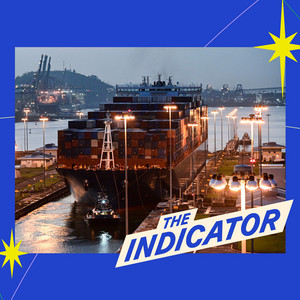
And today we are talking geopolitics and how they're playing out at the Panama Canal.
As you've probably heard, President Trump has some major grievances with this crucial piece of the global economy.
Yes, he has said that China controls the canal, even though it is owned by Panama.
And just yesterday, the administration scored a victory.
American investment fund BlackRock agreed to buy majority stakes in two ports at the Panama Canal.
This deal transfers ownership in these ports, plus dozens of other ports in other countries, from a Hong Kong -based company to a U .S.-led consortium.
So the Trump administration may be placated on that front, but it remains unhappy about how much the Panama Canal charges for tolls.
The president has called these fees a ripoff.
So today on the show, we are going to focus on that.
What does it actually cost to go through the Panama Canal and who foots the bill?
We sort out who pays what to use this all -important waterway.
And we talked to someone with his own idea of how pricing could be made more fair.
service wealth management, and advice when you need it.
You can also invest on your own and trade on Think or Swim.
Visit schwab .com to learn more.
This message comes from Greenlight.
Did you know that parents rank financial literacy as the number one most difficult life skill to teach?
Meet Greenlight, the debit card and money app for families.
With Greenlight, you can send money to kids quickly, set up chores, automate allowance, and keep an eye on your kids' spending with real -time notifications.
Kids learn to earn, save, and spend wisely.
And parents can rest easy knowing their kids are learning about money with guardrails in place.
Try GreenLight risk -free today at greenlight .com slash NPR.
This message comes from NPR sponsor, Land's End Outfitters.
You've worked hard to build your brand, so why settle for one -size -fits -all clothing?
Land's End Outfitters creates apparel your employees truly want to wear.
See why Land's End Outfitters has been a branded apparel supplier to some of the world's most respected brands for more than 30 years.
Go to business .landsend .com slash pod20 and use code pod20 for 20 % off your first product.
That's business .landsend .com slash pod20.
Code pod20. To start with some history, the U .S.
built the Panama Canal and controlled it for decades.
In 1977, the U .S. and Panama signed two treaties that eventually ceded full ownership over the canal over the next couple of decades.
So Panama now owns the canal.
But the U .S. remains the waterways number one user.
Some 40 % of U .S. containership traffic goes through every year.
The canal is also important for military and strategic reasons.
The Panama Canal is controlled by an independent arm of the Panamanian government.
The agency is called the Panama Canal Authority, and this is the organization that sets the rates.
Jean -Paul Rodrigues is a professor at Texas A &M University in Galveston.
He's an expert in maritime transportation and economics.
And this is how he describes the canal authority's approach.
The goal of the Panama Canal, from their perspective, is to extract as much revenue as possible from the operation because it's expensive to operate the Panama Canal.
They've done a lot of investment.
At the same time, also to still have my customers.
Jean -Paul says the Panama Canal operates like your typical business.
Make as much profit as you can while keeping your customers happy.
Operating expenses for the canal totaled almost $2 billion in 2024.
And about a decade ago, the Canal Authority finished a massive years -long expansion project that cost over $5 billion.
The Canal Authority borrowed money to help pay for that expansion.
So it needs to make money to operate the canal and pay back that debt.
That money comes mostly from tolls.
But if the rates are too high, shipping companies might choose to go over land by rail, or they could go through the Suez Canal depending on where they're located.
They are alternative.
You're not in a pure monopolistic situation.
So it's been a talk of war type of game in recent, you could decades or so, between the users and the Panama Canal Authority, which must finance its operation and also must pay the Panamanian government.
So let's look at how the canal makes money through tolls.
The first thing to know is that the rates are not determined by a ship's country of origin.
So American ships, they don't pay more than anybody else.
Instead, fees depend on the type and size of ship that passes through.
We will look at government ships first, since this was a point of friction between the Trump administration and Panama.
According to a report by Bank of America, the average fee for a U .S.
warship to go through the canal is $30 ,000 per transit.
Revenue from warships and other government vessels like naval repair ships add up to just several million dollars per year on average.
Still, the administration believes any fee is unacceptable.
Secretary of State Marco Rubio made this clear on an official visit to Panama last month.
I find it absurd that we would have to pay fees to transit a zone that we are obligated to protect in a time of conflict.
Rubio is referring to those treaties between the U .S.
and Panama. Those agreements give the U .S.
permission to use military force if the canal's neutrality comes under threat.
After Rubio's remarks, the State Department said that Panama had agreed to stop charging U .S.
government ships to go through the canal.
Both the Panamanian government and the Panama Canal Authority denied this.
We reached out to the State Department.
It told us that it's confident the two sides, quote, will find a way forward, end quote.
And it called Panama a strong and trusted U .S.
ally. Even if U .S. government ships get to use the canal for free, they are only a small part of the waterways traffic.
The biggest users of the canal are commercial ships.
John Paul says when it comes to commercial ships, the toll has three basic parts.
First, there's a base fee, and then there's a fee that's charged per ton or per container, depending on the type of ship?
There is actually a fee for each type of ship.
Container ship, oil tanker, refrigerated ships, you name it, there's a specific fee that applies.
After the base fee and the per ton fee, there's a third category of service charges.
This covers inspections and even things like paying extra to get priority.
Jean -Paul says that when you add up all these fees, there is a huge range in what these ships pay in tolls.
It can go from a half million dollars up to $1 .5 million for some of the larger ships.
In recent years, a lack of rainfall has led to low water levels at the canal, and that meant fewer slots each day for ships to go through.
And so the Panama Canal Authority has adjusted its fees in response.
It started collecting a freshwater surcharge for ships of a certain size.
It also introduced an auction system.
Now shipping companies can bid on a limited number of slots.
In 2023, Bloomberg reported that a Japanese firm paid a record $4 million for a gas tanker to get one of those slots.
Michalis Marakakis is a business professor at the University of Navarra in Barcelona.
He says this auction system is open and transparent.
Plus, it does the job of allocating a scarce resource, which in this case is a transit slot at the canal.
But he does have one critique.
It favors the big shipping lines, the big companies that can afford to pay as much.
So it creates essentially this unfairness, this distortion in the market.
Mahalas and a couple colleagues wrote up a proposal for a different kind of auction system.
It works like this.
Let's say there is a line of ships waiting to go through the canal.
And let's say I join the line in last place and you, Mary, are right ahead of me.
I offer you some amount of money to go ahead of you, and you can accept or decline based on how badly you want to keep your place in line.
Or how bad I want the money.
Yeah. If at some point I make a bid to the vessel ahead of me in the line and that bid gets rejected, then I stop and I just wait for my turn.
This kind of system is called sequential bidding.
Mahalas says the advantage of this process is that it lets a smaller shipping company get compensated for giving up its place in line.
He says this makes the system more fair while also keeping it efficient.
It's not that the Panama Canal is like greedy capitalists trying to rip anyone off.
They need the money.
On the other hand, that comes at the expense of smaller firms, probably who are serving smaller customers.
So it's the how are you trading off the equitability with the market efficiency.
The Panama Canal Authority hasn't telegraphed any changes to its auction system.
It has, however, raised its tolls.
The most recent increase went into effect in January.
Maritime expert John Paul Rodrigues says that even though those fee hikes were announced years ago, they caught the attention of the Trump administration.
Any change in the toll structure has an economic impact within the United States.
And when they saw the toll increases, it created some kind of a response.
Is this pushback justified or not?
It's a matter of debate, but it is not coming out of a vacuum.
We emailed the State Department to ask whether it has a position on the fees that commercial ships have to pay.
It told us in a statement that these fees per treaty obligation to the U .S.
must be, quote, just and reasonable and non -discriminatory.
Meanwhile, Jean -Paul says, the canal has a big expensive challenge ahead of it.
The canal authority is planning to build a dam to create a new reservoir that will help tackle its water issues.
Construction is expected to start in 2027.
This episode was produced by Julia Ritchie with engineering by Jimmy Keely, with fact check by Lily Kuros.
Kate Kincannon is the show's editor and the Indicators of Production of NPR.
this message comes from charles schwab when it comes to managing your wealth schwab gives you more choices like full service wealth management and advice when you need it you can also invest on your own and trade on think or swim visit schwab .com to learn more support for this program comes from texas mutual insurance company a workers comp provider dedicated to handling claims efficiently and compassionately their specialized adjusters are trained to take policy holders through each step of the process, providing clarity and direction after an on -the -job accident.
By proactively working to support businesses from the time a claim is reported, Texas Mutual can help injured employees get back on the job and back to their lives.
Learn more at texasmutual .com slash claims.
This message comes from Warby Parker.
If you wear glasses, you know how hard it is to find the perfect pair, but step into a Warby Parker store and you'll see it doesn't have to be.
Find a Warby Parker store near you at warbyparker .com slash retail.