Hi, I'm Marc Sanchez, brains -on, resident taco lover, and weird gadget inventor.
Almost every brains -on episode starts with you.
You send us a question and we build a show around your curiosity.
But there's another way you're at the heart of the brains -on universe.
This is a public radio podcast, and you are the public.
That means we rely on your donations to keep us going strong.
Every donation makes a difference.
Contribute any amount today at brains -on .org -slash -donate.
You're listening to brains -on, where we're serious about being curious.
Brains -on is supported in part by a grant from the National Science Foundation.
Magic fish ball, magic fish.
Tell me, will I win the meat raffle tonight?
Try again later? This thing is useless.
Brains -on producer Rosie Dupont, what are you doing in the broom closet?
Hi, Molly. I'm not Rosie today.
I'm the rose that knows, future seer, advice giver, freelance stylist and interior designer.
How can I help you?
I've got some questions.
And I've got answers.
Here, take a seat on this bucket.
This broom closet is kinda crowded.
Oh, come on. It's my new fortune telling office.
It's full of fantastic tools.
Look at this empty fish bowl.
It's like a crystal ball.
Just put your hand on it and say, magic fish bowl, tell me.
And then ask your question.
Okay, magic fish bowl, tell me, can twins feel each other's pain?
I just felt a pain in my foot.
I must have stubbed my toe on that vacuum.
Or maybe twins do feel each other's pain.
Okay, next question.
Okay, magic fish bowl, tell me, did the Vikings really have horns on their helmets?
I'm getting a vision of you, Molly.
You're wearing a helmet with horns and holding a giant spear.
You look like a Viking.
And what's that? You're singing opera, like la, la, la, la.
So what's the answer to my question?
What was your question again?
Did the Vikings have horns on their helmets?
Try again later. Look, these questions aren't really in my wheelhouse, shall we say.
I do better with questions like, how many eggs are in a dozen?
Or is burnt sienna in my color palette?
If you want answers to your questions, you should talk to a twin specialist or a Viking expert.
Great idea, Rosie. I think I will.
Oh, great. Well, be sure to tell them the rose that no sent you.
If they wanna come in for a consultation, send them to the end of the hall on the eighth floor in Broom Closet B.
And I'll read their fortune.
You're listening to Brains On from APM Studios.
I'm Molly Bloom, and my co -host today is Maya from Chico, California.
Hi, Maya. Hi, Molly.
So as you probably know, listeners send us lots of questions, like hundreds a month.
So many questions. And we love them so much.
We notice that there's a special kind of question that we get every so often, and this kind of question begins like this.
Is it true that? We love these questions.
Maybe you heard something from your friend or saw something on TV, and you wanted to know.
Is that thing true?
And how do we know if it's true or not?
That's called being skeptical.
It means you don't just believe everything you hear.
You question things.
It's a great way of staying curious.
A few years ago, we did a series of episodes about this called Prove It, where we looked at how journalists and scientists find the facts.
You can find links to those episodes on our website, brainson .org.
Those episodes answer a few, is it true questions too, like.
Is it true that ladybugs are as old as they have spots?
I've heard that diamonds are the strongest material in the world.
Why is this, and how do we know it's true?
Hi, my name is Lily and I'm from Phoenix, Arizona.
I've heard that coffee can stunt kids' growth.
Is that true? Do fish have brains?
And I heard they have a three second memory.
Is that true? Such great questions.
You can find answers to all of them in our Prove It series.
Go check out those episodes.
And if you have an is it true question, send it to us.
What thing have you heard that you wonder about?
We love finding answers for you.
You can send them to us at brainson .org slash contact.
We love you. Today we're answering three more is it true questions from our listeners.
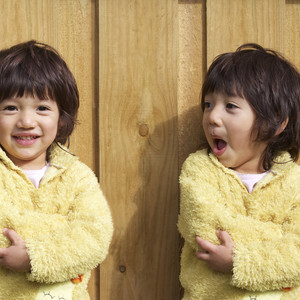
And the first is, is it true that twins can feel when the other is sad or in pain?
Do you think twins have some kind of connection in their brains?
No, I don't think so.
Okay, well, we have someone here with us today who might be able to help us figure this one out, our intern, Jess Miller.
He's actually a twin himself.
Hi Jess. Hi Molly. Hi Meyer.
That's right. I have a twin brother named Thomas.
He lives in Virginia where I grew up.
He and I were born on the same day just one minute apart.
Are you two pretty similar?
Not really. To understand why, let's cover some twin basics.
There are actually two main types of twins.
Some look really similar to each other.
They're called identical twins.
Identical means exactly alike.
And one reason why identical twins can look so similar is that their DNA is almost exactly the same.
Oh, I've heard of DNA.
It's like a set of instructions for making a body.
Correct, Amundo. Now, it's not guaranteed that identical twins will look the same, but they're more likely to because like I said, they have very similar DNA.
The other kind of twins are called fraternal twins.
My brother Thomas and I are fraternal twins.
I have curly hair and he has straight hair.
He has brown eyes and I've got blue eyes.
And even though Thomas doesn't like to admit it, I'm actually a couple inches taller than him.
So I'm guessing you don't have exactly the same DNA then?
Right. Fraternal twins like us only share half of our DNA, which is about the same as any other siblings with the same parents.
And we don't just look different.
We act different too.
When I was a kid, I liked art and writing.
Thomas liked math and sports.
So, yeah, even though we're twins, we're pretty different.
Jess, we're really lucky to have a twin expert like you here because we're hoping you can help us answer our first Is It True question?
Is it true that twins can feel when the other is sad or in pain?
Great question. It seems like siblings who are born at almost the exact same time or who even share the same DNA like identical twins do would have some kind of special connection, right?
So it makes sense that people might think twins can feel each other's emotions.
I couldn't remember a specific time when that ever happened to me.
But I called my twin brother Thomas to find out his side of the story.
I don't think I can say a time, certainly now that we live, you know, across the country from one another, there's I'm never walking around and thinking, like, Jess feels sad today or Jess just stubbed his toe.
Maybe we should start texting each other when we hurt ourselves.
Yeah, well, let's try it.
I'm going to pinch my arm right now my my left arm.
I'm going to pinch it near the elbow.
And you tell me if you can feel anything.
No, I'm not feeling anything.
Why don't you give it a try?
OK. Right arm getting pinched.
No, not feeling it.
There you have it. Conclusive evidence.
Hmm. So, Thomas and Jess can't feel each other's pain.
Is that true for all twins?
Good question. Scientists have actually tested that with different experiments.
In one experiment, they took two twins.
We'll call them twin A and twin B.
Then the scientists put the two twins in separate rooms and at random times, they'd show twin A something to surprise or scare them.
Oh, oh, sorry. Just thinking about being scared scared me.
Totally get it. Anyway, where was I?
Oh, right. They'd show twin A something scary or surprising.
Then they'd have the other twin, twin B, hooked up to a special machine that took pictures of their brain.
To see if twin B could sense when twin A was in pain just by looking at what was happening in their brain?
Exactly. When someone is scared, certain spots in their brain activate and scientists can see that using the brain scanner machine.
But here's the thing.
In this experiment, those brain pictures showed that twin B couldn't sense when twin A was scared.
Hang on. I've heard so many stories of twins who have some kind of connection, like in 1979, two twins who'd been separated at birth for almost 40 years found each other again.
It turned out they had the same exact job, drove the same kind of car and married women with the same name.
They even gave their sons the same name.
Whoa, that's wild. Yeah, there are lots of stories of twins who have some kind of special connection, especially identical twins.
Some of this is probably because they have almost the exact same DNA.
And if they grew up in the same household at the same time, it means they're more likely to think, act, and move through the world in a lot of the same ways, just like any other siblings.
Right. But scientists have tested this over and over again, and they've found that twins don't seem to be able to feel each other's emotions.
So to answer the question, is it true that twins can feel when the other is sad or in pain?
As far as we know, no, they can't.
Right. If new studies are done that find something different, we might change your minds.
But for now, it seems like this idea is fiction, not fact.
Thanks, Jess. My pleasure.
So long. And we have a lot more mysteries to talk about, starting with the...
You ready to hear it, Meyer?
Yeah. Here it is. OK.
What do you think? I think it's someone that left their phone in the washer.
What makes you think that?
Because the water and then, like, the rumbling, yeah, I definitely heard water, too.
Or, like, someone that, like, left their phone or, like, put some recording device under, like, a sink or something.
OK. So it's, like, near a sink or a washer, something that has water going on.
Do you think their phone or recording device is OK after that?
Yeah, probably. OK.
Phew. Was waterproof or something you think?
I mean, they could do it if they put, like, plastic wrap around their phone.
Ah, OK. Very smart.
All right. Let's hear it one more time.
OK. Any new thoughts after hearing it again?
Like, maybe someone, like, washing dishes.
Oh. That totally could be it, too.
OK. So it seems like we're pretty confident water's involved.
We're going to hear the mystery sound again, get another chance to guess, and then we'll hear the answer after the credits.
So stick around. We are working on an episode about how paper is made.
Paper is all around us.
There's pizza boxes and toilet paper, books, and wrapping paper.
We use it to pay people, wipe up messes, share ideas, and so much more.
And we want to see your paper creations.
What have you made out of paper?
Origami sculptures?
Paper planes? What's something cool that you've made out of paper?
Probably drawing. Oh, very nice.
What do you like to draw?
I can, like, do someone's name in block letters and then make it look 3D.
That's really cool.
Well, listeners, take a picture of your paper creation and send it to us at brainson .org slash contact.
While you're there, send us your mystery sounds and questions.
Like this one. Why does bread have holes in it?
You can find answers to questions like these on the Moment of Om podcast, a short dose of facts and fun every weekday.
Find Moment of Om and more at brainson .org.
So keep listening. Brains On Universe is a family of podcasts for kids and their adults.
Since you're a fan of Brains On, we know you'll love the other shows in our universe.
Come on. Let's explore.
Brains On! I'm their biggest fan.
I also love Forever Ago, a fun history podcast for the whole family.
Listen, I will play you Forever Ago now.
You will love. Homing pigeons were a speedy way to deliver messages to military bases.
Some pigeons could fly hundreds of miles in a single day, zipping through the air as fast as 60 miles per hour.
That's so fast for such a tidy bird.
These pigeons delivered lifesaving messages throughout the war.
Zorp! Where did the signal go?
Must find Forever Ago now.
Listen to Forever Ago, wherever you get your podcasts.
Today's episode is sponsored by Select Quote.
Getting life insurance is one of those very grown up things that you sometimes don't think about until you realize, hey, I'm the grown up in this family and I should probably think about life insurance.
You want your kids and your spouse's future to be financially secure just in case something unforeseen happens.
And with life insurance through Select Quote, a customized affordable policy can do just that.
Select Quote is one of America's leading insurance brokers with nearly 40 years of experience, helping over two million customers find over seven hundred billion dollars in coverage since 1985.
If you've been worried about trying to fit shopping for life insurance into your busy schedule in as little as 15 minutes, a Select Quote licensed insurance agent can tailor a life insurance policy to your family's needs and budget.
Get the right life insurance for your family for less at selectquote .com slash brains on go to select quote dot com slash brains on today to get started.
That's select quote dot com slash brains on.
Hi, friends. Today's episode is supported by Wild Interest, the new podcast created by curious kids for curious kids.
Wild Interest is the new podcast created and hosted by children where hilarious sibling hosts shared jokes and stories get to the bottom of mysteries like Bigfoot and Mothman and even interview a few cool grown ups along the way.
They like to explore nature, science, current affairs and even the paranormal.
Parents, you're going to love Wild Interest because it's rooted in kindness, compassion and curiosity.
Kids will love that we have episodes on everything from what it's like to track nature in the deep woods and how to avoid being tracked on the Internet to why some sailors are living on a half sunken ship in the middle of the South China Sea.
This series celebrates our innate curiosity with childlike innocence that touches the heart and sparks the imagination.
Let your kid's imagination run wild and check out Wild Interest, the new podcast for curious kids by Curious Kids.
Wild Interest, find it wherever you get your podcasts.
It's wild. But, but, but, but, but, but, but, but, but, but, but, but, but Brains On.
You're listening to Brains On.
I'm Meyer and I'm Molly.
Today we're taking some of the is it true questions you've sent us and putting them to the test.
If you have one, send it to us at brains on dot org slash contact.
We just heard that twins cannot feel each other's pain.
Next up, we'll answer a very different kind of question about the Vikings.
Vikings were fearsome warriors and skilled sailors.
About a thousand years ago, they dominated Europe and beyond.
Viking warriors paddled longboats that sometimes looked like dragons.
And they wore helmets with horns, or did they?
Recently, we got this question from Cora in Portland, Oregon.
Is it true that Viking helmets didn't have horns?
We decided to ask Dr.
Heidi Norgard. She's an archaeologist from Denmark.
And she knows a lot about Vikings.
The Vikings we know today are a kind of a fairy tale that was told in the 1800s.
This was hundreds of years after the time of the Vikings.
So people in Europe hadn't seen Vikings for themselves.
Most people in Europe at the time lived and worked on farms.
The steam engine was becoming more common.
And people were becoming more familiar with Viking myths and stories.
Around the same time, archaeologists were very interested in the treasures they found from the Viking age.
Artists were interested, too.
They began painting pictures of Vikings with big beards, muscles and horned helmets.
There was even a series of operas that came out called the Ring Cycle, inspired by Viking mythology.
Here's Heidi again.
This opera is about strong men who are fighting for their country.
And the designer of the costumes wanted to have these men look even more strong.
And he was the one that put horns on the helmets.
That was his kind of design.
So the idea is born in the opera.
And until today, we haven't changed this picture.
So a costume designer and a few artists in the 1800s created this image of Vikings wearing horned helmets, and it sticks with us today.
But to answer Cora's question, Vikings did not have horns on their helmets.
Whoa, big time plot twist.
Vikings didn't have horned helmets.
Which makes sense when you think about it.
Horns would have made their helmets take up too much space on warships.
And they would have been dangerous and clunky in battle.
A helmet should help the thought away from your head.
It kind of glides off the helmet.
When you put horns on your helmet, the thought will get catched in the horns.
So Vikings wore simple helmets made of iron or leather or no helmets at all.
But ancient helmets with horns have been discovered where the Vikings once lived.
For example, about 80 years ago, people discovered two ancient metal helmets with big, bull -like horns in Denmark.
So how do scientists know these helmets didn't belong to the Vikings?
When archaeologists looked closely at those horned helmets, they realized they were similar to objects from the Bronze Age, way before the Vikings existed.
A few years ago, Heidi and a team of scientists tested ancient glue found on one of the horns and confirmed the truth.
Those helmets are at least two thousand years older than the Vikings.
They belong to someone else.
Archaeologists solving ancient mysteries.
I've always wanted to be an archaeologist.
Oh, my gosh. When did you start getting interested in that?
Ever since I read about Pompeii.
Oh, Pompeii is so cool.
Can you tell me what Pompeii is in case kids don't know what it is?
It was this city that was covered in ash because Mount Vesuvius erupted.
Oh, my gosh. So, like, the whole town in Italy is basically like preserved because of all of the ash that fell on it, right?
Yeah, that's so cool.
So what kind of archaeology would you want to do?
Probably like that or being a paleontologist?
OK, yeah. So, yeah, the difference between archaeology and paleontology is archaeologists study humans and paleontologists study ancient dinosaur stuff and other old animals.
But you're interested.
You're interested in old stuff that doesn't exist anymore.
Is that because it's kind of mysterious?
Yeah. Very cool. Like, what's the question you have about the past that you would want to find an answer to?
How old are humans?
Like, when did our new species start existing?
Hmm, excellent question.
Yeah. I can't wait till you're an archaeologist and you find some answers.
Digging into the past is so much fun and so is digging into tricky questions.
Lucky for us, we have one more to answer.
My name is Holland and I'm from Massachusetts.
I was wondering, is it true the dogs can't see as many colors as humans?
I have wondered if that's true.
That's something a young scientist named Jay Knights wondered too.
Let me set the scene.
It was the late 1980s.
Jay was working in a lab that studied how brains see color.
When I would tell people that I work on television, they a lot of times would ask me different questions about it.
And one of the most common questions people would ask is about what kinds of colors dogs see.
Are dogs really colorblind?
Back then, a lot of people thought dogs could only see black and white.
But Jay looked into the research that existed and there wasn't a lot.
And the research that did exist hadn't found an answer.
The lab Jay worked in had developed a way to test color, vision and animals like monkeys.
So he set out to find an answer about dogs.
The way we do it is we start with a question and, you know, then we come up with a tentative answer to that question.
So the question is, do dogs see color?
This is how science works.
First a question, then a hypothesis.
That's a prediction of an answer to your question.
We have a hypothesis, it makes a prediction and then we can test that prediction.
So the question was, do dogs see color?
And the prediction was, yes, we think they can.
And Jay started with a dog he knew very well.
My wife and I had a little dog, a toy poodle.
His name was retina.
Yes, retina like the part of the eye that senses light.
Your whole body is made up of cells.
You got blood cells, brain cells, bone marrow cells.
The list could go on and on, but we don't need to.
You get the idea. Your eyes made up of cells too.
And on the retina, that special light sensing part of your eye, our special cells called cones.
Humans have three kinds of cone cells.
Cones that sense red light, cones that sense green light and cones that sense blue light.
With these three cones, we can see a whole rainbow of colors.
When Jay tested retina, the dog, he figured out that retina's doggy eyes had two types of cone cells, ones that sense blue light and ones that sense yellow light, which means they see the world in shades of blue and yellow.
Then Jay tested a few other dogs and found these dogs results were the same as his dog retina.
The data supported the hypothesis.
So it seemed like his guess was right, at least based on what we know now.
Science, you can never prove something completely, but we do an experiment and then go, OK, our hypothesis so far seems well supported because this is what we would predict.
Did he just say science can never prove something completely?
He did. That's because scientists are really good at understanding that there's so much about the world we don't know.
New technology could be developed that shows us things in a new light.
New questions could be asked that give us a new way of understanding something.
So scientists are good at pointing out that what we know right now is just that.
What we know right now.
And knowing something right now doesn't mean we stop asking questions and trying to learn more.
Being skeptical is important.
Stay curious and keep asking, is it true?
Today, your questions helped us learn some pretty fascinating things.
Like can twins feel each other's pain?
No, even though they may have a lot in common.
And the Vikings didn't wear horned helmets.
A costume designer and some artists invented that idea in the 1800s.
And dogs can't see color like we do, but they do see the world in shades of yellow and blue.
That's it for this episode of Brains On.
This episode was written by Jess Miller, Rosie DuPont, and me Molly Bloom.
Our editors are Sandin Totten and Shayla Farzan.
Fact checking by Ruby Guthrie.
We had engineering help from Josh Savageau and Trevor Parks with sound design by Rachel Breeze.
Original theme music by Mark Sanchez.
We had production help from the rest of the Brains On universe team.
Anna Goldfield, Nico Gonzalez Whistler, Lauren Humpert, Joshua Ray, Mark Sanchez, Charlotte Traver, Anna Wegel, and Aran Woldeselassie.
Beth Perlman is our executive producer and the executive in charge of APM Studios.
Our Chandra Kavati and Joanne Griffith.
Special thanks to Mrs.
Miller, Lisa Hutton and Oliver Hutton.
Brains On is a nonprofit public radio program.
There are lots of ways to support the show.
Subscribe to Brains On Universe on YouTube where you can watch animated versions of some of your favorite episodes or head to BrainsOn .org.
While you're there, you can send us mystery sounds, drawings and questions.
Okay, Meyer, are you ready to hear the mystery sound again?
Yeah. Oh, yeah. Okay, let's hear it.
What do you think? The last time you were like, maybe a sink, maybe some water.
I think it's washing dishes, washing dishes.
I think you're really close with that.
I think there's definitely a sink involved, too.
I think there's definitely dishes or something.
Sounds like something's like grinding, maybe.
Like, can I hear it again?
Yeah. It's a garbage disposal.
It does sound like a garbage disposal like in the sink.
Because you have to run the water while the garbage disposal is gone.
Yes. And the little funk is you plopping the food in.
Oh, yes. I think you are correct.
Should we see if you're right?
Yeah. Okay, here's the answer.
My name is Reed from Ann Arbor, Michigan, and that was the sound of my garbage disposal grinding up limes.
Oh, good job. You got it.
A garbage disposal grinding up limes.
Excellent, excellent work.
We have one in our house.
My brother likes to turn it on and off and on and off.
In case people don't have garbage disposal at home, it's connected to your sink.
And you can put, you know, like if there are food chunks that go down your sink, it'll kind of mash them all up.
And there's this little bolt that spins around and then it mashes up the food.
Yeah. Nice work, Meyer.
Garbage disposal's are very loud.
Now it's time for the brains honor roll.
These are the incredible kids who keep the show going with their questions, ideas, mystery sounds, drawings and high fives.
Ronak from Bowmanville, Ontario.
Jeanine from Taipei, Taiwan.
Felix from Cedar City, Utah.
Asher from Remington, Virginia.
Elio from Brooklyn, New York.
Theodore from Brisbane, Australia.
Gray from Charlotte, North Carolina.
Johanna from Surrey, British Columbia.
Bobby from Carrboro, North Carolina.
Susie from Hobart, Australia.
Lucy and Teddy from Barcelona.
Henrik from Minneapolis.
Sage from Oakland, California.
Oliver from Montreal.
Alilah from Nashville.
Kayla from Baskin Ridge.
Azalea from Nevada.
Inka from Melbourne, Australia.
Curtis from Buffalo, New York.
Juliet from Minneapolis.
Lucia from Bloomington, Indiana.
Ella from Westlake Village, California.
Hayden from Melbourne, Australia.
Freya and Mira from Deerfield, Massachusetts.
Amelie and Miles from Jerbys, Belgium.
Annabelle and Graham from Iowa.
Astrid from Victoria, British Columbia.
William from Masterton, New Zealand.
Leo from Linwood, Washington.
Aspen from Anchorage, Alaska.
Amira from Lincoln, Nebraska.
Jada and Jackson from Brookline, Massachusetts.
Emma from Indonesia.
Seth from Issaquah, Washington.
Asher and Audrey from Arlington, Texas.
Isabella from Miramar, Florida.
Gracie from Knoxville, Tennessee.
Nicoleta and Lucas from Fort Worth, Texas.
Alida from Washouwa, Washington.
Joey from Bronx, New York.
Abigail, Madeline and Clara from Burwin, Illinois.
Julia from Maplewood, New Jersey.
Ezra from Ellensborough, Washington.
Mark from Seattle. Alden from Brooklyn, Massachusetts.
Quentin from Jackson, River and Piper from Nashville.
Ella and Kia from Sunnyvale, California.
Jacob and Sadie May from Fowler, California.
Finn and Amen from Minneapolis.
Isla from Caledon, Ontario.
Keeler from Austin, Texas.
Howard from St. Paul, Minnesota.
Abigail from Noggetuck, Massachusetts.
Devin from Santa Clara, California.
James from Charleston, South Carolina.
Abe and Josie from Albert Lee, Minnesota.
Kyle from Temecula, California.
Hazel from Toronto.
Ezra from Cheltenham, England.
Maria Josephine and James from Buffalo, New York.
Jasper from Connecticut.
Kai from Leesburg, Virginia.
Sadie and Hannah from Bozeman, Montana, and Zoe from Manitoba.
We'll be back next week with a mystery sound extravaganza.
Thanks for listening.