I'm Miesha Roscoe, and this is the Sunday Story where we go beyond the news to bring you one big story.
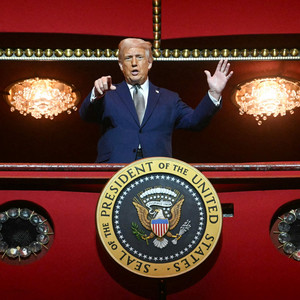
We are more than three months into Donald Trump's second term as president, and there's a question that's coming up a lot.
What is the state of American democracy?
Last year, at a Fox News town hall campaign event, Trump insisted he would be a dictator, but only for one day.
There is energy. We're going to drill, baby.
After that, I'm not gonna be a dictator.
After that, I'm not gonna be a dictator.
Now many scholars say the U .S. is moving swiftly away from liberal democracy and towards some form of authoritarianism.
It is certainly reversible, but we're no longer living in a liberal democracy.
We are very certain that United States is moving in a direction of autocratization.
I think we're on a very fast slide into what's called competitive authoritarianism.
That was Steven Levitsky, a professor of government at Harvard, Shebnam Gamushu, a political scientist at Middlebury College, and Kim Laine Shepley, a Princeton sociologist. Of course, there are scholars who disagree with them, but in recent surveys, hundreds of political scientists from all over the country were asked to rate the health of American democracy.
And they downgraded America's democracy score more than ever before.
NPR's Frank Langfeit has been covering democracy for some time and was intrigued by these landmark results.
He decided to speak to some scholars and others who've come here from authoritarian countries and find out what they make of President Trump's first months in office.
Welcome to the show, Frank.
Hey Ayesha, great to be here.
What struck you in your conversations with these scholars?
Yeah, there's one particular thing, Ayesha.
Um, I had arranged to interview this guy, a scholar.
He's originally from an autocratic country in Asia.
And at first, he agreed to speak on the record. And then, like a day or two before the interview, he writes me this.
I want to read it to you.
It says, I've been following with concern the news this week, and I've decided, for now, I don't want to be quoted in a news piece.
So, so, what was the news and why did he have this change of heart?
I'd seen this video.
I'm sure you've probably seen it too.
It was widely covered in the news.
There are these plainclothes Homeland Security agents.
They detain a doctoral student at Tufts University.
This all happens in broad daylight on a street outside of Boston.
So this student, she's from Turkey, her name is Ramesa Ozturk, she's here in the US on a student visa, and in the video you can see these men, and it's a woman or two, come up to her.
They grab her wrists, she begins to resist. She starts to yell.
Then they take her phone, they hand cover it, and then they lead her off to a car.
Yeah, I remember there was a huge reaction to that video, and so what happened to this student?
So after she was picked up, they sent her to Louisiana.
She's never charged with a crime.
And a little more than a week ago, a federal judge released her, said the only evidence the government provided for holding her was that she co -wrote an op -ed in the student newspaper, urging the university to divest from companies doing business with Israel.
Of course, this is not how Secretary of State Marco Rubio had described the whole thing.
He said that the U .S. had revoked her visa, suggesting she was some kind of troublemaker.
This is what he said.
I think it's crazy to invite students into your country that are coming onto your campus and destabilizing it.
We're just not going to have it.
So we'll revoke your visa and once your visa is revoked, you're illegally in the country and you have to leave. Every country in the world has a right to decide who comes in as a visitor and who doesn't.
So that's what scared your source?
Yeah, I mean, he told me that when he saw that video, he recognized this exact tactic and essentially what he was seeing was an abduction and it reminded him a lot from what happens in his homeland.
He's worried that he could be detained as well.
Oh, definitely. He's on a green card here.
And he's worried that officials could get more aggressive and they could target him.
He's also concerned, frankly, about the potential for being deported.
His home government went after him some years ago because he criticized the government in a private online post. And he's worried he could be detained if he ever ends up getting sent back to his homeland.
Now, eventually, Aisha, he did agree to talk to me.
but only if we didn't use his voice or his name.
So we got an NPR producer to voice his answers.
And so I asked the professor what he was thinking when he watched that video.
This was the problem that I felt like I left back home, and it's here.
Coming from a country where occasionally they sort of disappear activists from the streets.
This felt like a very familiar pattern.
The lack of faces, the lack of uniforms, the arbitrariness of the whole process...
Some authority figure says, come with me and then this person vanishes.
It felt a lot like this was the problem that I thought I'd left an ocean away.
And suddenly there it was.
So Frank, I'd like to talk to you about something that we heard from some of the political science professors at the top of our conversation.
They refer to something known as competitive authoritarianism.
and what is that? Yeah, first, I guess I wanna point out what it isn't, because I don't wanna overstate this.
We're not talking about hardcore authoritarianism like what you would see in China.
Of course, that's a one party state, there are no meaningful elections.
Instead, we're talking about a case where a leader is democratically elected, and then from office, reshapes the state to maximize executive power.
And it kind of works like this.
The executive fills the civil service with key appointments.
I mean, we're talking the prosecutor's office, the judiciary, fills them with loyalists, and then he or she, they'll attack the media, the universities to kind of blunt public criticism, and also we'll either intimidate or co -op business leaders.
And the idea is to tilt the electoral playing field in the ruling party's favor.
And that would mean elections would happen, but they wouldn't be fair.
So political scientists were recently asked to rate the health of American democracy.
Can you tell me more about how the survey works?
Yeah, so it's a national survey.
It's called Bright Line Watch. John Kerry, not that John Kerry.
He's a Dartmouth professor, this guy, and he's co -director of this survey.
And this is how he explained what they do.
– We always ask our respondents to rate the performance of American democracy on a 0 to 100 scale.
So 0 would be complete dictatorship and 100 would be a perfect democracy.
The professors consider 30 different indicators.
So for instance, whether the government interferes with the press or punishes political opponents.
Whether the legislature and judiciary check executive authority.
Right after Trump's election, political scientists rated democracy in the U .S. at a 67.
Late last month, scholars downgraded democracy here to 53.
The survey started back in 2017.
Kerry says that's the biggest plunge ever.
If you had asked me five years ago, I never would have expected the United States to be—to have fallen this far.
And the U .S. score actually landed midway between our neighbor Canada and Russia, which, as we all know, is a hardcore authoritarian state.
After the break, we considered two political leaders who people say concentrated power and transformed their countries.
Stay with us. This message comes from Lisa.
Lisa has several different mattress models to choose from.
Each designed for specific sleep positions and feel preferences and using the highest quality materials they meticulously design and assemble their mattresses in America for exceptional comfort and support.
Visit Lisa .com for 30 % off mattresses and a free sleep bundle plus get an extra $50 off with promo -code NPR, that's L -E -E -S -A dot com promo -code NPR.
This message comes from Jackson.
Seek clarity in retirement planning at Jackson dot com.
Jackson is short for Jackson Financial Inc, Jackson National Life Insurance Company, Lansing Michigan, and Jackson National Life Insurance Company of New York.
Purchase New York. This message comes from NPR Sponsor Tools and Weapons, the podcast hosted by Microsoft's vice chair and president Brad Smith.
Across three exclusive conversations on the company's 50th anniversary, Microsoft CEOs Bill Gates, Steve Ballmer, and Satya Nadella share the stories, dreams, and drive that fueled the digital revolution and explain why it may be at its most exciting point yet.
For these and more conversations with other thought leaders, search tools and weapons wherever you listen to podcasts.
This message comes from Lisa.
Leesa has several different mattress models to choose from, each designed for specific sleep positions and feel preferences.
And using the highest quality materials, they meticulously design and assemble their mattresses in America for exceptional comfort and support.
Visit leesa .com for 30 % off mattresses and a free sleep bundle.
Plus get an extra $50 off with promo code NPR.
That's L -E -E -S -A .com promo code NPR.
We're back with The Sunday Story.
I'm here with NPR correspondent Frank Langfit.
Frank, when people talk about President Trump's second term, they sometimes say he's following a play book from other leaders.
Like in countries like Turkey and Hungary.
Yeah. One leader that they'll talk about is Recep Tayyip Erdogan, he's the president of Turkey.
A little bit of background.
Erdogan was formerly he was the mayor of Istanbul, then in 2002 his party won a parliamentary majority and Erdogan became Prime Minister.
Now, under Erdogan, there was a really nice period economically, what they referred to as the Golden Years as a lot of strong economic growth.
And he leveraged his popularity to basically take control of the levers of power.
We didn't just wake up one morning in an authoritarian system, of course it happened very gradually.
This is Fulya Pinarš.
She's an anthropologist who studies Turkey and the Middle East at Middlebury College in Vermont.
And she says she watched Erdogan slowly tighten his grip on power in her homeland.
Newspapers were taken over or shut down, journalists were imprisoned or exiled.
Even one of my older sisters who was a journalist, she lost her job.
Pinarš's sister, she worked for a major newspaper there.
And it was taken over by a pro -government corporation after it revealed an arms deal that Turkey made.
And soon after, many critical journalists were basically pushed out of other newspapers too.
So this wasn't just about one newspaper, it was a part of basically a broader pattern of media consolidation and silencing people.
And Pinar says the government also targeted a lot of academics.
So many of my professors, mentors, colleagues were criminalized while I was still there just for advocating for peace or labor rights or unionization rights.
So this wasn't really abstract for me.
These were the people who shaped me, who taught me how to think and express myself and it became clear that I couldn't build a future in Turkey without fearing for my safety or freedom.
And so Pinar, this is 2016, she moves to the US, she's basically seeking academic freedom, and she's also studying for PhD at Rutgers.
But the US has not over time proven to be the haven that she'd hope.
And since taking office, you know, Trump has withheld as we've reported billions of dollars from universities that he says haven't done enough to fight antisemitism.
And Pinar, she's on tenure and she's kind of worried, and has changed actually the way that she's teaching right now.
So I'm trying to be more careful.
You know, at the end of the semester, students usually provide feedback about professors and then your promotion depends on that.
Before in her lectures, she used to cite death tolls for conflicts like the war in Gaza.
Now, what she'll do is just direct students to readings where they can find the answers on their own.
And otherwise, she's kind of worried that students who disagree with her might report her to the school administration And Pinar says she wants to protect herself against any possible charges of bias.
Do you think before and even during your time in the United States you'd ever have to do this?
No, I didn't see that coming, honestly, and this was actually the reason why I came to the United States.
So how do you feel about being in America now?
I feel quite fragile because I feel like I can't work freely here.
It just feels like I'm stuck.
Frank, so let's shift to the country that some scholars say is even more of a model for the Trump Administration and that's Hungary.
Hungary's government has close ties to the Trump administration, and Trump has called Prime Minister Viktor Orban a strong man and a tough person, And Strong Man, that's a compliment from Trump.
It is. Yeah. So how did Orban turn Hungary into what the European Union says is no longer a full democracy?
Yeah, so this is an interesting story too.
Orban becomes Hungary's youngest prime minister.
This is back in 1998.
He's 35 years old. He was defeated four years later, but then he sweeps back to power in 2010.
And his party won so many seats in the parliament, it had enough to change the Constitution.
And then over time, basically, he took control of the country's media, universities, and courts.
Kim Lane Shepley of Princeton, she's studied Hungary for many years, and she offered a couple of examples of Orbán's tactics that might sound a little familiar to Americans right now.
For instance, Orbán targeted the business models of news companies.
Kim Lane Shepley of Princeton, she's studied Hungary for many years, and she offered a couple of examples of Orbán's tactics that might sound a little familiar to Americans right now.
overnight. He cuts all the advertising to the independent and opposition media.
They all have a hole blown in their budget.
Nobody expected that would happen.
Shepley says Orban also took aim at higher education.
The universities, a bastion of criticism of the government in the first two years, Orban cut the university budgets by 40 percent.
So how did Hungarians respond?
I think in the early years, first couple of years, there were a lot of mass protests, but I was talking to Stefania Kaprincaj.
She used to run the Hungarian equivalent of the ACLU, and she says those big protests, they didn't, they didn't really have much impact.
A key lesson that we learned is that resisting is not enough.
I really believe that people who are pro -democracy, who are pro -human rights really have to think hard about how to attract and how to reach new audiences.
And I think that starts with understanding their grievances, listening to what they care about, and really responding carefully to those.
So did her organization do that?
They did. They basically got out of Budapest and headed to the provinces.
They opened local offices.
They went to food fairs.
After four or eight years, we realized that what we need to understand is why people don't care so much or don't care enough about these anti -democratic measures.
And what did you learn?
So what we learned is that people are disillusioned by democracy.
And so what they said they realized they needed to do was connect the concept of people's rights to practical issues they were struggling with.
And, you know, everything from like access to social services to the things that they sort of needed in their day -to -day lives.
And she says, you know, it took a few years but they're finally working much more effectively with grassroots groups.
We were saying, oh, so this is the local issue that you are interested in because this is something pressing for you, let us help you, let us work with you, with our expertise, acknowledging that you have expertise on a topic that is important for you.
So we have seen much more engagement like this that is actually interesting and relevant for people.
How are these two strongman populist leaders in Turkey and in Hungary, how are they doing right now?
What's the current situation?
It's a really interesting time.
Orban has some big challenges.
He's facing a much more energized opposition, and it's led by a former protege, who's actually ahead of Orban in the polls.
And in Turkey, after more than two decades, Erdoğan's competitive authoritarian model, and now, it's under a lot of strain.
In March, police arrested the Istanbul mayor.
This is Erdoğan's main rival in any future election.
And this set off the largest protests in Turkey in a decade.
Another Turkish scholar that I spoke to, two teachers at Middlebury College, her name is Shebnem Gumushu, and she's actually in Turkey right now doing research. And she's been watching this all play out.
Frankly, I wasn't expecting this kind of a mobilization, extensive mobilization in Istanbul and across the country.
So that's quite surprising to me because I thought, and probably Erdoğan did too, that he already established some sense of understanding that his was a repressive regime.
And he thought he intimidated people into submission and he thought he succeeded, clearly he did not.
The mayor, this guy who was arrested, he's still in prison.
And Gamuşu says, is the country is at an inflection point, because Erdogan, he can no longer keep up the pretense that this is a free and fair democratic system.
So there are two options ahead of it.
So it's going to be either like Russia, or it's going to become a full functioning democratic country.
So a system that some say the Trump administration is trying to take a page from could be running out of steam.
Yeah, I mean, a competitive authoritarian system, it doesn't really work for a ruling party if it ends up losing major elections.
Okay, so we've heard a number of parallels between some of what the Trump administration is doing and what autocratic leaders have done elsewhere.
But America is still a democracy, at least in some forms. The midterms are coming in 18 months.
We're still talking to each other freely.
Um, so I have to ask, um, did you talk to scholars or experts who think maybe there are some who are being overly dramatic here or that the concern about autocracy in America is overblown?
Yeah, that's a great question, Ayesha.
I talk to 14 scholars, and the vast majority are, I think are very worried about an authoritarian slide, but there are some who see things differently.
And I think it's worth listening to them.
There's a guy, Todd Kent, he's a political scientist at Texas A &M and he says, you know, the United States is so polarized today that the party out of power is always going to be kind of accusing the one in power of being anti -democratic.
And so we tend to see things in the world through our own ideology and political persuasion.
So Republicans now are looking at the world and saying, that's what we voted for.
Democrats are saying, no, this is anti -democratic.
I also talked to a guy named Darren Shaw.
He's a professor of government at the University of Texas at Austin.
And he says the pendulum is swinging towards what he calls the imperial presidency.
But he also says that Trump is raising a lot of valid questions that resonate with a lot of voters.
However much you dislike where it's coming from, can we sit down and have a serious conversation about, you know, what is Harvard doing with its admissions policies, and do students feel safe on campus?
Do scholars really think that Trump will ultimately succeed in reshaping American government?
Many are really worried I think, but a few are skeptical.
There's a guy that I know, a professor, his name is Kurt Whelan.
He's also a professor of government at the University of Texas at Austin.
It's very too early to say the United States is sliding into competitive authoritarianism.
Trump's actions would end up having this effect, but only if they remain uncontested.
And Whelan points out that so far, you know, the lower courts are checking Trump and the United States is still of course, a democracy and popular opinion really matters.
And this is a point that Whelan makes.
He said, you know, if you look at these autocratic leaders like Hugo Chavez, the late Venezuelan leader and El Salvador's naive bokele.
They needed overwhelming popular support.
Like, we're talking approval ratings from 65 % to more than 90 % to change their country's political systems. These populist leaders managed to engineer new constitutions that seriously concentrated power.
That was the breakpoint that put those countries on the path to a competitive authoritarian war.
But in the United States, that's out of the question.
Because you know, Whelan says Trump doesn't nearly have the support he'd need to change the constitution, which of course, if you remember, he recently said he wasn't sure he had to uphold anyway.
And there's another way of looking at this moment, too.
I spoke to Jeremy Pope.
He's a political scientist at Brigham Young University.
And he says, even if the US does not slide into some form of authoritarianism, the long -term effects of this kind of governance will be profound.
I think he's doing immense amounts of damage.
I think he's perhaps, and it does not give me pleasure to say this, unalterably changing our norms in a way that is going to free up future presidents from both parties will feel more free to do the kinds of things that Trump has done.
And that will frankly threaten the rule of law.
And even if we don't move towards competitive authoritarianism all the way, you don't really have to believe that that will happen to be very nervous about the future of American democracy.
What does the White House have to say about all of this?
Well, I sent them some emails laying out the various things that people are saying that I've interviewed, and the White House didn't have any comment.
The only thing that they asked interestingly was the identity of one of my academic sources.
And they wondered if this professor might have donated money to Democrats.
I checked and the professor had not.
When we come back, a pep talk for some Americans from an unlikely source.
This message comes from U .S. Bank.
Simplify how you do business with Business Essentials.
A powerful combination of no monthly maintenance fee checking and card payment processing.
Deposit products are offered by U .S. Bank National Association Member FDIC.
These days there's a lot of news.
It can be hard to keep up with what it means for you, your family and your community.
Study." Consider this from NPR as a podcast that helps you make sense of the news.
Six days a week, we bring you a deep dive on a story and provide the context, backstory and analysis you need to understand our rapidly changing world.
Listen to the Consider This podcast from NPR.
I'm Tanya Moseley, co -host of Fresh Air.
At a time of sound bites and short attention spans, our show is all about the deep dive.
We do long -form interviews with people behind in the best in film, books, TV, music and journalism, hear our guests open up about their process and their lives in ways you've never heard before.
Listen to the Fresh Air Podcast from NPR and WHYY.
We're back with the Sunday Story.
Frank, you've reported overseas for many years.
You've lived and reported from autocratic countries including China and Saudi Arabia, Sudan and Cuba.
What does autocracy look and feel like to you?
You know, I'd like to go back to that scholar at the beginning, the one who didn't want to talk with his voice or name.
I think he put it really, really well.
Let's give a listen.
I think many Americans have a cartoon vision of what authoritarianism looks like.
They think it's sort of jackboots in the streets and prison camps in rural parts of the country.
They don't recognize that for many people, indeed most of the population most of the time, authoritarianism is sort of banal.
Yeah, I kind of feel the same way.
You know, I spent all together about a decade in China.
But on a daily basis, Aisha, you couldn't really tell that it was an authoritarian state, at least not the way that he describes or the way people would imagine it.
If you and I right now, if we're strolling along the river in Shanghai, we'd be looking at these huge buildings.
In my old neighborhood, there are three skyscrapers.
They're taller than the Empire State Building.
and lovely restaurants along the river.
And so when you look at it, there's no sign of the authoritarian state.
But here's the part that's super creepy.
I could also take you about 20 minutes from there to a public park where I did some reporting.
And there are these little holiday cottages where the government would detain critics without any charges.
They would just hold them there for days.
And it would be really strange because kids would be playing in the park near the pond around the cottages.
the public had no idea what was going on inside.
And so, really, it wasn't like, you know, everything stops and everyone's going, I'm in authoritarian country.
No, authoritarianism in China is mostly invisible most of the time.
Unless they step out of line.
Exactly. Now, while you were in China, you met many activists and ordinary people who were fighting for democracy, so then, how does that impact the way you're now reporting or democracy in the US.
I see what's happening in the US through a very different lens, because like some of those folks that you were hearing from from overseas, who've lived in authoritarian countries, I too have recognized some of these things.
And what I'd like to do is talk about this one human rights activist that I've been in touch with particularly the last couple of years.
Her name's Yat -Chio Wong, she's Chinese.
She lives here in Washington.
America has treated me so well.
I'm so grateful for America.
She grew up not too far from Shanghai.
She first learned English while listening to Voice of America online.
And she says that when she was a teenager, she kind of fell in love with democracy.
The internet was relatively freer at the time.
So like you start to learn a concept of freedom of expression.
It is a right in America, the bill of rights.
And then, you know, you start to aspire.
You know, I wanted to go to that country, become that part of culture and, you know, way of life.
I want to first go to study in America, learn from America, then come to China, and to try to change China.
Wong, she moves to America for college.
And then during the Arab Spring, there was this talk of some kind of a similar Jasmine revolution in China.
So Wong, she goes on this anonymous Twitter account that she set up, and she encouraged people to go out and protest. Well, the next year, Ayesha, She flies back to Shanghai, and she's almost immediately detained by police.
Then they interrogated me for three days or two days.
What did they ask you?
What are you doing in America?
Who do you know? At the State Department, I was, like, so confused.
So I was so shocked, like, I was nobody.
What did I do? Like, why like suddenly I'm in this situation?
I was very, very traumatized.
Now I can just tell the story freely.
I couldn't tell a story for a few years.
She realized she couldn't do the activism she wanted to do in China, eventually she came to the US for good.
Then a couple of years ago Wong became the China director at Freedom House.
That's the human rights think tank here in Washington.
Wong is no fan of President Trump, but obviously there are a lot of Chinese Americans who actually do like the president.
But for Wong, the Trump presidency it's really affected her personally.
The administration has effectively shut down Voice of America which is of course how Wang learned to speak English in the first place.
And then they slashed funding for Freedom House and that cost Wang her job working on human rights.
I got laid off because of him, right?
Wang sees Trump as an autocrat, but she also says the United States and China are still vastly different countries.
And she says there's at least one big difference, you know, between what happened to her in Shanghai and what happened to that Tufts University graduate student who, you know, federal agents just grabbed off the streets outside of Boston?
I had no support. Nobody knew that happened to me.
Here, you know, the news media, thanks to the free press in the U .S., that we know about these Tufts students, right?
And Ayesha, here's the twist. You know, Wang learned democracy from America, And now she has advice for people here who are worried about the state of democracy in the United States right now.
I want to say that you might feel shocked right now.
You might feel powerless and paralyzed.
It's very, very normal.
I experienced it, but trust me, you will become more courageous.
Believe in yourself, believe in your neighbors, believe in the fundamental yearning, the fundamental belief in democracy and human rights, we will prevail.
Frank, thank you so much for this reporting and just kind of shining a light.
Well, Ayesha, very happy to do it, but I think these are voices that lots of Americans should be hearing.
That's NPR's roving national correspondent, Frank Langfette.
This episode of The Sunday Story was produced by Justine Yan.
It was edited by Jennie Schmidt.
Gilly Moon mastered the episode.
The Sunday Story team includes Andrew Mambo and our senior supervising producer, Liana Simstrom.
Irene Noguchi is our executive producer.
I'm Ayesha Roscoe. Up first is back tomorrow with all the news you need to start your week.
Until then, have a great rest of your weekend.
Welcome. This message comes from Capital One with the Capital One Saver Card. Earn unlimited 3 % cashback on dining and entertainment.
Capital One. What's in your wallet?
Terms apply. Details at CapitalOne .com.
This message comes from T -Mobile for Business.
Lights. Camera. Innovation.
Walt Disney Studios chose advanced 5G solutions from T -Mobile for Business to transform the movie -making process.
Together, they kept a remote production hub in Hawaii in sync with a team in California to bring Lilo and Stitch to theaters this summer.
This is picture -perfect collaboration.
This is Walt Disney Studios with T -Mobile for Business.
Take your business further at T -Mobile .com slash now!
This message comes from Odoo.
Some say Odoo business management software is like fertilizer for businesses because it promotes growth.
Others say Odoo is like a magic bean stock because it scales with you and is magically affordable.
And some describe Odoo's programs as building blocks for creating a custom software suite, but some say Odoo is fertilizer magic Beanstalk building blocks for business.
Odoo, exactly what a business needs.
Sign up at Odoo .com, that's O -D -O -O -dot -com.