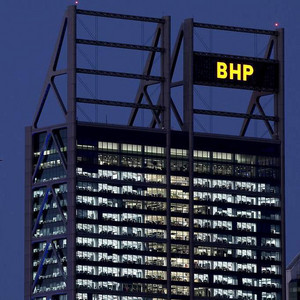
BHP, in some respects, it is one of the last bastions of the old Anglo-American commodity order.
The demand are threatened and also something not so prosperous for the real estate.
China is very carefully laying the groundwork for a post-collar world order.
From economic consideration, it is not so good for us to move away from Australia.
My view is that BHP in the end will arrive at a negotiated settlement that will, in some way or another, give ground.
It will be interesting to see if this does become a case study for Chinese policymakers in terms of how they can aggregate buying at the national level and then begin to play a more substantial role in price setting.
The chat lounge.
Chat lounge.
Chat lounge.
China has reportedly paused its iron ore purchases from Australian mining giant BHP amid pricing disagreements.
The company has made no clear move or public statement on the issue as we speak.
Is this just a temporary dispute?
And how might it test the Sino-Australian relationship, which has only recently begun to stabilize after years of strain?
Joining me to discuss this topic Joseph Mahoney, Professor of Politics and International Relations, East China Normal University.
Warwick Powell, Adjunct Professor, Queensland University of Technology, Australia.
And Dr Joe Mi, Deputy Director, Institute of American and Oceania Study.
Chinese Academy of International Trade and Economic Cooperation.
Great to have you all back on the show, gentlemen.
Let me begin with Dr. Zhou here in Beijing.
According to reports, the disputes mainly revolve around whether iron ore pricing should remain US dollar denominated or shift to the yuan, and whether there should be a 15 price increase.
So, dr joe, this is ongoing, right.
Why has um currency denominations suddenly become a sticking point, given the us dollar has been the standard for decades?
Yeah, i think it's a very interesting topic when we're discussing about the currencies.
Currencies is kind of a payment tools for the different stakeholders to have the transactions.
So in the previous time.
We know that US dollar is so dominating the markets for the international trade, especially for the raw materials, including the crude oils and also the steel oil.
I think that is kind of a fact that many countries do not have any other options when they are trying to buy the raw materials from the suppliers mainly in the world.
And if you're looking at the raw materials commodity markets, mainly are just a very few of the suppliers and the demands.
So for this time for the still, I mean the oils.
I think that's a real interesting because China is a the biggest single demandor or buyer of this kind of raw materials.
And when they are trying to discuss about the ways of transactions they have to discuss of the three or four main suppliers in the world.
So in the previous decade.
I think that most of these buyers from China.
They are just scattered on a smaller steel factories or other demanders.
They do not have any options.
They can just listen to what the suppliers want them to pay.
So this time, I think that the time has changed.
If you're looking at not only the raw materials, like the steel ores or crude oil, but also the gold, the prices keep on going up.
And I think that is really our reflection that the world is rethinking about what we can do.
Do we have any other choices except for US dollars?
Because we are seeing our depreciated currency in recent times.
Do we have any safer way of doing this?
It's not only happening between China and Australia.
I think that it's also happening between Russia and India.
So there are more discussion about the currencies we are using, because the currency is not just a payment tool.
It's not just a neutral position.
Some countries trying to manipulate that and also use the sanction to do something to others.
So we are seeing some change, especially from the international market.
Some people, some companies are willingly to use RMB as instead of US dollars.
I think that trend is reasonable because they want to diversify the risks and do not want to put everything in just one single basket.
But that is also very important even for the US side, because US always believe the US dollars is one of their most powerful tools to control the global governance and also the international trend.
I believe those problems you just mentioned are there for years or decades.
But now China thinks it's the right time to make this move.
Yeah, I mean, that is based on the power of the balance.
And maybe they are shifted just from the original one.
The group has been set up to deal with negotiation on the pricing of the steel ore recently, just in the recent years.
All the Chinese demand on the steel ore be organized into one business company.
I think that is natural for them to consider about whether it is possible for us to do some change based on the change of these scenarios.
I want to add one more point that is the steel industry is changing in the recent years.
We are seeing that, if you're looking at the US side, they put so many tariffs on the steel and a lot of related products.
So that has changed a lot of things.
Even if you're looking at the EU side.
They also put some new tariffs on the import of those steel and ironing products.
So in such a world, the world is more fragile or fragmented.
And I don't think the market is like the before.
We do only have a more free market and the demand are threatened and also something not so prosperous for the real estate a lot of challenges for the demand side of this.
You know the balance, so i think that in this regard the demand side is more powerful, so it should have some an option to see some different things of opinions.
But bhp or other Australian iron ore producers might not think so.
So, Professor Powell, why is there now such a wide gap in price perception between the two sides?
Well, I mean the significant gap between pricing and costs really comes down to the ability by which the supply side has been able to control information and ultimately, also for the pricing to be determined on the basis of an institution, Platts in particular, and a methodology that is underpinned by information asymmetry.
So we have a situation where everything to do with costs and prices has been opaque and therefore not transparent to the buy side.
The buy side has been in a relatively weak position in that regard.
And I think the Chinese side, as we have seen with the formation of the integrated buying group, has realised that it needs to exercise a lot more influence, as the world's largest aggregated buyer of iron ore, to influence the costs of these raw commodities.
BHP is a very interesting case in the Australian context because it is now in some regards an outlier as far as its operational and working relationships with Chinese buyers are concerned.
Rio Tinto has joint ventures with Chinese Steel Groups, which delivers for the Chinese Steel Groups transparency in terms of costs and opening in relation to the settlement currency, namely that there is now room for RMB or hybrid arrangements.
The Chinese side obviously has some influence on operational governance through board representation and also, as a result of that, has some say about the strategic orientation.
Similarly, China or Chinese parties have become more involved in the financing of the Fortescue Group.
In relation to Fortescue's ambitions on green steel, bhp is an outlier in the sense that it has largely been its own operator.
It clings to the us dollar platts opaque system.
It resists cost visibility and in some ways and perhaps this it is a little bit unfair to call it this, but but i'll say it anyway i think in some respects it is one of the last bastions of the old anglo-american commodity order, and so it is now under pressure to behave in ways that are more reflective of the new power dynamics in markets and in the world generally.
Then, Professor Mahoney, from your perspective, does it signal anything broader in its economic or geopolitical approach?
The first is, you know, China did develop CMRG the China Mineral Resources Group in 2022 as a state-owned enterprise to signalize the purchase of iron ore for China's steel industries and aluminum industries.
So this is as Professor Zhou mentioned.
It's a relatively recent development, but it's one now that's really starting to be in a position where it can exert more leverage in negotiations.
And so this is part of what we're seeing.
One of the reasons that not the only reason, but one of the reasons goes back to the problems that we started to see between China and Australia in 2017 and 2018 and then, which really got a lot worse in 2020 and 2021, culminating in the AUKUS deal and many other things.
And back during that time we saw China responding to this sort of hostile foreign policy from Canberra with placing restrictions on certain commodities like barley wine and coal.
But it couldn't do this with regard to iron ore because Australia was providing, I think, sort of 50 of China's iron ore imports and China simply couldn't afford to walk away from that.
So that's one of the reasons why we see CMRT being formed in the next year is to try to develop other sources to diversify China's imports, to make it less vulnerable to whatever direction Canberra decided to take, especially as it was advancing with US strategic designs that were aimed at containing China and even erecting various blockades, as we saw with Biden's tech blockade, which remains in effect.
So that's part of it.
But then also when we started really seeing the acceleration of these problems in 2020 and 2021.
This is when China doubled.
Back to Guinea.
There had been a project there, an iron ore mine development project dating back to the 1990s, but it had languished.
But given the challenges in the Australia-China relationship in 2020, that was reinvigorated.
And of course, we see that project coming online and expected to initiate deliveries next month.
Now those will only reach about 28 million tons a year by 2028, which is not going to be a major offset for the amount of iron ore that China needs to import annually.
And then again, you know, and I know because I read a lot of what Warwick writes about, and he could probably talk about this better than I can, given his strengths in economics but we are in the midst of de-dollarization.
And we're in the midst of this for two reasons.
One, because the United States is pursuing unsustainable financial and fiscal policies and still exporting financial risks through its outsized role in controlling the global financial system and in the bully position that the dollar still is able to sustain.
So there is this gradual transition to de-dollarization.
We know that China is not running as far ahead as some countries want, but nevertheless China is very carefully laying the groundwork for a post-dollar world order, with the understanding that that world order may show up a lot sooner than a lot of people anticipate.
You read various projections that the dollar has another 15 or 20 years, but there are also some starker possibilities that we may run into some serious problems before 2030 or by 2030.
So China is, I think, trying to move towards de-dollarization to make sure that it's not facing outsized risks to the dollar or changes that are coming, but also ensuring that it's not going to face strategic risks should Australian policies suddenly shift, diversifying its imports.
The Chat Lounge.
The Chat Lounge unpacks views and opinions on hot issues in a more casual way.
Thanks, Professor Mahoney, for that detailed reminder of this timeline of what's going on right now and the geopolitical implications here.
But now let's move on to how this is playing out on the ground in Australia, in China and across global markets.
Like you all mentioned, BHP has long been one of China's most important iron ore suppliers.
Then, Professor Powell, how might this affect BHP's clients and the supply chain within China?
Like you mentioned, BHP reportedly provided around 40% of China's imports in the past.
One of the interesting things about the nature of these kinds of disputes is that both sides particularly in terms of a combination of pricing and inventory, both sides are constrained by certain realities.
And the core reality here on the buy side is the extent to which there are inventories built up that will provide the buy side with negotiating buffer on the one hand, as well as the potential for those inventories to be compensated a little bit down the track should negotiations take longer than expected.
Now i think that they're in the overall chinese steel mill sector.
They're somewhere in the order of up to about three months worth of buffer stock, which will take us to the end of the year roughly.
On the other side, the export side, the capacity to hold buffers is actually a lot shorter.
That's because buffers take room.
And as production systems continue to produce the ore, you really need to be able to move stock on and get them onto ships and moving to mills around the world, so that your production systems can sustain.
And the reason you need production systems continuing to mine is because you've got workforces to pay, you've got machinery to keep active, etc., It also creates challenges around working capital requirements because the longer stocks it's still and isn't transacted and ultimately settled, you are in effect having to pay for the cost of the working capital that you have foregone during that period of time and having to finance either off your own balance sheet or finance through debt.
So I think the negotiating situation is, for the time being, likely to favour the China side to some extent, because China actually just has a longer time buffer than the HP.
China also has some alternative supplies that can help plug some gaps, should this negotiation drag out longer than expected.
But I think that most people would hope and I'm going to say this from both sides of the transaction would hope that the issue can be resolved within the next month or so, because in the end and getting trade up and running again, even on new terms, is going to be beneficial for all concerned.
Can I ask a question here to you?
All right.
So I concur with everything that Warwick has said, but I want to follow up with him on another point, which is we know that aluminum prices right now are trading at a 52-week high.
But we see Goldman Sachs anticipating prices could decline significantly over the next two years.
Could this be another factor that's driving this decision-making now?
In other words, if we do see an interruption in Chinese metal production, that could functionally support prices, which may also help the Chinese side if this dispute does linger.
Yes, because one of the interesting things about the timing of disputes, particularly one that has in effect been initiated by the China side, is that a range of calculations would have been entered into to evaluate whether or not this was a relatively good time to initiate such a dispute.
And I think that the calculus was ultimately that, given the downsides of the status quo and given the prevailing balance of inventory and pricing in the other commodities, and given that there are other supply chains that can, to a small extent, contribute to plugging some gaps down the track, a view was reached that there was no better time and, in fact, no more necessary a time than now, than to initiate this dispute or to catalyze a process that would force the issue to the table.
So there are some pricing benefits, no doubt.
I think they're transactional.
And as you've touched on already, there are structural issues at stake as well.
And if you can get a win on both pricing cyclical pricing as well as structural institutional configurations out of a process, then I think you've done a pretty good job.
So that's probably the kind of balancing act calculus that the China side has given some thought to.
Dr Zhou, is this what's on the mind of the China side, like the CMRG, or do you see it as a reflected deeper shift towards centralized state control in commodity imports in China, maybe in the future?
I do believe that there are several factors.
All the guests have discussed.
There are something to do with mechanism, something to do with real demand.
I think that is important for us to understand that the conditions are not just decided by this company itself.
They are also connecting with so many manufacturers and also real estate, the infrastructure and so many demanders.
They are just one very important entrance for us.
So I would say that if you are considering that condition, maybe the expectations are being redirected based on this forecast of the price.
And if you are using the US dollars, maybe it's definitely will get more expensive because of the depreciation of US dollars in the coming months.
But if you are using RMB, I think that is much more stable compared with US dollars.
If we just think from these pricing issues, I would say that is also more stable for the transactions to be happened.
And it is also very important for the balance between China and Australia.
China is a big deficit to Australia for many years.
That is also the situation.
You're saying that this decision or the nomination shift is in favor of BHP and Australia?
I mean for both sides, I mean BHP, especially for BHP, because that company is one directly stakeholders for this transaction.
But for Australia, there is another big situation or background we need to discuss.
Even when we have some dialogues with Australian parts.
You know, last month we discussed several sectors and among them, the steel sector is one of the most important ones.
But that sector is not only from Australia part.
I would say that there are also one very important stakeholders from China and they are investing in Australia, in Perth.
I would say that is also a complicated situation.
It's not like just a one-to-one.
We are integrated.
I mean the transactions.
We are not just trying to take some advantages from Australia part to China.
That is also a way for both sides to have a better expectation about the real demands and the real supply.
And we have to discuss about the possibilities of possible disruptions by the financial areas or other kind of issues.
So the transactions I mean from China's side, I would say that this company is trying to to provide better choices.
And also, you know, especially for the innovation.
The financial area is one of the most important areas for the innovation.
I think the RMB can be used in a better way, but the real stake is about the demand and supply balance.
All right.
Professor Powell, then there is no reason, at least in terms of the denomination issue, that BHP would not agree to this.
What's your expectation?
Do you think BHP will hold firm on the pricing mechanism and not give in an inch?
You've got to remember that there are actually three issues at stake here.
One is the settlement unit, so that's the currency question.
The second one is a shift from benchmarking on an annual price to quarterly pricing.
So what China's seeking is for quarterly price determination, rather than the current mechanism, which is based on an annual price, and that is to deliver greater flexibility and responsiveness to the supply and demand balance.
Okay, so that's the second issue.
Shorter pricing cycles will also provide the buy side with greater negotiating leverage, because they are in a position then to manage seasonal demand and infantry, and that way they can have some influence over pricing as well.
And the third one, which I think is actually the most pivotal, is to seek to replace Platts as the benchmark and price discovering mechanism.
The Chinese side essentially say that the Platts mechanism involves conflicts of interest.
For example, financial institutions like JP Morgan are shareholders in Platts as well as in BHP.
So that's the first issue that there's a conflict of interest.
There are also concerns that the Platts mechanisms deliver asymmetric informational power, particularly to the Western side, and it goes to the ways in which the pricing is actually arrived at on a daily basis.
So what we're looking at here is a three-pronged set of questions which are both transactional, so they relate to price determinations on a quarterly or an annual basis.
Price stability, which goes to your exchange rate risk question.
But ultimately these are institutional and structural questions around the power of Western institutions, both monetary institutions and also price setting and informational institutions.
Now, you asked a question about whether BHP will hold the line.
My view is that BHP in the end will arrive at a negotiated settlement that will in some way or another give ground, because BHP cannot afford to have growing stockpiles of iron ore sitting in Australia going nowhere.
And that ultimately is the pressure point that BHP will face.
So this comes down to who can last the longer in this process and ultimately, of course, how those beneficial or benefit a negative impact trade-offs are arrived at.
That be under no illusions that this is far more than just a commercial question.
This is actually a one part of a multi-pronged move to expand the use of the rmb as a global settlements currency where appropriate, to accelerate currency multi-polarity and to change the informational order of things globally.
This has been The Chat Lounge.
When we come back, check out how might this incident test the Sino-Australian relationship, which only began stabilizing recently after years of tension.
Don't go away.
The best military commander is not he who fights a hundred battles and wins every one of them.
The best military strategy does not lead to the desiccation of the enemy's capital city.
Decoding the art of war will help you understand why there's no art in war and how Sun Tzu stayed undefeatable using the science of war, with fun stories and insightful breakdown of famous battles.
Find Decoding the Art of War wherever you listen.
Welcome back.
We continue our chat on China's pause on BHP iron ore purchases.
Professor Powell, you said it all depends on who can stand there till the last minute.
But for BHP, how long can it hold then?
BHP has a need to move infantry.
So this really comes down to what capacity it has to have infantry building up.
And this is both a physical question how much space they've got to do this and also a financial question, because inventory that isn't moving also means revenue not coming in.
So you've got two pressure points.
And when revenue isn't coming in, you're paying for that through your cost of interest.
So you've got both physical pressure points and financial pressure points.
I believe that BHP is likely to have capacity to build up and hold inventory for somewhere between two and four weeks, so at full production, you're looking at a four-week window.
Now how do you adjust for that if you can't move the inventory?
Well, you have to reduce production.
Reducing production had implications in terms of workforce management and also winding down your operations and then winding up your operations again later on.
So whereas on the China side, China overall in an aggregate sense, has reserves of up to about three months worth of reserves.
And don't forget, China can continue to supplement its iron ore imports from a number of other sources, including others from Australia, as well as from Vale in Brazil and The soon to come online Simandou project, in which China actually has an equity position and through that gains full transparency to production costs.
So the nature of the balance of power, if you will, is fundamentally changing, from one where China was for a long time a buyer, even if it was the most significant buyer, to one in which China has now become increasingly embedded in supply chain networks and, through that process, is now seeking to alter the asymmetry in information and the power relationships that come from the control of information systems because ultimately, pricing is determined on the basis of the information available.
Yeah, we can see that trend, but on the Australian or on the BHP side, In terms of the price, what kind of a concession it might make?
Because I got some figures here.
According to Australian federal budget, a 10 US dollar a ton movement in iron ore prices can result in an increase or decrease in Australia's GDP of between 5 billion Australian dollars and more than 10 billion dollars a year.
The impact on the annual tax take can also run into the hundreds of millions or even billions of dollars a year.
That's not a small number.
How much do you think HP will agree with the price demand on the Chinese side?
Or do you think the Australian government will eventually have to intervene, if you will, on this issue?
Look in a commercial negotiation, of course the sell side will be looking for the maximum price that it believes it can achieve, particularly if it can sustain that price.
And the buy side will be looking to gain the lowest price it can possibly achieve.
I'm sure that the parties, in a pure commercial sense, will be able to find something that they can both live with.
So I think that that's the first point.
Insofar as the impact on corporate revenues and taxation is concerned, that's a question for BHP and the Australian government ultimately.
The Australian resources sector has historically had a very significant capacity to influence government decisions concerning royalties and taxation.
And I would not be surprised if this particular episode was catalyses another round of discussion, shall we say, between the Australian resources sector and the Australian government in relation to taxation and royalties arrangements.
The Australian resources industry, or should I say the resources industry in Australia, has never missed an opportunity to argue for lower taxes and lower royalties and anything that they can use to justify an argument that says they should pay less tax and less royalties they will seek to use.
Will the Australian government accede to that?
Well, that's a different question altogether.
And that's an open-ended question, because it's a question about political judgment at a particular moment in time.
Talking about political judgment, Professor Mahoney, your take here?
Well, I thought Warwick might go down another path there, and he could probably go down this path better than I could.
But one of the things that we saw, one of the narratives we saw coming out of the increasing disputes from 2020 and 2021 is is this allegation from the Australian side that China was resorting to economic coercion?
I've always found this concept to be reflective of a double standard.
In other words, if a country decides to embark on a foreign policy that is hostile to another, and then that country the country that's being aggressed against decides to change the way it does business because it doesn't like being aggressed against.
I don't think that's economic coercion.
I think that's merely responding with a diminished trade relationship.
It will be interesting to see if this issue is seized upon by China hawks, anti-China hawks in Australia, as a new example of a Chinese state system that is effectively trying to bully a major company in Australia, one that plays an important role in the Australian GDP.
I think that that would be a mistake in so much as going down a dark path like that would only, I think, further complicate a continued healthy trade relationship between BHP and China.
And certainly BHP needs that trade relationship with China because there's no other country that can absorb all of that production, despite Trump's wildest dreams that he can reshore the aluminum industry in the United States.
So I think that this is a moment that's a little fraught.
We may see some China hawks moving in that direction in Australia.
But my guess is the current Australian government will tread very carefully, given the fact that its own relationship with the United States is a lot less certain than it was a couple of years ago.
And it really can't afford to see a significant erosion in economic or political ties with China at this point.
Professor Powell, what's your expectation?
How might this test or strain the Australia-China relationship, which actually only recently began stabilizing after years of tension?
Look, as I said, I think that in one part this is a commercial transaction challenge that often the parties will agree on something, but one with structural geopolitical implications.
The Australian government so far has played a very steady hand, if you will, in terms of its public remarks concerning this situation, essentially expressing a view that they're hoping that the issue gets resolved sensibly and efficiently and quickly.
Australian hawks have yet to jump onto the bandwagon on the issue at this point in time, I think in large part because BHP is a very substantial corporation that can exercise a reasonable degree of influence over Australia.
The short-term utterances of politicians.
So there'll be very few politicians who would want to jeopardise BHP's own negotiations at this stage in time.
So the window still exists for the issue to find a mutually satisfactory solution both from BHP's point of view and ultimately also from Australia's point of view.
Either way this goes, and in terms of there being an outcome, there certainly will not be a back to how things have been.
This intervention by the China side will cause a change in the arrangements along the three dimensions that I mentioned.
And the Australian government in many regards, are just going to need to accept this as a consequence, because it will continue to receive taxes, it will continue to receive royalties and it has no deep reason to sanctimonious about a change of these arrangements, particularly if BHP has signed up to them.
As I mentioned, the other exporters of iron ore to China are already involved in various ways with RMB-based transactions, including the funding to Fortescue, which is provided in RMB for its green steel ambition.
So unless the hawks jump on this and it is possible that they will they're actually in quite a But you do expect this to be short term, right.
Well, it's in nobody's interest for it to become longer than a three-month dispute.
Certainly, I don't think it's in BHP's interests.
And China will need to keep a very close eye on its own utilisation rate and its inventories, because at some point it will need to ensure that it has buffers and has inventory for its own requirements.
So at some point in the next one to three months, the parties involved will start to experience problems that are relevant to each side right?
So from a seller's point of view, as i mentioned, it's really about cash flow and inventory.
From the buyer's point of view, it's really about depleting inventory and future needs.
So at some point, what are the parties going to do at mounting inventories sitting in australia?
The parties will need to reach an agreement at some point in time to keep their own systems going.
Right.
Then on the Chinese side, what's the interpretation, Dr. Zhou?
Are we looking at a brief standoff, a gradual normalization or a possible escalation into broader trade pressure?
I think that is just a single case.
If we're looking at the trade, the catalogs between China and Australia, The trade are not so diversified, especially when China imports things from Australia.
So it is a way in my understanding that Australia side for this company they do not get less advantages by using RMD to accept that because the value are not so reliable.
I would say that it is even providing some more possibilities.
But the problem is that if they are going to accept the term of using RMB, they have to set up or trying to improve their infrastructure to do with RMB-related settlement mechanism.
And when they are getting and having more RMB, they can also use those currencies to buy more products from China.
So there should be some kind of you know mechanism for them to lend the RMB to other companies in Australia or in other countries.
So that is a way that you know they need some inputs to improve the infrastructure and also something to do with financial derivatives or kind of innovations.
But according to the price or the values, I don't think that they will lose more.
On the contrary, they will even gain more respect from China side and we have better connections based on the currency.
So it's not a bad deal.
I don't think it's just a bad deal for them.
So in this regard I would say maybe we can do more to improve the resilience about the bilateral trade.
And some of the Australian people, they argue that they're over-dependent on China.
But I don't think that is a fact because we're developing and it is such a big market, so many potential opportunities.
So if we can connect better and trust each other better, I would say that is an even more brighter future for the bilateral cooperation.
So this year is the 10th year of the chapter, the China-Australia Free Trade Agreement.
We are going to review this very important free trade agreement between our two countries.
I think that maybe we can introduce more mechanism, not just from the BNAT level, Maybe by the governmental levels.
We can do more about the settlement of the currencies or any kind of possible innovation by the agreements between these two countries.
I think it's much more possible for both sides to consider about how can we have a better expectation and a stable expectation in such an uncertain world, and it will benefit both of us.
So you don't think this episode could mark the beginning of China's longer term strategy to diversify iron ore supply and reduce its dependence on Australian sources?
No, I don't think so.
Because I think that, even if you compare it with the other supply, I mean, Australia is the nearest to us and I think that the quality of the product is so good.
So if we have more choices, I think that all of these sources are complementary to each other.
We're not trying to reduce import from Australia.
I think that it's from economic levels of consideration.
It is not so good for us to move away from Australia.
If possible.
You know, I think, that China has been developing in the past decades about our domestic urbanization and industrialization.
But now there are more countries, especially in Africa, and also some other developing countries.
They are going to industrialize them and they also have a lot of demand on the infrastructure.
So in this regard, I would say that the capacity of using the studio more wisely would be much more potential, not just here in China.
We are trying to use our skills, our technology, our ideas to help our partners in other developing countries to improve their status.
So if we are able to do that, I think that's the concept about not just the demand and the supply, but also The concept about the climate change control or reducing of the emission of the carbons are also very important.
And that is you know.
When we talk with steel businesses from Australia, they also share the same concerns that we can do more collectively.
I would say that is possible for us to do more.
The Chat Lounge.
The Chat Lounge unpacks views and opinions on hot issues in a more casual way.
Inside China, there's always been such a call, calling Chinese companies to regain their pricing power, especially when the Chinese economy is growing at a fast speed.
So this appears to be the first time Beijing has taken such a direct step in the iron ore trade.
But are we likely to see similar measures in other sectors?
And if so, what might that mean for the global commodities landscape?
Dr. Zhou.
Well in my understanding that there are just the powers between the supply side and the demand side.
I don't think it's just our only thing that we can consider about the steel.
And I think the power is so prevalent in the world.
We do not want to do everything to change to new scenarios.
But if the demand is shrinking, we cannot afford to buy more from these suppliers.
We should get lower price.
It's a kind of the law of the market.
I think that maybe the commodities market is one very important example that other sectors maybe they will just look at that.
And a lot of prices are depending on the prices of the international commodity markets.
So I don't think that there are some kind of plans or a blueprint for us to follow from one sector to another.
This is a benchmark.
I would say that it's possible for some kind of applications in different areas.
But I mean, there is only a lot of understanding about that.
I think that this principle of respecting the international governance and the agreement has not been changed.
We are not trying to use the power like the coalition to other countries.
We are discussing about the possibilities.
Possibilities maybe they coming from the commercial negotiations, maybe they come from the talks between the garments, but they are not just the unilaterally.
I don't agree that.
You know, it's kind of a bullying or kind of practices to threaten the other side.
We are discussing this, maybe in a different way, but i i would say that we can do more to improve the.
You know, the feelings or the expectation of the markets in the coming days, based on the discussion and the more information exposed.
What's Professor Mahoney's expectation then?
Well, I think, on the one hand, it's.
I do think, you know, we do have this tendency in China of trying out new mechanisms, developing new mechanisms and then testing them and see how they work.
We don't have any other groups quite like CMRG operating.
You know, we do have other big state-owned groups like COFCO and others.
So COFCO is charged with national food security.
It does oversee a lot of overseas food purchases.
It will be interesting to see if this mechanism does work out.
And again, this was a mechanism that was developed, I think, very specifically with the Australia problem in mind, going back to the disruptions in the relationship that started in 2017 and that reached that nadir in 2021.
And then you have the formation of CRMG.
I don't think China wants to be too aggressive in, Certainly when you look at how it's kind of migrating some of its food purchases from the United States to Brazil, Brazil's part of BRICS.
I don't think China wants to take a more aggressive position in negotiating prices with Brazil, although I'm sure they do whatever they can to represent the better interest of Chinese consumers.
Nevertheless, it will be interesting to see if this does become a case study for Chinese policymakers in terms of how they can aggregate buying at the national level and then begin to play a more substantial role in price setting.
And even doing it, I think, as Professor Zhou and Professor Powell have made clear, in ways that are not win-lose.
I mean, this is something that will ultimately benefit both sides if they can come to clearer terms.
And indeed I agree that the internationalization of the yuan is something that serves the greater interest of Australia and makes Australia less vulnerable to the security trap that it still faces vis-a-vis the US control of the global financial system.
So it is something that they're resisting, but it's also something that will ultimately be for their own good, as well as again, as was mentioned, promote the development of mechanisms that will further accelerate cross-border trade in their local currencies versus having to go through the dollar.
So my guess is that it'll stay very specific to iron ore for the while, at least.
You said you don't expect it to be or don't want to put it in a way like a win or lose, but it seems there is a loser here.
It could be BHP, right?
Professor Powell.
That's not the case.
That's not the case.
It's not necessarily a win-lose.
I think the other two speakers have been very clear that this is something sometimes and not to sound paternalistic or patronizing but Sometimes you have people who, for whatever reason, are stuck in an old way of doing things and they have not been able, for whatever reason, to accommodate the new realities.
It's in BHP's best interest to figure out a solution that accommodates the realities of their core business interest.
And so it may be a little painful to deal with that in the short term, but ultimately it will serve their interest and help stabilize the relationship, as opposed to continuing to have a unhappiness in this relationship, a relationship that is so primary to BHP's business model.
Yeah, but in terms of BHP itself, Professor Powell, do you think it's the only loser here?
Things cannot progress as it desires to, right?
Would you term it as the only loser?
What lessons can both sides take away from this is our last question.
Look, I think, as I mentioned, there are three dimensions that are on the table at the moment and they are related.
One is the time cycle for the settlement on pricing.
So we're looking at moving from an annualized pricing mechanism to a quarterly pricing mechanism.
That obviously introduces a greater degree of dynamism within the marketplace and that Over a long period of time we'll have upsides and downsides for all CERN, depending on the particular period in the commodity super cycle that we're talking about.
The second one goes to the actual mechanisms of price determination itself.
And at the moment, it's through the Platts Index.
And the Platts Index is based on voluntary information provisioning, which is then modified by the executive through essentially subjective and opaque mechanisms.
Now, China is seeking to introduce a more transparent way in which pricing is ultimately determined.
And again, over a long period of time, that's in the interest of all parties.
The interesting thing about iron ore over a period of say, 10 years, is that we know that Australian exporters have experienced well, actually over a much longer period than that, have experienced episodes of what we would call super profits as a result of major demand cycles emanating mainly from the China side.
And that has been to the tremendous benefit of Australian iron ore miners and their shareholders.
And again over a long period of time.
One would expect and hope that pricing would normalise in ways that deliver sustainable outcomes for both the buy side and the sell side.
You have to remember that a seller does their maximum prices, but if their pricing forces those customers to experience difficult economic times, then that's no good for the seller either.
And the last issue goes to the currency itself.
To be honest with you, I think that's the least of the issues here from BHB's point of view.
It's an international company.
It will have sophisticated ways in which it can handle multi-currency settlements and handle foreign exchange risks.
So these aren't huge operational questions in the long run, but they do involve change.
And the change brings uncertainty.
And when you have been in, I guess, the driver's seat for a long time.
The idea of having to come to grips with a changing world around you is one that, for very understandable and natural reasons, you would seek to delay as long as you possibly can.
But I think it is inevitable that a new set of arrangements would emerge as a result of this intervention.
We won't go back to the status quo ante and everybody will move on.
And I would expect that if we were to have this conversation in a year's time, we will be talking about the flow of iron ore from Australia to China, And I would expect some hybrid settlement systems to be in place which would involve the RMB, but also possibly some US dollars as well.
It'd also be a painful process for BHP or others to accept the new reality then.
They're not averse to change.
They can cope with change because... They'll have to adapt.
Because they have to adapt.
And so they will adapt and they will move on and they will do what they need to do to adapt.
They are in the business of 99 or it's selling them and that's what they will seek to try and do.
All right.
And Professor Mahoney, what lessons do you think both sides can take away?
Well, you know, I think the key again that we live in this new era, that letting relationships deteriorate have consequences, that China is continuing to advance and develop its economic governance structures.
And we haven't talked much about the new mining operation in Africa.
Again, it will only provide an estimated 68 tons per year by 2028.
You think it'll replace BHP?
No, not at all.
Not at all.
But it is coming online at a time when it would be able to, you know, because if we go back to Warwick's estimate of three months that China can, can hold.
I don't know if he was figuring their Semando imports rolling in a month from now, but they would be a significant but not massive offset.
I would go back to the point that, again, that Warwick was saying.
Sometimes corporations they have, whatever their biases, their prejudices.
They like making super profits, I'm sure, but they have a responsibility to their shareholders to continue to maximize profits.
And when it comes time to make an adjustment.
So that means they may have to get into a dispute, but in order to sustain their business model, they have to make this adjustment.
So to some extent, we may be looking at a resistance on BHP's part that is performative, that they're doing due diligence in terms of representing their shareholders' financial interest, which will then compel them that same interest will compel them to find a negotiated settlement.
So I agree that, in a year from now, all other things remaining constant, that this will be a story that we would have largely forgotten.
And last but not least, Dr. Zhou.
I think that all of us have to respect the fact and we have to keep our minds open and we have to move in.
We don't have to stop where we were.
I think that in the future, there are so many possibilities.
So in such a case, I mean, it's not the final decisions by both sides, but they start up our kind of discussion like today.
We can try to think about what if we can do something else, if that is possible, for you know the both sides to benefit from or it just giving us more options or trying to reduce the uncertainty.
I think that is worthy of doing some discussion and that is worthy of trying to find some interesting solutions and mechanisms are trying to do better to meet the demand of the market.
Well said.
And on that note, we wrap up our chat.
Many thanks to Dr Joe Mi, Deputy Director, Institute of American and Oceania Study, Chinese Academy of International Trade and Economic Cooperation, Warwick Powell, Adjunct Professor, Queensland University of Technology and Joseph Mahoney, Professor of Politics and International Relations, East China Normal University, for your time and insights.
Just as we were wrapping up production of this episode, new reports came in.
PHP has agreed to use the Chinese currency for pricing, but the final price remains unsettled.
How long will the standoff last?
We'll be watching closely.
Email us your comments at radio at cgtn.com.
I'm Tuyen.
Join us next week for more insights at the chat lounge.
Till then, take care.
The strong wind was howling and whistling.
He was the first Chinese citizen to graduate from Yale University in the mid-19th century.
I was born on the 17th of November.
She had prominent features.
Three of us were old enough to lend a helping hand.
He navigated between two vastly different cultures and moved further to realize his dream and promote understanding between the people of China and the United States.
Ye Mingxin was a native of Hanyang.
I realized no danger.
China is really awakening.
Come and join us in discovering the incredible journey of Yong Wang in his autobiography My Life in China and America.
Check out the audible stories on radio.cgtn.com and all major podcast platforms.
Just search for the podcast Books and Beyond and find My Life in China and America.