This is Planet Money from NPR.
Ali goes back to Iran every few years.
And in those visits, he always notices how it's changed.
Every once in a while, for the better.
Like when he was just there in December, he went to a restaurant and looked around.
I was like, wow, I cannot believe I'm sitting at the restaurant and no one is wearing hijab.
None of the women were covering their hair.
They were riding motorcycle bikes.
Women were not allowed to ride motorcycle bikes, but they were choosing to do it.
But other changes he's noticed have been more ominous.
Like this trip, people were way more worried about money than they used to be.
He says a decade ago.
People were more open.
They didn't have to think about their businesses.
They didn't have to think about their struggles, like the financial struggles and all that.
The financial struggles, that has been a huge part of the change that Ali's been tracking.
Like he says, things changed even over the course of his short visit in December to see family and friends from childhood the few that stayed.
One simple indicator was the price of egg.
Yeah.
Like a dozen egg, like just within that weeks that I was visiting just like jumped by 30 something percent.
And in part because of the dire economic situation this year and in recent years.
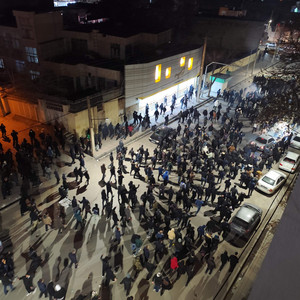
While Ali was in Tehran, a protest started.
The one you've probably heard about.
It was sparked by the currency plummeting.
Vendors in Tehran's bazaar went on strike because they couldn't sell anything at a profit.
Then a popular opposition figure, the son of the former monarch, Reza Pahlavi.
He urged Iranians to go out into the streets on January 8th and just walk with their family and friends.
A lot of people called me and they're like, hey, don't go out.
It's risky.
You know, you may get arrested.
You may get shot.
You may something can happen.
Your entire life is there.
Don't go out.
But then he kept talking to more people, people in Tehran.
Everyone told me they're going for a walk.
And going for a walk that night at 8 pm was the key word for hey, I'm going out to join the protest.
Ali ended up joining the protests, too.
Took some video.
By the way, he asked us to use his nickname to avoid retribution from the Iranian government.
What did you see?
Uh, it, it was crazy.
Like it's something.
It was something that I never had witnessed, uh like, to that extent, to that uh uh degree in terms of the number of number of people that i actually witnessed with my own eyes, like this time.
It was everywhere, literally at every area right, all the cars that were driving would see the people and, as a support, they were um, honking on the horn and people are starting to chant um, you know, like a downward dictator.
All these chants Honestly, like I would say myself and everyone that was looking, everyone was hopeful.
We're like, wow, we're like this many people came out.
This is great.
We're finally going to get a revolution that we want.
It seemed to Ali that everyone in the country was fighting corruption, fighting for freedom, for their human rights and for economic stability.
The regime has had intense protests over human rights for decades.
This protest was about all that, too.
But it was triggered by economic pain.
And a lot of that economic pain is from corruption.
But a lot of it is because of the U.S., because of sanctions.
The U.S. has been sanctioning Iran in one way or another for 47 years.
The aim has been to push the regime to stop arming militias and terrorist groups in the Middle East to stop pursuing nuclear weapons.
And one way sanctions can push countries towards change is by infuriating their citizens.
The economic pain people experience can lead people to pressure their governments to comply to stop the pain.
And for a second in Iran.
With those protesters in the street, it looked like sanctions might help achieve the goal of pushing the Iranian government towards change.
But instead the regime cracked down, shot thousands of people in the streets, imprisoned thousands more, shut down the Internet.
All of a sudden, we saw a panic in the crowd, so we couldn't tell what was happening.
We have to move.
You hear the panic, like you hear people like some sort of like screaming, they're trying to run.
There was definitely fear in there.
Ali managed to get home safely.
But in the days that followed, as people in Iran got connected back to the internet, he would learn about all the killings.
The Iranian government has said 3,000 people were killed.
Independent observers estimate the true number to be many times that, in the tens of thousands.
My friends are OK, but when I say OK, no one's OK.
People are not OK.
They may be alive, but they're not OK.
Ali says you got to keep in mind.
The entire history of this regime in Iran has been littered with protests and filing crackdowns.
Protests and filing crackdowns.
This is not new.
But there is a difference lately, partly because the economic situation has gotten so grim, which is particularly demoralizing for young people.
Their lives, their future, their hope, everything's changed, right?
They don't have much to look forward to.
Basic human rights are not there.
That's why most of the people that now you see their photos, most of the...
People that have been shot are the younger generation because they're fearless.
Of course they all have a dream too, but they're putting the dream of freedom ahead of their own dream.
Hello and welcome to Planet Money.
I'm Nick Fountain.
I'm Mary Childs.
Today, as we hit publish on this episode, representatives from the US and Iran have just met in Oman, after a week in which President Donald Trump threatened attacks and Iran continued to crack down on protesters.
The protests in Iran are about so many things.
The biggest things.
Human rights, women's rights, anti-corruption, freedom.
But this time, they are also motivated by economic hardship caused in part by U.S. sanctions.
Today on the show, what were those sanctions?
What do they do to Iran's economy?
And what has been the result?
Sanctions are supposed to avert war.
But how different from war are they really?
So what are sanctions?
Sanctions are a tool countries use to try to get another country to do what it wants, like to stop being communist or to stop doing a war.
The idea is to influence political behavior without military force, by imposing restrictions on trade and capital instead.
But as a tool, most experts will tell you they only work some of the time.
Like when communication is really good, the goal's really narrowly defined and the targeted country isn't too big or too well integrated into the global economy.
The U.S.'
's sanctions on Iran have not always conformed to those expert recommendations.
Nonetheless, the U.S. has had sanctions on Iran for basically the past 47 years.
Iran cannot have a nuclear weapon.
Almost every U.S. president, from Trump back to Jimmy Carter, has imposed some sanction.
And most comprehensive multilateral sanctions.
Cut off all trade and investment with Iran.
I took a risk with regard to our action in Iran.
It did not work.
International economic sanctions upon Iran.
To understand how all those sanctions fed into this moment a bigger than ever protest, a violent crackdown and the US threatening an attack.
We're going to look at three key moments in Iran's economic history.
And the history of U.S. sanctions.
Three moments that help explain how we got here.
The first moment is right around the time of the very first US sanction against the Islamic Republic.
It was the founding moment of this new country, when the supreme leader, Ayatollah Khomeini, took power in 1979 and Iran was redefining itself.
That is the year after political economist Ivolela Peseron was born.
I was born in the midst of a revolution.
Eva Leila is an academic at the University of Cambridge.
Her parents were among those who left during the revolution.
That was where I should have grown up, essentially.
My parents liked waiting for me to get my passport and to be big enough to go on a plane.
And then we left and we moved to England.
Iva Leila's dad had been the head of research at the Central Bank of Iran under the Shah, a very, very US-friendly monarch.
So friendly that the U.S. engineered a coup to reinstall him as the Shah in 1953.
Under the Shah Iran had for decades been very connected with and influenced by the West, most notably the UK and the US.
Photos from the 1970s circulate periodically.
Maybe you've seen them.
They look a lot like Europe, kind of.
Women are out and about with their hair out, wearing Western-style dresses.
Western influence was also very pronounced in Iran's economy.
The U.S. and Iran were tied together by oil.
At the time, American companies had a deal where they owned 40 of Iran's oil shares and UK companies owned another 40.
The U.K. and the U.S. were constantly interfering in Iranian politics.
After decades, the Iranian people decided to reject the rule of the Shah and all this Western influence violently.
In 1979, enormous protests over corruption and economic disparity and foreign influence overthrew the Shah.
And the Islamic Republic's first religious and political leader was installed.
And Growing up in England, Eva Leila always heard about her origin story, about being spirited away in the midst of this revolution.
So then I was always interested in trying to find out more about this.
Like what is this country that in my other parallel life, like I would have grown up there and lived there?
So she focused her research on Iran, ended up writing a whole book about it.
Iran's Struggle for Economic Independence.
And it has a subtitle, which I don't remember.
Honestly, the subtitles, like, so legit.
Hang on, let me find it.
Is reform and counter-reform in the post-revolutionary era, potentially?
Crushed it.
If you're trying to understand how sanctions have impacted Iran over time.
Ivo Leila says this period just after the revolution is super important.
Because, from the beginning, a huge part of the new government's project was to define itself against the US and Western influence.
Eva Ledlis started to understand this way back when she was semi-following in the footsteps of her economist dad getting a PhD.
She is a political economist.
And at the outset she wanted to understand how the politics of the moment led Iran to set up its economy in the years after the revolution.
Totally new country writing new founding documents.
And one of the biggest debates was how this new Iran would interact with the rest of the world and with the United States.
To start the research for her PhD, Eva Leila flies to Tehran.
She wants to go to the National Archives to dig into what media coverage of the country's founding looked like, to see what people were actually saying at the time.
So she needs to request access to those archives.
Like, hey, do you mind if I come dig through your history a bit?
Economics seems like it's not political.
Of course it is inherently extremely political, but it was easy to go and say oh, I'm just trying to understand all of these imperialist exploiters, how you've navigated that and protected them.
Iran from further exploitation.
And it wasn't a lie because I am interested in that as well.
She gets permission, so she puts on her headscarf and goes to the archives to read old newspapers and magazine articles, contemporaneous accounts of the revolution in 1979 and the years immediately after.
A lot of it, the older newspapers were not digitized.
So initially it was literally looking at huge books.
Like a year's worth of newspapers all bounded to one huge book.
And it was just turning the pages and taking notes and just reading.
What are you looking for?
I sort of didn't know at the very beginning.
That resonates.
But as she is reading the news clips and then the official transcripts, she finds her way to the heart of this big debate among Iran's new leaders.
They're in a chamber and they're all debating.
So you've got like, the representative from Zanjan or from Tehran or from Esfahan, and they're just all debating.
What do they want their new constitution to look like?
She sees that into their laws and constitution they're writing things about how the previous regime was looting the national wealth and made Iran economically dependent on foreign capitalists.
In the constitution's preamble they write this time they weren't going to be subject to foreign exploitation and that this new nation had purged itself of foreign ideological influences.
And then gradually, a picture starts to emerge that you realize that wow, people really were talking about this quite a lot.
One faction seemed to believe that Iran had to have economic growth powered, at least in part, by foreign investment money from abroad.
Another faction felt that foreign investment would be a betrayal, could lead only to exploitation.
Like foreigners getting rich off Iran's oil again.
And there's one thing in these big books that she finds really instructive.
She sees in these newspaper pages and transcripts that there was one event that had a huge impact on their decision making.
The hostage situation.
In November 1979, militant Iranian students took over the US embassy in Tehran and held 52 Americans hostage.
The students were protesting that the US had allowed the deposed Shah to come to New York for cancer treatment.
But more broadly, overthrowing the old regime had been about rejecting U.S. influence.
And down the road, Iran's new government representatives are trying to keep up in real time.
It's not that far from where they're sitting.
I could see the movie of what I was reading in my mind's eye that they're commenting on.
Oh wow wait, what's going on outside?
What's the latest news and what's happening?
And that really radicalizes the direction of the discussion.
And then there's one more key piece of news in the archives.
The US responds to the hostage situation by putting its first sanction on Iran, freezing assets held in the US until they released the hostages.
And all this, the students, the American pressure.
It changes the mood of the room.
And it's like you can see, it's like this flashpoint where it sort of could have gone in a slightly different direction.
Yeah, economically, the mood changed in favor of shutting out foreign investment.
One guy suggests banning foreign companies from getting any concessions permission to operate in the country.
And Eva Leila writes in her book, they quickly whip up a line and put it in the Constitution.
Absolutely forbidding foreign concessions.
They go full protectionist.
And they make those decisions in the context of this really live discursive war with the Americans and conflict through the embassy seizure.
That's one of the big things Iwilela found in all those big books that the hostage situation and the sanctions that followed, the clear desire to keep foreign influence out of Iran, helped calcify Iran's oppositional stance.
Their whole economic identity was created in opposition to the U.S. and the West.
Which meant for the coming decade.
While growing global trade was lifting its peer countries, Iran was cut off voluntarily and through sanctions.
Iran in this period wanted to have its own economy.
The idea being we can do it all ourselves.
That proved pretty challenging.
At that same time, Iran and Iraq began a devastating eight-year war.
Iran needed foreign imports like raw materials and consumer goods, which made surviving with a closed economy even more difficult.
The damage and the cost of that war is the thing that really set Iran back.
This is researcher Asfand Yar Batmagellich, or Yar.
He's Iranian-American.
His parents also left Iran in the revolution.
For them, Iran was a place of childhood memories.
My father went back to Iran for the first time in 2009.
And I was an impressionable high school student at that point.
And Iran became real in a way that it hadn't been up until that point.
When Yara's in college he does his first academic research on Iran a pretty cool project about the smuggling of cigarettes under sanctions.
Now he has a think tank focused on Iran and West Asia and he researches and teaches about sanctions and their effects.
And he told us that after the Iran-Iraq war in the 90s, the country started to open up increasing trade with non-US partners.
Right, and that period of opening up, that is the second key moment in our brief economic history.
A period during which Iran started inviting economic exchange with many countries, despite the US sanctions of the 90s.
There was a concerted effort on the part of Iranian leaders and here we're talking about in the Islamic Republic to belatedly make good on the promise of the revolution to improve the living standards of ordinary people.
They needed to rev the economy.
To do that, they kind of put away their whole no foreign investment thing.
And they gave more leeway to the private sector.
It was surprisingly neoliberal.
Part of the reason for this being that many of the economists who were in senior positions in government at the time, despite having stayed in Iran after the revolution, they had nonetheless been trained in the US and Europe in the 70s, when this kind of neoliberal consensus was really consolidating.
These are people who felt that Margaret Thatcher had done a lot of great things.
During this opening up period, Iran worked to lower the tariff rates it charged to be more in keeping with the norms of global trade.
It reopened the stock exchange in Tehran.
And it started to change policies to actively attract foreign investment.
And over time, this liberalization basically worked.
GDP grew in fits and spurts, but keeping pace with its peers like Turkey.
The middle class of Iran was growing.
Economically, things were basically fine.
And all of that happened while there were U.S. sanctions.
During the 90s, the US imposed sanctions on Iran for state sponsorship of terrorism and also because Iran was pursuing nuclear capabilities.
But Iran was able to find enough economic partners that weren't the U.S.
Those sanctions were kind of weak sauce.
Yar actually got to see the results of this second period of our economic history of Iran, the yield of those two decades of opening up and economic growth.
In 2013, Yar's dad went back to Iran again, and this time, Yar went with him.
He was in college at the time.
The country hadn't opened up much politically.
Women still had to wear hijabs.
Homosexuality was still a crime.
The state was executing increasing numbers of people.
Huge anti-government protests were violently quashed.
But economically, Iran was surprisingly vibrant.
You could see that this was a country where most of the things in the stores were made in Iran where, unlike most countries, the cars that people were driving were made in the country.
This was a country where you had a diversified economy with a large services sector and you had local manufacturing.
You had, of course, agricultural sector as well.
And then the oil sector was like, you know, a part of it.
How did that manifest as you're like on the ground walking around with your dad?
Yeah, I mean it seems crazy, but traditionally people would be buying their food and household goods in a bazaar.
But the country was moving towards basically modern supermarkets.
And in fact in Iran.
At the time, there was a joint venture between the French supermarket giant Carrefour and a UAE company called Majid Al Futaym.
And they were building hypermarkets, supermarkets the size of like a Walmart.
And it was revolutionizing modern retail in Iran.
There were more mall developments going up.
People were buzzing around buying their things.
But Yar had landed at an interesting time.
Because, while things on the surface were looking relatively good, there was an undercurrent of anxiety.
This period of economic growth was already on its way out.
It was as though these things were taking place, but in a mood that was ultimately quite depressed.
I remember a conversation, obviously with a taxi driver, not to Thomas Friedman myself, but where he asked me how much my flight had cost to come to Iran.
And what he was doing was mental math to understand how that related to his monthly wage.
He was calculating how much not keeping up he was.
And you're always thinking, what is this feeling?
Why are the vibes so off?
What I was sensing it later became clear to me was that, starting in 2012, Iran had experienced its first major economic contraction in what was essentially two decades ago.
And this brings us to our third of three moments in Iran's economic history.
This contraction, which was largely the effect of the biggest, most comprehensive sanctions yet.
Better tailored sanctions with international cooperation.
Yeah, this time the U.S. successfully got a bunch of other countries to join in.
And the U.S. started to figure out how to isolate and cut off specifically Iran's financial system.
These new sanctions began in about 2010 and aimed to pressure Iran into abandoning its nuclear program.
And they tried to strike a delicate balance.
The US wanted to avoid war and to avoid hitting Iran with new sweeping oil sanctions, because hurting its oil would hurt the global oil market, which could tank the US economy.
So policymakers came up with a staggered version of sanctions that pressured other countries to reduce how much oil they imported from Iran.
But only bit by bit, one chunk every six months.
And if those countries refused to join in on these staggered oil sanctions, the US would sanction them their banks.
So the countries complied.
And U.S. officials also peer pressured banks around the world to stop doing business with Iran.
The U.S.
Treasury says it engaged eventually with over 120 financial institutions and bank regulators in over 60 countries.
Basically saying, oh, look at that transfer you facilitated into that small random bank in Iran.
It actually went to fund terrorism.
Did you mean to do that?
Unfortunately, if you do it again, we will have to cut you off from any financial systems that interact with the dollar, which is to say, almost all financial systems.
Which basically meant, do you prefer doing business with Iran or the U.S.?
Your call.
And these novel techniques worked to cut Iran off from the banking system.
Which is why, by the time Yar was walking around those new malls, he could already kind of feel the effects of those sanctions.
And so, you know, for ordinary people, this was a blow.
They were experiencing increased inflation.
Their currency had devalued in a way that was wiping out their purchasing power.
The country was struggling to do basic banking with the international community.
Iran was now falling behind its peer countries.
All these emerging economies around the world in Latin America and Southeast Asia were emerging.
And Iran wasn't.
It was backsliding.
The Iranian people were upset.
The fundamental reason why Iran stopped experiencing robust growth after 2012 is the sanctions.
Yar says some Iranians blamed the U.S. for that, but many blamed their own government.
They knew the sanctions were causing their misery.
But they saw the logic that their government's defiance was causing the sanctions.
And in 2013, Iranians surprised the world by voting in a president who wanted to ease tensions with the US and the world.
The president in Iran is number two to the Ayatollah, and this president was a critic of Iran's nuclear program and its geopolitical costs.
So, at the close of this third and final moment in our economic history of Iran, Iran came to the negotiating table and agreed to a nuclear accord.
What we in this country call the Iran nuclear deal was finally negotiated under President Obama in 2015.
The US would remove its nuclear-targeted sanctions, provide economic relief and in exchange, As we speak, Iran has rolled back its nuclear program, shipped out its uranium stockpile and the world has avoided another war.
The Iran nuclear deal seemed like this big triumph of negotiation and nonviolent tools.
The sanctions had worked.
After the break, the other side of that triumph.
So the U.S. and other countries had made a deal with Iran.
Iran would roll back its nuclear program and the US would de-escalate sanctions and provide Iran with economic relief.
But now that we're done with our brief economic history, we are going to walk you through a few ways that sanctions didn't work quite exactly as the US planned or hoped.
The first problem showed up when the U.S. wanted to reward Iran for negotiating with the U.S.
So the US had to remove some sanctions and the economic pain it was inflicting and give Iran its frozen money back.
Yar says here is a twist in the story of these successful sanctions he spent so much time thinking about.
A little nuance.
See, US officials had just spent years pressuring banks all over the world to stop dealing with Iranian institutions for fear of funding terrorism.
And they were so convincing that they'd created a culture of overcompliance.
So there was famously a meeting in May of 2016 where Secretary of State John Kerry went to London and had this roundtable with senior executives from international banks.
And the message was exactly that.
It was, it's safe to do business with Iran now.
Be careful, do your compliance, but we actually want to see Iran reconnected.
Like, we told you to stop doing business there.
Now we are telling you to start again.
Thank you so much.
And the response from the banks was not exactly cooperation.
The then chief legal officer for HSBC wrote this incredible op-ed in the Wall Street Journal, where he kind of told John Kerry to pound sand and just said that his bank was not going to re-engage Iran.
This chief legal officer at HSBC, a former US sanctions official, himself was saying nah no, thank you.
His bank and probably also his peers were not going to jump back into Iran.
The U.S. just spent years telling all of the banks how dangerous it is to do business there.
We are a private bank and we will make our own private decisions about the risks.
And, to some extent, the US can't seem to undo the sanctions properly because of its own lofty American ideals.
Like, the U.S. can't force private banks to pursue business they don't want to do.
It's a free country.
Yar says the banks have been so well-trained to steer very clear of the risk.
This culture of overcompliance has become an Achilles heel for the ability of, in particular, the US.
When the time comes to make a concession and to roll back the sanctions, you have to let economic activity resume.
And we're just very bad at that when it comes down to it.
So, despite that very important person meeting in May of 2016, big banks did not really go back into Iran.
So on that front, the US failed to deliver on the supposed benefits of coming to the negotiating table.
But that wasn't the only way that sanctions didn't quite work out as hoped.
It became obvious that the U.S. can't keep its own promises in another way, too.
Because just over a year after the Iran nuclear deal, it got torn up after Donald Trump was inaugurated.
In 2018, Trump reimposed the sanctions and over the years has added more.
And the economic misery in Iran worsened.
Inflation has gone up and up, GDP has fallen, and so has GDP per capita.
And there is this other really big flaw with sanctions in Iran.
And this one is almost always true of sanctions.
And it is that sanctions actually benefit some people in the sanctioned country.
So in Iran, the Islamic Republic, the people in charge, they may not even mind the sanctions that much.
Eva Leila, our political economist who poured over those giant books in Iran's archives.
She says sanctions can make some people very rich.
Namely, there's this sort of parallel military in Iran that answers to the Ayatollah, called the Islamic Revolutionary Guard Corps or IRGC.
It's also like a company.
And the IRGC has benefited from the lack of international competition.
Like instead of Exxon or Boeing getting a contract, they get it.
I don't think we really know exactly what proportion of the economy they control, but it's a really big chunk that they are involved in.
By some estimates, they control 50% of Iran's economy.
They are the most powerful economic player in Iran.
And the last way that sanctions haven't really worked is advertised.
It's become increasingly clear that sanctions are not quite the bloodless tool the US suggests, because the actual mechanism by which sanctions put pressure on a government is the immiseration of its people.
At first, it's just inflation.
Things start costing more.
And then it becomes hard to get what you need.
In theory, sanctions aren't supposed to affect people's ability to access medical supplies, but then they do.
So then it becomes harder to get your medicine.
So if you've got diabetes, maybe you don't get your insulin.
That is then a way in which we can see that sanctions are not nonviolent.
They are a form of warfare.
And they just sound more palatable.
Research published last year at the Lancet Global Health Journal found that over the past decade, US and EU sanctions have caused more than half a million deaths per year.
And Ivo Leila says, when you impose sanctions on a regime that's not responsive to pressure from its people, which has often been the case in Iran, it's an even more likely path to violence.
The regime has shown an ability to withstand and endure through violence, lot of protest movements previously, and it has lots of very powerful tools at its disposal to shut down the internet and to shoot people and to put many more people in prison.
And i don't know if it can do all of that.
It can hold on to power in some form.
If you ask Ali, who kind of narrowly avoided the violent crackdown on protesters in Iran, he says he does think sanctions have isolated the Iranian regime and weakened it economically, militarily and politically.
And of course, the effect of it is... is felt by the people, by ordinary people.
And it's very sad.
But going after this brutal regime, they had to do this.
I think it's an effective way to creep up the regime.
This is a rapidly evolving story.
Trump has been talking about maybe attacking Iran, and the US has been building up a military presence nearby.
Ali says the Iranian people need help from other countries.
Help, he says, was promised. all the brutal things that happened, there's no way you can go back.
You can't go back to the normal, right?
So everyone can see the end.
It's just the sooner, like if we can have some sort of help, it's going to happen sooner.
There's going to be less lives lost.
But there is no way that things can go back to normal.
Like Ali was chanting with his friends in the streets.
They want this uprising against the Islamic Republic to be the last one.
This episode of Planet Money was produced by James Sneed.
It was edited by Marian McKeown, fact-checked by Sierra Juarez, engineered by Jimmy Keeley and Sina Lefredo.
Alex Goldmark is our executive producer.
Thank you to Nargas Bajagli, co-author on a great book about the effects of sanctions on Iran, and to Eddie Fishman, author of Chokepoint's American Power in the Age of Economic Warfare.
I'm Mary Childs.
And I'm Mick Fountain.
This is NPR.
Thanks for listening.