Public media counts on your support to ensure that the reporting and programs you depend on thrive.
Make a recurring donation today to get special access to more than 20 NPR podcasts.
Perks like sponsor free listening, bonus episodes, early access and more.
So start supporting what you love today at plus.npr.org.
You're listening to shortwave.
Amanda Meng was on vacation the day before New Year's Eve when the messages began.
I got a signal message.
There had been some on-the-ground reports of network interference and of course they wanted to know what we could see in our measurements.
Amanda is a part of a research project called IOTA, or Internet Outage Detection Analysis.
Her research partners were telling her that something weird might be happening with the internet in Iran.
And it actually took several days before we could see something abnormal in the data.
And then on January 8th, we all started to see our measurements just kind of start to fall off.
So a near complete shutdown where Iranians were no longer connected to the global internet.
This is not the first time the Iranian regime has shut down the internet.
The regime during times of mobilization will shut down the internet to try and suppress that mobilization, as well as to control information.
Also creating that chaos of not being able to connect with people.
Connect to emergency services might drive people back home out of the streets.
And of course, the government has said it's shutting down the Internet for national security.
Yes, right.
They always offer some sort of reason or motivation, and it often has to do with national security.
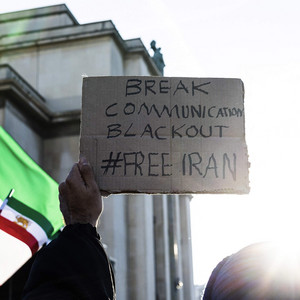
The current Internet shutdown came as a response to protests across Iran, with crowds calling for political change amid rising inflation and a devastating drop in the value of Iranian currency, the rial.
Since protests began, more than 5000 people have been killed, according to the US-based human rights activist news agency.
NPR hasn't independently verified that number, and observers and activists estimate the death toll may be much higher.
Now, when it comes to the Internet, initially it was a total digital blackout.
But over time, some selective services have come back online.
These are known as whitelisted services.
And so we are starting to see Google Search, Google Images, which are whitelisted applications, be accessible, but still only within the domestic Internet.
So emails cannot be sent outside of Iran, for instance.
Yeah, we're not seeing Gmail up at all.
Despite the near-total internet shutdown, some voices are getting through.
Like this protester, who sent a voice memo to NPR's Arazu Razvani.
Shut up.
I can say now the city is in a trance-like state.
People don't leave their houses much.
It feels as if, as the expression goes, they splashed death everywhere.
This man is among the 3 of Iranians who have managed to stay online through the satellite internet system Starlink.
But doing so is a crime.
Today on the show you're on offline how computer networking happens, how a government can shut it down and how scientists are monitoring that connectivity from afar.
I'm Emily Kwong and you're listening to Shortwave, the science podcast from NPR.
And many more delicious and lean protein options.
For wellness when you need it.
Shop Smart Meal Shortcuts to stay motivated, like Ready to Eat Salad Kits.
Shop all things wellness at Whole Foods Market.
This message comes from Charles Schwab.
When it comes to managing your wealth.
Schwab gives you more choices, like full-service wealth management and advice when you need it.
You can also invest on your own and trade on Thinkorswim.
Visit Schwab.com to learn more.
For 47 years, Iranians have lived under a dictatorship many no longer want.
Now the country may have reached a breaking point.
Iranians have recognized that they need to take matters into their own hands, pushing back against authority.
We ask three central questions about how Iran got here and what comes next.
Listen to ThruLine on the NPR app or wherever you get your podcasts.
Okay, so to talk more about the internet and the internet shutdown in Iran, I'm going to dig deeper with Amanda Meng, a social scientist at Georgia Tech, who you heard from earlier, and Alberto Dainotti, a computer scientist, also at Georgia Tech, who studies internet infrastructure.
And Alberto, let's start from a technical standpoint.
What is the internet?
So internet stands for internetwork.
So it's a network of networks.
So it was designed to make completely different networks interoperable and interconnect them.
Some of these are the networks of our ISPs internet providers that allow us to connect to the internet.
Some are networks of big telecom operators.
Some are networks of universities like ours, for example.
I know this is extremely complicated, but what exactly is a network?
Okay, so we say that a network is a set of endpoints like hosts and clients and servers that want to talk to each other.
Right, like a computer sends an email to another computer.
Those are endpoints.
Yes.
A cell phone, a laptop... and so on.
And these endpoints?
Somehow they are connected to intermediate nodes, which we call routers and switches.
Ah, yes.
Right.
But you could even think about cell towers, for example.
We see traffic from many endpoints and then they route it around.
But the way endpoints and routers are connected with each other is really through links, which can mean actual cables, like fiber cables or the cable that reaches our home, or Ethernet cables, but it can be even Wi-Fi.
Links that are in the air, basically, like radio signal, cell phone signal, satellite signal.
Those are links that interconnect these nodes.
It seems like magic, but it's all by design.
But given that the Internet, just as you're describing it, the infrastructure seems seemingly everywhere.
And then with the wireless component and satellites involved, how do you even shut down something like that?
It really depends.
The way connectivity and infrastructure is organized in various country by country.
And so the keyword here really is centralization.
How much the connectivity infrastructure is centralized.
So you might find some countries have mainly a big state telecom as a network operator or a handful of operators.
In other countries you will find dozens who are densely connected and can leverage many different entry and exit points of traffic in the country or from the country to the rest of the world.
And in Iran, is the internet infrastructure fairly centralized?
It is, yes.
Okay.
And the government for years has worked also on making sure that they could have a certain degree of control on how the traffic flows and through which systems, which intermediate nodes, which links.
Yeah.
And going back to you Amanda, you and Alberto learned about the internet outages through your work together on IOTA, this research project.
Why is it important that something like IOTA exists?
Yeah, so IOTA.
It provides a public service for people to look at internet connectivity measurements anywhere in the world and see if their internet is connected.
What's down?
Where is it down?
How long has it been down?
So it provides data that's Hopefully, people can get insights from.
Hopefully, it's actionable data on Internet connectivity globally.
Now, you measure Internet connectivity using three main signals.
Can you describe each of those three signals and what they tell you about whether the Internet is flowing or not in a place?
Starting with the first signal, router announcements, what are those?
Yeah, so Iranian networks announced the fact that they are reachable and will say well, if you want to talk to these certain sets of IP addresses, just talk to me and I'll take care of delivering the traffic.
That doesn't mean that the traffic will be delivered.
The other one is also very simple, is active probing.
We basically constantly ping networks all over the world.
And the third one is basically a form of network traffic pollution that constantly exists on the internet.
And we learn to cleanse this noise and use it as a liveness signal that is coming from different countries, different regions and different network operators.
So we call it telescope traffic, because it's captured through a research infrastructure that, by analogy with astronomy, has been called network telescopes.
And to be clear, Iran has shut down the Internet before, notably during protests in 2019.
There were also mass casualties.
This is known by some in Iran as Bloody November.
Did IOTA's tools pick up on a drop in Internet connectivity back then?
Is the government using any different tactics this time?
Yeah.
In 2019, you do see routing announcements go down to, say, 60%.
So they were using this blunt force tool to take away connectivity and they weren't able to do anything more sophisticated like whitelisting with the white SEMs or just providing access to certain people.
So they've become more sophisticated in how they're implementing their shutdowns so that They can keep online what they want to keep online.
What do you guess they're doing?
Well, I think they want to be able to communicate as government officials.
And I think they also want to control information.
So I think certain journalists get white sims, so certain journalists.
People who are trusted information sources are allowed to have connectivity.
Also, I don't know that we're seeing this right now, but with the Women Live Freedom movement in 2022.
They were just shutting down mobile connectivity.
And that was to mitigate against the economic cost of these shutdowns.
Because when you're taking everything down, the economy is going to be affected.
So being able to be more precise with how you implement this and be more sophisticated, you're definitely increasing some of the costs that are, in a way, political costs as well.
With the innovation of satellite internet, is there some internet infrastructure that's just beyond the government's reach?
That no matter what those in power want to do, the internet will still find a way?
Is this like a race between governments and internet infrastructure?
That's a really tough question.
I guess that's what we are trying to understand and study.
The signal jamming that we were referring to earlier is an example of how The signal jamming of Starlink
Yeah, for example, Starlink.
The satellites owned by SpaceX.
Yeah, yeah.
It's an example of how even this type of connectivity can be within reach of governments.
It's really something that is evolving and under our noses and we're all trying to understand how things will keep evolving.
What is the value in this research for you both in really understanding internet connectivity when it's shut down?
The internet is relatively opaque, especially the internet infrastructure, and so there is a scientific aspect in trying to understand Internet connectivity better, and especially trying to understand when connectivity fails in general, not only when governments or the shutdowns, but also when large fractions of population experience outages for other reasons.
Sure, from like natural disasters and such.
So to me, a big question is when, where, how the Internet fails.
And we still don't have precise answers to that question.
Amanda, what about you?
I mean there's certainly questions about sovereignty, like sovereignty of a state and how the Internet shows up in that.
Ukraine was definitely coming to mind, as Alberto was talking about centralized versus decentralized networks.
And, you know, we saw Ukraine be much more resilient because of how decentralized their internet is.
Yeah, I mean, different context, but still that... But that made a difference.
Yeah, and then I think, you know, this question of...
How to participate in civic life and how to be able to not just mobilize around a protest but mobilize resources in general.
The Internet is still playing a part in that.
Given the power of the Internet in modern life.
Amanda, what do people lose when they don't have access to the Internet?
Yeah, I mean, I think...
The first thing is connection to loved ones.
That's one of the first things we hear from our partners is Trying to get a hold of your brother or your mother or your father.
Where are you?
Are you safe?
I think that's really one of the number one first things that you lose.
And you lose the ability to use your whatever mapping app that you use to try and get to safety.
You may lose access to your bank account.
There's really so many things that you lose.
As for Iran, estimates for when the internet will be fully restored range from days to weeks.
If you want to learn more about what is happening in Iran, check out our show notes.
We'll link to more NPR reporting.
And follow us to stay up to date on the latest science behind the headlines.
I'm Emily Kwong.
Thank you for listening to Shortwave from NPR.
See you tomorrow.
Forty years ago, the space shuttle Challenger exploded shortly after liftoff.
The nation was shocked, but the night before, engineers had pleaded for a launch delay.
He said the Challenger's going to blow up, everyone's going to die.
An NPR investigation into why last-minute warnings about the launch were dismissed.
Listen now on the NPR app to the Sunday story from the Up First podcast.
On Ye Gods with Scott Carter, hear from the faithful.
I told my very Catholic mother that she needs to meet Jesus.
The faithless.
I just so don't believe in God.
And the fearless.
Serve people, connect with people.
That's how we thrive.
If life's a mystery, we investigate.
Who done it?
I pray that you were God.
Listen religiously to Ye Gods with Scott Carter wherever you get your podcasts.