This BBC podcast is supported by ads outside the UK.
From coast to coast, unlock adventure at Red Lion Hotels by Senesta.
Where restful sleep, friendly service and local knowledge await.
Whether for business or pleasure, spend less and make more of every trip.
When you sign up for the Senesta Travel Pass, you'll get their best rates instantly.
Go to senesta .com to book your stay and unlock their best rates with Senesta Travel Pass.
here today rome tomorrow join now at sinesta .com terms and conditions apply summer's here and it's officially the season of wellness for me that means feeling energized focused and confident and symbiotica has become a key part of my routine i take their magnesium l -3 and 8 and liposomal glutathione every morning it's an easy ritual that gives me sustained energy and focus all day long every formula is science -backed and highly absorbable so i know I'm actually getting what my body needs.
Go to Symbiotica .com and use code iHeart to get 20 % off your order.
That's Symbiotica .com and code iHeart for 20 % off today.
This is a special edition of the Global News Podcast from the BBC World Service.
I'm Nick Mars and at 14 hours GMT on Sunday, the 22nd of June, these are our headlines.
Iran condemns the US attacks on its nuclear facilities as a betrayal of diplomacy.
diplomacy. Donald Trump says US bombers have totally obliterated Iran's key nuclear enrichment facilities, but Tehran denies that they've been destroyed.
Also in this podcast, we look at the consequences for financial markets and what options does Iran have to respond to the attacks.
In our earlier podcast, we brought you news of the US attacks on nuclear facilities in Iran.
President Trump said the Iranian nuclear installations had been completely obliterated.
Shortly before we recorded this podcast, the U .S. defense secretary, Pete Hegseth, gave an update.
This is a plan that took months and weeks of positioning and preparation so that we could be ready when the president of the United States called.
It took a great deal of precision.
It involved misdirection, and the highest of operational security.
Our B -2s went in and out of downtown Tehran, these nuclear sites, in and out and back without the world knowing at all.
In that way, it was historic.
Our Washington correspondent, Gary O'Donoghue, spoke to my colleague, James Kumarasamy.
We're getting a timeline which which involves some of these bombers, around five of these big bombers taking off to the east from the United States.
There was a decoy sent westwards, which the Chairman of the Joint Chiefs has been talking about.
He's talked about the other assets that were involved, including a submarine, which fired a bunch of Tomahawk cruise missiles, which we know about.
It seems that around 14 of these huge bombs were used.
These 30 ,000 -pound bombs were dropped against two targets, he says.
That will be Fordow and one of the other two that we know about, 75 precision -guided weapons used in the whole process.
Interestingly, he said that the battle damage will take some time to assess, but there is extremely severe damage, he said.
Now, that is an interesting point because the president in his address last night talked about complete and total obliteration of their capacities.
Well, it sounds like the Pentagon is being a little bit more cautious at the moment.
And what are they saying about possible reprisals?
Well, they haven't got on to that in terms of the Pentagon yet.
But, of course, Donald Trump has warned Iran against that.
But there are, you know, we've heard from the Iranian foreign minister that that is an option.
And they are planning for all sorts.
They are planning for Iran's missile attacks in the region.
They are obviously some of its proxies, which have been severely depleted, of course, Hezbollah and Hamas.
but also what the Americans call terrorism as well.
So there could be attacks on softer targets, attacks on some of those bases in the region.
There's 40 ,000 U .S. troops in the Middle East and a whole bunch of bases, some of them less protected than others.
So there is a range of possibilities they're planning for.
The nature of that retaliation will, I think, determine what happens next.
And what about the decision making process and the different strands of thought within the administration?
I'm just seeing that the US Vice President J .D.
Vance has told NBC, US is not at war with Iran, but at war with its nuclear program.
And there was definitely thought to be various strands of thought about the wisdom of this.
Yeah, well, I think that's probably why you saw the president there last night, not alone, but with his secretary of defense, with his secretary of state, who is also the NSA at the moment, and with the vice president, in a show of unity.
integrity. Donald Trump doesn't give up the limelight easily.
And having those three there, albeit in non -speaking parts, I think was an indication that those strains of opinion you've talked about, while they're not sort of writ large amongst that group, they are reflected to some degree amongst that group.
And certainly when you get to the lower, you know, the lower parts of the party and the support base, there are divisions and unhappiness and that's been very republic.
Gary O'Donoghue. Iran's foreign minister has given his reaction to the US strikes.
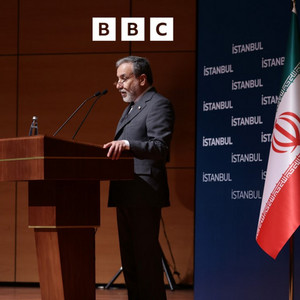
Speaking in Istanbul, Abbas Arachi said Washington had crossed a big red line and that Tehran had the right to defend itself against such aggression.
The Islamic Republic of Iran condemns in the strongest terms the United States' brutal military aggression against Iran's peaceful nuclear facilities.
It is an outrageous, grave and unprecedented violation of the fundamental principles of the Charter of the United Nations and international law.
The warmongering and lawless administration in Washington is solely and fully responsible for the dangerous consequences and far -reaching implications of its act of aggression.
Previously, Iranian officials said that any U .S. involvement would trigger an attack on U .S. military bases in the Middle East, which hosts thousands of U .S. troops across at least eight countries.
Tarana Fathalian from the BBC Persian service told me more about the reaction from Tehran.
Iran is very angry.
They have called this a savage military aggression, a violation of territorial integrity and sovereignty of Iran.
They have reserved the right to defend and respond.
But conversely, at the same time, Mr. Al -Aghdi was saying that Iran has been betrayed by these attacks and Tehran is committed to diplomacy.
So it's still keeping that as a possibility.
On today's press conference, there was a lot of talk about diplomacy.
I actually said that the the door to diplomacy was always open, it was an option, but this is not what is happening now.
He stressed that diplomacy was an option, but it's not happening now.
And he called on the international community, the UN, to condemn and take action.
And he said that if they don't take action and make a quick response and condemn, there may be consequences and US will be responsible for consequences.
Iran's foreign minister says he's going to meet Russia's President Putin on Monday.
Can they expect a very sympathetic ear from the Russians?
One would say that Iran has not received the sympathetic response that it kind of expected from Russia so far.
So I think they are hoping that they get some support.
But we have to wait and see.
Tarana Fatalian of BBC Persian service.
But what military options does Iran have?
A question for our security correspondent, Frank Gardner.
They've really got three strategic choices to make.
They could do nothing in terms of retaliation to the United States, because I think there's probably a degree of sympathy for them around the world.
There's a lot of anger by some Iranians, many Iranians, and a lot of nervousness in the Gulf, so there would be relief in the Middle East, in the wider Middle East, if that was the end of it, and they could even return to talks.
But that would risk making the regime look weak because, remember, they were threatening dire consequences if this happened, and then it did happen, and they've talked about consequences going on forever.
There will be a lot of pressure, I think, on the regime from within its sort of security architecture architecture to retaliate in some way.
They could hit back very hard. They could escalate this by hitting either US bases, US diplomatic missions.
The most likely place people think is that they would possibly use their proxies to hit US bases in Syria and Iraq, which is what they did after the assassination that Donald Trump ordered of Qasem Soleimani, the head of the the Iranian Revolutionary Guards Corps Quds Force some years ago.
That's how they retaliated.
There were no deaths because Iran warned America in advance.
That was a very measured, relatively moderate response, but still powerful.
All they could wait and retaliate at a time of their own choosing.
Meanwhile, the war sort of dribbles on, but make it sound like an understatement.
It's horrific for anybody involved in it.
But the war grinds on between Iran and Israel with the exchange of missiles and so on.
But if Israel believes that the nuclear threat has been eliminated at Fordow and Natanz and Isfahan with U .S. help, then it may well decide to say mission accomplished and we're not going to do any more airstrikes on Iran.
run. But there are indications that Iran kind of evacuated quite a lot of material out of Fordow in the days before this strike.
It's possible that part of its nuclear program has survived.
And there is now a real risk that hardliners in the regime are going to get their way and say, right, come on, gloves off.
The only way we can stop these attacks happening in future is to actually build a bomb.
North Korea did that.
And look, no one's attacking North Korea.
Indeed, we were discussing that earlier in the programme.
There is one other more general way in which Iran could disrupt things for much of the world.
And that is in the Straits of Hormuz by disrupting oil exports.
And that would hurt, as I said, around the world.
Yes. Interestingly, the Iranian foreign minister, I think it was, has refused to rule that out.
He He didn't say they were going to do it, but he didn't rule it out.
This is the narrow channel that runs between Oman and Iran, the Strait of Hormuz, through which roughly 20 million barrels of oil a day, which amounts to 20 % to 30 % of the world's oil supplies flow.
So it's a major energy artery.
If Iran decides or discovers that any of the Arab Gulf states, which all host US bases, but if it decides that they are complicit in this attack, and there's nothing to say that they have been at the moment, but if it decides that they took enemy action, as it were, then that makes their own facilities extremely vulnerable.
Cast your mind back six years, Nelly, to that mysterious attack on Saudi Aramco's petrochemical facilities in September 2019 at two places called Abqaiq and Khraes.
I went down there to go and have a look at it, and this was where a barrage of drones, explosive drones, hit these petrochemical facilities from the north.
It was said at the time they'd been fired by the Houthis in Yemen.
I went there, and all the holes were facing north.
They were fired from Iraq by Iranian proxies.
And that was a bit of a wake -up call to Saudi Arabia, as to it took more than half its daily oil exports offline in the space of a few minutes.
And that was a real wake up call to the Gulf states as to how vulnerable they are to Iranian drones and missiles.
Frank Gardner. Well, this significant escalation of the conflict in the Middle East also brings uncertainty to the financial markets, particularly when it comes to the price of oil.
Our business correspondent Mark Ashdown told me how the markets have been reacting prior to the US involvement.
They've been pretty calm, I have to say, over the past week or so in this period of instability.
Pretty stable, I have to say, at the moment.
No major swings either way.
Brink crude, of course, opens tonight.
That went up at the start of the Israel -Iran conflict.
It had been trading at about $65 a barrel.
It's currently around $76 a barrel.
To give you a bit of context, though, back in 2022, during the Russian invasion of Ukraine, crane, it hit $112 a barrel.
So not a spike in that respect, but it's certainly ticking up.
The key now is how Iran responds.
Does it start targeting the Strait of Homs?
20 % of the daily shipping of oil passes through this tiny, narrow waterway between Iran and Oman.
If they start to target that, that could really start to have an impact.
I mean, Iran aren't a major producer on the scale of the US, Saudi Arabia, and Russia, just 4 million barrels per day.
They're about about the seventh biggest producer of oil, but they certainly could have a massive impact if they hit that, that straight -forward move.
Markets open tonight, of course, in Asia.
We will look for a reaction.
As I say, been fairly steady over the past week or so.
Markets do tend to look ahead.
They'll look ahead at sort of six months, 12 months.
And, of course, as we get some companies potentially hit, airlines, for example, but then the big oil producers may see a benefit, you know, the value increasing.
Interesting to see that maybe not expecting such a huge impact on the markets, as we saw with Donald Trump's tariffs last month.
Yeah, exactly. I mean, a huge drop for many days there after Donald Trump's tariffs.
But interestingly, it's come back.
There was a massive drop as he announced them.
The FTSE, the S &P 500, the NASDAQ all recovered to the levels they were before.
So, as I say, we may see some short -term fluctuations, but long -term, the market will take a sort of rational view of this.
Mark Ashdown. To put all this into context, I asked the diplomatic analyst Jonathan Marcus Marcus, for an assessment of what's been happening and where it might lead.
Well, it's a very, very uncertain moment, in large part because we can't see a way forward at the moment to bring the fighting, the kinetic part of this, to an end and move back to the negotiating table.
Remember, Iran was perhaps willing to have some kind of negotiations, but was drawing a red line, insisting that it would have to be able to enrich uranium.
It had already enriched uranium way beyond needs it might have for a future nuclear power, for fuel for a power station.
So it's very uncertain.
The Americans, I think, will not do any more bombing unless the Iranians respond in some way.
The hope must be that the Iranians measure their response, calibrated it in such a way that the Americans don't go for a second round.
Of course, if the damage to Fordow isn't as great as the Americans have initially said, that might encourage Mr. to Trump to go back and finish the job.
Then the question is, what will the Israelis do?
How much more damage do they want to cause to Iran's missile production, any other ancillary nuclear facilities?
And the key question then, of course, in Tehran, what will the regime do there?
Will it respond? Will it go for broke and decide to pursue a nuclear programme?
If so, what has happened to the significant quantity of highly enriched uranium that it already has.
That used to be buried away at Isfahan.
That facility has obviously been hit.
We don't know whether the material was there or what has happened to it.
So, you know, as so often in these crises, one dramatic event leads to a whole cascading set of questions.
And you'll hear lots of dire predictions about what the Iranians might do and catastrophe and all of this.
Yes, terrible things could happen.
But the the fundamental point is the Iranian regime is very, very weak.
It's the pillars of its whole strategic position have been knocked away one by one.
And there has to be some very serious thinking, I think, in Tehran as to how they dig themselves out from this particular hole that they are in.
There's certainly an alternative view on the part of Israeli Prime Minister Benjamin Netanyahu.
He says that the US attacks could lead the Middle East to an era of prosperity prosperity and peace.
Wishful thinking? Well, I think in the short term it is, of course, wishful thinking.
And look, there is no doubt in a very broad sense, I mean, one does not want to agree with Mr Netanyahu, a man I disagree with profoundly in a number of ways.
But the fact remains that behind an awful lot of the trouble in the region over the past decades has been the Islamic regime in Iran.
It has clearly wanted to export the revolution.
It has clearly sought sought to use proxies and allies in other countries to pursue one of its key strategic games, which was the ultimate goals, which was the ultimate destruction of Israel as a Jewish state.
That strategy is now in tatters.
Now, if the regime disappeared and there was a friendly, outward -looking Iran that gave decent rights and opportunities to its own people and wanted to build a better and a fairer society, clearly that would be much better for the region at large.
But I think that's at the moment pie in the sky.
That's a sort of, you know, land of rainbows over the hill at the moment.
We're nowhere near that.
The regime is still very much there.
It's fighting for it.
Certainly it's international life at the moment.
And we'll have to see.
I think all depends on what Tehran's response to all of this is.
And Jonathan, we touched on this a little bit earlier, but the broader issue of nuclear proliferation in general, what does the attacks from the United States do for concerns over that?
Well, I think it increases the concern for potential nuclear proliferation, particularly if an Iranian nuclear program isn't in some way stopped.
And the best way of stopping it is obviously ultimately through negotiation and agreement.
The difficulty you have is that the Iranians and some other countries may decide that the best way of avoiding this kind of onslaught from a superpower or from a regional power like Israel is to have an atom bomb, a nuclear weapon.
If that is the conclusion, that could be very dangerous.
But you know, Iran again is at the centre of all of this.
If Iran doesn't have a nuclear bomb, then very few other countries in the region would seek to get one.
So ending the Iranian nuclear programme one way or another is, I think, a very important element in the cause of non -proliferation.
Jonathan Marcus. And that's all from us for now, but there will be a new edition of the Global News podcast later on.
if you want to comment on this podcast or the topics covered in it you can send us an email the address is globalpodcast at bbc .co .uk you can also find us on x at bbcworldservice use the hashtag globalnewspot this edition was mixed by Callum McLean and the producer was Oliver Berlau the editor is Karen Martin I'm Nick Miles and until next time goodbye