Grownups, Wondery Plus subscribers can listen to Wow in the World early and ad-free right now.
Join Wondery Plus in the Wondery app or Wondery Kids Plus on Apple Podcasts.
Hey, Wowzer fans, Mindy here.
And before we start the show, I gotta let you know that this November, with a special new episode featuring our friends at Circle Round and Terrestrials on Radiolab for Kids,
And don't miss when Elmo from Sesame Street stops by Wow in the World to make us all belly laugh on November 24th.
Oh, but that's not all, Reg.
On December 1st, we are sharing our 250th episode of Wow in the World with all of you.
We think this one is going to be music to your ears.
Literally.
Did I mention it's a musical?
And if you're a member of the World Organization of Wowzers...
Oh boy, do I have a surprise for you.
You can listen to our 250th episode early with me and other members from around the world on Saturday, November 22nd, at 7 pm.
Eastern.
That's right, we are throwing another listening party.
Join us as we dance along to our new songs.
React to the episode with other members in the chat and more.
Grownups.
If you want your wowzer to join this members-only listening party, you can sign up to become a member today at Tinkercastcom.
Slash wow.
Already a member?
Well, you can find the link and password to join the event when you sign in at Tinkercastcom.
Slash wow.
That's it.
It's going to be a November to remember.
But for now, let's get on with the show.
Woo!
When I turned on the light, I discovered that all my beans were de-alphabetized.
Oh, no!
Dennis, this isn't very scary.
Guy Raz, this was supposed to be a scary story.
It is scary, Mindy.
How am I supposed to find my chickpeas without an organizational system?
Yeah, Mindy!
Thank you.
Okay, who else has a spooky story to share?
Well, I can tell you the one about does this look infected?
Babe?
Ew, no!
Please don't.
Oh, I got one.
It's a real spooker about a little goblin with arthritis in his knucks.
Spoiler alert, the little goblin is me.
No, Tommy, I want to tell the one about the Phantom of the Opera tickets that were all sold out.
Reggie, it was so scary!
What about you, Mindy?
Do you have a spooky story to share?
Well, I did just read a spooky scientific study in the journal Behavioral Ecology.
Too scary!
It's not too scary.
It's science.
Hold me, guys!
No, Dennis, go back to your chair.
This story...
It comes from a study conducted by researchers at the University of Copenhagen in Denmark.
It's the story of a teeny tiny parasitic flatworm known as the lancet liver fluke.
I do not know what that is.
Okay, well, a liver fluke is a... No, before that.
Okay, a flatworm is a... Rewind farther.
Okay, a parasitic flatworm... Yeah, that.
What?
I do not know what that is.
A paracynics?
A paracritics?
I don't know what you're saying.
Oh, okay.
So a parasite is a teeny, tiny creature that must live on or inside of another living thing in order to stay alive.
And to survive, it takes nutrients from the other living thing.
Yeah, a parasite is like a little thief.
Well, I still don't get it. can explain, Granny G. Huh?
You can?
Think of a parasite as someone who comes to visit your house and eats all your food and drinks all of your chocolate, milk and steals all your friends and sleeps in your bed when you're away and uses your toothbrush and takes your money and finds your birthday card from your grandma and crosses your name out and writes his own in it.
So it says To Dennis, my number one granddaughter.
Wait, that was you?
It was an example of a parasite.
Okay, I get it now.
Dennis, did you use my toothbrush?
It was an example, Mindy.
Are we still telling scary stories or no?
Thank you, Thomas Fingerling.
Yes, we are.
Now, where was I?
I believe you were at the beginning, Mindy.
Oh, right.
Flashlight, please.
Flashlight.
Thank you.
And now, I submit to you the spooky yet scientific tale...
Of the life cycle of the lancet liver freak.
Once upon a time, on a warm summer day, a tiny ant was taking a leisurely stroll down the sidewalk.
Tra-la-la, boop-be-doo-be-doo, I love being a tiny little ant.
When he stumbled upon something delicious.
Ooh, what's this now? was a big honkin' lump of freshly coughed up snail mucus.
Poodleally.
Snail mucus.
But little did the ant know, there was more to this snail mucus than he bargained for.
This snail mucus sure is tasty.
I wonder what the secret ingredient is.
That secret ingredient hidden deep inside the snail mucus was an army of teeny tiny parasitic flatworms, known to scientists as the lancet liver fluke.
Hello, I'm a little liver fluke.
Is everybody here?
Yeah, all here.
But these liver flukes were only in the larva stages of their little liver fluke lives.
We're all babies.
And in order to grow big and strong, these baby larva liver flukes would need to find a liver.
Hey, quiet, quiet.
Does anyone see a liver around here?
No, I don't see one.
We're inside an ant.
And ants don't have livers.
Oh, okay.
Ants don't have livers.
Well, we're going to need to get to another living animal with a liver.
But where in the world could these lowly liver flukes find a living liver?
Moo, moo, moo.
I'm a cow with a ripe old liver.
That's it.
A cow.
But how could this army of liver flukes get from the inside of an ant to the inside of a cow?
There was only one solution.
There's only one solution.
We need to get that cow to eat this ant that ate us.
It's the only way to that liver.
Okay.
Hey, cow, look.
A delicious ant.
Come on, cow.
Hold on a second.
What?
What do you want?
The tiny liver fluke parasites were eaten by the ant?
Yes, when the ant ate the snail mucus that the liver flukes were chilling in.
And now that they're in the ant...
They want to be eaten by the cow?
Yes, because the cow has the liver that the liver flukes need to live off in order to grow and survive.
So wait, the best way to get the cow to eat the liver flukes is to get the cow to eat the ant?
Yes, because the liver flukes are all inside the ant, so wherever the ant goes, the liver flukes go with it.
Okay, but how can they be sure that the cow will eat the ant?
Well, if you'll allow me to get back to my story, I was just about to get to that part.
Oh, right.
Sorry.
Please continue.
Thank you.
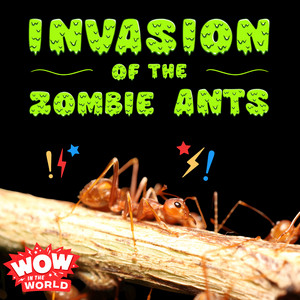
Now, the only way to get this ant eaten by the cow would be for the liver fluke to climb up, up up into the ant's brain.
What?
Kairos, shh.
Oh, sorry, sorry.
Okay, I'll go up.
The rest of you stay right here in the abdomen.
You're so brave.
Thank you for saving us.
You're our hero.
While the army of liver flukes were in the abdomen, one brave parasite made the treacherous journey up, up up into the ant's brain.
Oh, my goodness.
So many stairs.
Okay.
Here we are.
The brain.
Wow.
It was then that the liver fluke took control of the ant's brain once and for all.
All right, just got to hack into the mainframe and... Access granted.
Napster, I'm in.
Uh-oh, that feels weird.
It began sending instructions to influence the ant's behavior.
You know, mind control, tell it what to do.
Okay, let's see what this baby can do.
Ant...
Scamper over that way.
You got it.
Scamper, scamper.
Oh, wee!
Wow, the lancet liver fluke can tell the ant where to go?
Yep.
Hooray, this is so fun.
Now put your hands in the air like you just don't care.
Hooray!
Hooray! is so creepy.
Oh, creepy doesn't even begin to describe it, Guy Raz, because... I'm a zombie ant now.
Now, with control over the ant's movement, the liver fluke can get itself and the others into position poised to be eaten by the cow.
Okay, ant.
Climb that blade of grass over there.
You got it, dude.
Higher, higher, higher.
Quit rushing me.
Moo, moo, moo.
I'm a hungry cow.
This grass looks tasty.
Maybe I'll just eat it.
Mmm, mmm, mmm.
I love eating grass.
Okay, and stop right here.
What we do?
Yum, yum, yum.
Right into my tongue.
And here we go!
Yum, yum, yum.
At this point, the army of baby larva liver flukes are taking a ride down the cow's digestive slide.
We're off to see the liver, the wonderful liver of cow.
Hold on.
I'm sorry to interrupt, Mindy.
A liver fluke climbed into the ant's brain, took control, and got the ant eaten by a cow?
What?
That's what she said, boy.
Mindy, this story is getting ridiculous.
Ridiculous?
No, no, no.
This story is getting scientific, Guy Raz.
But wouldn't the cow's stomach acids just destroy these tiny parasites?
Well, you would think that would be the case, but the liver flukes have a plan for that, too.
They do?
Yeah.
See, they have this unique ability to form a hard-shelled protective capsule around themselves.
And the liver flukes huddle together inside that capsule and ride in it until they reach the liver.
The liver flukes ride in a capsule through the digestive system?
All the way to the cow's liver?
Moo, moo, moo.
This just seems too wild to be true.
What can I say, Guy Raz?
Science is bonker balls.
That's one way to put it.
But sadly, there is one liver fluke who will never see the light of the liver.
Oh, yeah?
With the army of liver fluke nestled safely in their capsule, their fearless leader realized that its time here had come to an end.
Ahem.
My legion of larval liver flukes, I am sorry to tell you that my time here has come to an end.
Yes, my work here is done.
I made the treacherous climb of a lifetime.
I took control of that ant's brain and turned it into a zombie.
And I found you a liver to call home.
Thank you, I'm so sorry.
Yes, yes, I'm a big brave hero.
But alas, my journey has come to an end.
Fare thee well, my lovely larval liverflutes.
I leave you in peace.
That's right.
That liver fluke sacrificed its own life to help the others survive.
At this point, the leaderless liver flukes have come too far in their quest to give up now.
The liver is just on the other side of this highway of intestines.
Come on, everyone.
I can almost smell that liver.
Once we get through, the bile ducts will be there.
They begin their treacherous journey sailing through the sea of stomach acid, inching their way through an inner state of intestines as the capsule surrounding them dissolves.
They're almost there.
We're almost there!
Soon they make their way through the cow's bile ducts and before they know it they've reached The liver.
We did it!
The little larval liver flukes feast on the blood of the liver...
And before long, they grow big and strong, and soon they're fully grown flukes.
Wow, look how big and buff we are.
Yeah, we're not babies anymore.
Let's lay eggs.
The liver flukes lay their eggs one by one.
And then, when the cow is done digesting... Oh, time to poop.
The eggs are loaded up onto a cow poop barge and sent out to seek their fortune.
Bye-bye eggs.
Make us proud out there.
Oh, they grow up so fast.
Wait, the eggs are just...
Pooped out?
Well, yeah, pretty much.
And then what?
Well, they just hang out there in the cow poop waiting for a snail to come along and eat them.
So the snail just eats the poop eggs?
Well, the snail eats the poop with the eggs.
That is not how I like my eggs.
Me neither, Tommy.
I like my eggs scrambled like finger-length brains.
And I like mine without poop all over them.
Okay.
Can we... to the story, please?
As I was saying, the liver fluke eggs lay in the poop waiting for a snail to come along and eat the poop with the eggs in it.
Um, Guy, I believe that's your line.
What?
Yeah, you're the snail guy, Roz.
Everyone's gotta play a part.
Can't Reggie do it?
No, not everyone can understand Reggie, so you have to do it.
Okay, fine.
Fine.
Yeah, eat the poop eggs, Garage.
Okay.
What is this?
A fresh pile of cow poop with eggs inside?
Yum, yum.
Don't mind if I do.
And once the snail eats those eggs, jack.
The eggs develop into larval baby flukes and reproduce or multiply until there are several thousand of them.
And soon those baby larval liver flukes are ready to move on.
And when the time is right, the snail oozes out a big lump of snail mucus.
There, Roz.
It's you.
Oh, sorry.
What is he doing?
Is he okay?
Sorry, sorry.
A slime ball filled with baby larval liver flukes oozes out of the snail and is left on the ground just waiting to be eaten by an ant.
And thus, the circle of life of the liver fluke begins anew.
The end.
That was a really disturbing Serving story, Mindy.
Why, thank you, Guy Raz.
I thought the ant was the best part.
You know, the way it ate the snail snot full of little baby liver flukes.
And I thought that the one heroic liver fluke was the best part.
The one that controlled the ant's brain and turned it into a zombie and made it get eaten by a cow.
And I thought that the cow was the best part.
Because it ate.
The ant filled with them liver flukes and then got them to crawl around its liver and suck its blood and pooped them all out when the party was over.
And I kind of enjoyed the part of the snail.
When the snail came upon the cow feces filled with the liver fluke, eggs and
Okay, yeah, I didn't enjoy that part either.
Too gross.
Well, that was a good spooky story, Mandy.
Yeah, and how did you come up with the part about the liver fluke hijacking the ant's brain?
Oh, I didn't, Dennis.
In fact, I didn't come up with any of that story on my own.
These were actual scientific observations made by researchers at the University of Copenhagen in Denmark.
Nuh-uh.
It's true, Dennis.
Yeah, sometimes science can uncover truths about our world that that seem like spooky stories.
And sometimes science is stranger than anything we could possibly make up ourselves.
Gnarly.
Well, I'm hungry.
Anybody else still thinking about that snail mucus?
No!
Wow in the World will be right back.
Grown-ups.
This message is for you, grown-ups.
It's mindy and guy ross here from wow in the world.
Mindy and i have some brand new wow in the world toys out in the world just in time for the holidays, made for the kids who love science and for the ones who don't yet, from our 100 experiments, that wow kit to the telescope and astronomy kit, our wow in the world toys help your wowser learn about their world through play plus can hear exclusive audio content from me and Guy Raz to help your wowzer discover even more wows.
Grown-ups, give the gift of wow and wonder this holiday season with our latest wow in the world toys designed with your curious wowzer in mind.
You can shop our wow in the world toys at tinkercastcom slash toys.
That's tinkercastcom slash toys.
Hi, thanks for calling Wow in the World.
After the beep, get ready to record.
Hi, Mindy and Guy Raz.
I'm Maddie.
My Wow in the World is that lobsters, starfish and axolotls can grow their limbs back if they come off.
Say hello to Reggie.
The Annoying Dennis.
Hi.
The Baby B. I'm the baby.
Wah, wah.
Someone changed my diaper.
Wah.
Grandma G-Force.
Oh, snap.
And dun, dun, dun.
Oh, yeah.
Hi.
My name is Louis, and I'm from Hamilton, Winnow.
My wow in the world is that a hummingbird's wings can flap in a figure eight and it's the only bird that can fly upside down backwards and can hover.
Hi, Mindy and Guy Ross.
My name's Violet.
And my name's Hazel.
And we're from Wyomissing, Pennsylvania.
Our wow is that scientists can turn peanut butter into diamonds.
Say hi to Dennis for us.
Hi there.
Bye.
My name is Taylor from Nashville, Tennessee.
And my Wow in the World says there are more than 1500 active volcanoes on Earth and around 50 to 70 volcanoes around every year.
Thank you.
And I love.
Wow in the World world is that there is a fish that swims upside down called the whip-nosed anglerfish.
Say hi to Reggie, Grandma G-Force, Thomas Fingerling, and Harley.
Man, we just look alike and sound alike.
Wow in the World is written by Mindy Thomas and Tom Van Kalken with help from me, Guy Raz.
Original sound design and music editing is done by our senior production director, Jed Anderson, and audio producer Tyler Tholtz.
You can also hear Jed Anderson in the voices of Dennis Thomas Fingerling, Reggie and many of the other silly characters that you hear on our show.
And Lizzie Freilich can also be heard as some of the silly characters on our show.
Jessica Bode keeps our facts straight as our fact checker.
And Meredith Halpern-Ranzer powers the wow at Tinkercast.
Our theme song was composed and performed by three-time Grammy nominees, The Pop-Ups.
Find them at thepopups.com.
Special thanks to Kit Ballinger, Rebecca Caban, Dr Natasha Crandall, Kenny Curtis, Kristen Yang, Thuy Mac, Erica Medina, Henry Moskal, Jodi Nussbaum, Ali Paksima, Linda Rothenberg, Steph Sosa, Joanna Weber, Anna Zagorski and all of the other tinkerers at Tinkercast HQ.
And to keep the WOW rolling after you finish this episode, visit us at Tinkercast.com.
There you can become a member of the World Organization of Wowzers to get year-round mailings and weekly activities.
Shop our WOW shop, get tickets for upcoming events and Find our best-selling books and learn about some of the other amazing podcasts from Tinkercast.
Grown-ups, you can follow Wow in the World on Facebook, Instagram, and Twitter at Wow in the World.
And our email address is hello at Tinkercast.com.
And if you're a kid with a big wow to share with us...
Call us at 1-888-7WOW-WOW for a chance to be featured at the end of our show or an upcoming episode of Two.
What's in a Wow?
Thanks again for listening.
We're here every Monday or you can check out Two What's in a Wow every Friday right here in the Wow in the World podcast feed.
And don't forget, we wow on the weekend with Dennis Saturday and Sunday.
Keep on wowing! the world was made by Tinkercast and sent to you by Wondery.