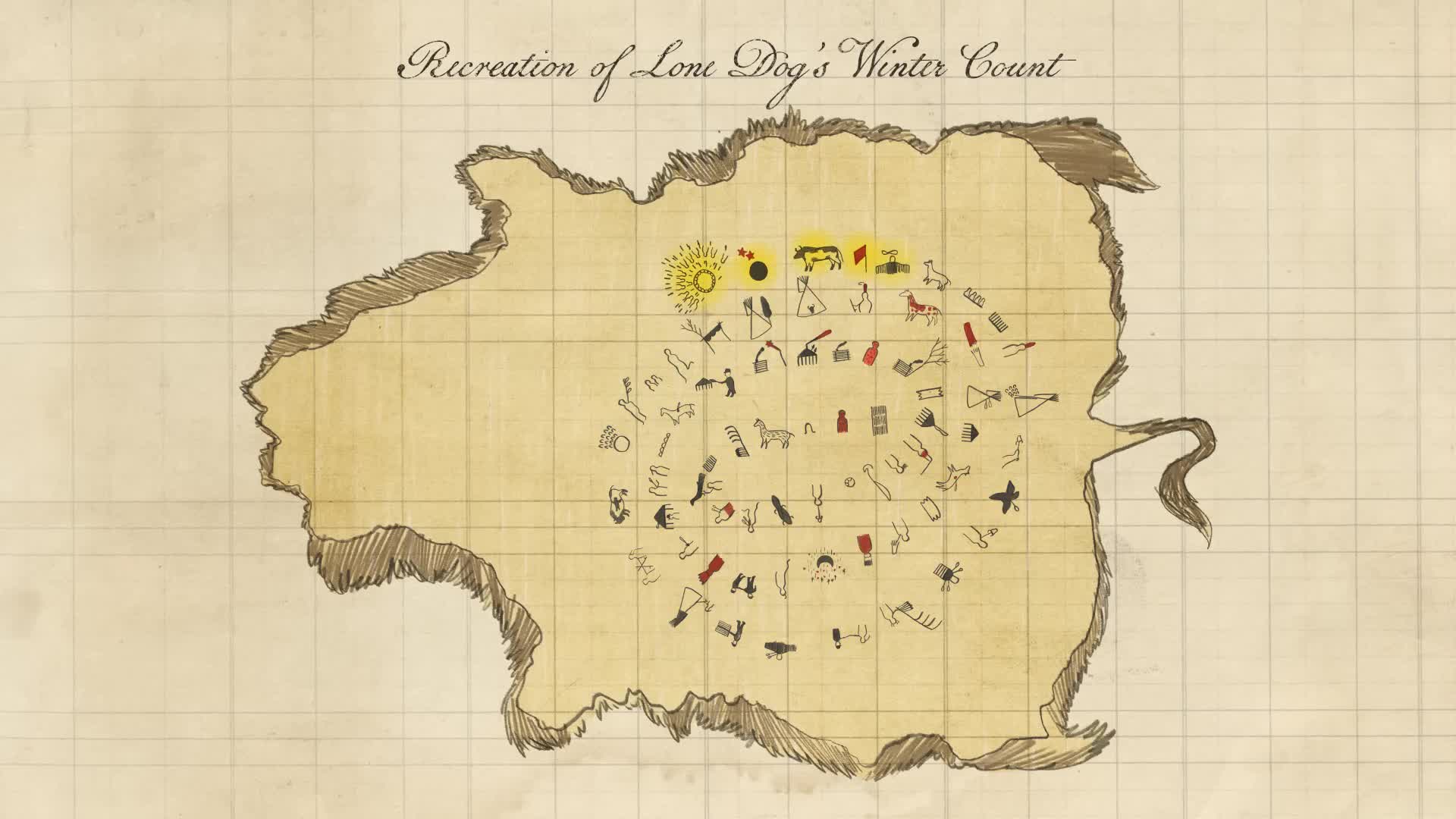
Here's the year the stars fell.
The year of Minnie Buffalo.
The year of whooping cough.
The year of measles.
The year of an eclipse.
The year the white soldiers attacked.
A year of peace.
A year of war.
This is a winter count.
It's a record of 71 years of Yanktonite history.
Each picture represents a notable event between first snowfalls.
But this is just a snippet of a much larger timeline.
Every tribe has one, a history that's deep, ongoing, and totally unique.
And yet, they're all unified by one thing.
Hi, I'm Che Jim, and welcome to Crash Course Native American History.
First things first.
There's no way we can tell the entire history of indigenous people and what's now the United States.
But that doesn't mean we can't bridge some gaps and add a little complexity to common understandings.
Maybe we'll even go crazy and fix some misunderstandings.
Studies have shown that across the board in US schools, students aren't getting much of an education when it comes to Native American history not by a long shot.
As one Navajo Hopi student wrote in 2019, of the US history books used in my classroom, there are 307 pages and only 10 pages talk about natives.
So yeah, this will be hard.
And we won't cover everything, but we'll cover a lot of things.
We hope to answer some big questions, leave you curious about others and really blow your hair back with facts about how Native history has shaped our world today.
So let's start with the word on words.
There are over 500 Native tribes, also called nations, within the U.S. alone.
Some are recognized by their federal government, and some aren't.
I'm a member of the Navajo Nation, not to brag.
But even that simple statement has layers of nuance.
We call ourselves Diné, which means the people.
Navajo is the name that came about thanks to Europeans.
Some Diné folks use the term Navajo.
Others prefer not to.
It's a to-each-their-own situation.
Throughout this series, I'll use specific native nations' names.
So if I'm talking about the Kickapoo or the Hula Pi or the Chickahominy, you'll hear me say so with perfect pronunciation to boot.
Okay, I'll try my best.
And I'll use the word native, like A lot.
I might say native folks or native people, but I'll also say indigenous.
That's the broadest term for people worldwide who's been living in a particular place since before settlers arrived.
Like, for example, in the US, the Aleut, the Chumash, and the Kanaka Maoli, all indigenous.
But the Sami in places like Norway, the Maya in places like Mexico and Guatemala and the Ainu in Japan are also all indigenous.
And that way, we're kind of like cousins.
Not by blood, more by vibes.
You'll also hear me say American Indian, a label that some indigenous people embrace and others reject.
Pro It's been around for a long time.
It's used in US laws treaties, even the names of federal agencies like the Bureau of Indian Affairs.
Indian is also just a term older native people like to use, especially around other native people.
Con This is not India, buddy.
Another con?
Even though any native could self-identify as an American Indian, it doesn't officially include all indigenous people.
That's because the government only applies the term to members of fairly recognized native nations in the contiguous 48 states, but not Alaskan natives or native Hawaiians.
We'll talk a lot more about what it means to have federal recognition, as well as the status of Natives in Alaska and Hawaii later in this series.
For now, let's end this vocabulary lesson with Native American.
This term came about in the 1960s as an alternative to American Indian.
It's gained a lot of ground as a go-to option.
But Native American has its own issues.
Like, the Americas are all this business.
Maybe even this.
Possibly this too?
But now we're getting wild.
Of course, this term isn't preferred everywhere.
In Canada, many indigenous people prefer to be called First Nations or First Peoples, one of the three categories, alongside Inuit and Métis.
In Spanish-speaking Latin America, many prefer Indígenas.
So Native American isn't perfect. but it broadly describes Indigenous people within the U.S.
At the end of the day, how natives choose to identify is very personal.
I call myself Indigenous.
I also call myself handsome and brave every morning in front of the mirror.
Every Indigenous person has their own preferences when it comes to identity.
Though, for the record, you're all brave and handsome.
Just not as much as me.
The point is, there are no definitive rules on indigenous terminology.
There couldn't be.
Like, remember how I said there are hundreds of native nations inside the U.S. alone?
Well, even that's complicated.
About 40 native nations today have territories split in half by the U.S. border.
Like the Garnier-Gahaga or Mohawk Nation of Akwesasne to the north or the Tohono O'odham Nation to the south.
And many many, many Native nations like the Ho-Chunk were forced away from their ancestral homelands and live in a totally different region today.
But with just 24 episodes, we needed to narrow down so we have room to go deep.
So that's why we'll be focusing mainly on the history of Native peoples in the United States, and that's why we're calling this series Native American History.
I fought for the name A Brave and Handsome History of Native America, but that was not successful.
Which brings me to the paradox at the heart of Native American history.
On the one hand, there are tons of Native nations with their own unique histories, their own timelines.
There is no single history that we can call Native American history.
On the other hand, Native nations share some common experiences.
Though they've happened in different ways, times and places, those common experiences are a result of settler colonialism, a force that binds Native histories together.
Remember back in the intro when I said that there's one thing that unites our histories?
This is that thing!
Let me break it down.
We'll start with colonialism.
That's where one nation exerts control over another nation and its resources without becoming part of that nation themselves.
For example, colonialism describes what happened when the British took over Nigeria in the 19th century, ruling indirectly through local leaders and getting rich off palm oil.
Nigerians still live there, but their lives were never the same.
The settler part takes this a step beyond.
The goal of settler colonialism is to remove and erase the people already living in a place so that a new group can move in instead.
And this isn't just describing a single historical event or person.
But yes, I'm talking about you.
Settler colonialism describes a system, and the history of the whole United States was shaped by this system.
It's the underlying logic behind centuries of wars treaties, policies and laws that affect Native peoples' lives to this day.
That system is part of the reason why basically any question that seems to be simple is going to be complicated.
Like, take this one.
How many Native Americans are there?
Well before settlers arrived in North America.
Nobody here called themselves Indian or a Native American.
These categories didn't exist.
We were kind of just living our lives.
But in the 19th century the federal government created a new, single Native identity, lumping all Native people together as a single race.
Suddenly, in the words of High School Musical's Troy Bolton, we were all in this together.
The government created records of tribal members and assigned each person a blood quantum or perceived fraction of Indian blood.
Freaky sounding term, right?
The idea was that, over time, children born to Native families would have lower and lower blood quantums.
Thinking of Indian blood as something that could be diluted down to zero over generations served the goal of eliminating Native people.
First, so their land could be taken.
And second, to eventually relieve the federal governments of its treaty and trust obligations to Natives.
But, hi, hello, we're still here.
Plan failed.
As of the 2020 US Census, about 97 million people, or 29 of the population, self-identified as American Indian or Alaskan Native.
Though this, too, is, wait for it, complicated.
It's not clear how many of those people were enrolled tribal members, members of tribes the federal government doesn't recognize or even just people who've heard family stories about their great-great-grandma being a Cherokee princess.
Southerners have such big imaginations.
Anyway, we'll talk much more about Native identity in Episode 4.
For now, let's talk about what we mean by the history part of Native American history.
The past five centuries have had an enormous impact on Native nations.
But also, the past five centuries are just a blip.
About 20 generations.
We often use the phrase since time immemorial or the beginning of time itself to describe Natives' deep and ongoing presence on this continent.
We're the descendants of the first inhabitants.
We've been here continuously for thousands of years.
Don't make me math the math on how many generations that is.
But when Native American history does get told, it's usually in a way that begins in 1492 and ends in the late 1800s, which might give you the impression that history didn't really begin until Europeans showed up, or that what happened before is unknowable, or that Native Americans were mere extras in an A-list drama of the United States.
And we mysteriously vanished by the 20th century, only a brief blurb on the nation's IMDB page.
But nah, none of those things are true.
Again, hi, hello, still here, we made it.
The past before European contact is not unknowable.
Native peoples' oral traditions hold knowledge of the past.
Like for generations, the Klamath people have passed down a story about a long-ago volcano that erupted and filled with water, becoming what's now Crater Lake.
And this memory of an ancient eruption?
It happened 7,600 years ago.
That was about 1,500 years before anyone even started building Stonehenge.
Our ancestors were very skilled at gossip, even gossip about volcanoes.
Which is why we'll include stuff that happened before 1492.
We'll talk about the creation stories, worldviews and connections to place, food and ancestors that are thousands of years old and still endure today, despite Scyther's best efforts to wipe them out.
We're also talking about how settlers' impact have persisted beyond the 1800s and continues to play out today.
Often you'll catch me talking about last year and hundreds of years ago in the same breath, because the past and the present are connected way closer than you might think, all wound together like braids or DNA or Twizzlers.
Because, when Native American history doesn't get told, the general public underestimates the ongoing impacts of colonization and discrimination.
Native people get written out of the past and the present too.
But it's time for that to end.
Because without Native American history, there would be no U.S. history.
The U.S. isn't even the oldest democracy around here.
I see you, Haudenosaunee Confederacy.
Native American history is more than a single story.
It's hundreds of timelines across hundreds of nations, each with their own unique experiences history languages, traditions and relationships with each other.
We're still here, connected in ways that transcend the attempts to erase us.
And we're shaping what happens next, whether this guy's ghost likes it or not.
I don't actually.
I don't care.
In our next episode, we'll talk about something else every native nation has in common, sovereignty.
And I will see you then.
Thanks for watching this episode of Crash Course Native American History, which was filmed at our studio in Indianapolis Indiana, and was made with the help of all these nice people.
If you want to help keep Crash Course free for everyone forever, you can join our community on Patreon.