Hi everyone.
Exciting news.
The Noisa Podcast Network has released a new book.
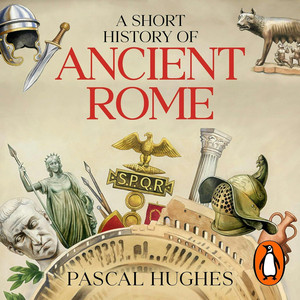
It's called A Short History of Ancient Rome.
The book is everything you love about the podcast, but a deeper dive.
Eighteen chapters, each one following the story of a remarkable person or event that changed Rome's history.
If you ask me, a real page-turner.
You can find A Short History of Ancient Rome in all good bookshops, or you can listen to the audiobook which just happens to be narrated by me.
Today, as a special bonus, we're bringing you a sample chapter from the audiobook.
This chapter follows Hannibal, the legendary Carthaginian military leader.
We'll follow him as he takes his mighty army, including a contingent of war elephants, over the snow-capped Alps.
His mission?
To attack Rome.
If you enjoy this sample chapter, grab a copy of A Short History of Ancient Rome written by Noisa founder Pascal Hughes in your local bookshop.
I love the cover design and think it would make a great Christmas gift for that history enthusiast in your life.
Or you can buy the audiobook narrated by me, John Hopkins, wherever you get your audiobooks.
If that's quite a lot of info to take in, just head to noisacom.
Forward slash books to find out more.
But for now, here is that sample chapter on Hannibal.
Chapter 5 Hannibal The Adversary.
It's daybreak on the 19th of October 202 BC in Zama, a large area of flat, arid land around 80 miles inland from Carthage in modern-day Tunisia, North Africa.
On the valley floor, two large armies together numbering tens of thousands, are preparing for battle.
A bead of sweat drips from General Publius Cornelius Scipio's long hair onto his clean-shaven face.
A red cloak is draped over his leather-muscled cuirass, a piece of armor that fits over his torso and mimics an ideal of the masculine physique.
He stands at the head of 29000 infantry and 6000 cavalry soldiers, deep in the heart of enemy territory.
In the distance Hannibal, the great Carthaginian general, an enemy of Rome, stands proudly at the front of his troops, the early autumn sun glinting off his ornate bronze helmet.
Behind him, around 36000 Carthaginian infantry are arranging themselves into three long lines, with 4000 cavalry flanking them.
Scipio grips his sword to steady his trembling hands as Hannibal's infamous weapons are walked into position at the front of the opposing army.
80 WAR ELEPHANTS ready for combat.
Scipio squares his shoulders, pushing down any anxiety, as the sounds of Roman trumpets and the cries of men and animals reverberate across the valley floor.
Then Hannibal raises his sword and his war elephants are unleashed.
Shaking the ground, they charge towards the Roman lines.
One of the greatest battles of the ancient world has begun.
In the words of Livy Before night fell, they would know whether Rome or Carthage would make laws for all the nations.
The reward for victory was not just Italy or Africa, but all the world.
But how did we get here?
How has Rome found itself in a winner-takes-all battle with the Carthaginian Empire?
For Hannibal, it's a story that takes seed nearly four decades earlier.
Hannibal's Oath.
It's 239 BC, 37 years before the Battle of Zama, and nine-year-old Hannibal has been summoned to meet his father in Carthage, the epicenter of the Carthaginian Empire.
The meeting spot is a temple surrounded by a tranquil courtyard, its walls featuring vividly colored paintings, some detailing elegantly dressed people captured in conversation.
A statue of Baal, the city's chief god, looks down on the scene.
In this peaceful place, the sounds of the bustling city outside feel distant.
Young Hannibal's gaze is drawn to a small altar in the courtyard centre, where stands a man with a thick dark, wavy beard wearing decorative military clothing.
It's the first time Hannibal has met his father, Hamilcar Barca, the great Carthaginian general, as the older man has been away fighting in Sicily.
Now Hamilcar stoops down and fixes his determined eyes on his child.
He is about to embark on an expedition to Iberia, in modern-day Spain, to expand Carthage's territory, and he wants his son to join him.
It is only two years since Carthage suffered defeat in the 23-year-long First Punic War between the rival empires of Rome and Carthage.
Hannibal has heard the stories of his father's heroic defense of the island of Sicily and his dismay at losing the territory to the Romans, who now have access to its plentiful resources, as well as controlling the sea straits that pass north and south of the island.
Carthage had begun the war with the superior navy, while Rome boasted the better army.
However, the shrewd Romans turned their weaker sailing skills into a strength, avoiding technical sea battles in favor of simply ramming the Carthaginian ships and using gangplanks to overrun them with foot soldiers.
Rome won the war and seized control of Sicily, despite the best efforts of Hannibal's father, who has been left resentful that he was given insufficient military support to overcome the enemy.
Now, as Hannibal excitedly agrees to join him on his new campaign, Hamilcar takes the boy's hand and lays it on the sacrificial altar.
The child's small fingers splay out among the remnants of an animal sacrifice, as he swears an oath.
I will never be a friend of Rome.
Young hannibal sicily's natural resources are now flowing around rome's expanding territories to make up for the corresponding loss to carthage.
Hamilcar and his sons, including hannibal travel to iberia what is now spain and portugal, intent on seizing land from the indigenous populations and exploiting the area's rich mineral wealth.
He is successful in conquering much of southern and eastern iberia and uses the plunder to strengthen Carthage's military.
In 228 BC however, Hamilcar dies, probably by drowning in a river, and seven years later Hannibal's brother-in-law is assassinated by a Gaul.
Aged just 26, Hannibal now takes charge of the Carthaginian army and begins planning revenge on the Romans.
Early in 219 BC, he attacks Saguntum, an Iberian city with ties to Rome, then orders his army over the Ebro River.
Lying 100 or so miles southwest of what is now Spain's border with France.
The waterway is a natural boundary line that Carthage has agreed not to cross at the end of the First Punic War.
Recognizing that any further incursions north could bring the Carthaginians a little too close for comfort to their own northern territories.
Rome is furious at the antagonistic move.
So it is that by the following spring, 23 years on from the concluding horrors of that first war, the Second Punic War erupts, engulfing the Mediterranean once again in violence.
As Hannibal begins his advance on the old enemy, Rome's key advantage over Carthage is its ability to rapidly raise armies from among its Italian half-citizens and allies.
It is this allied network that provided Rome with the manpower it needed to see out almost a quarter of a century of attrition in the First Punic War.
To defeat Rome, Hannibal believes he must get inside Italy and secure some battlefield victories.
If that pays off, he thinks it will then inspire Italian townships to switch allegiance to him in a bid to regain their traditional ancestral freedoms.
The plan is far-fetched, to say the least.
Getting into the Italian peninsula in the first place is no small matter.
A seaborne invasion will likely be quelled immediately by the now dominant Roman navy, and there is no navigable overland route from Iberia to Italy that doesn't pit his army against the mountainous Alps that sit north of the Italian peninsula.
The Romans themselves are convinced this route is impassable because of the freezing temperatures and fierce tribes found within the mountains.
Hannibal is unconvinced by such skepticism.
After all, the deity Hercules is said to have crossed the Alps in days gone by.
If Hercules can do it, Why can't he?
In late autumn, 218 BC, Hannibal and his troops, along with some miserable bound Celt prisoners he has picked up along the way set off from Iberia for the Alps.
But getting to the foothills is perilous.
First, his army must navigate the high passes of the Pyrenees, where they endure attacks by wild tribesmen.
Then they are forced to battle a large army of Gauls when crossing the mighty Rhône River.
Several days after discreetly entering the Alps, some of his soldiers wearing full armor plummet down a precipice to their deaths after attempting to traverse a narrow icy pass.
A little later, several panicked pack animals carrying supplies meet a similar fate.
And while the sight of war elephants thousands of feet up in the mountains is a terrifying spectacle for tribes who have never seen such a creature before.
The elephants themselves are struggling too.
Spooked by the unfamiliar sights and sounds around them, not to mention the freezing temperatures the massive beasts are proving almost impossible to handle.
Soon, they are approached by a mountain chieftain who has traveled to meet Hannibal.
Explaining that this is dangerous territory.
He offers guides and supplies to assist him on his journey.
Without even a navigable map of the Alps, Hannibal welcomes the offer, albeit cautiously.
For a while, the guides seem to aid progress.
After several days of trekking, the army enters yet another narrow pass.
Icy rain hits the young general's face as he looks up at the rugged, sheer, overhanging cliffs.
What he sees makes him immediately regret his decision to come this way.
He steps back in horror, scrabbling for his sword, as war cries resonate through the landscape and the silhouettes of hundreds of tribal warriors appear on the ridgeline.
A volley of boulders and rocks strikes the Carthaginian soldiers strung out along the narrow valley pass in front of and behind their leader.
Regaining his composure.
Hannibal screams orders at the elephant handlers and cavalry soldiers in advance of him, then turns to see the elite infantry already slashing away at the attackers to his rear.
They must hold the line. or face being overrun.
Throughout the night, Hannibal's men remain trapped in the pass, defending themselves against wave upon wave of attack.
But as the hours pass, the skirmishes lessen in their intensity.
By sunrise, the Carthaginians have turned the tide and overwhelmed the enemy.
As they set about stripping the warm winter furs off the tribesmen's bodies, Hannibal himself searches among the dead and confirms what he already suspected that it was none other than the treacherous mountain guides who led his army into this ambush.
The Carthaginian death toll could have been far worse if Hannibal hadn't entered the pass with some of his best men deployed at both the front and back of his stretched-out army.
Nonetheless, they paid a heavy price, losing men, horses, and elephants.
After nine days of hiking through the mountains, occasionally going in the wrong direction, the demoralized Carthaginian army finally catches a glimpse of the green pastures of Italy's Po Valley on the horizon.
Winter snows will make their descent perilous, but the horrors of the Alps are almost over.
Soon they will be in the Italian foothills, preparing their march south to Rome.
An Enemy in Italy.
When Hannibal finally arrives in Italy, he dismounts from the only surviving elephant and plunges his arm into a river.
It's icy, cold waters, swollen by the winter snow and rains.
His feet are damp from squelching across the flat, muddy marshland, but they are of less concern to him than his right eye.
It's red and sore, and has been irritating him for days, aggravated by the swampy conditions.
In fact, he is suffering a severe bout of ophthalmia that will leave him permanently blind in that eye.
But at least he survived. is more than can be said of half of his men.
Though he set out with a combined infantry and cavalry force of over sixty thousand, after losing so many to skirmishes accidents, the conditions of the trek and desertion, he is now down to a mere twenty-five thousand men and six thousand cavalry.
But his expedition must continue, whatever his suffering and that of his men.
Rome must be brought to its knees.
Hannibal's unexpected arrival sends shockwaves across the Italian peninsula, with two hastily assembled armies sent out to confront the Carthaginians.
The odds stacked against him.
Hannibal stages gladiatorial death matches between some of his captured Celt prisoners.
There is freedom on offer to the victorious, and he hopes the spectacle will inspire local tribal groups to join with him against the tyranny of ever-expanding Rome.
He barks at his own men that the prisoners forced to fight are no different from them, trapped in a situation where only absolute victory will secure their liberty.
When one of the local tribes, the Torinai, refuses to join his force, he makes an example of them, slaughtering them all, including women and children.
The message is clear.
Join Hannibal or die.
The Battles of Tychianus and Trebia.
Behind enemy lines Heavily outnumbered and without a proper supply chain, Hannibal must do whatever he can to keep his soldiers going if they are to have any chance of surviving the coming Roman onslaught.
By late November 218 BC, he is close to the Tychonus River in northern Italy.
This year's Roman consul, Cornelius Scipio, leads out an army to engage the Carthaginians.
To his surprise, as the two forces line up readying themselves for combat, the Carthaginians almost instantaneously charge the Roman line.
The unexpected strategy creates confusion among the Roman soldiers.
Seizing upon this moment of weakness, Hannibal's cavalry encircles the enemy and attacks them from behind as part of a maneuver called a double envelopment.
Writing around 200 years after the fact.
Livy describes how, amid the chaos, Scipio's 16-year-old son, who shares his father's name, charges forward when he sees his father fall, risking his life to ensure that his father is able to escape.
The consul and his son live to fight another day, but the engagement goes down as a Carthaginian triumph.
Emboldened by Hannibal's victory, the local Celt tribes flock to join him.
It is not long before Hannibal faces a second Roman army, this time at the Trebia River.
In another moment of tactical brilliance, He decides to turn one of the Romans' main strengths their bravery into their central weakness.
At dawn on the 23rd of December, guards protecting a Roman camp near the river sound the alarm.
A dispatch of Hannibal's Numidian cavalry are firing projectiles into the camp.
The angered Romans hastily make chase, despite their empty stomachs and lack of preparation.
Courageously, they wade through the cold river in pursuit of their prey, but unbeknown to them.
The Numidians are only pretending to retreat.
In reality, they are luring the Romans into a trap.
Having crossed the river, the Romans stand in sodden clothes in almost freezing temperatures.
To their horror, Hannibal's army are lining up over the brow of the riverbank in the near distance, arranging themselves in battle formation.
The cold, wet, hungry Romans now face a prepared, rested fed and dry Carthaginian opponent.
As battle commences, a further 2000 elite Carthaginian troops emerge from hiding spots further down the riverbank, capitalizing on their advantage to win the battle.
Once again, Hannibal demonstrates near-perfect military planning and execution.
Lake Trissimone and Cannae.
Following summer, Hannibal raids a series of villages on the shores of Lake Trasimone, a little over 100 miles north of Rome, in another bid to lure a Roman army from its encampment nearby.
The Roman leader, Consul Gaius Flaminius, is advised to await reinforcements.
But he has a reputation as a hothead, and when he sees the destruction he orders his soldiers to confront Hannibal at first light.
However, Hannibal has the measure of his rival.
Predicting Flaminius' actions, he commands his troops to leave camp in the dead of night and hide in the hillsides north of the lake.
As Flaminius' army marches along the northern shore.
Later that morning, Hannibal's men descend from the hills, pinning the Roman soldiers against the water's edge.
The stunned Roman army is massacred.
The few that initially escape into the lake either drown in their heavy armor or are forced into the shallows where they are butchered by the Carthaginian cavalry.
Some sympathetic Roman historical accounts suggest that Flaminius' men have been fatally disadvantaged by the descent of a thick fog.
But it is difficult to avoid the conclusion that Hannibal bested his enemy by making better decisions.
A little over a year later, in August 216 BC, Hannibal has made his way down the eastern side of the peninsula towards the ankle of Italy.
Knowing that his army is still too small to take on the heavily defended fortifications of Rome itself, He is concentrating on breaking its alliances and bringing smaller tribes under his own command.
To stop him, a vast 80,000-strong Roman army amasses in Cannae, in southeast Italy.
Hannibal may be a military genius, but his men are now outnumbered two to one.
Rome's network of allies pulls together again.
Yet, to their horror, Hannibal uses his signature move, a double envelopment, to claim another extraordinary victory, as the Carthaginian general's reputation is cemented forevermore.
Half of Rome's fighting force is massacred, and Rome itself seems on the brink of collapse.
Quintus Fabius becomes dictator.
On hearing about the devastation at Cannae, hundreds of mothers and children gather at the gates of Rome, eyes fixed on the horizon, desperately hoping to see their sons and husbands and fathers as the returning army appears in the distance.
The sounds of mourning and wailing fill the streets.
It's reported that at least one mother drops dead of heartbreak as the awful truth becomes clear.
Tens of thousands of Roman lives have been lost.
In the days following the battle, the panicked Roman Senate convenes an emergency meeting.
In a bid to restore calm, the senators decide to elect a member of one of the great patrician families as dictator to see them through the crisis.
They choose Quintus, Fabius Maximus, the grandson of Fabius Maximus, hero of the wars against the Samnites and Etruscans.
Quintus Fabius' term as dictator is limited to six months, but he is expected to lay aside his new powers as soon as the emergency has passed.
With the atmosphere in the city on a knife edge.
Quintus, recognizes that, in order for faith in their leaders to be restored, the people are in need of someone or something to blame.
He declares that Rome's four recent battlefield failures against Hannibal are the result of the city's lack of religious observance, and embarks on a harrowing series of measures to cleanse Rome, restore the city's divine favor, to re-establish their collective pietas.
So the story goes he bans public mourning and has a vestal virgin buried alive for breaking her oath of celibacy and offending the gods.
He continues his mission by punishing other allegedly sinful men and women in the same way.
Yet, despite his brutality, quintus's actions do not cause much of a stir in the city.
Rather, Having identified scapegoats, he appears to be unifying its citizens.
Vestal Virgins.
The Vestal Virgins were an important all-female priesthood in Rome dedicated to Vesta, goddess of the home and hearth.
The order was said to have been established in Rome by Romulus' successor Pompilius, and initially numbered just two priestesses, although this would eventually grow to six.
The priestesses were selected when prepubescent, freed from ties to their families and expected to serve for at least thirty years, when they could retire with a pension and marry if they so wanted.
In the interim, they pledged to remain celibate under threat of punishment of death.
Their duties included maintaining the fire in the sacred hearth of Vesta's temple at all times.
Should it go out, it was feared Vesta would withdraw her protection from the city.
If Livy is to be believed, the Vestal Virgins actually predated Rome's foundation with Romulus and Remus's mother, Rhea Silvia said to have been assigned the office in Alba Longa before she conceived the famous twins.
Quintus is, however, cautious about engaging Hannibal in another direct confrontation.
Instead, he plans to quell the Carthaginian incursion through more attritional tactics.
Rather than chase open battle, he targets Hannibal's supply lines, reasoning that the Carthaginians will weaken in time.
Soon enough, with no field battles to fight or negotiations to make.
Hannibal finds himself somewhat isolated.
Rome now launches an attack on the city of Capua, which is sided with Hannibal.
After crushing its defenders and murdering its senators, the Roman authorities then set about selling Capua's inhabitants into slavery.
There is a growing sense that, Following the disastrous battle losses against Hannibal, Rome is at last turning the tide of the war.
But the Republic needs a hero to vanquish Hannibal once and for all.
Someone who can display virtus, that fabled Roman concept encompassing valor masculinity excellence courage, character and worth.
Publius Cornelius Scipio.
Publius Cornelius Scipio is born into one of the great patrician families in Rome.
His father, grandfather, and great-grandfather were all consuls.
Having saved his father's life at the Battle of Tichinus, Scipio has spent the last few years developing a reputation in Rome for bravery and loyalty.
In 210 BC, he has given control of his father's demoralized army in Hispania, a role Rome's military generals deem something of a suicide mission.
But, against the odds, the young general changes the course of the war there, with several decisive victories.
Most spectacularly, he oversees the successful siege of New Carthage, the power base for Carthage in the region.
Using a combination of terror tactics and wily diplomacy, Scipio then defeats Hannibal's brother, Mago Barca, in battle in 206 BC, securing control of vast territory and resources, including a silver mine.
Scipio returns to Rome a year later, where he hatches a bold plan to lure Hannibal out of Italy by mounting an invasion of Hannibal's homeland, hoping he will return to defend it.
After two years of fierce debate, the Senate finally agrees to support his daring scheme.
It begins in 204 BC.
At the prow of a Roman transport ship traveling at speed across the moonlit Mediterranean Sea.
Scipio scans the dull silhouettes of hundreds more vessels surrounding him.
Between them, the ships carry 35,000 tightly packed Roman soldiers.
His invasion force is on a one-night journey from Sicily to a North African town near Carthage.
On arrival, havoc breaks out as the Romans set about terrorizing the local population.
Scipio's first military objective is to seize the town of Utica, a little way northwest of modern-day Tunis, to use it as the Roman base of operations for their wider invasion.
In contrast to Hannibal's devastating early victories in Italy, the Romans fail to take their target and are forced to encamp on a nearby peninsula.
It's not the start the mighty hero of Rome has hoped for, and it seems as if he may have no choice but to capitulate in light of this defeat.
In the spring of 203 BC, lookouts at the main Carthaginian military camp, located out in the desert, raise the alarm when they spy a small detachment of Roman soldiers and slaves approaching, led by Scipio himself.
The Roman general enters through the wooden palisades and is ushered in to meet the Carthaginian leaders.
Scipio declares that he has made the seven-mile journey from his own camp to enter peace negotiations.
It seems he believes the war can never be fully won and, having seen the might of Carthage, he doubts the Romans can defeat them.
It's an unexpected and astonishing confession, but the Carthaginians welcome him and talks begin on an agreement that would see Hannibal exit Italy in return for Scipio leaving North Africa.
As the negotiations continue, the men who have accompanied Scipio but are not allowed into the talks roam freely around the camp, their eyes darting left and right as they walk past row upon row of simple huts.
They appear to be slaves.
But on returning to the Roman camp, they take off the coarse tunics they've been using as disguises, put on their usual officer's clothing and immediately get to work drawing detailed plans of the enemy camp.
They map out the complex network of passageways that connect the rows of thin-walled, thatched-roof huts housing some 93000 troops.
The deception is finally revealed late one night after several weeks of seemingly upbeat negotiations between Scipio and the Carthaginians.
Without warning, a volley of flaming arrows fizzes through the sky and sets alight those same thatched roofs.
Out of the darkness, panicked shouts ring out across the desert.
Roman soldiers soon flood through the camp's passageways and into the huts where they indiscriminately slaughter the inhabitants.
Many of the Carthaginians, still believing the inferno has started accidentally, are slain as they attempt to dampen the flames.
By sunrise, perhaps tens of thousands of Carthaginians lie dead in the dust.
In the wake of this attack, a ship leaves Carthage for Italy, summoning Hannibal to come home.
After 15 years of roaming, the Italian peninsula Hannibal agrees arriving with 12000 soldiers poised to defend their homeland.
He nonetheless receives a muted welcome from a terrified population.
In a strategic game of cat and mouse, Scipio has blockaded a river valley that provides Carthage with most of its food supply.
Hannibal acts quickly. assembling extra soldiers, cavalry and war elephants from local towns.
In the autumn of 202 BC, he meets with Scipio, offering the Romans an opportunity to return to Italy without further bloodshed.
But Scipio is said to reply, It is that you must submit yourselves and your country to us unconditionally or conquer us in the field.
The stage is set for the ultimate showdown between the two great empires.
Zama.
The rival armies face off in the locale of Zama, not far from the border of modern-day Tunisia and Algeria.
Hannibal is in the midst of giving his men a rousing speech when he is interrupted by a blast of Roman trumpets and thunderous war cries.
Unable to be heard, Hannibal lifts his arm to signal the release of his war elephants.
Scipio's battle formation has been designed for this moment.
Unlike earlier confrontations, where the tightly packed Romans were crushed as they tried to escape the elephants, this time his men are arranged into blocks broken up with intermittent unmanned channels.
The terrified elephants rush straight for these exit routes, stampeding harmlessly through the Roman lines before fleeing into the desert.
Just moments into the battle, Scipio has rendered Hannibal's chief instruments of terror useless.
Now Scipio turns to his own secret weapon.
For years, the Numidian cavalry, renowned for their mastery at fighting with javelins, have stood alongside Hannibal.
But the wily Scipio has played his own long game wooing the Numidian leaders, so that many have now changed their allegiances to him.
Scipio's own Numidian cavalry charge at Hannibal's lesser cavalry force, pursuing them deep into the desert.
With both cavalries thus occupied, the infantry clash.
Without the support of their mounted troops, Scipio's smaller army struggles to hold its ground.
Emboldened to an extent by their home advantage, the Carthaginians fight with a passion driven by the knowledge that not only are their own lives at risk, but those of their loved ones living here in North Africa too.
Slowly, the Romans find themselves being flanked by Hannibal's chillingly familiar double envelopment strategy.
Scipio rushes reinforcements to the center of the battlefield, where Hannibal's elite soldiers are making ground.
By now, Hannibal's battlefield mastery is in full display.
The ground is so blood-soaked that the Roman ranks find themselves slipping on the gore beneath their feet.
But suddenly, there is renewed hope.
In the early afternoon, a great dust cloud rises in the distance, followed by the noise of clattering hooves.
Scipio's cavalry, having defeated Hannibal's, is on the charge into the Carthaginian back line.
They begin to encircle the battlefield, until by nightfall, Rome is victorious.
Protected by his best fighters, Hannibal escapes and returns to Carthage, a city he has not seen for 36 years.
In the aftermath of Zama, the Carthaginians surrender, and the Second Punic War comes to a close.
Carthage has to pay a war indemnity of 10,000 talents, equivalent to almost 300,000 tons of silver.
Their once mighty navy is restricted to a mere ten warships, and their stray elephants are put to death.
Reduced to the status of a dependency of Rome, albeit one allowed to make many of its own laws.
The ailing superpower will never reclaim its former glories.
Back in Rome, Scipio is granted the great honor of a triumph.
Vanquishing the legendary Hannibal is the high point of his career, an achievement that has not just surpassed his father's, but also brought more glory upon his name than anyone else in Roman history.
And though the days of a small parade lasting an hour or two are long gone, even by the standards of the day, his is no ordinary triumph.
Days long, the celebrations in his honor include games, feasts, and revelry.
The biggest moment however, is the procession itself, involving countless musicians, and the display of vast quantities of plunder.
Innumerable processions, prisoners of war follow terrified in the final hours before their ceremonial executions.
Finally, with tens of thousands lining the streets, the man of the hour himself appears Scipio Africanus, the conqueror of Africa, standing atop a chariot emblazoned with ivory and gold and pulled by four decorated horses.
An effigy of a phallus hangs beneath the chariot placed by the religious order of the Vestal Virgins to ward off the evil eye.
Behind Africanus, a slave stands holding a golden crown above his head.
A later account by the early Christian historian Tertullian claims that the slave would also whisper to the general as he proceeded around the city.
Respiche post te hominem te memento.
Look behind you.
Remember that you are a man.
There's good reason to offer this reminder.
The dazzling purple and gold of Scipio's toga tells the people of his standing in the mortal world.
But with his face painted with red pigment.
In reference to the great Jupiter, he himself appears less of a man and more like a god.
According to Livy, around 183 BC.
After several years living in exile Hannibal, now in his mid-sixties, removes his ring from his finger, detaches its gemstone and reveals a small poison-filled compartment.
Rome's great nemesis seemingly dies by his own hand, although there are differing accounts around the exact circumstances of his demise.
To the surprise of many, Hannibal dies a changed man.
Weary of the horrors of conflict, in his final years the famous warmonger has become an outspoken advocate for peace.
With its leaders, driven as they are by the relentless desire for glory, the Roman Republic doesn't share his new ideals.
And though Scipio has raised the bar of what can be achieved by one general, he has also ensured that his descendants must go even further if they are to match his legacy and bring honor upon their own names.
In 146 BC, Scipio's grandson, Scipio Aemilianus, raises Carthage to the ground, killing or enslaving every inhabitant of the city.
That same year, Rome sacks the Greek city of Corinth, signaling a major staging post in its conquest of Greece.
With Carthage and the Greek world thus subdued, the march of Rome appears unstoppable.