Hey good Life Project listeners, we have got a special treat for you today.
We're doing things a little bit differently and sharing a preview of a new podcast that we're really excited about.
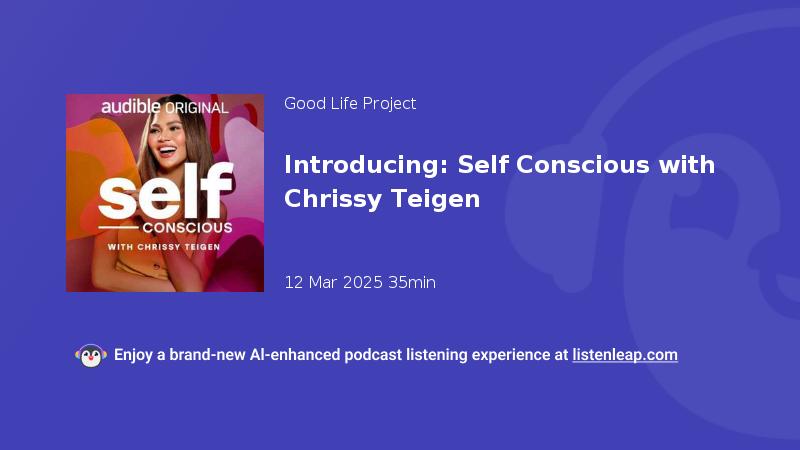
It's called Self Conscious with Chrissy Teigen and I think you're going to love what's in store.
Chrissy brings her signature authenticity and wonderfully irreverent spirit to conversations about personal growth.
In her latest episode, Chrissy sits down with psychologist and author Adam Grant to explore or how greatness isn't something we're born with.
It's something we build, step by step.
The conversation feels like kind of like the most fascinating dinner party chat where vulnerability meets wisdom.
They tackle everything from embracing discomfort to transforming struggles into strengths.
It's the kind of talk that makes you not alone, thinking, yes this is exactly what I needed to hear.
So listen to Self -conscious with Chrissy Teigen and subscribe wherever you get your podcasts or head to audible .com slash Chrissy Podcast to find out more.
And now here's Chrissy's enlightening conversation with Adam Grant.
You're listening to Self -Conscious with Chrissy Teigen, an Audible original podcast.
Join me as we explore the cutting edge of health, wellness, and personal growth with the world's leading experts and thinkers.
From inspiring stories to actionable insights, our conversations aim to help you lead a healthier, happier and more productive life.
We often celebrate greatness as a mysterious gift, something bestowed upon a lucky few for the rest of us to marvel at from afar.
But this view was misleading.
Greatness isn't something that just shows up, it's cultivated, earned through persistence, and shaped by the journey rather than the starting point.
My next guest, the organizational psychologist and bestselling author, Adam Grant, aims to shift our focus away from prodigy and extreme talent, encouraging us to recognize that everyone has the capacity to achieve greatness.
In Hidden Potential, the science of achieving greater things, Grant writes that, potential is not a matter of where you start, but of how far you travel.
Challenging the myth that success is reserved for the naturally gifted, rather it's those that we're overlooked that we should keep an eye on, the late bloomers.
Grant highlights three key elements for achieving success, developing strong character, having supportive structures in place, and creating fair opportunities for everyone.
He explains that success comes from prioritizing values, receiving guidance from mentors, and ensuring systems are in place that allow all individuals to reach their potential.
In today's episode, Adam Grant delivers practical strategies that could help anyone unlock their hidden abilities, sharing insights on how to harness discomfort as a tool for growth, the value of embracing mistakes and the importance of deliberate play and skill development.
Adam Grant, welcome to Self -Conscious.
Tommy, what inspired you to write Hidden Potential and how does it challenge the conventional understanding of talent and success?
I basically wrote the book because I was terrible at a bunch of things I was passionate about and wanted to get better.
and was lucky to have some coaches and teachers who saw more potential in me than I saw in myself.
And I think you can only go through so many experiences where people say, you can't do this.
You literally lack the talent and then end up becoming halfway decent at it or even mastering it before you say, wait a minute.
Maybe the conventional wisdom is wrong here.
So Kristy, it happened to me first as a springboard diver when my teammates called me Frankenstein because I was so stiff that I could hardly touch my toes.
and ended up going from being the worst diver in my school to making the Junior Olympics and being recruited to dive at the NCAA one level.
And here I am thinking this should not be possible.
I could not have been a worst fit for this sport.
And then the same thing happened with public speaking.
I'm an introvert. I was extremely shy.
I got extremely difficult feedback when I first started teaching.
And then a decade later, I found myself giving TED Talks and keynote speeches.
and that experience just made it really clear to me that we all are capable of more growth than we realize.
And yes, we all start at different points, but we shouldn't underestimate the distance that we're capable of traveling.
And when I dug into the evidence, it very much told that story and I thought, oh, I'm not an outlier.
I'm actually the norm.
I think it's really interesting that you even got into diving in the first place knowing that you weren't going to be one of the best at the beginning.
That takes a different personality type to do that alone.
Is it or did I just resort to diving because I'd already gotten cut from basketball and soccer?
I loved sports and when I saw a lifeguard on a break right before I started high school doing flips and twists, I was just mesmerized and said I want to learn how to do that.
It really didn't occur to me that I was bad at it yet.
I didn't even know what it meant to be good at it and I'd never seen myself dive.
So I think I just I was drawn in by just the love of the challenge.
And I think that is very much what even when you look at world -class athletes, musicians, you see this with scientists and artists too, that the people who go on to be the very best in their fields, whether it's making the Olympics or winning international medals, they did not stand out as more talented than their peers when they were kids.
They stood out as more passionate and they had unusual motivation which allowed them then to keep growing and keep improving.
Whereas Because the kids who were great right away often would hit a wall and stagnate and lose interest.
It's a big difference between John's parents and my parents would be that I was always going to have a C in math.
I would have A's and everything, but math was always going to be a C.
So, when the grades came in every few months it would be, oh yep, you got a C in math because math isn't your thing.
Whereas John's family was like, you got a C in math, which he probably never, ever did ever, but let's work harder at it.
It's just a big difference in how we were raised, and then I got that more ingrained in my head as time went on.
You argue that greatness is not about where you start, but how far you travel.
Can you explain how this idea underpins the book?
I actually think the contrast between your parents and John's captures it really well.
I think that some parents and some people believe that how good you become at any skill is largely a function of where you start.
And so, if you start out good at something they say hey, you're a natural, you're gifted, you're talented in that area, and you should go and develop that capability.
And if you're not, you should move on and do something else that you're more qualified for.
And that, Carol Dweck would say that's a fixed mindset instead of a growth mindset.
And I would take that a little further and say look, at the end of the day, not everyone is going to become great at everything.
But most people can become better at most things than they realize.
Because you don't ultimately have a great view of where you can land from where you start.
And what that suggests is something really simple, which is you shouldn't assume you're going to be great if something comes easily to you.
You shouldn't assume that you should quit if something is hard for you.
Often times, the fact that something is hard means that if you stay with it, you're going to study it more carefully, you're going to persist more at it.
And ultimately, you're going to learn it more deeply.
And also, if you had to struggle at it, oftentimes that makes you the best learner and the best person at teaching yourself.
And I think there's a real lesson that oftentimes early struggle is a sign, if you stick with it, that you're going to internalize the lessons much more deeply.
You emphasized the importance of character skills.
What specific character traits are most critical for unlocking potential, and how can they be developed?
If I could pick one...
would say the courage to embrace discomfort.
It's something that a lot of people learn the importance of the hard way, and I wish it'd have been taught to me earlier.
And I'm trying to make sure that the message gets broadcast to our kids, which is something that I learned when I was struggling at teaching in public speaking.
Kristy, can I tell you a little story?
Yeah, of course. All right, so when I first got on stage, I was just beyond nervous.
And I remember my first student comments, one of them read, you're so nervous you're causing us to physically shake in our seats.
Not a lot I can do with that.
And then I got a call from the U .S.
Air Force asking if I would teach a class for their colonels and generals on leadership.
And I was in my mid 20s, they were twice my age.
They all looked like they came right out of Top Gun and I felt massive imposter syndrome.
So the anxiety went into hyperdrive.
And I remember feeling like I had to convince them that I knew what I was doing.
So I started talking about my credentials and the research I'd done and the expertise I had on leadership.
and I taught this four -hour class, and the feedback was just brutal.
One of the generals wrote, there was more knowledge in the audience than on the podium.
Oh. Oh. And I was just like, facts, true.
Can't argue with that.
Yes, there is. I would quit.
I gain nothing from this session, but I trust the instructor got useful insight.
I remember feeling like, how do I become a bear and hibernate for six months so that I don't have to face this for a very long time?
It was devastating.
Not only did I want to quit, I felt like I would never be good at anything again.
And it was extremely uncomfortable, except for this one thing, which is I had committed to do a second session with another group of Air Force leaders a week later.
I'm somebody who honors my commitments.
And I wasn't going to walk away.
I felt like this is the closest I've ever come to serving my country.
I have to show up. And Christy, I didn't have time to learn new content.
I had already packed everything I knew into that four hour session.
All I could do was basically just try to put myself in the most uncomfortable position possible and go to the critics who had crucified me and ask them for more.
I went to a couple of the Air Force leaders and I said, you just gave me these comments and I read them to them and I said, what advice do you have for how I can address them in the next session?
I wanted to crawl out of my own skin because here I am admitting to these people that I was trying to that my performance was an unmitigated disaster and they told me I did not belong in front of them.
And in doing that I got some really great advice.
One of them said, you should call out the elephant in the room, what do you have to lose?
I had to do something to convince them that I respected them.
And there was this real clash of their experience and my education and it just didn't feel like we were on the same page at all.
So, long story short, I remember I worked we walked in the next week and I looked out at the room and they all had Top Gun style call signs.
I was staring out at the room and I saw Gunner and Striker and Sandoon, and I just looked at them and I said, alright, I know what you're all thinking right now.
What could I possibly learn from a professor who's 12 years old?
One of them just started laughing and said, come on, that's ridiculous.
You look like you're at least 13.
And it broke the ice and I had taught more or less it's the same material, but now I tried to take myself off of pedestal and I tried to admit to them, look, I don't have the experience that you all do.
And I got much better feedback afterward.
They said Professor was junior in experience, but he dealt with the evidence in an interesting way.
And the professor seemed to get younger every year.
Or are we getting older?
I don't really know.
I like the experience of learning from somebody who's almost young enough to be the troops that we're trying to command.
Because it was a great lesson for me in embracing discomfort, which I had to do one in going to those leaders and asking them, tell me more, tell me why I was so bad and what I can do to get better.
And then to then stand in front of them and admit, I don't have the answers you're looking for, but I want to have a good conversation anyway.
And I've always found since then, that the more I throw myself into uncomfortable situations headfirst, the more I grow.
Can you explain the concept of scaffolding and how mentors and coaches can create structures that support sustained growth.
So scaffolding is one of my favorite concepts in learning theory the basic idea is that a lot of parents and teachers and coaches think that if I want to help someone get better at something I have to basically hands -on instruct them in every step.
And that can be good for initial skill building but it doesn't help with confidence.
What great teachers, coaches and parents do differently is they provide some initial instruction and then they create a little bit of scaffolding.
So they might demonstrate how to do something and then let the kid watch and try to emulate it And that's a little bit like the scaffolding you set up so that a construction crew can scale a building, right?
You're allowing them to reach a height They can't get on their own But then at some point you're gonna remove the support and they are gonna figure it out on their own And I think that's what great educators do is they say okay, I'm gonna teach you I'm gonna model it for you and then you're gonna hopefully be in a position to be able to climb to the next level on your own.
And that's gonna show you that you actually have the capability to keep improving.
This is an amazing takeaway.
For me, one of the hardest parts of teaching children is wanting them to do it the right way.
And my way is usually the right process for me.
And I know other...
I would never put this kind of pressure on other kids.
But as long as they get to the right answer eventually, yes, that's fine, but I'm always been very stuck on here's the right way to do things.
John and I changing our mentality to thinking of it as putting up some scaffolding is a much better way to go about it because they're going to get to that answer eventually.
And it might not be the way I wanted them to get to it or as quick as I wanted them to get to it, but they will find it eventually.
What changes do you think need to be made in education and workplaces to better recognize people's hidden potential?
I think this actually is a lesson I learned from an amazing chess grandmaster, Maurice Ashley.
He was a Jamaican immigrant to the U .S.
who caught the chess bug in school and got offered a job teaching chess and shows up at a middle school in Harlem where the kids are just profoundly disadvantaged, and they have to compete against these ritzy private schools that are the chess equivalent of an Olympic training center.
They start learning chess in kindergarten, they have one of the country's best teachers coaching them, they're then taking the most promising students for private lessons, and Maurice has just a random group of kids, a group of poor racial minorities who joined the team and some of them have never played chess before.
One of them learned how to play from a drug dealer in a park, another was being recruited for a gang, and the deck is completely stacked against him.
And Maurice ends up leading this team, the Raging Rooks to the national championship.
It's just, it's unreal that he accomplishes this.
So I want to know what did he do for them that leveled the playing field and created opportunity?
And one of the ingenious things that he does as a teacher is he teaches the game backward.
Instead of teaching the beginning of the game and saying, okay, you can move upon up one or two squares to start, which he thinks is boring and gonna lose them, he says, we're gonna teach the end game.
I'm just gonna put a couple pieces on the board and here's how these two or three pieces can move and your job is to checkmate the king.
And then they win and they get fired up and that they lose and they wanna play again so that they can make up for it.
And once they've experienced the joy of victory and the agony of defeat, they wanna work backward and learn how do you get to the endgame and set yourself up for a checkmate?
And Chrissy, I think this is a metaphor for life.
I think that we could be teaching most of the important skills backward.
I think even in learning to sew, you could give your kids the final stitch or two and then they have that sense of completion and creation, and then maybe they can work backward from there.
How do you think deliberate play differs from traditional practice and why is it more effective in unlocking potential?
Ooh, all right. This is fun.
The core principle holds that repeated practice with feedback is pretty reliable if you want to get better at something, but the problem is repeated practice is really boring.
And you can, even before you get to the point where you burn yourself out, you can experience what was called bore -out repetition.
It's monotonous, it's my numbing.
The idea of deliberate play is to break the monotony and say instead of beating yourself up through the daily grind, can you turn the daily grind into a source of daily joy?
And you see this all the time.
Evelyn Glaney, the musician, She would create little game -like challenges for herself, harmonizing Bach on a snare drum, right?
That's a fun way to practice a bunch of skills that doing scales would be much more repetitive, and so she's keeping herself engaged that way.
Steph Curry do this.
He's got a whole series of games where he, instead of just dribbling and shooting over and over again, his challenge is to see how many shots he can make in a one -minute window from certain spots on the court, and then he's competing against his own personal best and the clock.
And so he has that extra motivation to keep practicing.
And I think that more practice should be organized that way.
And it's not gamification.
It's not saying we're gonna trick you into liking a task that you hate.
It's actually changing the nature of practice so that the process of learning itself is fun.
How can people overcome the fear of failure and see mistakes as opportunities?
I think it's hard. I think, especially as a recovering perfectionist, I haven't done a good job with this, and I've been trying to work on it with our kids, so I guess one of the pivotal moments for me was when I was getting ready to get my first TED Talk, I was freaking out and I was pacing around the house, just going over lines over and over again, because I'd been told I needed to know them, by heart, like happy birthday.
There's no teleprompter, so you have to know it cold.
And of course you can improvise, but then you have the 12 to 14 minutes, and if you flub, you're going to regret it.
So I think our oldest was 8 at the time.
And I remember Joanna just watching me pacing around.
She said, what are you doing?
And I explained to her that I had to give a big speech, and I was really nervous for it.
And in that moment, I don't know why.
But it dawned on me that I should ask her for advice.
And I said, what do you think I should do?
And she said, you should find a smiling person in the front row and make eye contact with them.
And that'll calm you down.
And it hadn't done on me.
I was going to have at least 20 or 30 people that I knew in the theatre to ask them to sit in the front row so that I could see them when I walked on stage.
Simple, great advice.
So I did it. It calmed me down a little bit.
If you watch that talk, I still feel like my breathing sounds like Darth Vader, but it could've gone worse.
and a few weeks later, Joanna was going to be in her first school play and she was really nervous about it as a fellow introvert, also very shy, and she asked for advice and instead of telling her what to do, I was able to go to her and say, what did you tell me to do when I was nervous?
And she said, find a smiling face in the audience.
I said, great, we're gonna be smiling faces in the audience and tell us where you want us to sit and we'll be there.
and I watched Joanna get on stage.
And she looked at us and we smiled at her and she started beaming and it was the beginning of her coming out of her shell.
And Chrissy, that experience taught me.
I had been hiding those moments behind the scenes of all the mistakes I'd been making on stage, of all of the anxiety I was facing as I tried to get comfortable in front of a crowd.
And what I should have been doing all along was telling our kids.
Yeah, I have to go in front of a group of really scary people today, and they're extremely impressive, and I think I'm going to bomb, but you know what?
I'm putting myself in front of them anyway because I love this material and I'm passionate about sharing the knowledge and I want to get better at this, and I think that there's no better way to get comfortable with making mistakes than saying I want to model this to my own kids and so if I can't get in that zone, then they're not going to learn to take risks, to fail, and to get back up and try it again, And so for me, parenting is the ultimate teaching ground for this.
What role does feedback play in personal and professional growth?
And how do you think we can seek out constructive feedback more effectively, pending we're ready for it?
I'm probably more ready for constructive negative feedback than I ever have been in my entire life because I was so not confident in this industry before, but now I'm like, I understand that it's going to be things that make me better.
But man, that didn't happen until maybe this past year actually.
I actually think that it's not as helpful to ask for feedback as it is to ask for advice.
This is something I learned personally, but this is also something that's been supported by some new evidence.
The problem when you ask for feedback is people look at the past and they either become critics who are attacking your worse self or cheerleaders who are applauding your best self.
And neither of those things is ideal for your growth, right?
The critics demoralize you.
Sometimes the cheerleaders make you complacent.
You want coaches who are going to look to the future and see your hidden potential and help you realize it.
And so if you ask somebody, can you give me a suggestion for how I can improve?
They're more specific, more concrete, and more actionable.
And it's also just easier to give, right?
Feedback, it feels like I'm judging you.
I'm throwing down a gauntlet and telling you, like, here's what's wrong with you.
Whereas advice, oh, I just have a tip.
What do you think of that?
It's yours to follow or not.
We're both parents, how do you teach character to unlock hidden potential?
I think one of the character strengths that matters most to me is raising kids to be givers, not takers, and it's so clear that when kids are motivated to help others they actually end up learning more and growing more because they benefit from what John was talking about a minute ago which is the coach effect and the tutor effect where when you have to explain something to someone else you really start to understand it and internalize it.
And it's one of the many reasons I want kids to learn generosity.
So one of the things that my wife Alison and I noticed years ago is we were ...
Our kids were coming home from school and we were asking them, what grade did you get on the test and how many goals did you score on the soccer game?
And it was all achievement focused.
And this is what happens to so many parents is that that's the stuff that's easy to measure and you think it's what's going to make your kids successful.
successful. So you only talk about what they're doing to accomplish their goals.
And that crowds out conversations about character to the point that if you ask parents what they want their kids to learn, they say being caring and kind is their number one priority in the U .S.
But their kids think that being high achievers, being successful matters more to their parents because of these conversations.
So Allison and I sat down and said, we've got to change this.
What are we going to do about it?
And we decided that on Friday nights, we were going to ask our kids, who did you help this week at school?
And it was remarkable how the conversation shifted.
They would tell us these amazing stories about somebody who was struggling to understand a lesson in class and how they tried to provide a little bit of tutoring.
They would say, hey I noticed somebody was sitting alone at lunch and I invited them over to our table.
And some of it was just everyday kindness that they were showing naturally.
some of it was they knew we were going to ask on Friday.
So they started looking for opportunities to be helpers.
And I think this is so great.
And then Alison added a second layer, which is she said, I want to ask who helped you.
And at first I didn't get it.
I was like, we don't want them to be takers.
We want them to be givers.
Why do you care who helped them?
And she said, I want them to pay attention to who's the kindest kid in class, not just who's the coolest kid in class.
And I thought that was brilliant, and sure enough, when we started asking them, who helped you, we started to see that they gravitated more to the kids who treated others well, as opposed to just the one who might have been the most popular.
And I think this is a great routine for teaching character.
Every week, ask your kids, who did you help and who helped you?
You mentioned that teaching others can enhance our own learning.
How can we incorporate teaching into our personal development?
The easiest way to do that is to find something you want to learn and bring a group together to learn it with you and then you start dividing up the different elements and teaching each other.
So there was a group that I worked with years ago that somebody wanted to learn Spanish and said don't have a Spanish tutor, we don't have funds for it, what do we do?
And they found a bunch of people in their office who also wanted to learn Spanish and they literally said we're gonna divide up the different lessons and everybody's gonna teach a piece of it.
I thought that was such a simple way to make sure that everybody had a role in everybody had a chance to share as well as to absorb the knowledge, and they picked it up much faster than they expected.
I think all you need is one or two people who are interested in growing in the same area that you are, and then if you commit to teaching each other, it's a great way to build the skill.
We're seeing a ton of this now, with learning to code, people saying, All right, we're just going to each pick a coding lesson and a different person is going to guide every week.
So Adam, how do you see principles of hidden potential being applied in actual, real world settings like schools, workplaces, communities?
One of the things that I would love to see more of, in schools especially, is students getting a chance to really build relationships with their teachers as opposed to just showing up for class and learning the material and then leaving.
There's some evidence from, let's see, Tennessee and North Carolina and also Chile, the country showing that if kids have the same teacher for multiple years in a row, they actually learn more.
And that's because instead of just specializing in their subject, the teachers get to specialize in a student.
They get to build a real connection and give them personalized coaching and feedback and guidance.
They get to know their goals and their dreams and their strengths and their growth areas.
And we do this in every other walk of life.
You wouldn't. Can you imagine your kid turns five and you just hand them off to another parent for that year.
I used to raise them.
No, you want the whole upbringing to instill your parenting lessons in your kids.
We do this in sports really well too.
We often will put our kids with a coach who can spend four or five or six years with them.
We do this in early music education too, right?
I want to find that piano teacher who they can make a personal connection with, but for some reason the education system does not do this." And I think we're afraid, at a basic level, that your kid is going to get stuck with Professor Snape or Miss Viola Swamp and then that it's going to ruin three years instead of just one.
But the research on this shows that actually the worst teachers benefit the most from having the same students for multiple years because they can actually grow together.
I really like the idea of focusing more in schools on personalized relationships because a teacher who just sees your test scores or just hears your occasional comment in class is not going to see your hidden potential.
And now for the toolkit.
Each episode our guests distill their expertise into practical and actionable insights.
Today, Adam Grant shares strategies for bringing out the hidden potential in all of us.
This exercise, one of my favorites, count your contributions, not just your blessings.
And the genesis to this is some research I did years ago with Jane Dutton, my colleague.
We were struck by the fact that all these people do gratitude exercises.
And at some point, if you start to do them daily, you run out of things to be thankful for it.
It becomes repetitive.
But also sometimes it puts you in a passive position of receiving benefits from other people, but not necessarily building your own confidence and motivation that you have something to contribute.
So we designed exercise that's about counting your contributions, where we ask people, instead of just three things they're grateful for, to come up with three ways that you helped other people or made someone else's life better in the past week.
So let's do that one.
Chrissy, who did you help this week?
I don't count many wins for myself because I'm always just thankful to be in that space and thankful that I've been allowed in that space or thankful for the life that I have.
It's gonna be really even tough for me to say, honestly.
Good, that's part of the challenge.
I think you're right through.
I think this is the kind of win that's especially easy and especially important to count because it influences other people.
And sometimes we fail to count the things that count most.
So everybody needs to feel that they matter, right?
And part of mattering is knowing that other people value you and appreciate you and rely on you.
And so the question here is how have you made a difference to other people in the past week.
I always create these big moments for our kids where something small that they have is we really treat it with a great deal of care, and we celebrate their wins a lot and we celebrate their little things whether it's like a little tutu recital, or Miles has, you know, a flag football game or something, I think I'm very good at celebrating those moments and making sure that we always take like full advantage of the things that we are able to do planning a day at the circus for them and do something fun with them.
And then also watch this insanely great performance.
Um, I'm good about planning things for them that they're going to remember for a long time.
I love that. Oh, that was hard to drag that out of you, but there it is.
So here's your homework assignment.
Count one contribution every day for a week and then report back on how it went.
So Chrissy, second exercise is going to be making hard decisions.
We're going to build on that point we made earlier about how sometimes the best way to navigate your own choices is to give advice to somebody else who's facing a similar one.
The psychology of that is really fascinating.
Have you ever noticed, this is not a rhetorical question I'm actually asking have you ever noticed that you give better advice to other people than you make decisions for yourself?
Without a doubt, yes.
True for most of us.
It's called Solomon's Paradox, and the reason for it is, when you make decisions, you get stuck in the weeds and you're considering too many options, you're comparing them on too many different dimensions, and it's hard to take a step back and see the big picture.
Whereas when you give other people advice, you have distance from their problem, and it's much easier to zoom out and say, here are just the three things that you should focus on and so advice -giving is a great way to force that peripheral vision and give you that higher level perspective.
So let's do this. Tell me what is the dilemma you're facing right now?
Is there a decision you have to make or some kind of choice that you have upcoming that you're not sure what to do?
We had to remove people from our home and our atmosphere because it wasn't serving us from the greater good as a household.
It wasn't beneficial to our house to have certain people in it.
And it was just driving too many people crazy.
And, so really being able to cut ties with people that weren't the best for us and best for our home.
That was really difficult for us.
Oof. Sorry to hear that.
That can't have been easy.
And I hope you didn't cut any of your four children loose.
No, all four are still quite attached.
But it's been hard because we are so open and we love a big family atmosphere in the house, especially with people that work with us.
And it it's been really difficult because some people you've known for seven, eight, nine years.
And then all of a sudden you're telling them this isn't working out.
And I do know the way I would talk to anybody else and this is what a lot of my friends did was that it's going to be hard.
But what would you tell to anybody else if somebody isn't contributing in a positive way to your family, then then it's going to be okay.
There you go. It's hard to say.
If you could have done it sooner.
I think people always, what's that expression?
It's don't bite the hand that feeds you.
I think the reverse also is something we need to remember which is, don't keep feeding the hand that bites you.
Last exercise is called Cake Time.
I learned about it from a group of schools in Denmark.
This is actually something done throughout Denmark.
every week one kid brings a pastry to class and as kids are eating the kid who brought the treat has to describe a problem or challenge they're facing and then asked the the rest of the class for advice on this and I thought it was such a powerful way for every kid to get a chance to be a little bit of vulnerable and seek help and open up about what they're struggling with and it turns out that other people asking you for help is the best way to learn to be kinder and more generous because when you're confronted with somebody else's need or challenge, it naturally activates your compassion.
So I started thinking this is a great exercise to do in families.
That if we did cake time once a week and said, okay, we're going to have one, one kid help to make the dessert or pick it out and then they're going to share something that's been a challenge for them and we're going to ask the whole family to come together to try to help them.
That would be a great way to build that norm and to model the kinds of helpfulness that we want to see happen every day in our household.
So, Krissi, what would that look like for you?
I'm sure Miles would say I was just diagnosed with type 1 diabetes, and I hate my shots, and I hate my monitor, and I hate people asking me about it, and I'm a little embarrassed.
And then, your other kids would hopefully chime in and say, here are things we can do to help make that less embarrassing.
Here's something you could say to preempt that reaction when people ask.
And the hope would be then that they're coaching each other and supporting each other through those kinds of difficulties.
Adam Grant, I want to thank you so much for joining me today on Self -Conscious.
Adam Grant's Hidden Potential is available on Audible.
Until then, tune in, turn on and feel better.
I'm Chrissy Teigen, and you've been listening to Self -Conscious...
an audible original podcast.
This has been an Audible original produced by Audible and Huntley Productions, hosted by Chrissy Teigen, executive producer for Huntley Productions.
Chrissy Teigen, executive producer for Audible, Stacey Creamer, recorded and engineered by Alex Gai, mixed and mastered by Jeremiah Zimmerman, edited by Lisa Orkin, head of creative development at Audible, Kate Navin, Chief Content Officer, Rachel Guyatza, copyright 2024 by Audible Originals, LLC, sound recording copyright 2024 by Audible Originals, LLC.
see.