Support for NPR and the following message come from Freshworks, who believes complexity is the enemy of efficiency.
Stop wrestling with bloated, expensive software.
Uncomplicate with fresh service for IT and fresh desk for customer support.
Learn more at freshworks.com.
Hello there, short ravers.
Emily Kwong here with a quick word before the show.
So this week is Giving Tuesday.
That is the global day of generosity that NPR celebrates every year.
But this year is different.
Because it is the first time in 50 years that NPR is operating without federal funding.
That is a huge deal and a big challenge.
But it is one that we can take on together.
At Shortwave, we bring you science coverage that is fun human, that introduces you to new ideas, amazing discoveries and everyday mysteries.
It helps you feel a little more connected to this planet and the people we share it with.
We know all of this matters to you, and that is why some of you have already stepped up to share in the cost of bringing you shortwave each week.
Like Gloria, a listener in Texas who says I would be less informed, thoughtful and interesting without Fresh Air.
ThruLine, Shortwave, and Up First.
I love these programs and I hope they continue.
We are so grateful to listeners like Gloria who have stepped up to support NPR this year.
You can join them.
Sign up for NPR Plus and mark your You're listening to Shortwave. from NPR.
Emily Kwong here with my favorite astrophysicist.
You know her.
You love her.
You hear her a lot.
Her name is Regina Barber.
Aw, Emily, thank you for reading that so well.
I wrote that for you.
Oh, my God.
Nope, out me.
Gina.
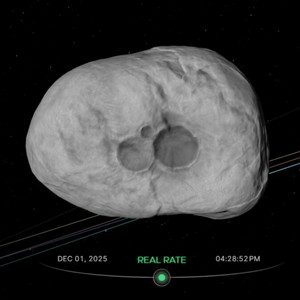
You're here to tell us about 3i Atlas.
Yes.
I keep hearing about this comet, but why are people so obsessed?
So, Em, this comet isn't from here.
Like, she doesn't even go here.
Okay, that's my Mean Girls reference.
Do you like it?
I do.
Okay.
So it's a piece of ice and gas and rock, like most comets are, but it's from another solar system.
It's interstellar.
But we know it's from our own galaxy.
We know it was created around another star, not our sun.
We get to see it once and then never again.
So wait, it's not like Halley's Comet, which comes, what, every 70-something years?
76 years, yeah.
This is just one and done.
Yeah.
How do we even know it's a comet?
Yeah, so... And not like an asteroid.
Yeah, so astronomers have been studying 3I Atlas since July of this year.
We know it's a comet because it has this icy nucleus.
It has a bright cloud of gas and dust.
Astronomers can see this through their telescopes.
They also see that it has a tiny tail.
And most comets we see from Earth, they orbit our sun.
And they're made during the formation of our solar system.
But this one, this comet, 3A Atlas, it came from somewhere else.
It's going to come in, then it's going to leave.
And she'll scream, get in, loser, we're going shopping on the way by.
Yes.
Okay.
So why are astronomers so invested in studying her?
Because 3A Atlas tells us something about planets around other stars which we definitely care about.
It's the only way we're ever going to get material from another solar system.
I mean, certainly within our lifetimes.
That's John Tonry, an astronomer who was part of a team that created the NASA-funded Asteroid Terrestrial Impact Last Alert System, or ATLAS.
And they were responsible for finding this comet and it was the third ever detected interstellar comet.
Oh, that's why it's 3I.
Yes.
I stands for interstellar.
Yeah.
And Atlas, by the way, they do a lot.
They survey the entire sky several times a night.
And they also look for objects that may collide with Earth.
After all, if something's going to hit us...
Just before it hits us, it gets really bright and really big, and so it's not hard to find.
You just have to be looking in the right place at the right time.
Although this comet, to be clear, is not going to impact Earth.
That's good.
Okay.
What else are people saying about 3I Atlas?
So like the first interstellar comet, that one was found in 2017.
There's this Internet rumor mill and it's going on about how 3-Eye Atlas could be alien technology.
But John says no way.
I'll bet you my house at 50-50 odds.
That it's natural and I'll take you to the bank every day.
There's just not a chance that I would I'd be worried about that bet.
He sounds fun.
Yeah, he is fun.
I didn't know this until like I started researching the story, but.
He is my PhD advisor's PhD advisor.
What?
So he is my academic grandfather.
Respect.
But just because this isn't aliens does not mean that this interstellar comet isn't exciting.
So today on the show, we go interstellar with the comet 3I Atlas, what it can tell us about another part of the galaxy far, far away, and what was so interesting about the first interstellar comet found, Oumuamua.
I'm Regina Barber.
And I'm Emily Kwong, and you're listening to Shortwave, the science podcast from NPR.
This message comes from AT&T America's first network is also its fastest and most reliable.
Based on RootMetrics United States Root Score Report 1H2025.
Tested with best commercially available smartphones on three national mobile networks across all available network types.
Your experiences may vary.
RootMetrics rankings are not an endorsement of AT&T.
When you compare, there's no comparison.
AT&T.
This message comes from LinkedIn ads.
All the professionals you need to reach in one place.
Get a $250 credit on your next campaign so you can try it yourself.
Just go to linkedin.com slash NPR pod.
That's linkedin.com slash NPR pod.
Terms and conditions apply only on LinkedIn ads.
Okay, Gina, before we get into this new interstellar comet...
Why is everyone so obsessed with them?
Why are you so obsessed with me?
Isn't that a Mean Girls line, too?
Oh, no.
Why are people so into this topic?
Because they're really, really rare.
So I talked to Teddy Coretta.
He's a planetary astronomer at Villanova University.
When the first one of these objects, one eye, umuamua, from the Hawaiian word for scout, was discovered in October of 2017, I had only been a graduate student for about two months.
And I really kind of thought, oh, this is the one we're ever going to find.
Yeah.
Right?
You know, I am so out of luck.
But we clearly found another one.
Yeah, yeah.
And he was actually part of the team that studied the second one.
This was in 2019, a two-eye Borisov.
And then he's also studying this new one, a three-eye Atlas.
Oh, I remember covering Borisov on Shortwave.
Yeah.
It just started around that time.
So it seems like from the very beginning, though, people have been baffled by these objects.
Yeah.
Oumuamua also raised allegations that it came from alien tech.
Why yeah, it didn't have a tail um, and most comets do, yeah and um, when you know comets move irregularly um like, you know like Like, something's pushing it or something's coming out of it like a rocket.
It looks suspicious.
Right.
So here's my PhD grandfather again, John Tonnery, and I talking about this controversy.
As soon as we discovered it, We sort of jumped in and did a bunch of kind of back-of-the-envelope things like well, could it be an alien spacecraft if it were?
Blah blah blah blah, blah.
You know, all that sort of stuff.
That's fun.
Fun to think about.
It gets the students engaged.
But there's basically no reason... to think that it's anything other than a physical object.
But when you come down to how come it's dry.
Most of the things we'd expect to be ejected from other objects stars are our own are just loaded with volatile molecules like water and CO2 and CO and so forth and so on.
And so that's kind of strange.
So when astronomers say volatiles, they mean stuff like ice.
You know, so when it gets hot, it turns into gas.
And when it comes to comets, you know, some of that can make a tail.
Okay, so a muamua had no tail, was kind of dry. moved in a weird way.
Yeah, but what really got a lot of people excited about Oumuamua was that weird movement I mentioned earlier.
It moved as if something was pushing or pulling it.
Gravity from a planet or a moon or a sun as it passes by is really the only thing that does that in space.
But it was moving like it had exhaust, maybe from volatiles, but we couldn't see those volatiles.
There was a little bit, just a teeny weeny, weeny bit of extra acceleration.
That was ascertained as it was moving away.
And people got very excited about that.
And there have been lots of theories about what it could have been.
Maybe the most realistic ones are just nitrogen or hydrogen pockets of Right.
Those molecules that got boiled off.
And you wouldn't necessarily be able to see that.
You wouldn't be able to see it because they wouldn't get excited.
So they wouldn't emit any light.
And so you just wouldn't know it.
So it'd be like invisible comet farts.
Yes. were causing little like bops in the movement or something.
Yeah.
I mean, and we also didn't see it for very long.
It was only here for a couple of weeks.
Yeah.
But Teddy pointed out.
While there was never by any means a really large fraction of scientists who were, let's say, willing to entertain or really that interested in this idea that maybe this object was artificial.
It had been constructed.
It was some way related to aliens.
That's not to say that we had an easy time explaining many of its properties quickly.
What a baffling little interstellar visitor.
We're so glad that she came by.
And it sounds like scientists did come to the consensus that One-Eye Amuamua was not made by aliens.
No.
It was made by nature.
No aliens.
Okay.
Let's talk about this new interstellar visitor, 3-Eye Atlas.
Okay.
Will it tell us something about other solar systems, if scientists manage to truly study it when it comes to see us?
Yeah, that's the goal.
So, like interstellar comets, like I said, they formed around another star in our galaxy with the same material, material that probably that star's planets formed.
Yeah.
So they carry chemical compounds.
Clues from, like, distant worlds?
Yeah.
So if we determine what the interstellar comet is made out of, we can compare them to comets in our own solar system and we can figure out is our solar system normal?
Is it unique?
Yeah.
But how do scientists figure out, like...
The chemical ingredients of a comet.
You can't catch it.
Yeah.
So what we do is we actually look at the light.
Like most astronomers, all we can do is look at light.
Yeah.
Unless we have advanced notice, then we can actually send a spacecraft out.
We've done this before.
We've sent it to asteroids and brought back material.
Right.
Like Bennu.
Yeah.
Yeah.
But this one, we're not going to like send it. spacecraft to.
We're going to look at its light and how it's reflected off.
This comet, and what that looks like, can tell us about the comet's composition.
Ice is pretty reflective so we can look and we can see maybe there's ice.
We can also look at the color.
When you see a comet with your naked eye and you notice it looks a smidgen green, that's because diatomic carbon carbon bonded to carbon is glowing in the sunlight and changing the way it looks to you.
Do we know what color 3I Atlas is?
So this is actually pretty complicated because a comet's color can change over time.
So when it was found it looked a bit reddish and now it looks a little greenish blue, more like the comets in our solar system.
And it all depends also on like what telescopes are looking at it, like what filters.
But also what's happening to the comet, right?
So if it gets hotter, it's maybe like boiling off different stuff when it gets closer to the sun, you know.
So it depends on what's actually happening to the comet.
Here's Teddy again talking about what scientists are looking at.
So we can sort out not just what kinds of gases are being emitted by the comet based on the way that they glow in the sunlight, but we can determine the ratios of them too.
We can start to group them together, ask if two comets look the same, even if one is a lot closer, a lot brighter, we can compare.
Oh well, it has more of this kind of molecule than this other one.
Maybe it's like this class of comet.
I'm happy for Teddy though, because it sounds like he went from thinking I'm never going to see one of these interstellar comets to seeing three in his lifetime, studying two.
Yeah.
Why does he think...
I don't know.
Science has been able to find so many interstellar comets recently.
Yeah, I definitely asked him that.
I was like, is it new technology?
But he speculates that scientists now just know what to look for.
Oh, as NASA and the other space agencies have funded and supported searches for near-Earth asteroids, dangerous comets, things that get close by.
It's not just a question that we're scanning more of the sky, and we are.
It also is that the teams who do it are getting better at finding fainter kinds of sources in their data.
John.
He told me about an asteroid that Atlas found, called YR4, maybe over the South Atlantic with about 100 megaton explosion.
It would have been a big explosion.
But we would have been fine.
People would have been fine.
Probably.
We now know it's not going to hit in 2032.
So it's a big disappointment.
Why is it a disappointment?
Did you want to be like the one to be like, I found it.
We can make preparations.
Got it.
Got it.
Let's just be clear here.
You're not a monster.
That's right.
That's right.
That's right.
We have a purpose in life, which is to give you warning on a civil defense time scale.
You want to be able to give warning.
And if I'd been able to say there.
If you hadn't funded us, you would have been sorry.
That would have been great.
So it's still conceivable it might hit the moon in 2032.
Well, okay, moon.
Something might still be coming for you yet.
Yeah.
Gina Barber, thank you so much for coming on to talk about interstellar comets and why they are not aliens.
You're welcome.
You're welcome.
This is our beat now.
Interstellar.
Interstellar forever.
Interstellar buddies.
Yeah.
If you liked this episode, check out our show on ThePhysics.com. of the film Interstellar, or our episode on how Pluto, despite not being a planet, is still helpful for learning how our solar system formed.
We'll link both of these masterpieces in our episode notes.
Also, NPR's first ever Pod Club Awards are coming up and you can crown the winner of the People's Choice Award.
Vote for us at npr.org slash people's choice.
This episode was produced by Rachel Carlson.
It was edited by our showrunner, Rebecca Ramirez.
Tyler Jones checked the facts.
Kweisi Lee was the audio engineer.
Beth Donovan is our vice president for podcasting.
And I'm Regina Barber.
And I'm Emily Kwong.
Thank you for listening to Shortwave from NPR.
Public radio is as American as apple pie.
This Giving Tuesday is our first without federal funding.
We need you to keep this American tradition alive.
Give now at donate.npr.org.
NPR helps you process.
Wow, I'm really needing the who, what, where, when, why, and how on this.
Puts the headlines into context.
Is this different?
And always reports the news without fear or doubt.
Okay, but in fairness, do you think there's something you need to do differently when you express yourself on issues like this, to lower the temperature?
Stand with NPR this Giving Tuesday and make your gift at donate.npr.org.
On the next ThruLine from NPR, the mother of Thanksgiving.
If every state should join in Union Thanksgiving on the 24th of this month, would it not be a renewed pledge of love and loyalty to the Constitution of the United States?
Listen to ThruLine in the NPR app or wherever you get your podcasts.