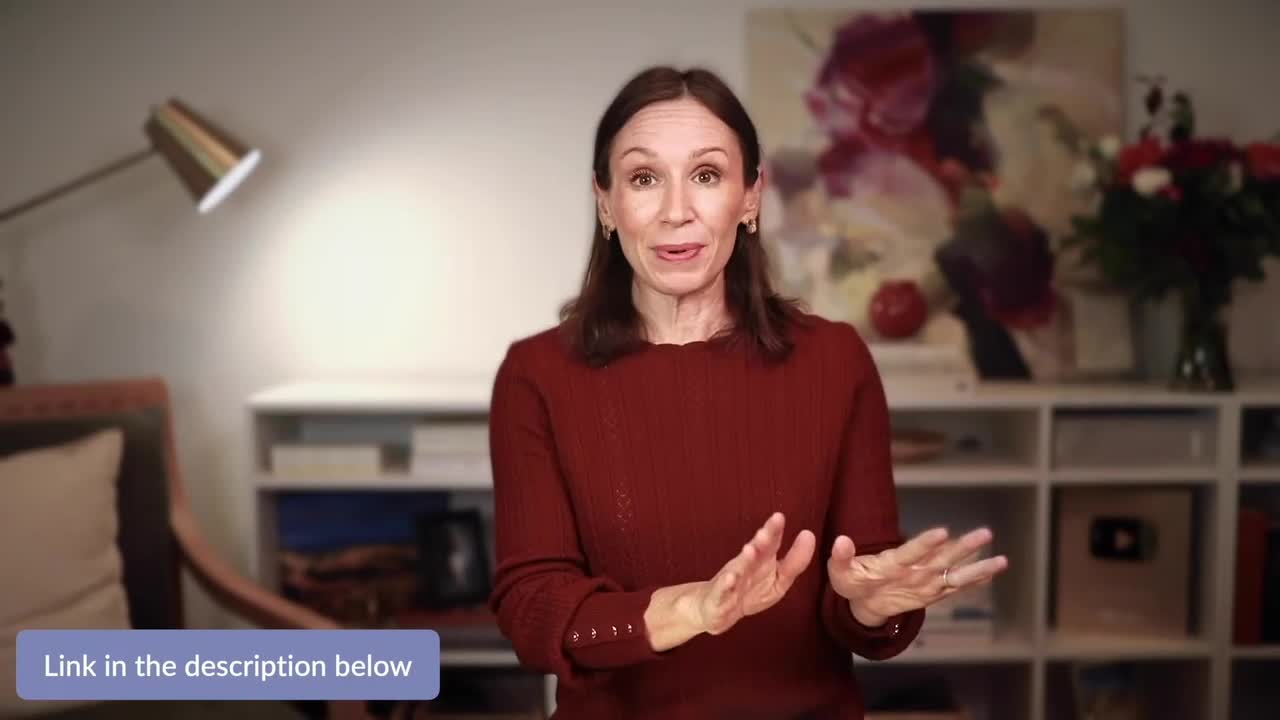
Recently, one of my students asked, how do I interrupt politely?
Because I was on a call with Americans yesterday and I wanted to say that I was only able to stay for 40 minutes on this call.
I didn't know how to interrupt in a polite way.
Can you help?
Absolutely.
And this is perfect timing, because recently I shared a lesson on how to respond to interruptions in English.
But if you are the one who needs to stop a conversation, let's talk about how to do it right, because interrupting is a delicate matter.
In English-speaking culture we kind of discourage interruptions, except in a few situations, like if you need to share an important or urgent message or ask for clarification, or if you want to express a thought before the conversation moves on.
The key in those moments is yes, knowing what to say and have to say it.
So today, that's exactly what we're going to cover.
You'll get five tips for interrupting politely, 11 phrases you can start using right away, and what changes about this process when you're on Zoom or Teams.
Now, before we get into the tips for how to interrupt politely, I want to talk about why interruptions may feel so different in English.
I know that in many cultures, overlapping speech is normal and friendly.
It's a sign of engagement in the conversation that you care, that you're listening and that you want to be part of the conversation.
But in English-speaking culture, the expectation is different.
The general rule is to wait for a natural pause in the conversation before you start speaking.
Even when you have a good intention, jumping in at the wrong moment can send a message that you're being dismissive, aggressive or insensitive.
I want you to imagine that a conversation is like a game of ping pong.
It's a ball going back And fourth, one person at a time.
So with that in mind, here are five tips for how to interrupt politely in English.
The first tip is to have a good reason.
Before you interrupt, ask yourself why.
If you have an important message to share, or a question that will affect what happens next, or an idea that you need to share before the conversation moves on, those are all good reasons to interrupt.
But if it's because you just want to tell your own story or you don't want to lose your turn, it's better to wait.
The simplest test for this is if the conversation could continue Without your interruption.
It probably should.
That doesn't mean you won't get your chance to speak, but it means you need to wait for it.
The second tip is to start and end your interruption with politeness.
In English, the phrases we use to interrupt almost always begin with an acknowledgement, something that signals that you know you're stepping into the speaker's turn.
These are words like, sorry, excuse me, and pardon me.
These words are like a small act of respect that says I see it's your turn and I'm asking to briefly borrow it.
And then, once you've shared your thought or asked your question, a quick thank you closes the interruption smoothly and keeps the tone collaborative.
The third tip for interrupting politely is to pay attention to your tone.
Even with the right words, your tone can make or break the interruption.
Again, interrupting can feel rude by default.
So your tone has some extra work to do.
And it's important to aim for a soft and calm voice.
Not aggressive, not rushed, and not harsh.
The best way to get that soft, calm voice is to smile while speaking.
Smiling changes the shape of your mouth, which changes how your voice resonates.
This might seem like a small change, but the impact is significant.
Smiling contributes to an increased pitch, improved resonance, and a warmer, more approachable tone.
When you're interrupting, the polite words we talked about in Tip 2 give you a head start, and your tone of voice does the rest.
And now tip number four is to wait for the right moment.
And this one is a bit bigger or more complicated than the others.
It's an easy one to miss because it requires careful observation.
When you need to interrupt, there's a good rule to follow.
Wait one or two seconds. after the speaker has ended a sentence.
If they haven't started another sentence yet, you may have a safe spot to enter the conversation.
But here's where it gets tricky.
Sometimes a speaker pauses for a second or two and we assume that they're finished, but they're not.
They're just thinking about their next thought.
They're trying to organize their ideas.
And then if you jump in, you've cut them off.
So how do you know whether someone is finished or just thinking when they pause?
There are a few visual cues that we can use to help.
For example, if the speaker is taking in a short breath, or if you hear some fillers like um ah, hmm.
If someone is still moving their hands while they're thinking, or if they're looking away as if they're trying to organize their thoughts.
All of these are indicators that they are simply pausing before they continue speaking.
And it's still their turn.
But when those signals stop, when their hands settle and their eyes return to you and the room goes quiet, that's the moment to jump in.
Now there's one more thing here.
When someone is sharing something that is more complex, vulnerable or emotional, the timing of all of this changes.
Instead of just one or two seconds, it's better to wait a bit longer, even if it feels kind of uncomfortable.
In those conversations it's better to wait maybe three to five seconds, because jumping in too soon in those conversations can of course break someone's train of thought and it can feel dismissive or even cause unintended hurt in those higher stakes or more emotionally charged conversations.
In those situations, a short, slightly awkward silence is always better than an interruption that is too quick.
And then tip number five is to signal with body language first.
Whenever possible, Let your body do the asking before your voice does.
Here, you can always use a small hand gesture like a raised finger.
You can also lean forward slightly and make clear eye contact with the speaker.
All of these signal that you'd like to say something, without your voice ever cutting in, and often the speaker will see your signal and naturally give the conversation over to you when they're ready.
No verbal interruption needed.
But when you do need to speak, if it is combined with a gesture first, Your interruption feels less abrupt because the speaker anticipates it.
They were already expecting it once they saw your non-verbal gesture.
Now, before we move on to the specific phrases you can use to interrupt, I want to mention something here.
Today you're going to walk away knowing exactly what to say when you need to interrupt.
And if you want that same confidence, knowing that you have the right words to say in any situation in English, I have a free training for you.
It's called how to get the confidence to say what you want in English.
It's a training I've shared with more than 20,000 people. and I'd love to share it with you as well.
So I'll leave a link in the description notes below.
And now that you have those five tips for interrupting politely, let's look at 11 specific phrases you can use.
All of these work for one-on-one conversations, phone calls, meetings and group discussions as well.
We'll go through four common situations to understand them.
Let's start with what to say when you need to deliver a message.
There are three phrases I want to share with you here that are great when you have important information to share before the conversation moves on.
First, I hate to interrupt, but I wanted to let you know.
Or I'm so sorry to interrupt, but and I don't mean to be rude, but may I interrupt quickly.
For example, let's imagine that you're in a team meeting and you suddenly remember details about an important deadline that has been changed and you want to share that information before the conversation moves on.
In that moment you could say I hate to interrupt.
But before we move on, I wanted to let you know that the report deadline has been moved to noon today.
This kind of interruption is quick and clear, so that the meeting can move on and you get the opportunity to share that important information.
Now, our next group of phrases to use are perfect when you need to end a conversation.
For example I'm really sorry to interrupt, but I have to be at a meeting for work and I need to get going.
Now, to get going means to leave or depart now or soon.
And now here's a second option.
Oh, sorry to interrupt, but I just noticed the time and I need to get to work.
But it was great chatting with you.
I want to take a moment to see how these phrases work in a real life situation.
So imagine you run into your neighbor on your way to your car.
You stop for a chat and then the conversation kind of continues.
It goes on longer than you expected.
And now you're at risk of being late to pick up your kids from school.
So here's how you end it.
Oh, I'm so sorry to interrupt, but I just noticed the time and I really need to get going.
It was lovely to catch up.
Let's talk more soon.
In this case, you have an apology, a reason and a warm closing to interrupt the conversation and close it so that you can leave.
Next step is what to say when you need to ask a question or clarify something.
And these interruptions are essential.
If something is unclear or an important detail was not fully explained, you need to check before moving on.
So to do that, you could say, sorry to interrupt, but may I ask a quick question?
Or I apologize for interrupting, but I'd like to make sure I understood you correctly.
And I don't mean to be rude, but I'd like to ask a question.
Again, let's look at how this works in real life.
And this time I want you to imagine that your colleague is walking the team through a new process.
Halfway through you realize that you're not sure whether the new steps apply to existing clients or only to new ones, and the answer changes what you need to do in your job this week.
So, before things move on and you get lost, you could jump in with.
I'm sorry to interrupt, but I'd like to make sure I understand correctly.
Does this process apply to existing clients as well or only new clients?
Again, this is a high value interruption.
You're not slowing the meeting down.
You're making sure that the meeting accomplishes what it is supposed to do.
And now our fourth set of phrases for interrupting politely are perfect when you want to join a conversation or express an opinion before the topic moves on.
The first one is, so sorry to interrupt, but before we move on, I'd like to add my thoughts on this.
Or excuse me, but can I jump in here?
Or may I add something quickly before we move on?
For example, if you're in a fast moving group discussion about how to handle a difficult client, you might say I'm sorry to interrupt, but before we move on, I'd really like to add my thoughts.
I've dealt with something similar before.
I want to take a look at the structure of that example.
We have an apology for interrupting, a clear reason for the interruption and a quick promise of value.
That last part of I've dealt with something similar before gives the group a reason to pause and listen.
Now, so far, everything we've covered works for conversations in person.
But virtual meetings are a different game.
On Zoom, Google Meet, or Teams, it can be trickier to interrupt politely.
People's eyes are often on another window or screen.
There can also be audio delays that cause you to accidentally cut someone off.
And without all the body language cues we just talked about, it's harder to signal that you want to speak.
So in those moments, here's what to do.
Tip number one is to use the raise hand function.
This is the most polite, low disruption option.
Simply click the raise hand button in your meeting platform and this alerts the host or the speaker to call on you when there's a natural pause.
This is particularly useful in larger meetings with multiple speakers.
The second option is to use the chat.
If you feel that interrupting will disrupt the flow, simply type your question or comment into the chat.
Again, the speaker can address it when there's a natural pause and you don't have to break the rhythm or flow of the conversation.
And then tip number three is to make your body language clear.
When the raise hand or chat options are not a good fit, like if you're in a small group discussion on Zoom and everyone can see you you can use the same body language cues that you might use if you were in person.
You can raise your hand on camera and even lean toward the screen.
And then, once you're ready, interrupt with one of these polite phrases.
Something like, sorry to jump in, I'd like to add.
Or, before we move forward, I want to build on.
And one more, sorry, I don't want to lose this thought.
Could I just add one thing here?
Now, before we move on, if you've ever been interrupted in a conversation and you didn't know how to handle it in the moment, that is the other side of this conversation.
And I have a fall lesson exactly on that. how to respond when someone interrupts you in English.
I'll share a link to that lesson in the description notes below so that you can watch it next.
What I want you to remember from today is this.
Even if English-speaking culture does not value multiple people speaking at the same time, interrupting in English doesn't have to feel awkward or rude.
With these five tips and the 11 phrases that you've learned today, you have everything you need to step into a conversation politely, get your point across and keep the tone of your voice warm.
And now I would love to hear from you.
I'm curious which of these phrases you'll start to use in your conversations this week.
Take a moment to tell me in the comments.
And, as always, if you found this lesson helpful to you, don't forget to subscribe or follow, wherever you're watching or listening from today.
Thank you so much for joining me and I look forward to next time.