At Sierra, discover great deals on top brand workout gear like high quality walking shoes, which might lead to another discovery.
40,000 steps, baby.
Who's on top now, Karen?
You've taken the office step challenge a step too far.
Don't worry, though.
Sierra also has yoga gear.
It might be a good place to find your zen.
Discover top brands at unexpectedly low prices.
Sierra, let's get moving.
Hi, listeners.
I'm Jeff Dalvisio, the chief multimedia editor and executive producer here at Scientific American.
I work every day alongside Rachel and Fonda and the rest of our crew here at SCI-AM to bring you science quickly.
But before we dive into today's episode, I want to share something very personal and important.
I spent the last 25 years of my life telling stories about science.
I've written, filmed, recorded and animated the discoveries that shape our world.
Whether it's exploring science inside of biosafety labs or out on ice sheets, I've witnessed the power of science journalism.
But here's the hard truth.
Journalism like ours is getting harder to do.
Newsrooms are shrinking.
Misinformation is growing.
And responsible reporting, real, verified human reporting, takes time, care, and support.
Subscribing to Scientific American is the best way to keep science journalism alive.
By subscribing to SIAM, you're supporting the work we do to bring you science quickly.
Please consider getting a subscription today at scientificamerican.com slash get SIAM slash science quickly.
As Thomas Jefferson once said, if a nation expects to be ignorant and free in a state of civilization, it expects what never was, never will be.
I know we all want to live free.
So let's keep learning together.
For Scientific American Science Quickly, I'm Rachel Feldman.
Breaking headline as we're on the air tonight, just in from the CDC, the sudden shakeup.
At this hour, folks, we are trying to figure out the job status of the CDC director, Susan Menard.
We're following breaking news out of the CDC where top officials are resigning en masse.
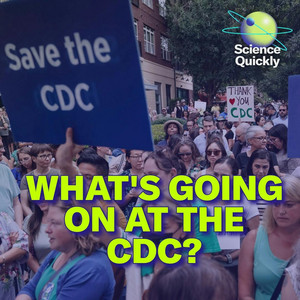
As you've probably noticed, things at the Centers for Disease Control and Prevention are pretty chaotic right now.
Last week, the Department of Health and Human Services announced that CDC head Susan Menares would no longer be leading the agency, an announcement that Menares and her legal team had plenty to say about.
On September 1st, a group of nine former CDC directors and acting directors penned a guest essay in The New York Times denouncing HHS Secretary Robert F Kennedy Jr'.
's leadership.
The group of CDC veterans who have served presidents of both major parties and collectively carry more than a century of experience at the agency, called Kennedy's recent moves unacceptable and said his actions should alarm every American, regardless of political leanings.
Additionally, a group of more than 1000 past and present HHS employees put out a letter this week calling for Kennedy to resign.
Here to update us on the situation at the CDC is Lauren Young, Associate Editor for Health and Medicine at Scientific American.
Lauren, thanks so much for coming on to talk to us.
Thanks for having me.
So big picture, what's going on at the CDC right now?
Yeah, so it's a bit chaotic and a lot of it is confusing, in the sense that we've been getting information rolled out, you know, minute by minute.
We've even had new developments.
That happened latter half of the week, after the major announcement that Susan Menares is no longer the CDC director.
We've had several other top officials submit resignations.
And at the end of last week, RFK Jr. announced an acting director for the CDC.
So it's a lot of things up in the air with these several resignations of top officials.
A lot of branches of the CDC are currently leaderless.
So it's going to take some time to figure out who's filling in where.
And there's a lot of concern among experts on how this is going to roll out with regular, just functioning at the CDC, just day-to-day operations.
It's a good reminder that the CDC yes, is the primary public health agency that we have in the US.
That's on top of things like pandemic preparedness, the COVID vaccines, other vaccine schedules, childhood vaccination schedules, but other things just like general outbreak surveillance.
So We're just hot off the tails of a major measles outbreak.
So we're kind of sitting in a hot seat right now trying to see how this is all going to shake out in just daily operations.
Yeah.
So let's start with the head of the CDC or perhaps former head of the CDC.
Last week, there was a lot of confusion about what the status of her employment was.
Could you tell us about her background, who appointed her, how long she served and what's been happening in the last week or so?
Yeah.
So Susan Monarez has actually been a public health figure for quite some time.
She's actually served for multiple presidential administrations prior to this.
She's not a physician, but she's been in the public health space for quite some time.
So President Trump originally appointed and nominated Menard for the position, and she was sworn in in July 31st.
So she's really only been the director officially for the CDC for a few weeks.
Prior to that, she was serving as the acting director, but for some time the CDC had actually been leaderless for several months.
And so within the last few weeks we've gotten news that she was supposedly stepping down, but that's been quite legally contentious.
Can you tell us more about that?
Right.
So last Wednesday during the day, the Department of Health and Human Services posted on X that Menard's was no longer CDC director.
There wasn't a lot of context to it.
It was just this kind of blanket post that, Shortly after that, Menard's lawyers, her legal team, posted a statement saying she had not received any notice that she had been fired and she was not planning on resigning or stepping down.
And shortly after that the White House spokesperson basically confirmed that she had been dismissed and had been terminated.
This was confusing, because then her legal team came back again and posted well actually, since the president was the one who appointed her and she is Senate approved, only the president can be the one to dismiss her formally.
So, technically speaking, and from my reporting as of Tuesday, I haven't seen anything that has indicated that the president has changed his mind or made any decisions, whether to reappoint her or to support the decision.
But theoretically, because she is a presidential appointee and was approved by the Senate, President Trump can come in and overturn this decision.
So things have been kind of chaotic at the CDC for a while, to say the least.
You know, they've been changing their recommendations about various vaccination schedules and requirements and having public health experts and organizations actively conflict with them in a way that's really unprecedented.
But this firing dot, dot dot question mark has led to sort of a cascade of people who seem just done with their work at the CDC and a lot of big resignations.
Could you tell us about that?
Yeah.
So far, there's been four big name resignations. of several different branches.
And I'll also mention too, there was a huge walkout on the subsequent day that all of this has happened.
So a lot of upset among all staff, even among these top officials.
But to name a few of some of the branches, for example, the director of the National Center for Emerging and Zoonotic Infectious Diseases stepped down.
And this was a person who had been with the CDC for more than 30 years and is one of the top influenza experts actually at the CDC.
And that's huge because this year we saw one of the highest years of pediatric deaths from influenza.
So it's really terrifying that we have one of the top leaders who's resigned from that position.
We've also seen the director of the National Center for Immunization and Respiratory Diseases also resign.
And we've also seen the CDC chief medical officer resign.
So those are just a few of folks who've decided to step down from their positions.
And what kind of reasons have they been giving in their statements as they've resigned?
There's been several.
A big theme has been just the sheer amount of misinformation and disinformation that's come out of these public health agencies since Kennedy has taken the helm of the HHS.
That's been, to me, one of the biggest themes.
A lot of the, you know, just sudden, confusing explanations around vaccination schedules.
There was a lot of citations too, of the measles outbreak and again, some confusing information about how you should be treated for it.
So there were several reasons.
A few of them also mentioned the tragic event, the shooting that happened earlier in August at the CDC's campus.
At least one of the letters had mentioned or referenced that as a potential reason for this.
I think some listeners might hear that these experts are resigning and think how could they leave an organization that they feel like is in so much trouble?
And I think the point that they seem to be making is the CDC has drifted so far from its mission statement and become such a chaotic you know misinforming, disinforming organization that they don't believe they can help public health by staying there.
Would you say that that's accurate?
Yeah, actually I was listening to several of these officials who resigned, one of which Deborah Howery, who was the CDC chief medical officer.
She was telling PPS NewsHour.
I thought my voice, and the voice of my colleagues that also resigned with me, will be more powerful on the outside.
And that really just was a tipping point.
She felt like she no longer could work in a credible way.
Another thing she mentioned and I've seen this too from several reports some of the violence that's been taking place against public health and directly against CDC staff.
You know they are fearful of speaking out and they feel that they have targets on their backs.
Those were a few things that she had mentioned that I think kind of speak to that question.
Yeah.
Well, I know you talked to a couple of folks who are experts in the public health space.
What did they have to say about why this is happening and what the implications are.
Yeah.
So I've spoken to a couple of public health experts.
Georges Benjamin, who's the executive director of the American Public Health Association.
He was telling me that he's concerned.
You know who would even want the CDC director position, let alone any position at the CDC or these public health agencies, when you have somebody in charge who doesn't believe in the science and believe in the evidence.
I think that's a question that a lot of people are sitting on.
And he also mentioned he's like you're seeing these people leaving because they've essentially just had enough.
You know they've had enough of trying to push for the evidence, following where the data is leading them, but then not being listened to.
I've been hearing a lot of that in the conversation.
Another person I talked to, Jennifer Nezzo, who's an epidemiologist and the director at the Pandemic Center at Brown University.
She's really concerned about how the lack of cohesion in these leadership spaces, in these public health agencies, what they are saying to other nations.
She's particularly worried about potential biological threats.
The emergence of that threat is potentially growing.
And what she told me, which I think really sits, is no one is home to watch out for health threats to the nation and no one will be there to respond.
And, you know, these are what our public health agencies do.
They're looking out for us 24-7, whether that's a foodborne illness outbreak, whether that's measles, whether that is a biological threat.
So I think that's something that I know all these experts on the outside and on the inside are thinking about right now.
Well, and as you mentioned, there are a lot of question marks about who will lead the CDC, who would want to, who HHS and the president want leading the organization, given the people that they've pushed out.
But what do we know about who's running the CDC in the interim?
Right.
So the HHS did announce an acting director for the CDC who is Jim O'Neill.
He's been serving as the deputy secretary of the HHS.
So he worked very closely with Kennedy.
So he's going to be right now the acting director of the CDC.
And like Menard, he's also not a physician.
He was a Silicon Valley investor and entrepreneur before. worked in like aging longevity spaces.
And during the pandemic, he was pretty critical of the CDC's response.
So far from what we know of O'Neill's stance on vaccination is he's publicly stated that he's pro-vaccine and that he has been an advisor to a vaccine company.
So we're just going to have to wait and see what happens.
Thanks so much for coming on to talk us through this, Lauren.
Thanks so much for having me.
On Thursday, which is when I'm recording this, Kennedy testified before the Senate.
While the hearing's stated focus was the administration's health care agenda for 2026, he was, of course, questioned on recent changes to the CDC.
Kennedy maintained that those changes were necessary.
For more up-to-date news on this subject, go to scientificamerican.com.
That's all for today's episode.
We'll be back on Monday with our Science News Roundup.
Science Quickly is produced by me, Rachel Faltman, along with Fonda Mwangi, Kelso Harper and Jeff Dalvisio.
This episode was edited by Alex Sugiara.
Shaina Posis and Aaron Shattuck fact-check our show.
Our theme music was composed by Dominic Smith.
Subscribe to Scientific American for more up-to-date and in-depth science news.
For Scientific American, this is Rachel Faltman.
Have a great weekend.
Thank you.