Hey I'm Robert Vinlow and I'm from New York Times Games, and I'm here talking to people about WURDL and the WURDL Archive.
Do you all play WURDL?
I play it every day.
Alright, I have something exciting to show you.
It's the WURDL Archive.
Whaaat? Okay that's awesome.
So now you can play every WURDL that has ever existed.
There's like a thousand puzzles.
WURDL Archive! Oh cool!
Now you can do yesterday's WURDL if you missed it.
New York Times game subscribers can now access the entire Wordle archive.
Find out more at nytimes .com slash games.
Subscribe by June 22 to get a special offer.
From the New York Times, this is The Daily.
I'm Natalie Kintro -F.
This week's protests and clashes in California are the biggest flare up yet over Trump's immigration enforcement.
They follow months of escalating ICE raids and rhetoric as the administration struggles to fulfill the president's big promises for mass deportation.
Today, my colleague Hamid Ali -Aziz goes inside one ICE operation and explains why the tensions over Trump's aggressive approach may only get worse in the months to come.
It's Wednesday, June 11th.
Hamid, welcome back to the show.
We've now seen five days of protests in L .A.
over these ICE raids.
First, the administration sent in the National Guard, then hundreds of Marines.
All of this comes after months of increasing enforcement across the country, ICE showing up in full force to find and detain immigrants in various cities.
As one of the people who's been leading our coverage of this, what do you feel like is the story of what we're seeing here?
To me, what happened in LA is a sign that the administration means what they've been saying.
They plan on going into every community in the United States to find people they believe should be deported.
And that includes Los Angeles.
That includes downtown Los Angeles.
California, a place that has been basically the center of resistance to President Trump's immigration crackdown.
They are not afraid of going into these communities and making arrests, but I think it also speaks to the fact that ICE has really been struggling to get their immigration arrests up.
And of course, President Trump came into office promising this historic mass deportation effort that he was going to deport more people than ever before.
Right, the largest mass -deportation operation in history.
Exactly, and thus far, that's been, you know, really slow -going.
Slow -going how? How do we see that?
Well, from the beginning of the administration until, you know, earlier this week, they have deported around 200 ,000 people.
And for comparison, during the Biden administration, in 2024, they deported over 700 ,000 people.
Wow. So this is a lot less.
Yeah. So I think at this point, they're on track for over 500 ,000 deportations over the course of the entire year, which is not really mass deportation in the way that President Trump promised it on the campaign trail last year.
Hamid, it certainly doesn't seem like they're failing on this measure for lack of trying.
They're obviously putting in a real effort here.
So what's going on behind the scenes?
What's making this so hard for them?
Well, it's every part of deportation is really hard. So getting travel documents from countries, getting countries to accept their people, getting enough planes to put people on to deport them to foreign countries, getting enough detention to hold people.
And in the past, ISIS really relied on jails and prisons to get their numbers.
That has been the like bread and butter of ISIS, going to jails, picking up people, and arresting them and deporting them very quickly.
But now so many American communities are turning back from cooperating with ICE.
So at every step of the way, they're running into logistics and resource challenges.
Got it, so just a bunch of obstacles here.
Yeah. But there's something else going on as well, which is that the Trump administration has been incredibly successful at lowering the number of people crossing the southern border.
They've essentially blocked asylum at the southern border.
They've told people they're going to turn them back immediately.
There's no access to asylum protections in the United States, and because of that, less people are crossing the border.
I mean, the numbers are historically low.
But those numbers mean that you can't get your deportation numbers up because during the Biden administration, during the Obama administration, deportations at the southern border were a big part of the deportation numbers.
So, the Trump administration no longer has that.
It's like, in a way, their success at the southern border makes this other goal of mass deportations a lot harder to achieve.
Yeah, exactly. Everyone is being thrown at doing immigration enforcement in the United States.
Entities in the Department of Justice, including the FBI, ATF, DEA, the U .S. Marshals, along with agents and officers at ICE.
But, they're not meeting the levels of enforcement that the White House and this administration wants.
I mean, Tom Omen has said publicly that ICE has done a lot, but they need to do more, that he's not satisfied with what they've done already.
And that's what's happening publicly.
But that pressure is manifesting even inside ICE headquarters.
Stephen Miller, the deputy chief of staff, one of the most senior individuals in the and met with top ICE senior leaders and walked them through, you know, what this administration wants when it comes to arrests and deportations.
I had one source with knowledge of this meeting say that Stephen Miller was asking, who thinks we can get to a million deportations this year?
Can we hit 1 ,000, 2 ,000, 3 ,000 arrests a day?
A quota, right? I mean, is your understanding that Miller was essentially asking them, look, hit this number?
We actually spoke with someone in that room who said that hey, he wasn't throwing out a quota for us.
But… Under President Trump's leadership, we are looking to set a goal of a minimum of 3 ,000 arrests for ICE every day.
Then Miller goes on Fox News soon after and actually puts that quota out there.
He says it publicly, a minimum 3 ,000 arrests a day.
And President Trump is gonna keep pushing to get that number up higher each and every single day so we can get.
I mean, this is unseen.
This is unheard of before at ICE, to hit 3 ,000 arrests a day.
That's a level they've never hit.
They haven't come close to hitting.
Oh, wow. And he's putting this out publicly.
And this number really kind of permeated throughout the agency.
Everybody has become aware of this target, this goal of 3 ,000 arrests a day.
So this message has become heard loud and clear across ICE.
So they're getting really extraordinary pressure for really high numbers at the same time that all of the easier avenues that they might take for deportations have just been cut off.
At the border, it's basically shut down and as you said, many cities won't let ICE into local jails.
I imagine this has left officers feeling like, how are we going to ramp things up?
Definitely. And we're seeing things that we've never seen before, like ICE showing up to immigration courthouses and actually waiting for immigrants to walk out of their hearings, to pick them up, arrest them and try to deport them as quickly as possible.
But it's one thing to report on these policies and to hear about this ramped up enforcement from across the country and it's another to actually see it.
of peace in America.
So I really wanted to go on the ground and see what it was like to be with ICE officers, with FBI agents, with DEA agents when ICE goes into American communities and tries to arrest as many people as they possibly can.
So actually, a week after that meeting with Stephen Miller at ICE Headquarters in Washington D .C., I was actually able to go on an ICE operation in Miami, Florida with a top official from the agency.
We'll be right back.
I gave my brother a New York Times subscription.
She sent me a yearlong subscription so I have access to all the games.
We will do word oh, mini, spelling bee.
It has given us a personal connection.
We exchange articles.
And so having read the same article, we can discuss it.
The coverage, the options, not just news.
Such a diversified gift. I was really excited to give him a New York Times cooking subscription so that we could share recipes.
and we even just shared a recipe the other day.
The New York Times contributes to our quality time together.
You have all of that information at your fingertips.
It enriches our relationship, broadening our horizons.
It was such a cool and thoughtful gift. We're reading the same stuff, we're making the same food, we're on the same page.
special rate if you act before June 15th.
Okay Hamid, you said you got invited by ice to go on this raid.
You go to Florida. Take me through what you saw.
So most ice operations start really early in the day.
And this one was no different.
Yo, good morning. How's it going?
Good. I need coffee.
Daily producer, Carlos Prieto and I woke up quite early.
I run four 30. And we headed out to a parking lot next to a U .S. bank in Miami, Florida.
So we're at this parking lot.
There's about a dozen, maybe 15 officers, most of them wearing tactical gear.
When we arrived, we saw that there was a group of federal agents, of course ICE agents, but there were also people there from the FBI. Good morning guys.
Thanks for coming out on this beautiful Wednesday morning.
Today we're going after an individual.
His name is Jerlyn Isuala Rivera.
And it was there where we learned that the first target, in fact, was an individual who had allegedly been arrested for sexual battery on a minor - This is the first person they're trying to arrest that day.
Yeah. It's also just like important to note the fact that this message of deporting people have been convicted of crimes so heinous that would make people so fearful to be their neighbors really has been the through line and the messaging from this administration.
So I think it's important to note the fact that like they were bringing me along for this right along.
This is the first target that perhaps falls in line with that messaging.
Everybody's in? Yes.
Got everybody? Yes.
So we got in the car with a senior ICE official, the number two in command of ICE deportation efforts in Washington, DC, Garrett Rippa, and we were riding along with him to this working class neighborhood in Miami, Florida.
I'm right behind you.
So which apartment complex?
What are we, which one are we looking at?
So black city bounded in front of the house right now on the street.
I don't know if you can see it from your angle.
I don't think I can.
We got to the neighborhood, we parked several houses away from the house that was targeted.
And we were supposed to wait for them to come out of their home and head on their way to work.
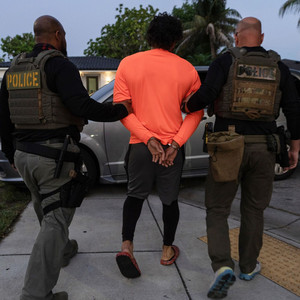
And within a few minutes, they had actually arrested their target.
So they just put the guy in the back of a van, and now they're checking, what I suspect is his car.
That's a blue Honda Civic.
At that point, I kind of thought maybe, you know, that was it.
All right, we're from Immigration and Customs Enforcement, ICE.
We're just gonna run your history.
I have a, wow. The target's brother was sitting in a car and surrounded by these ICE officials.
You apply for asylum and you're going through the proceedings.
That's what he's telling you.
Do you have a court date?
Interview date? — Walking through his status, walking through when he came to the United States, and at some point the call was made.
They cuffed him, and they led him into the same van that his brother was in.
— And to be clear, this guy was not an original target of this raid.
— No, not at all. He was not somebody that was on their radar, not somebody that they were going after, but he was just in the wrong place at the wrong time.
And that's really a key part of this crackdown by the Trump administration, this idea of collateral arrests, people who are not necessarily the targets, but are around the targets.
And the senior official that we were with said that they're not really differentiating anymore between criminal and non -criminal targets.
We always say that, you know, there's been a crime committed when he illegally crossed the border.
He said these people who have not necessarily a criminal history from crimes in the United States, they have committed crimes by crossing into the country illegally.
There's a crime committed when he's working without work authorization.
There's a crime committed when he's opening up a bank account.
So I know we sometimes say that individuals, you know, they don't have any criminal record. Well, there's a lot of crimes being committed.
It's just that under the past administration, those crimes are somewhat overlooked.
That in fact, in their mind, place them into the same bucket as other people that are historically known as criminals that ice targets.
It's really interesting because during the campaign, I think a lot of people assumed that when Trump said he would be targeting criminals, he meant violent criminals like people involved in really serious crimes.
And when I hear you talk about this kind of broader definition of the criminals that they're going after, it is hard to not think about how much pressure they're under to just get more people in detention to deport more people.
Do you think these things are related, that they've widened the net because they can't meet their numbers otherwise?
Yeah, I think if you're ICE, you need to widen the net and go after different groups of people not just the worst of the worst. And if anybody in the country who is here illegally is a target, that certainly helps with meeting these quotas and these demands.
Was he pushing for more arrests, like, you know, get the numbers up?
You know, when I actually asked Ripa about this meeting with Miller and ICE officials at the ICE headquarters, and— I don't think he was pushing for more arrests.
I think he was pushing for more initiatives.
So I think his message was, you have a lot of tools in the tool belt.
Let's just make sure we're utilizing all of those tools.
You know, he was definitely careful in the words that he chose.
But he did allude to this kind of pressure and this request for more enforcement for getting the numbers up.
And Ripa also said, like, you know...
Obviously, he's looking at the numbers and he works for the President.
And he wants to make sure that we're meeting the President's agenda and the department's agenda.
Miller has his own perspective.
Obviously, he wants to carry out the goals of the president and, you know, almost kind of alluding, of course, to this idea of mass deportation and mass arrest. I think this is what the administration wants.
It's individuals who are in the country illegally and criminals at that.
So, we heard about the first stop.
What happens next? Yeah, from there, we went to a upscale neighborhood.
This is Alton Road.
and this is the heart and center of Miami Beach. And we parked on the side of the road.
We were waiting for this individual who was from Mexico, who had their student visa revoked allegedly because of some issues with embezzlement charges in Mexico.
And we waited a little longer this time, I would say probably around an hour.
Oh wait they said we've seen 843.
They knew actually the time that he usually would leave his house.
Oh wow they've been tracking him.
Yeah this is something that ICE commonly does, is surveillance on their targets.
Oftentimes they rely on knowing when people leave their houses to pick them up out in public.
And in this case, that's exactly what happened.
The subject is getting in the vehicle right now.
OK. Is the plan to let him drive a little bit and pull him over?
This individual drove out with her car and was pulled over by several cars and detained on the side of the road.
And in the car was his daughter and his wife.
Ma 'am, what is your name?
Alejandro. Alejandro.
Do you have this identification with you?
I don't know, can I please start talking with this lawyer, please?
His wife seemed, you know, really emotional on the phone with their lawyer.
And actually, at one point, one of the ICE officers told her to calm down.
He was gonna walk her through what was going on.
We're gonna take him to the office which is in Miramar. They gonna take him to Miramar. I cannot go in there, but I can follow you." It's really kind of an emotional scene, I think, which really speaks to what a life -changing moment an ice arrest can be and the ripple effects on families.
This is a family that is now, for all intents and purposes, separated from their father.
And seeing that up close and personal was, you know, really important.
Yeah. I mean, you're watching them watch this unfold.
I mean, it just sounds so intense, honestly.
And I'm wondering, beyond just the raw emotion of this moment, what you're making of this second stop.
Yeah, what really jumps out here is the amount of resources that it took just to arrest one person.
I mean, you had several cars, more than 12 officers on scene, agents from the FBI, somebody from the State Department, ICE officers.
So many people gathered just to arrest one individual, which I think really speaks to the difficulty of arresting people in American communities.
It just takes so many people.
Is this not something you would have seen in the past, just this kind of outlay of resources?
Yeah, you definitely wouldn't have seen the FBI, the State Department, other agencies on the ground diverting resources to help ICE arrest one person.
And the thing I would point out is that this was the last operation for the day.
We started at 5 .45 in the morning and the operation lasted around four hours.
So you have several cars.
You have more than 12 officers and the ICE ended up arresting three people.
And one of them wasn't even a target.
It was just, like, a fluke.
Totally. Yeah, exactly.
That's some pretty hard math, if you're ICE.
I mean, I presume that the ICE leadership can also do that math, right?
How are they gonna meet these really lofty deportation goals?
Yeah, that remains to be seen, but one of the ways that you can get there is through these worksite operations that we've seen across the country maybe in recent days and weeks where ICE is actually able to show up at different locations where people are working, and they can arrest a large number of people at a time.
So that's one way. And another is this idea of self -deportation.
This is a message that the Trump administration has been sending constantly in recent weeks, this idea of leave the country voluntarily before we come and find you.
And these operations, I think, serve that purpose as well.
It's sending this message that ICE is all across the country, they're going to workplaces, they're going to people's homes, they're going to parking lots, and potentially, it could send this deterrent message to people that they should leave now and they should leave on their own accord and avoid all this altogether.
You're saying basically even though we've been talking about this huge investment of resources as a potential problem for ICE, there's another way in which the intensity of these operations has this secondary effect which is intentional, that people should just leave on their own accord to avoid getting scooped up in one of these kinds of raids.
Do ICE officers say that explicitly?
Like that that's part of the purpose of their raids?
What is the message this is sending to folks who are undocumented and don't have any interaction with the criminal justice system?
We asked this of Mr. Ripa, and he didn't say that this was the purpose explicitly, but he said there was a broader message behind it.
I think the message is clear that we are treating those individuals as criminals based on their manner of entry, and they should take advantage of other means to depart voluntarily.
They want people to leave the country before ICE comes and finds them.
They are sending this message through everybody that they possibly can, and trying to advocate for people to leave, leave now.
It strikes me that part of this messaging is to undocumented immigrants.
But there's another part of the messaging that is being directed at sanctuary cities, where ICE is basically saying, you need to cooperate with us.
You need to let us into your jails, you need to work with us and if you don't, you're going to keep seeing raids like this.
You're going to keep seeing these kinds of actions in these liberal cities like Los Angeles.
100%. This is something that the Trump administration has said they will do.
that these sanctuary communities are not going to keep them from coming into arrest undocumented immigrants.
So the idea here is, if you work with us, then we won't have to send all these ICE officers into the communities to find people, and while we're finding those people, we're not going to run into people that weren't even on our radar, but we're going to have to pick up those people as well.
But the facts on the ground are that a lot of these communities are not going to cooperate with them.
They're not going to be forced into working with ICE.
And I think it stands to reason that ICE is going to have to go further and further into American communities to get the numbers that they need.
You're saying that, given the facts on the ground, the only way for ICE to really achieve what it set out to do here is to go deeper and deeper into the country, to just get more aggressive.
And it just strikes me that especially if those efforts are concentrated in sanctuary cities, we may be seeing some of these tensions, like what we're seeing in LA, just continue to spill over again and again.
Definitely, and these are areas that are proud of their diversity.
They're proud of the fact that there are so many immigrants in their communities and there is a large base of people who are willing to come out and protest and to push back on ICE.
You know, I'm thinking of places like San Francisco, Los Angeles, Seattle, New York.
So you could definitely expect that moving forward if ICE takes this type of operation across the United States.
These kinds of clashes may just be inevitable at this point.
Totally. Hamid, thanks for coming on the show.
Thanks for having me.
Protests grew in dozens of cities on Tuesday as thousands of demonstrators took to the streets to oppose Trump's immigration crackdown.
While the demonstrations across the country have largely been peaceful, they've at times led to clashes.
In L .A., Mayor Karen Bass declared an 8 p .m. curfew for a section of the city's downtown.
In a primetime address on Tuesday night, California Governor Gavin Newsom made the case that Trump's decision to send military forces into L .A.
put the nation on the brink of authoritarianism, urging Americans to stand up to Trump in what he called a, quote, perilous moment for democracy.
Since Friday, hundreds of people have been arrested in at least five cities, including more than 300 in LA and San Francisco.
We'll be right back.
Here's what else you need to know today.
On Tuesday morning, a former student at an Austrian high school opened fire on the campus, killing 10 people and taking his own life.
It was among the worst European school shootings in years and was the deadliest attack in memory at any Austrian school.
The Austrian chancellor declared three days of national mourning.
And, if there's any protester wants to come out, they will be met with very big force, by the way.
President Trump said any protesters who demonstrated during a military parade planned in Washington on Saturday would be dealt with very harshly And I haven't even heard about a protest. But you know, this is people that hate our country, but they will be met with very heavy force It was a dark warning in which Trump didn't distinguish between peacefully demonstrating and engaging in violent acts The military parade was planned for the army's 250th birthday but will also coincide with Trump's birthday.
Trump said the parade would be a chance to quote, celebrate our country for a day.
We have planes. We have all sorts of things.
And I think it's going to be great.
We're going to celebrate our country for a change, you know.
Protests have already been planned across the country on the day of the parade, Though the progressive groups behind them had opted against holding demonstrations in Washington.
Today's episode was produced by Carlos Prieto, Claire Tennesketter, and Mooj Zaidi.
It was edited by Devin Taylor and Ben Calhoun, with help from Rachel Kwester and Paige Cowett.
Contains original music by Diane Wong and Alicia Be -E -Too, and was engineered by Chris Wood.
Our theme music is by Jim Brunberg and Ben Landsberg of Wonderly.
That's it for The Daily.
I'm Natalie Kitroweth.
See you tomorrow.