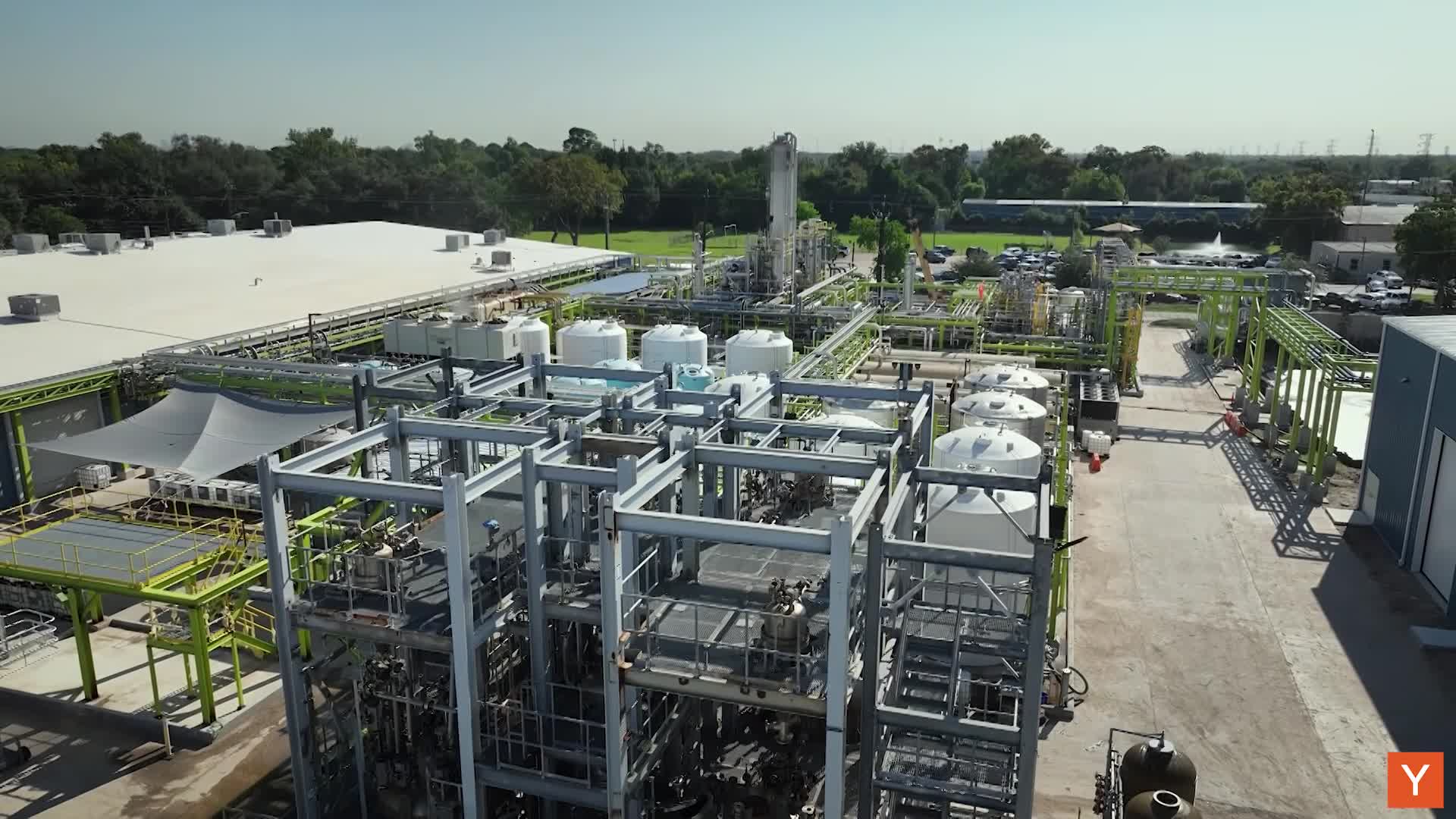
This reactor in Houston, Texas represents a whole new approach to chemical manufacturing.
We make chemicals in a completely new way.
We started off by making hydrogen peroxide.
Now we sell products for water treatment.
National defense infrastructure agriculture, you name it.
We make a chemical for it.
The story of Solugen is as scrappy as it gets.
It all started with this prototype, built out of PVC pipes the founders bought from Home Depot.
In its heyday, this did $12,000 a month in revenue.
Fast forward to now.
Solugen is a billion-dollar company shipping out tanker trucks of products that power critical US industries.
So how did they go from this single beaker of hydrogen peroxide to this full-scale manufacturing plant?
I visited Solugen HQ in Houston, Texas to find out.
What do you guys do here?
What is SolidGen?
We use biology to create chemicals that allow us to create smaller chemical plants and have a cleaner safer, more environmentally friendly footprint.
We've invented a process called chemienzymatic processing, where we take the specificity of biology by taking an enzyme and pairing it with a metal catalyst, which is what's traditionally used in industry.
What we've done with these is by marrying these two, you can actually create more efficient reactions.
So, instead of having a 60 yield, you can have 96 yield, which is what we have at scale, precisely because of these two catalysts.
Solugen is the first company to fuse biology and chemistry in this way, pulling enzymes from living cells, in this case corn syrup, and pairing them with novel metal catalysts.
The output is chemicals that can be used in everything from agriculture to skincare.
Traditionally, chemical plants relied on fossil fuel feedstock, which has led to all kinds of unintended consequences.
This new approach is cleaner, safer, and more efficient.
We receive rail cars of corn syrup, and then we run our utility system.
We change the parameters of the plant, the way that the enzymes are reacting, the way that the metal catalysts are reacting to oxidize the corn syrup how we want.
And then at the end, we evaporate water.
We take the final products, we store them in finished good tanks or we send them to a blend farm to get blended with other chemicals.
And that's the process.
Cyanogen started with a true eureka moment, the kind of freak invention that normally happens only in science fiction.
Sean was working in the chemicals industry and Gaurav was in medical school studying pancreatic cancer.
I was working on this like Skunk Works project to try to do direct hydrogen peroxide synthesis, where you react hydrogen and oxygen gas directly together over a metal catalyst.
And then you know I was working on this project and then Gore was like oh yeah no, like I found this like really crazy mechanism in pancreatic cancer where it's like locally 50 hydrogen peroxide concentration.
I was like, what?
That's wild.
It turned out that an obscure enzyme found in pancreatic cancer cells that Gorb was studying was the key to a new process for making industrial hydrogen peroxide.
So these pancreatic cancer cells, they put out peroxide.
Peroxide creates almost like an invisibility cloak around the pancreatic cancer that makes it difficult for immune cells to come in.
It was like, that's a very interesting discovery, but why?
And so once we asked the question why, we found out the reason was an enzyme.
It was just a mutated enzyme that's found only in pancreatic cancer.
And so that's when we said, what if the two worlds could collide, right?
What if enzymes and metal catalysts could coexist?
Here's how it works.
Cyanogen feeds corn syrup to the enzymes, the same ones from the pancreatic cancer cells, which transform it into new compounds.
They then use metal catalysts to further process those into the final chemicals that can be used to build all kinds of products we use in our everyday lives.
In most chemical plants, the feedstock comes from oil and gas, which inevitably produces toxic byproducts.
Solugen literally starts with sugar.
We have to suspend belief for a second.
People believe that anything to do with biology and chemicals, it's just a bad mix, because biology is too sensitive.
It's going to break down, blah, blah, blah, blah, blah.
But we said, let's suspend that criticism for a second and just look at the numbers.
And we say, if we can make the enzyme last this long on stream and the product is this concentration, we can make a lot of money.
And that's where we started.
This insight that organic enzymes could operate at industrial scale and efficiency was the company's first key breakthrough.
Today, Soligen operates both a biology and metals lab, where it produces its own enzymes and metal catalysts in-house.
These are actually enzymatic reactors.
So what we do?
We grow bugs, we break the bugs open, we take the enzymes and we put them in these reactors and we can stress them out and figure out what they're capable of doing at scale.
We have outfitted this with probably some of the best analytics that you can ever have for enzymes, which gives us a good insight into how things will scale.
Across from the biology lab is Salyugin's metals lab.
We just went to the enzyme lab.
Basically, now we pair that enzyme with the right metal.
And so you can basically mix and match which metal and which enzyme you want to pair together.
Their next big insight was a commercial one.
Previous startups that had tried to do something like this all started by raising a huge amount of funding and building a large-scale plant.
Sygen took a different approach.
They built their first reactor for just 10000 and then started selling to customers almost immediately.
Gradually, they scaled up to larger and larger plants.
So you did this techno-economic analysis.
And you're like, wait a second, this could actually work.
So May 2016, we got unofficial second place in the MIT 100K competition.
We lost.
We lost gloriously, but we got $10,000.
$10,000, that doesn't seem like very much money.
I think capital constraint forces very creative thinking.
Cause, like with 10 grand, like you have a very confined space of what you can afford to buy to try to make the product.
And so ours ended up being PVC, like a Walmart shelf.
You know, we couldn't even afford the metal catalyst parts.
It was just the enzyme portion.
This was the very first solugen reactor.
Yep, this is the first one complete with Schedule 80 PVC from Home Depot.
This is like a bubble column with a membrane.
So you sparge air in to the bottom.
Inside there's the liquid with the corn syrup and the enzyme and it's kind of spinning in a loop.
Then they're reacting, which makes the peroxide.
And then this is a membrane.
And so the membrane keeps the enzyme in the bubble column.
And then the permeate on the membrane is the peroxide product.
Armed with just their 10000 reactor but no customers.
Sean and Gorb applied and were accepted into YC, where they deferred a few months and set out to first try and sell the tiny volumes of peroxide they could make.
We made our first product in like September 2016.
We couldn't afford any controls, right?
So this is a total manual operation.
We'd come in in the morning.
We would try to get this reactor to a steady state.
And then I'd go to work.
He was, he'd go to the hospital.
He was in his last year of med school.
I was on surgery rotation.
On surgery rotation.
Wow.
Yeah.
36 hour shifts.
Good times.
And then in the evenings, go in and try to retune it to a steady state.
And then our first three customers were float spa hot tub owners in Dallas.
We discovered the supply chain dislocations because for these hot tub owners they were buying 3 peroxide in the brown bottle on the store.
That went through multiple distributors, multiple down packers, putting in little brown bottles, shipping it to the store.
Retail markup.
It's like oh, we only have 10 grand, but we're actually manufacturing the chemical and we're bypassing huge distribution value chains.
So on weekends we would pour the chemicals in people's hot tubs.
We looked at a bunch of markets to be like, what can we just like wedge ourselves into?
When we first accepted Soligen into YC, they had zero revenue, but they deferred by a batch and spent six months getting those first customers.
By the time they started at YC, they were gaining traction.
Typically, when people think about hard tech companies like you guys and YC, they're like that makes no sense.
What could you possibly accomplish for like a few hundred thousand dollars?
To most people it intuitively seems hilariously mismatched to the like costs and timelines of something like a new chemical plant.
This fundamentally goes back to the customer experience, which is what YC taught us to do, right?
For me it was like grad school for customers is how I look at YC, where it's like the second.
You have a PhD in your customer and you're an expert in their world.
Then you know exactly what you can and can't build.
It's that simple.
If you know this customer is not the right fit, that's okay.
Go to the next customer.
I remember the picture of the beaker because in your demo video, that's what it was.
Do you remember this?
The blue beaker and then we had the color change back and forth with the metal catalyst.
But I remember another thing about your application, which is Even though the only thing that you'd actually made was like one beaker full of this stuff, you had the idea completely worked out.
Like you totally understood the reason that this would work.
You'd worked out all the techno economics, like all the math was done.
The idea was fully flushed out.
I don't think the, like the core idea has changed one bit since the blue beaker phase.
Literally the same.
Yeah, it's just like a million times larger.
Yeah, it's just larger.
During YC, you guys are still driving around with like buckets of peroxide and selling them to spas.
You finish YC, you raise your $4 million seed round.
What happens then?
So we moved to where our customers were, which was Houston Texas, and we used the seed capital to build our first big pilot reactor, not just a PVC pipe reactor, but a proper 1500 gallon type reactor.
And then our first oil and gas field trial was January 2018.
And so we had billboards targeting this guy so we could go get our first oil and gas field trial.
Wait, you had billboards targeting one guy?
So what we did?
There was one guy at the saltwater disposal company who controlled all of the chemical spend.
What we figured out was where he frequents, like he actually goes to the field, where he goes and where he lives, or at least the neighborhood he lives in.
And we bought up the billboard and billboards are cheap along the highway that he commutes to work in, so that every day, as he's commuting to work, he's just seeing your billboards.
And then eventually he gets a call from us.
It's like a priming aspect of it that we knew this was the guy.
I was willing to spend 10 to 15K just to make sure that we can get in front of the guy.
And the second that he saw that and he got a call from us, he was like oh, I see your billboards everywhere.
And so that's when he felt special, right?
And this goes back to the customer experience.
Do you think the CEO of Dow would do that?
No, no way.
They were not going to do that.
Soon Sygen had signed enough customers that they were able to raise money again and build their first state-of-the-art plant, the BioForge One.
So this is BioForce.
Everything you're looking at here was built in five locations simultaneously and then shipped here on trucks.
We rented a crane for four months and just stacked it up like Legos.
So all of the tan tanks are filled with corn syrup.
That's our raw material.
We were able to hold four rail cars of corn syrup at any one time, which is about 800,000 pounds.
So it's like 800,000 pounds of corn syrup in these four large tan tanks.
That's the starting material for the whole plant.
That's the starting material for the whole plant.
And then the plant runs continuously 24-7.
So this is the full-scale version of the PVC reactor.
Is this the bubble column?
This is the bubble column.
It's so tall.
60 feet tall.
It's identical to the PVC reactor from Y Combinator.
It's just 10,000 gallons instead of 7 gallons.
We sparge air in the bottom.
Corn syrup and enzyme go in the top and the two react together.
All the other stuff is necessary, but like this piece is the magical piece, right?
This is the reactor that makes it happen.
Yep.
We feed in one Coke bottle of enzyme and you get two to four tanker trucks of product.
That's how efficient the enzyme is.
Wow.
After filling up the tanks, SolidGen loads up trucks to distribute the chemicals to nearby customers.
So this is the end of the line.
This is where customers pull up either with their own trucks or SolidGen supplies trucks and does all the logistics for them.
And we're able to fill up trucks at about 300 gallons per minute.
Building out lots of factories near customers to keep shipping costs down is a key part of how Sygen has managed to undercut its larger competitors.
What has it been like to build new physical stuff in America?
It is definitely challenging, but if you're in a part of the country that wants to have manufacturing back that's favorable to manufacturing, it is absolutely possible to build in America.
What does Cyogen look like in 10 more years?
It's actually going to be multiple different assets.
So we're actually like we've taken enzymes and metal catalysts and applied them to not just bioforges but other types of manufacturing assets that combine them.
And we'll be solving the most fascinating customer problems that, like right now, like we're not even aware of them, the problems that we're going to solve, they won't exist yet.
And so it's like just creating a culture that's willing to be wrong and solve those problems is actually what's most important right now.