Here is a riddle for you.
Can you think of a product that's illegal but so widely available that you could probably get it at any local gas station or corner store?
I'll give you a second.
If you said marijuana, first of all, what kind of gas stations do you have in your neighborhood?
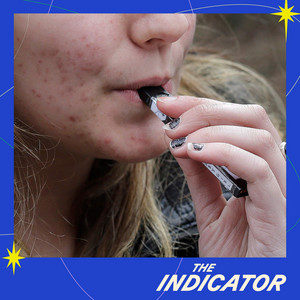
And second, the answer we are looking for is vapes, also known as e-cigarettes or e-vaporizers.
Each year, somewhere between 14 and 25 billion worth of these pocket-sized nicotine delivery devices are sold in the US.
And yet, according to the Altria Group, which has become one of the big players in this space, more than 60 of vapes sold last year were illegal under federal law.
This is The Indicator from Planet Money.
I'm Adrian Ma.
So how is this illegal market thriving right now, right under the nose of regulators, and what's being done about it?
Today on the show, journalist Nick Florco joins us to explain.
Nick writes for The Atlantic, where he reports on the ways business and policy affect public health.
And after the break, he'll help us clear some of the haze around the business of vapes.
This message comes from ServiceNow.
People should do the creative work they actually want to do, not boring busy work.
Now, with AI agents built into the ServiceNow platform, you can automate millions of repetitive tasks in every corner of your business IT, HR and more.
So your people can focus on the work that they want to do.
That's putting AI agents to work for people.
It's your turn.
Get started at servicenow.com slash AI dash agents.
According to the Centers for Disease Control and Prevention, about one out of every five deaths in the US each year are caused by cigarette smoking or secondhand smoke exposure.
So it makes sense that many health experts would consider nicotine vaping a less harmful habit than smoking.
But when I spoke with journalist Nick Florco recently on NPR's Weekend Edition, he said vaping is definitely not without its risks.
The reality is, I mean, when somebody's vaping, they're taking in chemicals into their lungs.
This is not something that we should be thinking about lightly.
And the companies that are actually authorized.
They're submitting this data to the FDA to make sure that their products aren't extremely dangerous.
There aren't heavy metals leaching into these liquids, etc.
And the products that are coming in from China are largely unregulated.
We don't know how these products are being made.
We don't know what is in them.
And a lot of the times they are being marketed to kids.
I mean, we're seeing kid-friendly flavors.
We're even seeing, you know, vapes that have little video games on them now.
Now, I got to admit that when I first heard Nick say this, I didn't quite believe it.
But a quick search online.
This is the first vape-tainment system.
It is a disposable vape where you can actually play games on.
Confirmed that it is indeed a thing.
Bruh.
This is so funny.
Products like these are not legal for sale in the U.S.
And Nick went on to explain why.
So the FDA is tasked with deciding what vapes can actually be authorized.
That's the official term.
And they use this standard called the Appropriate for the Protection of Public Health Standard.
I won't get into what that actually means, but essentially the FDA has to go through all of this data that are submitted by companies making a case for why the market needs this product and why it's not going to hurt kids.
And so...
A few companies have gotten that authorization.
Most recently, Juul just got their authorization to sell their products legally.
But most of these products that we see on store shelves haven't gotten that authorization.
We've seen the FDA shoot down millions of applications, actually.
And yet, despite those FDA regulations, President Trump's own stance on vaping seems to be a little muddled.
Like right before the election, he bragged on social media.
That he quote saved flavored vaping during his first administration.
And then he promised to save vaping again.
So what was that all about?
Yeah.
So in 2019, at the height of the youth vaping epidemic, the Trump administration actually announced that it was planning to ban all flavored vapes.
So data was consistently showing the kids overwhelmingly were attracted to these flavored products.
And so the thought was they needed to be completely rid of the market.
This was something that President Trump supposedly supported.
But then he ended up subsequently backtracking on it in the last minute for fear of political backlash.
And so when he says that he saved flavored vaping, what essentially he's saying is that he backed away from a policy that he once supported.
So a few weeks ago there's this industry group called the Vapor Technology Association and they say they dropped a million dollars on advertising aimed at President Trump.
President Trump target the Chinese companies making illicit vapes aimed at our kids.
But please keep the U.S. market open for American small businesses to thrive.
What are they trying to accomplish with this?
Yeah, it's really interesting.
So essentially they're lobbying for the FDA to be more hands-off to let more of their companies sell their products legally in this country.
But it's a really, really interesting needle that they're trying to thread here, because essentially you know they're saying yes, the FDA should be going after certain vapes that come from China that are targeted towards kids, but not our vapes.
Those people might be selling.
They're selling their products illegally too, but they're saying hey, we're different.
We're responsible.
You need to take a more surgical approach towards policing this market and not just pull all of these vapes off the shelves, because that's going to put our responsible small businesses at risk.
Okay, so how receptive is Trump to the vape industry's lobbying?
So there is reporting that he has met with the vaping industry.
He's clearly heard them talking about that industry.
And I think there's really two pieces that would lend his support.
So the first is that, you know, this is a business issue.
A lot of vape shops are small businesses.
There's this idea that we shouldn't shut down these businesses just because we might not agree with everything that they're selling.
And the other point though, that I think is really worth focusing on is this question of whether vapes can help adults quit smoking.
And so the Vapor Technology Association essentially says hey, we are not here to sell products to kids, to get kids hooked.
Actually, we're making adult-friendly products.
And even the FDA says if you switch from a cigarette to a vape, you actually could improve your health.
And so we should celebrate that.
Can you say more about how Trump's FDA is approaching vaping regulations?
So thus far, it really has been status quo from the Biden administration.
So over the past several years, the FDA has really, really struggled to regulate the vaping market.
So nearly every vape that you see on a shelf if you go to a convenience store or a.
The FDA has really, really struggled to police that market.
And so during the Trump administration, we've essentially seen the same things.
We're seeing enforcement actions of trying to pull these vapes off of shelves, but it really not making much of an impact.
And so this industry remains in this sort of gray area, where their products are very ubiquitous but technically are illegal.
Of course, a lot of people who want to see more regulations on the business.
Those people are concerned about the public health effects of vaping right.
For instance, the fact that it's addictive.
And I think that worry especially applies to younger people.
I wonder, is that as much of a concern now as it was compared to say, the first Trump administration?
Or have young people kind of moved on from vaping to things like nicotine pouches?
So it is still definitely a concern.
I mean, we should never be talking about vaping without talking about the impact on kids.
And most major public health groups still think the FDA should be taking a really stringent position here.
But the data do suggest actually that kids' vaping rates have dramatically dropped, which is a good thing.
So in 2019, we were seeing roughly a quarter of middle and high schoolers reported currently vaping.
That is now in the single digits.
Less than 6% of young people now actually report regularly vaping.
So we are seeing some change here and gradually we're seeing some folks change their tune in saying okay, if the youth vaping crisis has abated, if we figured out how to keep kids away from these products, what role do vapes now have in our society?
Can they have some sort of positive effect?
Should they be available to adults now that we have gotten the kid issue under control?
I mean.
I wonder, though do you feel like, if the regulations move the way the industry wants them to, is there a worry that the trend of declining youth vaping could actually backslide?
Yeah, absolutely.
And there's a real concern about these vapes that are there coming in. and being sold illegally.
I mean, the problem definitely isn't over, even though we're seeing the numbers get better.
And I think that's what public health groups are saying.
They're like, we can't take our foot off the gas here.
Yes, it's improving, but that doesn't mean we just give up and go pro-full vaping all of a sudden.
So to summarize, vapes are ubiquitous and mostly illegal.
They're addictive and potentially harmful to your health, but probably less so than smoking.
And if this all leaves you still feeling a little hazy on the public health value of vaping, one thing you can be sure of is that for the companies who make and sell vapes, even if they're illicit, it'll continue to be a pretty healthy business.
This episode was produced by Cooper Katz McKim with engineering by Jimmy Keeley.
It was fact checked by Sierra Juarez.
Patty Hirsch edited this episode.
Cake and Cannon is our editor and the indicators of production of NPR.