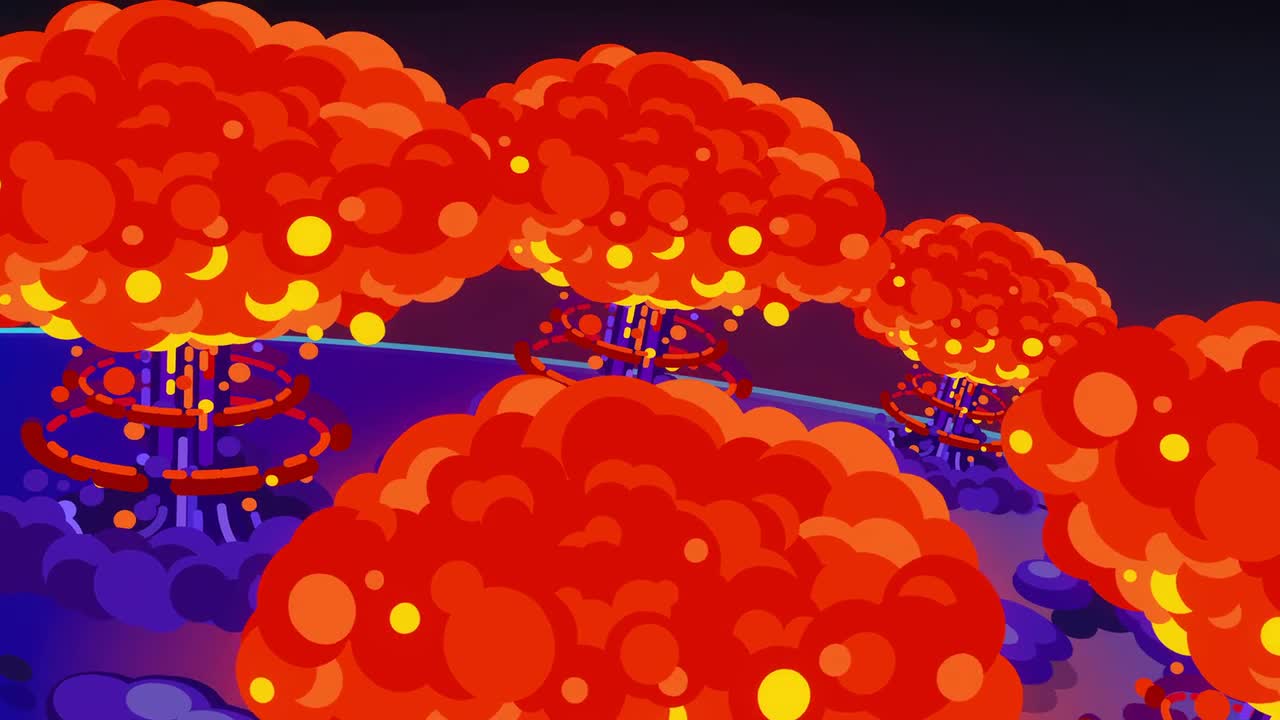
In the 1960s, the US planned to nuke Israel with hundreds of thermonuclear bombs.
And Panama.
And Alaska.
All in the name of progress driven by a mad scientist to use the most destructive of weapons to build things excavate canals, carve out harbors, tap oil and gas.
This was Project Plowshare.
It kept the US busy for two decades, burned hundreds of millions of dollars and exploded dozens of nukes for a bright future.
In the most feverish years of the Cold War, when the world got terrifyingly close to blowing itself up nukes for peace.
Our story begins with the brilliant hungarian physicist edward teller, one of the key scientists of the manhattan project, the colossal effort that led to the first nuclear bomb.
But almost from the beginning he dreamt of destroying the world much harder.
Traditional nukes like the Hiroshima and Nagasaki ones release energy by splitting heavy atoms like uranium.
But these are rare, expensive, and the resulting bombs are difficult to scale up.
So Teller lobbied for a different approach unleash the nuclear fire by smashing together hydrogen atoms.
That would allow for bombs thousands of times more powerful.
The problem was technically hard, but in the 1950s, Teller solved it.
The terrifying new thermonuclear bomb made Hiroshima and Nagasaki look like firecrackers.
Nuclear fire strong enough to end human civilization itself.
The Soviet Union followed quickly and a new madness for destruction took over the world.
Teller was having the time of his life as he got to chase his nukiest dreams, like a bomb so powerful that it would wipe out civilization in one single strike.
A real thing the US actually started working on.
We've told this story before if you want to watch it.
And, as the perfectly sane man he was, Teller had other great ideas, like nuking the moon to show the commies who's boss.
And if H-bombs could destroy the planet, maybe they could also reshape it.
The logic wasn't entirely unhinged.
Humans had been using explosives for mining and engineering for centuries, and H-bombs offered the same service with much more enthusiasm, at a decent cost.
Why not use them to dig dishes and make holes at a planetary scale?
The idea of nukes for peace was also pretty convenient.
With public opinion increasingly opposed to the arms race and ever more terrified by World War III, nuclear engineering was a way to keep on testing nuclear weapons without saying you were testing nuclear weapons.
So in 1957 the US launched Project Plowshare, a bold plan to use nuclear explosions for peaceful engineering.
And who would be put at the helm?
Exactly.
Cutting through continents.
In 1956, Egypt had just nationalized the Suez Canal, a vital artery for global trade and oil delivery to Europe.
So one of the first ideas of the new build-with-nukes doctrine was to blast open a new one through the Israeli desert.
On the other side of the world, the Panama Canal had long been in need of an upgrade.
Scientists explored extension routes and found they would need to remove 12 billion cubic meters of earth, 500 Great Pyramids of Giza.
A monumental task that would cost 6 billion dollars if done with shovels, but only 31 billion with nukes.
Time to blast open a panatomic canal.
But even Teller understood that before nuking through continents, you should start small.
So the first miracle of Project Plowshare would be a new harbor in Alaska.
In just a few glorious milliseconds, five nukes with the combined punch of 170 Hiroshima bombs would carve out a 500 by 200 meter trench, opening the region to commerce and prosperity.
The local communities weren't thrilled at the idea, but Teller insisted that the dangers of nuke engineering had been greatly exaggerated.
The major concern was radioactive contamination.
Hmm, canals and harbors were great, but nobody wanted them glowing with radioactivity for thousands of years.
Luckily, Teller had a plan, nuking the land from below.
In a nutshell, nuclear excavation works like this.
You drill a hole a few hundred meters deep and place the bomb at the bottom.
When it goes off, the blast hollows out a cavern in the rock and flesh melts its walls into magma.
The molten rock pools at the bottom, the ceiling collapses and the collapse ripples upwards until it reaches the floor, where it forms a crater.
The result is a massive hole on top, with the radioactive debris sealed under hundreds of thousands of tons of rock.
With the theory looking flawless on paper, the time had come to actually test it.
But before the government bombs anything, let's get some propaganda protection, just in case.
Our partner Ground News is a website and app built to help you think critically about the information you consume.
A mission we fully support.
They curate news articles from across the globe, adding context on political bias reliability, ownership and summaries that highlight what each side is leaving out.
You can even compare headlines to see how bias shapes the narrative.
Take this story about Finland planning to lift its ban on nuclear weapons.
Some frame it as a prudent response to the state of the world, while others warn of escalation.
Ground News also reveals blind spots, stories that only one side is covering, showing you what your usual news feed is hiding.
As information bubbles are becoming the norm, thinking critically about the news is no longer optional.
And Ground News makes it easier to do just that.
If you'd like to give them a try, go to ground.news.nutshell or scan the QR code on the screen.
Using this link gives you 40 off, an unlimited access subscription and directly supports our channel.
And now, back to nuking for peace.
The fiasco begins.
Plowshare debuted in 1961 in the desert of New Mexico.
A nuke with the power of 3100 tons of TNT was buried 360 meters deep in the heart of a salt deposit.
The goal was to explore a new idea to generate electricity.
The explosion would melt the deposit into a pond of red-hot liquid salt, whose heat could be pumped up to power turbines, a hybrid of fusion and geothermal power brought to you by H-bombs.
Above ground, hundreds of officials, scientists and international guests had gathered to witness the birth of a new era.
Everyone held their breath as the countdown ticked.
And then, with a distant thud, the ground shuddered.
Deep below, the explosion hollowed a cavern the size of over 10 Olympic swimming pools.
But Teller's team had missed a tiny detail.
The salt contained far more water than expected, which turned into superheated steam that massively amplified the blast.
The hole used to lower the bomb had been designed to collapse and seal itself after the explosion, but the unexpectedly monstrous pressure broke through.
So, a few minutes after the blast, a plume of radioactive steam erupted from the shaft, damaging cameras and instruments and bathing everyone in a strangely itchy sauna.
The US government tried their best to convince everyone that things hadn't been that bad.
But for some reason the masses had a problem with clouds of radioactive fallout even from peaceful nukes.
But that wouldn't discourage Teller.
So to show the world how cool H-bombs could really be, he scheduled another test, one 30 times more peaceful.
In July 1962, while Cuban officials were visiting Moscow to negotiate a missile deal that would almost spark World War III.
Three months later, a thermonuclear bomb worth seven Hiroshima nukes exploded 200 meters underground in the Nevada desert.
This time, the goal was to test nuclear excavation itself and check how big the crater could get.
The blast displaced 12 million tons of soil and hollowed out a gargantuan crater 100 meters deep and 400 meters across the largest artificial crater in US history.
But digging with nukes is tricky.
Bury the bomb too deep and you'll only get a disappointing dent.
Bury it too shallow and you risk launching a radioactive cloud into the sky.
Which was exactly what happened.
Someone had miscalculated the depth of the explosion and a plume of radioactivity punched through.
Fallout was detected as far as South Dakota and Illinois and panic broke out in Utah when radioactive iodine was found in milk.
It turned into one of the dirtiest tests on US soil ever.
Just one more nuke, bro.
The years that followed saw more peaceful explosions and peaceful fallout.
Meanwhile, Tenner's proposals got weirder.
Liquify tar sands in Canada with nukes.
Blast a highway through the Sierra Nevada with nukes.
Connect rivers in Mississippi with nukes.
But the crown jewel of nuclear dreams was still the Panatomic Canal.
A legion of scientists worked on it, and plans got disturbingly far.
One of the top contenders was Route 17, an 80 km trench across pristine Panamanian jungle.
That was short flat, pretty empty and perfectly nukeable.
250 bombs with the power of 8,000 Hiroshima's would do the job.
43,000 people across 17,000 square kilometers would still have to be evacuated.
You know, just in case.
And shockwaves might shatter windows as far as Costa Rica and Colombia.
But what were such details in the grand scheme of progress?
So let's rewind history and press the button to see what might have happened if Teller had got his way.
Ready to push the button?
Three, two, one.
Boom.
The first round of nuclear salvos close to both coasts obliterates hundreds of square kilometers of pristine rainforest in seconds.
A roaring success.
Unfortunately, a cloud of fallout catches the Pacific winds.
Weeks later, spikes of radiation are found over the Caribbean and radioactive iodine, cesium and strontium start to enter the food chains of both oceans.
Tuna and sharks become radioactive.
One option would be to stop, but to have a radioactive scar across the jungle.
Contamination of two oceans and no canal better push through.
So a second round of blasts goes off in the central Chukanaki river valley, only to find that the central part of the isthmus had far more clay than expected.
As soon as the rainy season hits, landslides clog the new craters like a self-healing wound.
The choice is leave a mud-choked, glowing blister through the rainforest or begin a colossal engineering nightmare just to keep the jungle from landsliding onto the canal.
Not to mention the ecological apocalypse and the devastating PR victory that 120 megatons of nuclear peace over Latin America would give Cuba and the USSR.
Luckily, in our timeline, the US blinked and began to sober up.
In 1970, a final report killed the Panatomic Canal, and with it, all nuclear excavation projects.
But Teller wasn't ready to let go, so he turned to nuclear fracking.
Not because it made sense, but to keep Plowshare alive.
Just one more nuke, and I'll build the future, bro.
But several explosions later, the result was ultra-expensive, radioactive gas impossible to sell.
In 1977, after 20 years and dozens of nukes across the US, Project Plowshare was finally cancelled without reaching any of its goals.
No canal, harbor or tunnel had been built.
In hindsight, it's easy to see how insane the idea was.
But at a time when World War III felt imminent, when kids were playing with atomic toys as mushroom clouds filled the sky, using nukes to build a better future probably did feel like a great idea.
On our new channel, Night Shift, we're telling dark and novel stories from history that you might never have heard before and that might stay with you, like the greatest pirate, the horrible life of past kings or the bloody war that led to the number zero.
Same Kurzgesagt, different vibe.
New style, hand-drawn, and made with love by real birds.
We've released over an hour of videos already, and the next one, about the struggle for power over the biggest drug cartel ever, is coming out tomorrow at 4pm CET.
Head over there now to subscribe and watch the other videos for history like you haven't seen it on YouTube before.
You want to listen to the beautiful soundtrack without my annoying voice?
Well, it's up to you.
Just select the audio track Interlingua down here and watch the video again as a music video.