Look at how long my arms are.
That's amazing.
How you doing?
Are you having a great day practicing English speaking?
All right, let's look at some more inner dialogue sentences.
Part 404, last one.
If you did all the three before this, you are a champion.
Anyways.
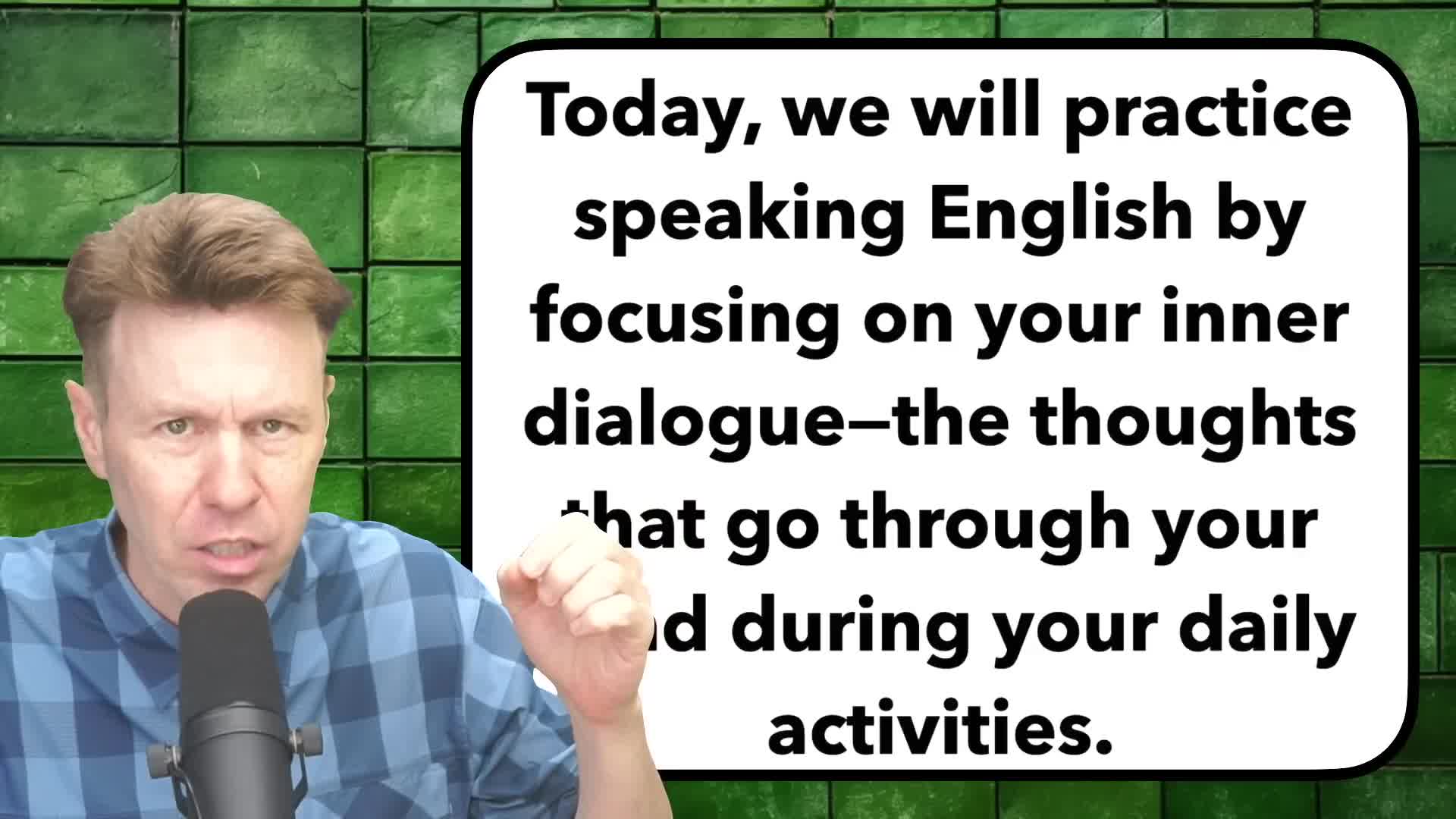
Like we've said before, today we'll practice speaking English by focusing on your inner dialogue.
Inner dialogue is your thinking in your brain.
Self-talk.
Talking to yourself.
That's better.
Talking to yourself.
The thoughts that go through your mind during your daily activities.
All right.
Couldn't come up with the right words there.
This is the last part of this four-part series.
Let's jump right into it.
Pick up groceries on the way home.
Pick up groceries on the way home.
Don't forget.
Pick those groceries up on the way home.
So you're reminding yourself in your head, pick up groceries on the way home.
Or, I must remember to pick up groceries on my way home from work tonight.
I must remember to pick up groceries on my way home from work tonight.
I must remember to pick up groceries on my way home from work tonight.
I must remember to pick up groceries on my way home from work tonight.
Is that too fast?
Let me try and say it at my natural pace.
I must remember to pick up groceries on my way home from work tonight.
That's my natural pace.
It's pretty fast, huh?
I must remember to pick up groceries on my way home from work tonight.
See if you can say it fast.
Say it.
Was it good?
I hope you did it good.
All right.
I did my best.
That's all I can do.
That's what you were probably thinking.
I did my best.
That's all I can do.
I did my best.
That's all I can do.
I did my best.
That's all I can do.
Honestly, I did my best I could under the circumstances, and sometimes that just has to be enough.
And sometimes that just has to be enough.
Yeah, honestly, I did the best I could under the circumstances.
And sometimes that just has to be enough.
Again, honestly, I did my best.
I oops.
I messed up.
I'm sorry.
Honestly, I tried my best, but I did my best, but it wasn't my best.
Let's do my best.
Ready?
Here we go.
Honestly, I did the best I could under the circumstances, and sometimes that just has to be enough.
All right, we got it.
Let's do it again.
Honestly, I did the best I could under the circumstances, and sometimes that just has to be enough.
Ooh, let's nail it.
Let's nail it.
Ready?
Here we go.
Honestly, I did the best I could under the circumstances, and sometimes that just has to be enough.
Right?
One step at a time.
One step at a time.
I always say this, right?
One step at a time.
You don't have to do everything at once.
Just take it one step at a time.
Yes, yes.
Again, you don't have to do everything at once.
Just take it one step at a time.
Everything will work out.
Maybe you're stressed.
Don't worry, don't worry.
Everything will work out.
Everything will work out in the end.
In the end, everything will be fine.
Everything will work out.
Even if things seem complicated now, I have to trust that everything will eventually work out for the best.
Again, I have to trust that everything will eventually work out for the best.
Final time.
Even if things seem complicated now, I have to trust that everything will eventually work out for the best.
Yes.
I've come a long way this year.
Yes, I have.
I have come a long way this year.
I have achieved many things.
I have come a long way this year.
When I think about it, I've actually come a long way this year, and I can feel proud of that.
Yes, I can.
I can feel proud about what I have accomplished so far this year.
Ready?
When I think about it, I've actually come a long way this year, and I can feel proud of that.
Again, when I think about it, I've actually come a long way this year and I can feel proud of that.
One more.
When I think about it, I've actually come a long way this year and I can feel proud of that.
Did I say something wrong?
Oh no.
Did I?
Did I say something wrong?
I keep replaying my conversation and wondering if I said something wrong.
I keep replaying my conversation and wondering if I said something wrong.
I keep replaying my conversation and wondering if I said something wrong.
I keep replaying my conversation and wondering if I said something wrong.
I need to get more exercise.
This is so true.
I need to get more exercise.
I'm out of shape.
I really need to find ways to get more exercise.
Even a short walk each day would be a good start.
Yeah.
Even a short walk each day would...
Be a good start.
Let's do this.
Here we go.
I really do need to find ways to get more exercise.
Even a short walk each day would be a good start.
Again.
I really do need to find ways to get more exercise.
Even a short walk each day would be a good start.
One more time?
Okay.
Okay.
I really do need to find ways to get more exercise.
Even a short walk each day would be a good start.
I'm proud of myself for handling that well.
I did a good job.
I'm proud of myself.
I handled that well.
Alright, I'm proud of myself for handling that well.
And in the place of that, you could say I'm proud of myself for handling that situation, handling my speech.
Well, I don't know.
Anything can go right there.
Let's see what this says.
You know, I am genuinely proud of myself for the way I handled that situation.
It wasn't easy, but I managed it well.
It wasn't easy, but I managed it.
Managed it well, managed it well, managed it well.
You know, I am genuinely proud of myself for the way I handled that situation.
It wasn't easy, but I managed it well.
All right, say it like that.
Ready?
You know, I am genuinely proud of the way Genuinely proud of myself for the way I jumped ahead.
I wasn't even reading it right now.
I was just saying it from memory almost, and my memory failed me.
Okay, let's try again.
You know, I am genuinely proud of myself for the way I handled that situation.
It wasn't easy, but I managed it well.
You know I am genuinely proud of myself for the way I handled that situation.
It wasn't easy but I managed it well.
I think we should do it one more time.
Ready?
Here we go.
You know I am genuinely proud of myself for the way I handled that situation.
It wasn't easy but I managed it well.
Yes.
Good job.
Way to go.
All right.
Having some fun with it, right?
Let's go nonstop from the top to the end.
Go ahead and read along with me or shadow me if you can.
Here we go.
Pick up groceries on the way home.
I must remember to pick up groceries on my way home from work tonight.
I did my best.
That's all I can do.
Honestly, I did the best I could under the circumstances and sometimes that just has to be enough.
One step at a time.
You don't have to do everything at once.
Just take it one step at a time.
Everything will work out.
Even if things seem complicated now, I have to trust that everything will eventually work out for the best.
I've come a long way this year.
When I think about it, I've actually come a long way this year, and I can feel proud of that.
Did I say something wrong?
I keep replaying my conversation and wondering if I said something wrong.
I need to get more exercise.
I really do need to find ways to get more exercise.
Even a short walk each day would be a good start.
I'm proud of myself for handling that well.
You know, I am genuinely proud of myself for the way I handled that situation.
It wasn't easy, but I managed it well.
Boom.
You did it.
Good workout.
Keep moving forward one step at a time.
And I'll see you in the next video.