Oh, how you doing?
I'm just sitting here all by myself, thinking about things, having some inner dialogue running, some ideas in my head.
All right.
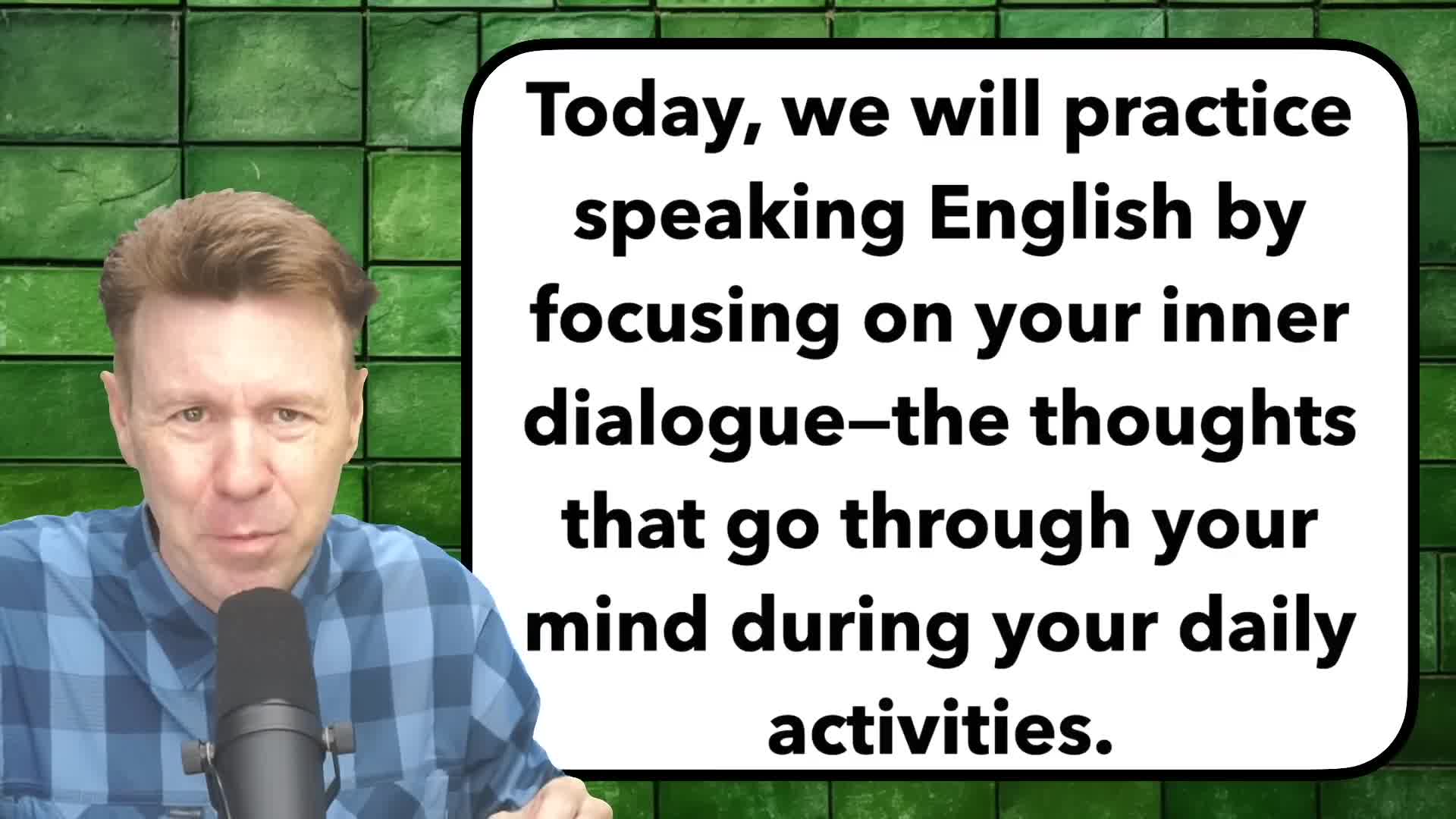
So today we will practice speaking English by focusing on your inner dialogue, thinking to yourself, right?
The thoughts that go through your mind. during your daily activities.
All right, let's try this.
Repeat after me.
Oh wait, today is part two of this four-part series.
You don't need to repeat after me on this.
I forgot that this slide was going to tell you that.
Now, here we go.
Am I doing enough at work?
I don't know if I'm doing enough.
Am I doing enough at work?
My boss might think I'm lazy.
I hope I'm doing enough.
I sometimes wonder if I'm really doing enough at work or if I should be pushing myself more.
I sometimes wonder if I'm really doing enough at work or if I should be pushing myself more.
Pushing myself.
So if you push yourself, you try harder, right?
Or if I should be trying harder.
I sometimes wonder if I'm really doing enough at work or if I should be pushing myself.
I sometimes wonder if I'm really doing enough at work or if I should be pushing myself more.
Are you pushing yourself more?
All right, okay, let's focus and get this finished.
We are so unfocused.
Let's focus and get this finished.
That's what I tell myself a lot.
Let's focus and get this finished, okay?
What are you doing, Chad?
All right, time to put away the distractions and focus so I can finish this.
Let's just do one thing at a time.
All right, time to put away the distractions and focus so I can finish this.
Let's just do one thing at a time.
Again.
All right.
Time to put away the distractions and focus so I can finish this.
Let's just do one thing at a time.
Shall we do it one more time?
Okay.
Deep breath.
Here we go.
All right.
Time to put away the distractions and focus so I can finish this.
Let's just do one thing at a time.
Good job.
I'm glad I tried, even if it didn't go perfectly.
It didn't go perfectly, but I'm glad I tried.
I'm glad I tried, even if it didn't go perfectly.
I'm glad I tried, even if it didn't go perfectly.
Did you try?
Did it go perfectly?
Well, if it didn't go perfectly, that's okay.
I'm glad you tried, even if it didn't go perfectly.
All right, longer version.
I'm glad I at least tried, even if things didn't go perfectly.
That last one didn't go very perfectly at all.
Okay, I'm going to say it real slow and clear.
Here we go.
I'm glad I at least tried, even if things didn't go perfectly.
What could I do differently next time?
What could I do differently next time?
What could I do differently next time?
Maybe next time I should try a different approach to see if it works better.
Maybe next time I should try a different approach to see if it works better.
Maybe next time I should try a different approach to see if it works better.
What's for dinner tonight?
I'm hungry.
What am I going to eat?
What am I going to make for dinner tonight?
What am I going to make for dinner tonight?
I wonder what I should make for dinner tonight.
Should I cook something or just pick up takeout on my way home?
I wonder what I should make for dinner tonight.
Should I cook something or just pick up takeout on my way home?
Or just pick up takeout.
You might say, or just pick something up on my way home.
Or just pick something up.
Or just pick up takeout.
Takeout is, you know, the takeout, buy it and take it out.
All right, I'm going to say it again two times nonstop.
Here we go.
I wonder what I should make for dinner tonight.
Should I cook something or just pick up takeout on my way home?
Again.
I wonder what I should make for dinner tonight.
Should I cook something or just pick up takeout on my way home?
I have a meeting at 3 p.m.
Don't forget.
I have a meeting at 3 p.m.
I have a meeting scheduled at 3 p.m., so I need to make sure I'm prepared for it.
Scheduled.
The meeting is scheduled at 3 p.m.
How do British say it?
They say scheduled.
Scheduled.
I don't like that.
Scheduled.
It's much better.
All right.
I need to respond to that email.
I need to respond to that email.
I need to respond to that email.
It's been waiting in my email box for two days now.
I need to respond to it.
I should remember to respond to that email as soon as I get the chance.
All right.
Let's do that better.
Here we go.
I should remember to respond to that email as soon as I get the chance.
I should remember to respond to that email as soon as I get the chance.
Last one.
I should remember to respond to that email as soon as I get the chance.
All right.
I hope I'm not forgetting anything important.
I hope I'm not forgetting anything important, you say.
I sure hope I'm not forgetting anything important.
That's a lot of text.
All right, here we go.
I just have a feeling that I might be forgetting something important today.
Maybe I should check my calendar again.
Maybe I should check my to-do list again.
I just have a feeling that I might be forgetting something important today.
Maybe I should check my calendar again.
I just have a feeling that I might be forgetting something important today.
Maybe I should check my calendar again.
All right, that's good.
I think that was enough.
What do you say we do all of those nonstop?
Say it with me or just read along.
Shadow me.
Here we go.
Am I doing enough at work?
I sometimes wonder if I'm really doing enough at work or if I should be pushing myself more.
Okay, let's focus and get this finished.
Alright, time to put away the distractions and focus so I can finish this.
Let's just do one thing at a time.
I'm glad I tried, even if it didn't go perfectly.
I'm glad I at least tried even if things didn't go perfectly.
What could I do differently next time?
Maybe next time I should try a different approach to see if it works better.
What's for dinner tonight?
I wonder what I should make for dinner tonight.
Should I cook something or just pick up takeout on my way home?
I have a meeting at 3 p.m.
I have a meeting scheduled at 3 p.m., so I need to make sure I'm prepared for it.
I need to respond to that email.
I should remember to respond to that email as soon as I get the chance.
I hope I'm not forgetting anything important.
I just have a feeling that I might be forgetting something important today.
Maybe I should check my calendar again.
Boom.
Good workout.
We did it.
Keep moving forward.
One step at a time.
Keep practicing.
Even if it's not perfect.
You don't have to do it perfectly.
You just have to keep going.
And I'll see you in the next step.