Inner dialogue.
What's inner dialogue?
We'll talk about this in today's English speaking practice.
I wake up every morning and make an English lesson for you.
Yeah.
All right, let's jump into it.
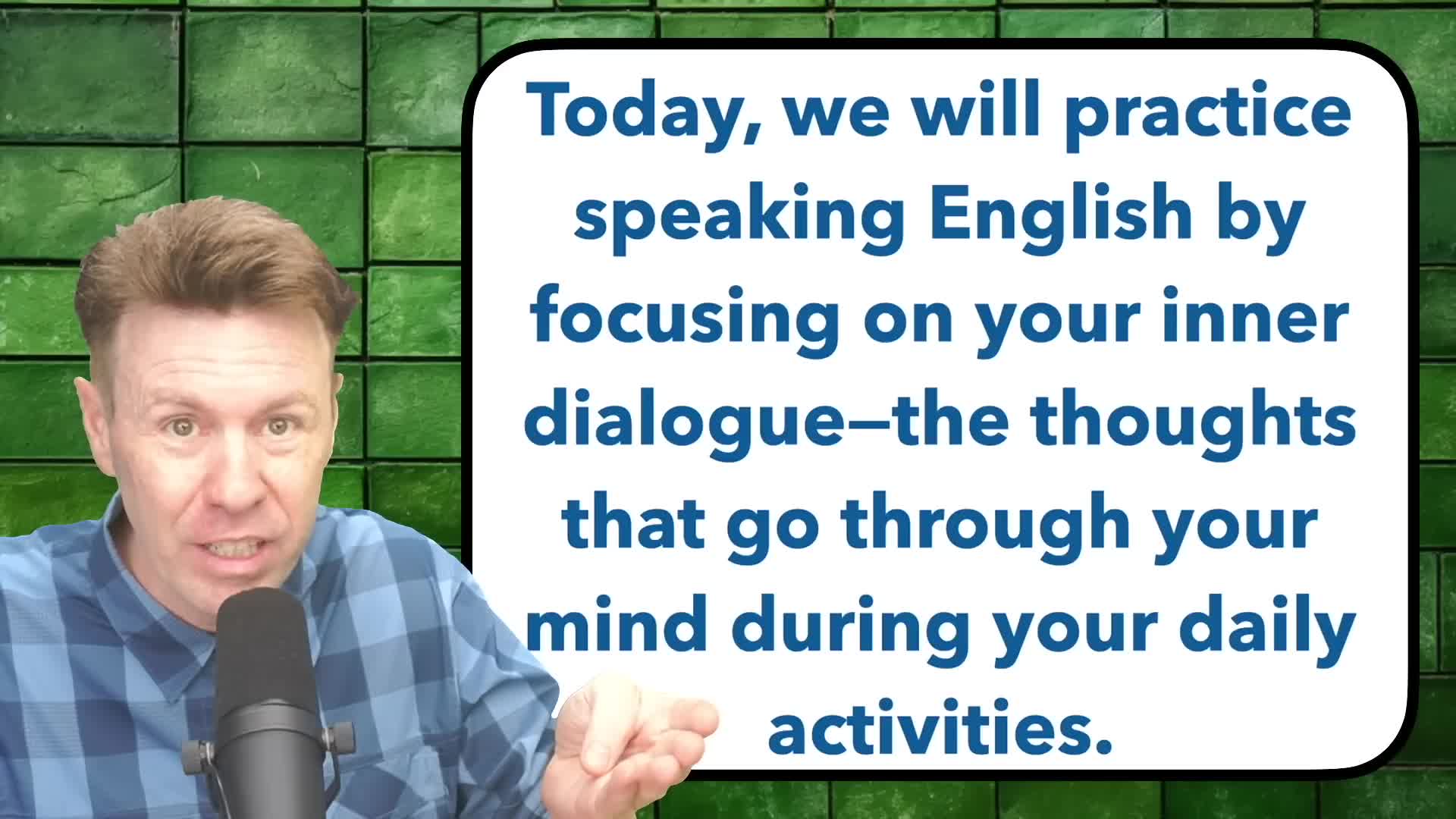
Today we will practice speaking English by focusing on your inner dialogue, the thoughts that go through your mind during your daily activities.
Your inner dialogue, that's just the thoughts that go through your head.
You talk to yourself.
You talk to yourself, inner dialogue.
So this will be a four-part series, and today will be part one.
Let's practice speaking English.
Did I lock the door when I left?
Did I lock the door when I left?
This is something you might say to yourself, right?
Did I lock the door when I left?
Okay, here's a longer version of it.
Wait, did I actually lock the door before I left the house this morning?
Maybe I should double check next time just to be sure.
I'm going to say it again.
Wait, did I actually lock the door before I left the house this morning?
Maybe I should double check next time just to be sure.
Wait, did I actually lock the door before I left the house this morning?
Maybe I should double check next time just to be sure.
One more time.
Wait, did I actually lock the door before I left the house this morning?
Maybe I should double check next time just to be sure.
You've got this.
All right.
You're reassuring yourself.
You're a little concerned.
You're anxious.
And you tell yourself, you've got this.
You can do it.
You can do it.
Or you've got this.
You've got this, Chad.
You know you can do it.
Don't worry.
Just deal with things one at a time and trust yourself.
You've got this.
Don't worry.
Just deal with things one at a time and trust yourself.
You've got this.
Don't worry.
Just deal with things one at a time and trust yourself.
You've got this.
You've got this.
You can do it, Chad.
I know you can do this.
All right.
Set an alarm for tomorrow.
Don't forget.
You've got to.
Got to do it.
You got to set an alarm for tomorrow.
I need to set an alarm before I go to bed so I don't oversleep tomorrow.
I need to set an alarm before I go to bed so I don't oversleep tomorrow.
I need to slow down and relax and say it like I normally would.
I need to set an alarm before I go to bed so I don't oversleep tomorrow.
Because I might oversleep and I don't want to oversleep.
I need to set an alarm.
All right, let's move on.
I need to remember to call mom tonight.
I need to remember to call mom tonight.
I really need to remember to give my mom a call tonight.
Even if it's just for a few minutes to catch up and let her know I'm thinking about her.
Even if it's just for a few minutes to catch up.
Catch up, that means to see how she is doing, get the latest information and let her know I'm thinking about her.
I'm thinking about her.
Her, it becomes er.
Thinking about her.
Thinking about her.
All right, I'm going to say all of that.
Shadow me.
I really need to remember to give mom a call tonight, even if it's just for a few minutes, to catch up and let her know I'm thinking about her.
Shall we do it one more time?
Okay, here we go.
I really need to remember to give mom a call tonight, even if it's just for a few minutes, to catch up and let her know I'm thinking about her.
Gotta let mom know you're thinking about her.
Don't forget to drink more water.
Yesterday you didn't drink enough water and you got a headache, so today, don't forget to drink more water.
That is a true story.
Yesterday I had a bad headache.
It's probably because I didn't drink enough water.
I should remember to drink more water throughout the day to stay hydrated.
I should remember to drink more water throughout the day to stay hydrated.
I should remember to drink more water throughout the day to stay hydrated.
If I say it enough times, maybe it will sink into my head and I will remember.
All right.
Next one.
Mistakes are how you learn.
You make the mistake of not drinking enough water.
You get a headache and you learn to drink more water.
Mistakes are how you learn.
It's okay to make mistakes.
That's how you learn and become better.
It's okay to make mistakes.
That's how you learn and become better.
You try.
Follow my pace.
It's okay to make mistakes.
That's how you learn and become better.
Better, better, become better, become better.
One more time.
It's okay to make mistakes.
That's how you learn and become better.
I shouldn't have said that.
That was awkward.
I shouldn't have said that.
That was awkward.
Have you ever said something that you wish you hadn't said?
You're like, Oh, I shouldn't have said that.
That was awkward.
Okay.
Here's a longer version.
I probably shouldn't have said that earlier.
It felt so awkward in the moment.
Now I keep replaying it in my head.
I keep replaying it in my head.
That means you keep thinking about it over and over.
Like a video, you're replaying it in your head.
I keep thinking about it.
I keep replaying it over in my head.
All right, let's say that.
Here we go.
I probably shouldn't have said that earlier.
It felt so awkward in the moment And now I keep replaying it in my head Again.
I probably shouldn't have said that earlier.
It felt so awkward in the moment and now I keep replaying it in my head.
One more time.
I probably shouldn't have said that earlier.
It felt so awkward in the moment and now I keep replaying it in my head.
What if I mess up this presentation?
What if I mess up this presentation?
What if I mess up this presentation?
I keep worrying that I might mess up this presentation in front of everyone.
I keep worrying that I might mess up this presentation in front of everyone.
That would be so embarrassing if I messed up.
All right, those are the ones for today.
I'm going to go nonstop.
You can read along.
Try to shout at me if you can.
Here we go.
Did I lock the door when I left?
Wait, did I actually lock the door before I left the house this morning?
Maybe I should double check next time just to be sure.
You've got this.
Don't worry.
Just deal with things one at a time and trust yourself.
You've got this.
Set an alarm for tomorrow.
I need to set an alarm before I go to bed so I don't oversleep tomorrow.
I need to remember to call mom tonight.
I really need to remember to give my mom a call tonight, even if it's just for a few minutes, to catch up and let her know I'm thinking about her.
Don't forget to drink more water.
I should remember to drink more water throughout the day to stay hydrated.
Mistakes are how you learn.
It's okay to make mistakes.
That's how you learn and become better.
I shouldn't have said that.
That was awkward.
I probably shouldn't have said that earlier.
It felt so awkward in the moment.
And now I keep replaying it in my mind.
In my head.
You can say in my mind also.
What if I mess up this presentation?
I keep worrying that I might mess up this presentation in front of everyone.
Boom.
Don't worry about it.
You're not going to mess up.
And even if you do, mistakes happen, so it doesn't matter.
Good workout.
Keep moving forward.
One step at a time.
I'll see you in the next inner dialogue lesson.