Indonesia has been trying to move up the value chain for the country.
It's a big step and as well for the region in Southeast Asia.
One of the hallmarks of this Indonesia project is mines to megapacks.
Think about how it can get into the broader regional supply chain that's developing.
For the global South this could be a template.
play. So there are some serious environmental concerns, and I think the more that those can be addressed, of course, it shifts the balance in favor of this being a leap forward in environmental protection and clean energy.
I think the next question will actually be what's going to happen within the region broadly.
of me. The chat lounge.
Chat lounge. Chat lounge.
The chat lounge unpacks views and opinions on hot issues in a more casual way.
From nickel -rich rainforests to battery plants on the rise, Indonesia is teaming up with China to chase the EV prize.
Welcome to the chat lounge.
I'm Tuyen. joining me to explore how Indonesia -China EV battery collaboration could power Asia's dream future, Andy Mock, a Senior Research Fellow at the Center for China and Globalization, Kevin Nauan, a Senior Research Fellow at the Asian Vision Institute, and Putra Aliguna, the Managing Director of the Indonesia -based non -profit think tank Energy Shift Institute.
A warm welcome to you all, gentlemen.
So let's start with the basics.
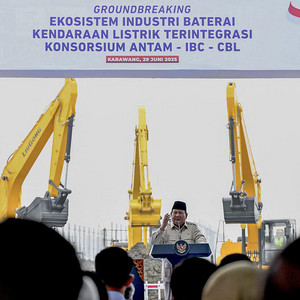
A lithium -ion battery plant is now under construction in West Java, Indonesia, part of a $6 billion joint project between Indonesia Battery Corporation and the world's largest EV battery maker, China's CATL.
Well, it's expected to go operational by the end of next year, with an initial capacity of nearly 7 gigawatt hours, expanding to 15 gigawatt hours in the future.
So, Petra, I understand President Prabowo has called this project colossal and an extraordinary breakthrough.
So, what does that mean?
What does this scale of production actually mean in global terms?
Yeah, hi to you and good to chat with everybody here.
Thanks for having me.
I think this is an important step for Indonesia as a country because Indonesia is home to roughly 60 to 70 percent of the global nickel supply chain.
And the commodity is a big part of the battery sectors, or at least it was in the last five to 10 years.
So this battery factory means a lot because it means that Indonesia has been trying to move up the value chain from basically a raw material exporter and now it wants to be within the higher value chain option.
So having an additional battery capacity is important.
Now, in terms of global capacity of manufacturing, it's not really that significant, frankly speaking, because right now there's about 3 ,000 gigawatt hour of manufacturing capacity.
And it will be roughly about five to 10.
It's not that significant.
But again, for the country, it's a big step, and as well for the region in Southeast Asia.
So basically, it's like a medium -sized plant?
It's a reasonably -sized plant.
So I think all of the crucial battery factories right now is within the scale of gigawatt hours.
The plant that is being outlined is somewhere between 6 to 15 gigawatt hour capacity.
So it's quite a reasonably sized plant globally.
And Andy, on a Chinese side, why do you think CATL chose West Java for such a major investment?
Well, Toyin, I think for several reasons.
So, first of all, CATL is a global leader in terms of market share when it comes to batteries.
It is also a technology leader and a pioneer.
So, a remarkably successful company recently had an IPO in Hong Kong during May.
I was actually on the floor of the stock exchange for the IPO.
But it's a company with global ambitions.
So first, why Indonesia says we heard a little bit from Putra about Indonesia, but it is the fourth largest country in the world in terms of population, rapidly growing.
And I think like some countries say in the Middle East, like the UAE, a strong visionary leadership, and I think the government of Indonesia recognizes the importance of electric vehicles and also sustainability, or I would say transportation, building transportation capacity, not only for the people of Indonesia, but maybe ASEAN and the world as well.
and environmental sustainability.
So I think from CATL's perspective, then they would see Indonesia, again, enormous potential market, a competent government with a complementary vision, which makes that very important.
Now then, why West Java?
So West Java, I think some think of as the Detroit of Indonesia.
So there are other global car manufacturers there.
And one point I want to add, I think we'll talk about more.
There's also this overlap in that CATL sees sustainability in particular, this so -called circular economy as an important part of its corporate strategy.
So for example, it recently announced a partnership with the Ellen MacArthur Foundation at Climate Week, which I think is just wrapping up this week, to ensure that their Their long term goal is at least 50 % of their batteries are not from virgin materials, so meaning recycling batteries.
And again, one of the I think the hallmarks of this Indonesia project is mines to mega packs if we want to call it that, meaning, you know, providing everything from taking the ore out of the ground, processing it, herning it into commercial products.
But also going beyond that and making sure that these don't go from, I think, what the Ellen MacArthur Foundation calls the traditional model of take, make, waste, meaning manufacturers take things out of the ground, they make things with them, and when people are done with them, they throw them away into a trash heap.
But that in fact, that this is meant to also build recycling into the circular economy of batteries.
And again, I think this is one of the key reasons CATL has chosen Indonesia for this very important project.
Then to Kevin, I understand you're now living in Cambodia, a regional neighbor of Indonesia.
So from your perspective, amid intensifying global competition over, you know, clean tech and EV supply chains, how is this battery project being perceived regionally or internationally, maybe from a Cambodian perspective in particular?
Well, I think there's three levels to look at it.
The first is the Cambodian perspective, which you mentioned, and the second is the ASEAN perspective, the regional perspective.
And of course, the third is more the perspective from the West, which is obviously, we're not surprisingly going to be a little bit more concerned and critical, maybe pointing out potential downsides of the deal.
But from the Cambodian perspective, it's viewed quite positively.
Cambodia has a substantial history over the past 20 years or more of increasing partnership with China and Chinese private sector development is the number one investment source in Cambodia.
And Cambodia also looks positively on large projects, Belt Road Initiative and so on.
So I think Cambodia sees this very positively and Cambodia has its own national policies for both automotive manufacturing and also for EV production and lithium battery production more specifically.
So Cambodia does not have the natural resource endowments that Indonesia has.
And so, of course, a big reason, as was mentioned, China and CATL is looking into Indonesia.
Also, other companies like Wayu Mining in Indonesia is because of the nickel supply.
So Cambodia doesn't have that natural resource endowments.
What Cambodia has is political stability and low -cost labor, which could allow Cambodia to kind of get into the supply chain in terms of manufacturing, maybe assembly of battery packs or another stage in EV production.
Production. BYD has announced plans to increase production in Cambodia and up to 10 ,000 units per year, which is the goal they've set.
So other Western companies as well have increased automotive manufacturing in Cambodia and Japanese companies also, such as Toyota.
So I think from the Cambodian perspective, it's viewed quite positively.
And I think Cambodia Cambodia is going to try to learn from this and think about how it can get into the broader regional supply chain that's developing.
So it wouldn't see it like a regional rival.
Rather, it's more like a partner, maybe.
Well, I'm not sure.
I wouldn't say partner as of yet.
They view it positively.
I think they see it as an opportunity for partnerships, but certainly not as a rival, just because, again, none of the upstream elements are there.
There is no real substantial nickel supplies in Cambodia.
And in terms of manufacturing the downstream element, I think they would want to get linked into broader supply chains that are connected to large Chinese companies such as CATL, so they can better access the chinese market through that right and we've already actually touched upon the significance of this project to indonesia or to china but more specifically um petra in the short term what benefits is uh indonesia actually expecting from this deal like more jobs or exports infrastructure environment or anything else can you be more specific about it Yeah, and I think both Andy and Kevin highlighted
they're very important points about, you know, regional partnerships as well as, you know, being in a circular value chain, right?
So if we pull back a little bit, the world is in an intersection, right?
The growth of the electric vehicles is very clear.
We're seeing the demand continue to rise.
And therefore, I think for many countries, it is a very clear intersection for them to decide whether they're going to take the fast lane or they're going to take the slow lane in the business as usual now for countries like indonesia i do not think that we're actually speaking about near -term goals because i think this is a very strategic moves both for the new term as well as the longer term because southeast asia as a whole is a big oil importer region and indonesia actually imported quite a big deal of its oil so moving into electric electric vehicles is the way to go moving forward. And having
an electric vehicle manufacturing capabilities supported by the batteries is very important.
So there's gonna be some jobs that created, but I think it's really the signal that is being sent is that the Chinese investment will be able to help certain countries to move up the value chain.
Now the degree towards that moving up the ladder will still be an open question.
Obviously, today there's a lot of investment happening globally.
A lot of people are talking about overcapacity and batteries and so forth.
So, I think there's still going to be a push and pull dynamics happening for the next few years.
So, a lot of jobs will be created.
But I think the most important part is actually it sent a new signal of development globally.
Whether some agree or not agree, A lot of people are seeing Indonesia as an exemplary case of how an ore exporting country can move up the value chain.
Many countries within Asia, as well as in Africa, are looking up to Indonesia because they are within that same intersection.
They want to move up the economies and they want to figure out how they can participate in a wider value chain.
Again, it's a complex story because at the end of the day, no one country can ever have the full leverage to dominate many things, right?
I mean, just because you have a nickel or just because you have a cobalt doesn't mean you will have the entire value chain in your country.
So picking up on what Kevin just mentioned, a regional partnership will definitely be an important part as well as the story moving forward. word let me stop there the chat lounge the chat lounge unpacks views and opinions on hot issues in a more casual way yes like you said it's a good example for others especially those maybe in in africa to follow in the future but um from the chinese perspective andy you've talked about how How this means to the company, CATL, but to a broader prospect, does it reflect the country's broader strategy to secure, you know, upstream battery supply chains in Southeast
Asia, or is there any more, you know, meaning to it?
Well, I think there are certainly tangible economic benefits for China and obviously for CATL from this project.
project but let me maybe focus if I may on a little bit more of the intangibles or maybe we could even call it the soft power aspect of this so you know one part of this is there will be a recycling line as part of this project and to go back to what happened at London Climate Action so with this announcement you know the vision is that within 20 years at least half the metals in every new CAT battery be recycled rather than mined.
So right there, you know, obviously, especially with younger people around the world, very, very sensitive, very, very alert to this kind of corporate responsibility, I suppose we could call it.
But here's another interesting part of this, right, is that the recycling of the globe is expected to reach about 160 billion US US dollars by 2040, and support more than 10 million jobs globally, with half in developing economies.
So again, we can see CATL as a Chinese company, but also a pioneer in kind of the technology, the industry, as well as the manufacturing, taking a leadership role here.
And I think that this, you know, we should not underestimate the soft power impact of this.
And And I imagine we'll be hearing more about this in the years to come.
Then, Kevin, from your perspective, some people actually characterize it as a leap forward in clean energy.
But others say it probably is a high voltage gamble.
How would you define it?
You know, between the two choices, I would go with the leap forward. I think Andy makes a very good point about the recycling.
CATL has been playing a leading role in developing recycling methods, and end -of -battery -life waste is a huge environmental concern from this type of production.
So, you know, if the end of battery life waste can be better addressed, and I think Andy touched on this a little bit, but also not just simply in terms of soft power, but in a way that is economically viable or even economically profitable, then, of course, there's a global public good benefit to what's happening.
I would point out, though, that I think, you know, there are still some environmental concerns related to what's going on, especially in the upstream element of Halmahera, which is the larger part of the investment in monetary terms related to the use of coal for the smelting and then potential wastewater management problems, which could be addressed with sufficient good governance.
You know, and of course the deforestation that results from open pit mining, which is the general practice for mining nickel in Indonesia.
So there are some serious environmental concerns, and I think the more that those can be addressed, of course, it shifts the balance in favor of this being a leap forward in environmental protection and clean energy.
Yeah, like many other large -scale industrial projects, environmental groups also raise concerns about this one.
So, Pooja, can you tell us how has the Indonesian government responded to such criticisms?
Yeah, I think it's important for us to set the nickel production in context first, right?
Roughly two -thirds of the nickel that is produced in Indonesia today doesn't actually end up in electric vehicles.
So what tends to happen is that most of them ends up in the stainless steel, which is a traditional industry.
But then we have this overly polarized debate that EV destroys the nature.
So there's a lot of validity to that statement, but there's also a lot of nuances on where those nickel actually ends up in because then you have people who's literally saying I don't like EV because it's destroying the environment, when the reality may be two -thirds of those nickel never ends up in electric vehicles um so the government has been responding in different ways although what is worrying is that it seems that many people seems to be more reliant on what the private sector can do rather than the government enforcement to put it mildly this is i guess another case of the difficulties
of balancing the trade -off between developments and you know progress and and then the social environmental impacts, right?
When Indonesia entered the nickel market, I'd like to call it that, Indonesia opened a floodgate, right?
It opened a floodgate.
It crashed the nickel market because it supplies so many nickels to the global market.
At the same time, it also crashed the ESG standards globally.
Is it fixable? I would like to believe that it is actually fixable, but it really need a strong government and it's coming from the government, that's one.
one. But secondly, as well, we also need a strong commitment from the private sector.
And I think earlier, the discussions about CATL commitment shows the progress is moving to the right directions because the leverage of moving towards a greener development seems to be stronger in more visible companies, right?
Visible value chains, such as the electric vehicles, I think is more sensitive to pressures about social and environmental as compared to something that That is more traditional, like the stainless steel.
So there's an opportunity here.
And it's good to see that companies like CATL is actually putting their step forward. I mean, traditionally, I think a lot of people seem to think that European companies may be more greener and so forth.
So it's very welcome to see that the signal is out there.
And now we really need to see how it's actually going to transpire on the ground.
Because the reality, let me close with this, is that everybody wants to talk about a green value chain.
Everybody wants to talk about the green nickel.
The reality is that not many are willing to pay a bit of a premium to get those products.
So I think we're seeing multiple dynamics in play and it will be an interesting space to watch. One other thing is that in China, as we know, three quarters of electric vehicle sales doesn't use nickel anymore.
So the land is actually, you know, the tectonic plate of the nickel sector is actually shifting as we speak.
So Indonesia has opened a floodgate.
Now, at the same time, technology is moving forward, both in terms of circularity as well in terms of moving to other kinds of battery technologies.
When you say Indonesia crashed the ESG standard, what do you mean by that?
Yeah, so before Indonesia flooded the global nickel market, there's many producers of nickel, right?
Anywhere from Canada, Australia, and so forth.
Each of these have vastly different colors about the level of environmental, social, and governance that they're implementing.
Now, when Indonesia open up its downstreaming sector, basically inviting all the investors to come in and build all the smelters domestically with all kinds of tax break and so forth, it basically untapped a whole new resource that is, let's call it very low cost, right?
So as you open up this very low cost, you're basically making everybody else uncompetitive compared to Indonesia's nickel.
And this is where the trouble comes, right?
Some Canadian nickel producer may say, hey, we got a greener nickel, right?
But who are willing to pay a bit of a premium as compared to us?
So I think that's the dynamics that is played here, is that Indonesia is producing nickel at such a cheap cost and at a very vast scale that many others in other countries is finding it difficult to compete with.
Kevin, do you find your Indonesian colleagues' explanation here convincing?
Yeah, for the most part, I agree with what's been said.
I think this particular project, you know, I think there's a lot of opportunity here to build best practices and the lessons learned can be replicated by other developing states, whether they're dependent on natural resource endowments or dependent on low -cost labor, as in the Cambodian case.
Right. And Andy, I'm not sure if you know anything about the Chinese company, CATL, whether it's bringing its experiences or what kind of experiences it is bringing or lessons learned to Indonesia or to this project in West Java.
You know, I would say generally, yes, of course, because, you know, we think about CATL in some sense, it's a relatively young company, but, you know, really has accumulated a lot of experience within China and, of course, is going global with investments, not just in Indonesia, but Europe, other parts of the world as well.
So I think certainly there are lessons learned, but at the same time, every market, every country is different.
So I think it's striking the balance there, and whether CATL can reach the level of global success like a Huawei, that has gone global and really adapted to a lot of local markets.
I want to go back, though, to what I think Putra was saying about the nickel market in Indonesia.
But, you know, one way we could look at that is it's actually a good thing, isn't it?
I mean, that, you know, we look at it from a market perspective.
Nickel is such an important input, not just for batteries, but stainless steel, like he said, but also alloys used in aerospace, military applications, etc. etc. So, you know, quote unquote, crashing the market, or meaning, you know, providing flooding the market with much a greater supply that lowers the prices.
Of course, existing suppliers, you know, may suffer.
But overall, I see that as maybe a good thing, right?
Because then that means that many manufacturers have lower input costs.
It might create the incentives to innovate with nickel to use it for more things i mean this is generally what we see with other inputs right whether that's computing whether that's other physical resources that when they become cheap enough it really unlocks you know new sources now of course we also have to consider the environmental impact as well but i just wanted to maybe add a little bit of another perspective of the glass being half full right perhaps on lower nickel prices this has been the chat lounge check out the biggest challenges Sino -Indonesian join project may phase down the road
when we come back stay with us the best military commander is not he who fights a hundred battles and wins every Every one of them.
The best military strategy does not lead to the desiccation of the enemy's capital city.
Decoding the Art of War will help you understand why there's no art in war and how Sun Tzu stayed undefeatable using the science of war with fun stories and insightful breakdown of famous battles.
Find Decoding the Art of War wherever you listen.
Welcome back to the chat lounge.
We continue our discussion on Indonesia -China EV battery collaboration.
collaboration. There are still some other concerns, one of which being Indonesia's dependence on Chinese technology and capital in its green transition.
So, Petra, how concerning does that sound to you?
To me, it's not concerning at all, right?
I mean, I think there's a lot of, I can't remember whether Andy or Kevin highlighted earlier, you know, there's a lot of, let's call it the Western view, the West versus the Eastern view.
There's a lot of critics about what's happening um china being the natural front runners in many clean technology today it's natural for them to be engaged with many different parties right whether it's cambodia malaysia india or even indonesia so i think i think it's just a natural part of the value chain and i think it's it's an open competition for everyone um countries like indonesia is also open to many investors right there's investors coming from europe and whatnot and really it's about which one can give the best value for their investments.
And I think it's a reciprocal relationship.
So to me, I'm not too worried.
Having a diversification strategy will be important, not just for technology, but also to raise the bar in terms of environmental and social standards.
And I do have to say, I agree.
There's a lot of positive sides of flooding the market with cheap nickel.
I think my reservation is really, we're flooding the market with cheap nickel, with compromised social environmental standards.
Really, that's really the underlying of my statement is that if we can get it better, maybe at a 10 to 20 % premium, I think we're going to meet a very good intersection between development as well as the energy transitions.
And on the Chinese side, I'm not saying it's a concern of CATL or the majority, but some people are worried that this could lead to industrial chain relocation, because this project spans the entire battery production chain from laterite nickel extraction and hydrometallurgy to battery manufacturing and recycling, like you all mentioned.
There could also be technology transfer risks or even loss of orders for the Chinese side.
So Andy, how serious do you think those concerns are in this context?
Well, I think what's going to be clear, Yoon, is that there are going to be increasingly important issues as time goes on, because we can see clearly China's moving up the technology value chain.
CATL, as I mentioned, is not just a global leader in terms of market share, but also technology leadership as well.
And, you know, I think it very clearly sees, you know, one of its strategic assets is its technology and its capability to innovate.
So, you know, like any good corporate executive, you know, I think the leadership team, you know, must be concerned about that.
You know, we look at it in AI with deep seek, although it's open source.
But, you know, there's still, I think, areas of of technology that they would want to maintain some sort of proprietary ownership of Huawei, et cetera, et cetera.
The list goes on and on.
So, you know, I think it's it is increasingly an important topic and nationally as well.
So we know that technology and manufacturing capacity is an important plank in national security.
So clearly, I think every country has these concerns and China, as it becomes increasingly a global technology leader, is, of course, paying more attention to these kinds of concerns.
And the question, of course, is what is the appropriate balance to strike, right?
And, you know, that's always, I think, really has to depend on the specifics of any particular situation.
As Americans love to say, the devil's in the details.
Indeed. Kevin, I understand you seem to always look at things from a positive side.
So what's your interpretation here?
well uh yes i try to stay optimistic um in general in life um and on this topic as well i i did i did try to point out what i think are some of the environmental concerns i think you know a lot of those concerns can be mitigated through good governance right uh putra mentioned enforcement but he also emphasized corporate level best practices i think really though the you know The results are going to depend on Indonesian government practices and what they put in place.
So they're taking a pragmatic approach where they're trying to balance energy sovereignty, energy security, also value -added industrialization with environmental protection.
That balance can be done if the right enforcement of violations is in place.
But that's going to depend on them, really.
I mean, Indonesia is a sovereign state, and so the burden is not on necessarily the international company coming in to do that.
In terms of the risks for Indonesia, the risk, you know, reliance on the Chinese market and potential downturn, a skills gap between Indonesian workers and Chinese labor, limited ability to diversify.
So as Putra mentioned, there needs to be a diversification plan in place.
And I have seen some literature which emphasizes the compulsion for security alignment on the part of Indonesia resulting from economic dependence on China.
But I'm not particularly swayed by those criticisms because a lot of those are, to some extent, unavoidable risks.
Market downturns are risks that people have to take.
And I think the success of the project for Indonesia will depend on effective tech transfer and skill transfer.
Now, does that mean that China is going to expand its technological ecosystem?
Yes, it does. I think that's undeniable.
But I also think that would come with any country investing.
And as Andy mentioned, China's the leader in green technology and especially in this area of EV and EV batteries.
So, of course, it's not surprising that someone who's at the cutting edge and is leading in an area of technology is going to successfully expand the reach of their technological ecosystem.
I think some of the criticisms, the problem is they're not looking at it.
These Western criticisms are not looking at it in terms of what's best for Indonesia, right?
They're looking at it for how does it affect them in the West?
and that's just not going to convince anyone in Indonesia.
You know, we have the same experience here in Cambodia with Huawei and 5G.
And when 5G was adopted here in Cambodia, there was a lot of criticism from the West. And I remember speaking to a member of Cambodian parliament and he said to me simply like, look, no one else is offering us 5G.
What are we supposed to do?
The criticisms are falling on deaf ears because national -level authorities are thinking about their own national best interests.
Indeed. You've talked about the flooding of Nickel.
Maybe it's already settled here.
But another concern is about the flooding or overcapacity of EV batteries.
You know, a mismatch between capacity and evolving demand or technology could indeed create excess capacity, especially in emerging markets like Indonesia, where uptake is sometimes uncertain.
certain. So, some caution, it may lead to wasted investments, stranded assets, or even political backlash.
So, Kevin, do you see it that way too?
There's certainly some potential for that.
And again, I think it depends on, to some extent, I don't think the public outcry is going to be over these more abstract issues of dependency and limited ability to diversify.
I think there There will be more based on how the project affects the livelihood of the people in West Java.
And so it will depend on the extent of deforestation, you know, wastewater pollution, whether or not, you know, toxic heavy metals are making it into the water supply, because these are the things that will affect the livelihood of the population in that area.
And Putra, how would you respond to such concerns or questions?
issues i think uh the talks about over capacity it's really depending who talks about it right i mean a lot of people are complaining about the overcapacity coming from the global battery because china is dominating the the sector but coming back to what andy's highlighted you know flooding the world with cheap battery is not necessarily bad right i mean people can get the electric vehicle adoptions moving so fast sure there will be a lot of uh the usual market dynamics you know market consolidation some companies will survive other may not but I think it's just part and parcel of having any kinds
of industrial development it's a big race right everybody want to be on first some will survive others may not be and I think it's not unique to the battery sector so now one point however relating to Indonesia I think an interesting statement is that there may be some state involvement within some of these value chain right um dana antara one of uh indonesia's uh quasi sovereign wealth fund um is potentially going to invest a little bit so i think they just need to be fully aware that the market as it is you know it will be highly competitive because sometimes as you inject some state funds people tend
to make a bit of a noise later on right so i think it's really about make it a prudent investment but the world is on a competitive race right be ready to fight Fight with good strategy and fight competitively.
The Chat Lounge. The Chat Lounge unpacks views and opinions on hot issues in a more casual way.
So overall, you three are very positive about this project, but there are some challenges going forward. So let's talk about those challenges.
What are the biggest challenges you foresee in keeping this project on track?
We've seen South Korea's LG Energy solution pulled out of Indonesia's high -profile Project Titan due to shifting market conditions.
That's what they say.
Puja, could similar uncertainties, be it economic or geopolitical, emerge here as well?
I think that thing is always on the table, right?
I mean, again, coming back to the global market dynamics, a lot of capacity on battery manufacturing.
I think we will see a lot of scaling back of ambitions.
Right. I mean, last year, there's at least about 300 gigawatt hour of announced battery manufacturing that was postponed or canceled.
That's a lot of capacity.
But what it also tells us is that there is a lot of adjustment.
Right. CATL actually scaled back their initial investment plans that they announced several years ago.
So I think there's a lot of rationalizing process and I think it's a good step.
You know, people are trying to figure out what's happening in the market and they tone it down a little bit.
I guess the risk is really not that many, right?
I mean, if they can build a factory on the ground, it'll probably going to be one of the most important factories in Indonesia and probably within the region as well.
So I think the next question will actually be what's going to happen within the region broadly, looking at the neighbors, the Vietnam, the Malaysia, the Thailand and whatnot, because everybody also wants to build their own battery manufacturing capacity.
I think it'll be interesting to watch what's going to happen within the next few years and all the announcement that is taking place.
Coming back to the risk that I highlighted earlier, the state involvement does present a bit of a risk for the Indonesian fiscal side.
But other than that, as long as the standards can be maintained high enough, and if we're hearing that CATL is progressive enough in their standards, I think it's a good step in the right direction.
So which one would you say is the biggest one, the state?
I think it's really just when state -owned enterprise or state budget enters an investment, they need to be ready to take the hit if they do lose money.
And I think that part is where in places like Indonesia can become a very politically sensitive subject.
You know, it's kind of like you're throwing money down the drain.
So I think it's really making sure that everybody approach this topic with a clear eyed view of what the market looks like today.
Overall, it's all good in terms of the plan for, you know, moving up the value chains, creating jobs, technology transfer and so forth.
but I think it's important for Indonesia, both the government as well as the Soviet Rofan to enter this with a cleared -eye assessment that this is a competitive landscape.
So I think that's actually quite a bigger risk in terms of politics, I think the politics side will be interesting.
Andy, so I think CATL should have taken into account Indonesia's domestic politics And when they make this decision to make investment there, what would you say might be the biggest challenges for this project going forward?
Well, yeah, so so, you know, if we step back, right, and just take a look at so so the battery market, you know, there's really two main markets.
So there's mobility, right, for transportation, cars, trucks, scooters, whatever.
And then there's storage solutions for stationary.
But, you know, if we look at kind of this issue, right, first, there's the economic impact of overcapacity.
And I think here, you know, if we look at what's going on in China today, you know, some powerful and painful lessons of what's called involution, right?
right, where, you know, you have a number of these companies in the electric vehicle space, so the BYDs, the NIOs, the Xpengs, the Teslas, in the Chinese market, all competing ferociously, driving prices down over capacity.
And, you know, on the one hand, the central government sees this as an issue that needs to be managed.
But at the same time, to go back to maybe it was Kevin's point, right, about the role of the state.
So here in China, of course, we have this countervailing political force of, you know, why does this continue?
You know, so one, of course, is local governments, whether we're talking municipal, or maybe provincial governments, want their champion to be the winner, and, you know, maybe keep supporting an EV in the hopes that it will be the last companies, one of the last companies standing.
So, you know, whether this issue plays out in other parts of the world as well, I think clearly is something that every company in every part of the value chain, whether you're in the vehicle space, the battery space, or maybe even upstream of this, you need to pay attention to.
And sometimes companies can get caught up, right, Right.
In these dynamics. So this is something, you know, we have to see, you know, to use a Michael Porter five forces analysis on this.
You know, if the barriers to exit are really high for whatever reasons and companies don't leave, you might be stuck in this position of overcapacity for a while.
And then the other question, you know, I think we can ask is, you know, is this a temporary situation?
So any new industry, any new market typically goes through, you know, an invention, innovation phase.
And then suddenly, like mushrooms after a rain, you have all these new companies starting and then there's a weeding out process and you reach some sort of market equilibrium, whether that might be one company or an oligopoly or, you know, some more like a restaurant market in a big city, right?
Right. People, there's many, many of them.
They come and go because the barriers to entry are relatively low.
The barriers to exit are relatively low.
Now, certainly it seems like the battery industry, because it is relatively capital intensive.
There are high barriers to entry permitting all of these other things.
You know, we have to see how will this play out.
But, you know, given, I think, CATL's track record, you know, again, very non -trivial to build a globally technology -leading battery company, you know, is not just technical expertise, but also, I think, management, vision, perseverance, you know, all of these other intangibles.
And we know from business in China, that growing in China is not necessarily so easy as well, right?
So if you're in Fujian, and you want to expand globally, that's not always the easiest thing either.
So I think we have to see, but I think CATL definitely a tested management team.
So let's see what happens in the long run.
So for the moment, you don't see any serious challenges emerging?
Well, I mean, I would put it this way, you.
And I mean, there are, of course, daunting challenges, right?
So Indonesia is a big country.
It's a complex country.
It's developing. It's a foreign market for CATL.
So, you know, there's lots of challenges, lots of things that can go wrong.
You know, this is the biggest one.
Well, you know, we have to see, right?
I mean, I would say it really depends.
You know, if we only look at indonesia i i would say again being completely outside of this it would be adapting to the local realities you know making sure you have good relations with local government the central government dealing with any potential stakeholder issues you know whether that's environmental labor concerns etc these are the things that typically derail foreign investments right but then you know we have to think about globally as well you know what if uh demand for electric vehicles falls off a cliff for some unexpected reason.
So again, lots and lots of challenges.
It's easy as armchair quarterbacks, right, to say, oh, this is an amazing opportunity, which it is, but at the same time, you know, the actual doing of it is incredibly, incredibly challenging.
You know, and again, I would look at it from an investor perspective, which is, again, which makes it, on the one hand, exciting, but also very challenging.
We look at, say, the EV space.
Who's going to be one of the companies left standing?
Who are going to be the big economic winners?
And who's going to be roadkill or a casualty of this incredibly competitive phase that we're in?
All right. And Kevin, do you see any imminent challenge rising in front of you?
I would just echo, I think, a lot of what Andy said about, you know, the local realities and dealing with local government for foreign investment and maintaining good relations.
You know, there's 18 related infrastructure projects.
So it's a very complex overall project and the challenges are built into it.
But I think in terms of the overcapacity globally, you know, the project is in its beginning stages.
So there's ample opportunity with the right management, as Andy emphasized, to adapt and evolve in the process of implementation to not sort of over leverage and, you know, to take that reality and keep it in mind, as Putra emphasized.
So I think that that's the best approach. When it comes to CATL, you know, this is a move in order to make the company dominant in nickel, lithium ion, nickel, manganese batteries, you know, with high energy densities, which are important for EVs, especially for more long, long distance travel.
And certainly a lot of the EVs, which are consumed in the West at this time, are using that.
So it's a risk for CATL, but it, you know, it's, I think, a risk worth it in that it pays off through dominance over the market because they already have such a control or an important portion of the LFP part of the market, right?
Right. So this for them is a way to kind of, you know, expand them globally and really make CATL dominant across battery types.
So I think it's a risk.
There's some risk there, but I think it's risk worth taking.
And I do think the issue of oversupply is an important one, but I think in In the long term, it will not be such a big factor.
All right. And finally, a question to you all.
In the long run, how might this battery hub reshape Indonesia's role in the regional and possibly global EV supply chain, if it can?
Maybe we start with Andy?
Well, I think that, you know, there's a lot to be excited about here, right?
Right. So, you know, again, Indonesia, fourth largest population in the world, but still with a lot of economic upside.
Right. What about a one point five trillion U .S. dollar economy like what?
Five thousand dollars ish per capita GDP.
So a lot of upside here.
And it's, you know, so -called industry of the future.
It's environmentally sustainable.
You know, most would say that we are moving towards a world of any V.
So I think that's very good.
And again, if Indonesia does well as a cornerstone of ASEAN, which is increasingly the economic center of gravity for the entire world, this is a positive.
For the global south, you know, again, this could be a template.
You know, we talked a little bit about other mineral resource rich countries that could pursue this approach of not just being a commodity exporter, but how do you move up the value chain?
You know, as Indonesia has done to say, look, you can't just take our nickel.
You have to come here and, you know, do things with it.
So, you know, I think, again, there's a lot to be excited about at a more strategic level.
But again, as having been an investor in this part of the world, these are incredibly difficult things to do operationally.
there's operational risk there's political risk there's market risk but when we look at the record of CATL visionary team led by Robin Zung talks about these really exciting things like going from parts per million meaning you know one fault in every million procedures or battery cells to parts per billion right and this is incredibly important if you want to go to these large scale storage batteries because they have millions and millions of cells they're not you know small they're you know enormous uh structures so if you have one failure per million that means you're probably dealing with failures
every day so you know there's a lot of exciting things here um so i think this is partly probably why we're also talking about this that it's important for indonesia important for asean important for the world and i think shows some really exciting things that CATL is doing.
And Kevin, is it really that powerful that could be a key piece in powering Asia's green future?
Yeah, I think so. But again, it's a unique case because of Indonesia's nickel supply, right?
It really puts it in a unique position.
So to the extent that other countries could sort of drive this value -added industrialization by cutting off exports of an essential commodity, you know, if that is the requirement of doing it, then it's not going to be easily copied elsewhere.
You know, one, of course, one case comes to mind is maybe cobalt in DRC, but that's not going to happen because of, you know, governance issues in the DRC.
So as is, you know, can it be copied, copy pasted?
No, but certainly, again, key lessons can be learned.
And I think the overall ethos of the approach of, you know, Hili Risasi, you know, the Indonesian policy, I think is important for other countries to think about about how they can implement it in their own way.
All right, last but not least, the Pujar Police.
Yeah, I think talking about China and the world, having CATL on the ground in countries like Indonesia is actually bringing a very big potential for an exemplary case, right?
CATL is one of the leading companies based out of China.
There's a lot of commitments for them to progress both technologically as well as all kinds of environmental and social standards, And I think having them closer to the ground, closer to the value chain, will be able to push the cart in the right directions.
I agree with what has been discussed here is that it may not be completely replicable in many other contexts.
But I think it will present a good example of how China cooperate with other countries.
And while at the same time bringing their leading companies to actually push the cart in the right directions, both in terms of progressing in investment, as well as hopefully raising the bar on the ESG development as well.
On that note, we've come to the end of our chat for this session.
Many thanks to Putra Adiguna, the Managing Director of the Indonesia -based Energy Shift Institute.
Kevin Nguyen, a senior research fellow at the Asian Vision Institute.
Andy Mock, senior research fellow at the Center for China and Globalization for sharing your insightful views with us.
The show is available on all major podcast platforms. Please email us your comments at radio at CGTN .com.
I'm Thuyen. Thank you for listening.
Join us again next week for more chat at the chat lounge.
Bye. The strong wind was howling and whistling.
He was the first Chinese citizen to graduate from Yale University in the mid -19th century.
I was born on the 17th of November.
She had prominent features.
Three of us were old enough to lend a helping hand.
He navigated between two vastly different cultures and moved further to realize his dream and promote understanding between the people of China and the United States.
Ye Mingxin was a native of Hanyang.
I realized no danger.
China is really awakening.
Come and join us in discovering the incredible journey of Yong Wang in his autobiography, My Life in China and America.
Check out the audible stories on radio .cgtn .com and all major podcast platforms. Just search for the podcast Books and Beyond and find My Life in China and America.
Thank you.