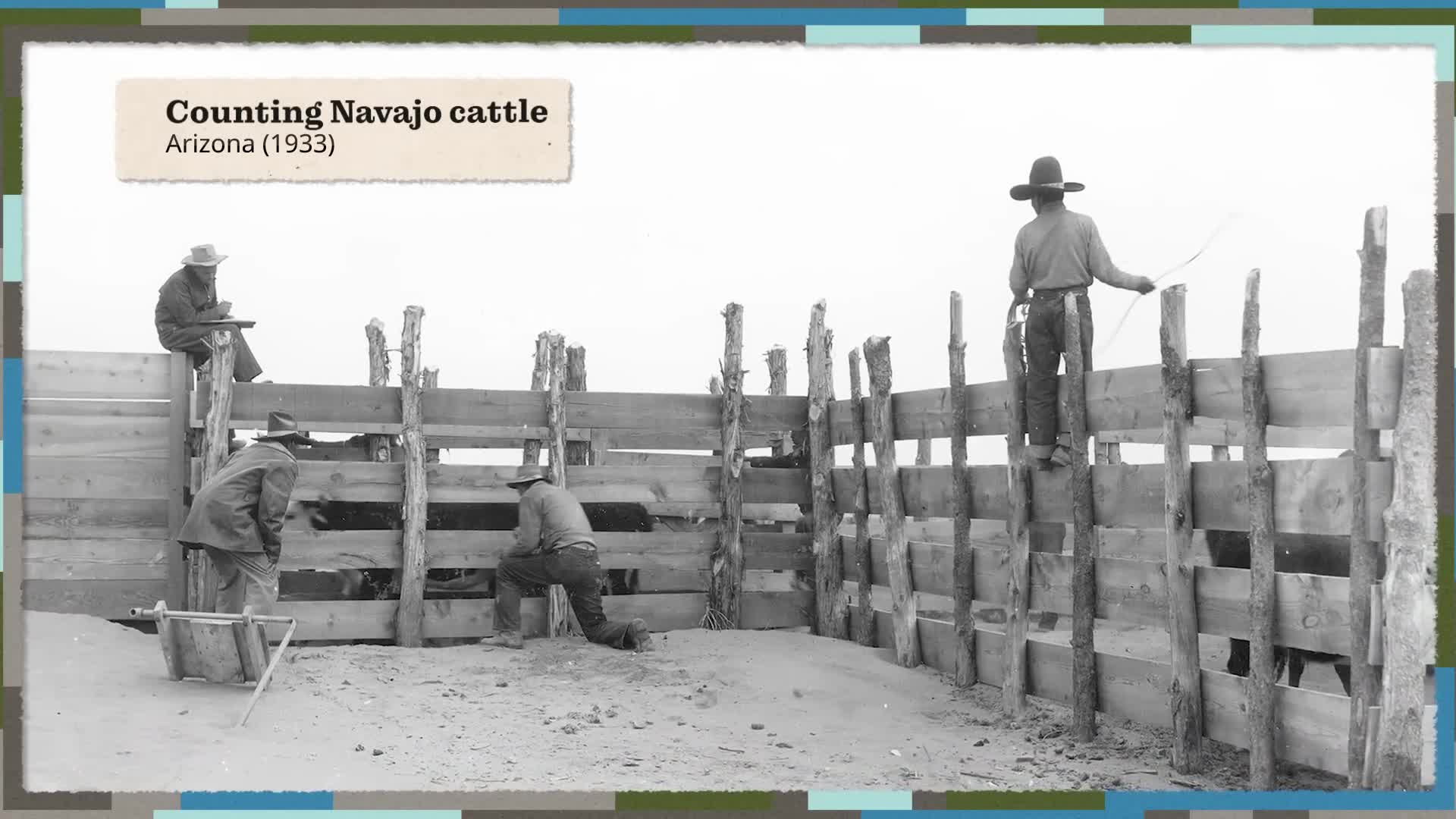
The land was dying.
In the early 1930s, millions of acres of Navajo land were at risk of erosion because of overgrazing by livestock.
So John Collier, the commissioner of the U.S.
Bureau of Indian Affairs, advocated for its conservation.
Sounds like a solid ally move.
Except it wasn't, exactly.
In a rush to save the land and use available government funds, he forced tribes to dramatically reduce their herds.
In some cases, simply by slaughtering them and leaving them to the buzzards.
This was a big deal.
A novel person's livestock was their food, income, and stability.
And now, it was destroyed.
So how can a plan with good intentions go so awry?
Hi, I'm Che Jim, and welcome to Crash Course Native American History.
In our previous episode, we talked about what's known as the Allotment Period, which started in 1887 with the passing of the General Allotment Act, aka the Dolls Act.
The law broke up reservations into smaller chunks of land given to individual Native people.
Their stated intentions were to give Natives more control over their own land and to break up the tribes in the process.
This legislation had a lot of negative consequences for Native people.
And by the 1910s, white folks in government were starting to take notice.
So 40 years after the allotment period began, Secretary of the Interior Hubert Work commissioned the report to assess the situation, putting US
Census Statistician Louis Miriam in charge.
Now, hold up.
This was a huge deal.
The U.S. government had been abusing Native peoples for hundreds of years at this point.
And for the first time, they openly said, have done something wrong.
Which, yeah, understatement.
But still, this was new for them.
In 1928 Miriam presented his research group's findings from visiting nearly a hundred Native American reservations and interviewing about a thousand Native people.
The survey, which came to be known as the Miriam Report, was more than 800 pages.
That's like a whole George R.R.
Martin book.
Because it turns out, there was a lot to say.
The results were worse than 12th sequel in a horror franchise bad.
The Dawes Act hadn't made things better for Native Americans.
It had made just about everything way worse.
Take finances.
Instead of making natives more self-sufficient, a lot may cause a huge loss of income.
In 1920, the average American was earning about $21,300 annually in today's money.
But Native Americans were living off what today would just be over $1,500.
And many natives who left their allotments to find work in cities found so little support from white communities that they ended up living in shanty towns.
And healthcare for natives had deteriorated too.
For example, the survey looked at the Canton Insane Asylum for Indians and found that the food there was insufficient, tuberculosis was spreading and there were so few trained workers that the people living there weren't getting the care they needed.
The research team also found Native education to be in dire straits.
Native boarding schools were overcrowded and harsh punishments were common there.
Native kids were being forced to do hard labor for hours every day while being malnourished.
Forget learning, they were suffering.
The Mirren Report shocked many in power, so Congress funneled its recommendations into new legislation.
With the help of well-meaning ally of Navajo Lifestyle Production fame, John Collier.
As Commissioner of Indian Affairs under FDR, Collier held broker what's often called the Indian New Deal and its centerpiece, the Indian Reorganization Act passed by Congress in 1934.
This was huge.
Bigger than the Super Bowl, the Heiress Tour, and the finale of the Great British Bake Off combined.
This was the first piece of legislation that wasn't aimed at either assimilating or destroying Native Americans, but rather helping them.
Major turning point in Native American history?
Check.
The IRA's purpose was to throw down an UNO reverse card on the federal policy that had come before it.
In the text of the law, the government recognized that tribes are qualified to exercise powers of self-government not by virtue of any delegation of powers from the federal government, but rather by reason of their original tribal sovereignty.
Which is a lengthy way of saying tribes can rule themselves.
Not because the government says so, but because tribes say so.
After decades of heavy government control, this was a major switcheroo for Native tribes.
And a good one at that.
Along with reinstating tribal self-governing power, the IRA encouraged tribes to reorganize their governments by adopting their own constitutions and instating tribal councils to enforce them.
The government also pledged to conserve indigenous lands and resources, lessen poverty through a new credit system and end the practice of land allotment.
Can we make some noise for the end of another terrible era?
On the surface, this all seemed pretty great.
But here's the tricky part.
The IRA did pass, but only about 40 of eligible tribal members voted on whether to adopt it, meaning many tribes reorganized without all or even most of their members getting their voices heard.
In the end, 160-plus tribes voted to reorganize under the IRA and adopted American-style constitutions.
And 77 tribes voted not to reorganize.
But why?
Didn't they want to govern themselves?
To have more agency over their lives and their lands?
Well, think back to the Navajo.
Their pastoral lifestyle had been all but gutted by the same agency that was promising them a better future.
Even the same guy.
Many Navajo weren't going to trust the people and institutions that had already hurt them.
And some tribes had too much internal politics going on to focus on an IRA vote, while others didn't want to deal with more meddling from the federal governments.
Under the IRA, they'd have to get government approval for lots of things, from the wording of their new constitutions to their spending plans.
But without that strict oversight, tribes could perform business as usual.
So what did it look like when a tribe did reorganize under the IRA?
Let me tell you a story about the U-Tribes of Colorado.
Collier needed some help persuading the Southern Ute and the Ute Mountain tribes to adopt the IRA.
So he enlisted the help of Sapia, the chief of the Moash band of the Southern Ute tribe, to convince them that the IRA was the way to go.
Sapia was the poster child for the IRA's potential.
He was a successful farmer and leader and he managed to sway both tribes, or at least a few people who voted to adopt the IRA.
But he kept the secret to his financial success to himself.
Preferential treatment from the government agencies conveniently left that part out, huh Sophia.
At first, things looked good for the Colorado youths.
They were able to buy back 220000 acres of their land that had been sold to non-natives, and not just any land.
Land with coal, gas, and oil deposits.
Hello, land leases.
Hello, moolah.
Their communities were bouncing back.
But something strange happened.
The Utes started to lose their culture. fewer teepees, more picket fences.
Less traditional clothing, more jeans and cowboy boots.
Fewer Ute language speakers, more I-only-know-English speakers.
And losing your culture is no laughing matter.
The disorientation many Utes felt led to rising alcoholism and depression.
So things were on the up and up, but at what cost?
And that's the story of the Colorado Utes and the IRA.
Many natives saw the changing governmental structures imposed by the IRA to be another kind of assimilation, a process where a minority group's culture gets absorbed or erased into a more dominant culture.
Written constitutions and hierarchical governments a lot.
The Founding Fathers didn't gel with the ways that tribal governments had historically functioned.
Like the Ojibwe tribe, had previously operated through consensus, where representatives from all villages had to agree before a measure was taken.
But under the IRA, things had to move more quickly to use funds before they lapsed, for example.
And the majority ruled.
On top of that, many Native folks called the IRA the Indian Rawl Deal.
For the way, it kept a lot of power in the hands of the US government.
New constitutions would require most actions.
The tribe took to be approved by the Secretary of the Interior and or the Commissioner of Indian Affairs.
And tribal councils had to adhere to the whims of the BIA, whose leadership could change each election.
But that's not all.
The programs created by the IRA were also severely underfunded.
And despite promises of restoring land or at least paying for what had already been stolen, the federal government brought back only 2 million of the 90 million acres of land lost to European settlers and businesses during the allotment era.
While land could no longer be taken by force from tribes and the IRA added millions of acres to existing reservations, natives were still only given a small fraction of what they were owed.
Maybe the main issue though, was that the IRA was a single piece of legislation that was supposed to fix a whole host of different problems in really different tribes.
Hundreds of years of broken treaties, land grabs and punishing legislation took too high of a toll to be fixed by one law.
But hey, it was Congress's first shot at rectifying those centuries of harms against Native Americans.
No one gets a perfect run off the bat.
You gotta start an ongoing process of change, right?
Right?
Except, here's the thing.
Even with all the other legislation that had been created in the past century, the IRA is still in place.
Let that sink in for a second.
The first attempt made in 1934 is still the law of the land, with all of its flaws and shortcomings.
So where does that leave tribes today?
In a lot of different places.
The IRA still holds up its end of the bargain in some ways, like through providing funding and financial assistance and by supporting some native land use, even for a handful of tribes that didn't organize under the IRA back in the 30s.
Which brings us back to the Utes and the Navajo.
The Utes, who had lost some of their culture as a result of this policy, have been making strides to preserve it, establishing Ute Mountain, Ute Tribal Park, the Ute Language Project and small bison herds on their reservations.
And the Navajo, whose herd was decimated to prevent erosion and voted not to adopt the IRA, are still debating the structure of their tribal government.
Should it be locally focused or more centralized?
Should they adopt a constitution or keep operating without one?
The project of native government is never really over.
90 years later, Native Americans still debate whether the IRA was a success or a failure.
And there are arguments that could be made for both.
But perhaps the reason it has fallen short of its promise is that the promise was too big to be tackled in one go.
Still, the IRA shows us how the process of repairing a relationship marred by hundreds of years of generational trauma can begin.
Notice a problem, observe and talk to folks who are dealing with it, and bring that knowledge onto actionable change.
It's tough, and it won't be perfect, but it's a start.
In our next episode, we're going to discuss Native American relocation and tribal termination.
And I will see you then.
Thanks for watching this episode of Crash Course Native American History, which was filmed at our studio in Indianapolis Indiana, and was made with the help of all these nice people.
If you want to help keep Crash Course free for everyone forever, you can join our community on Patreon.