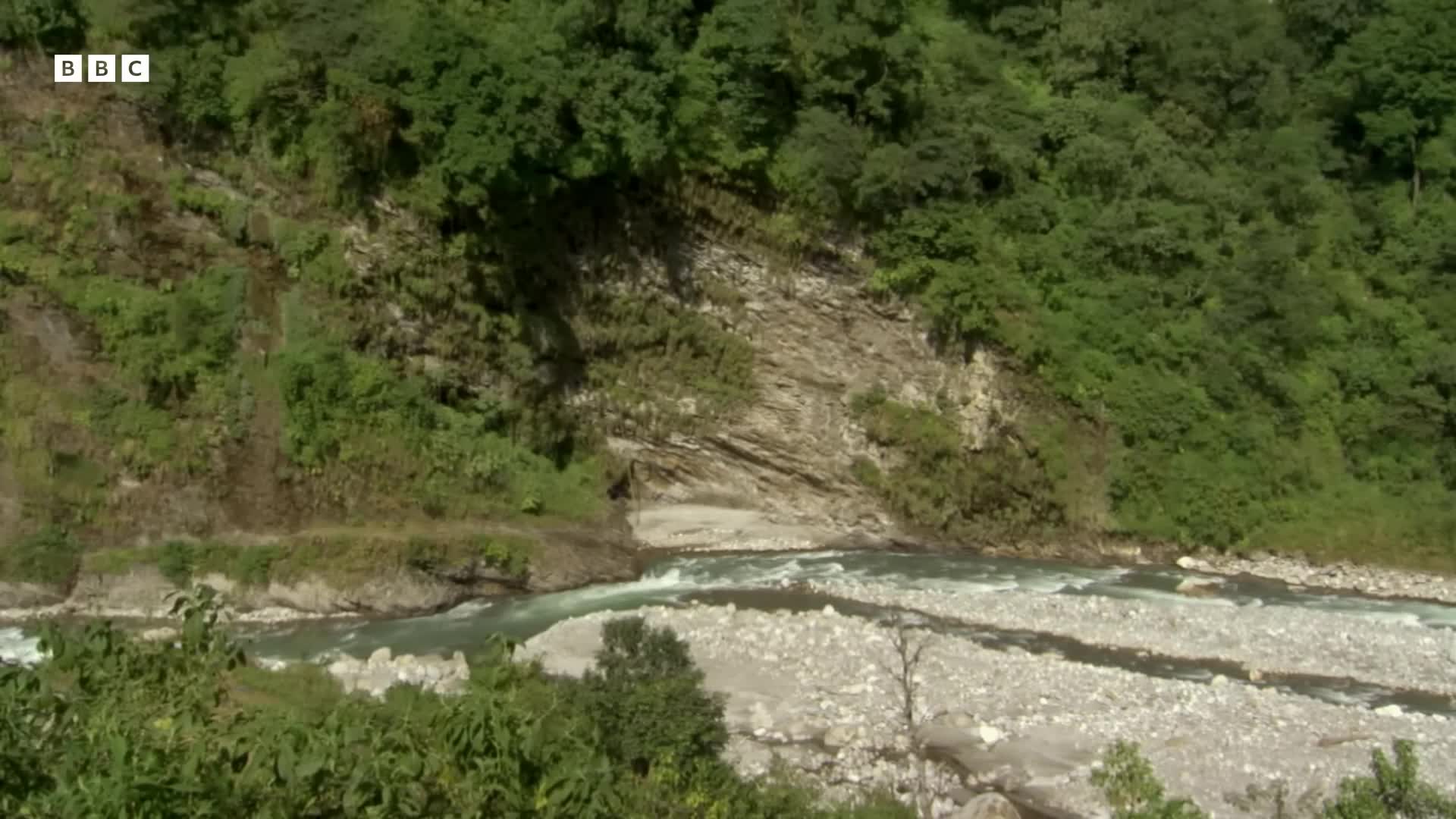
Here in the mountains, they have the biggest species of honey bee in the world, the giant cliff bee.
Their hives are built high up on the exposed rock.
On this one cliff alone, there are over 2 million bees.
Workers returning to the nest laden with nectar and pollen, tell other members of the hive where they've found their food by performing what is known as a waggle dance.
The directions are coded in the dancers' body positions.
And whilst the observers follow the tip-off, the returning bee must make its way into the hive to deliver its precious cargo.
Not always an easy task.
Because the hive is fully exposed, the only way the bees can defend it is with their bodies.
They line up several rows deep to form a defensive shield.
It is all for a good reason.
Hornets.
Voracious predators, they are here to hunt bees.
Separated from the rest of the hive, a single bee doesn't last very long.
The hornets cruise around the hive, hoping to strike unsuspecting bees.
But the guarding bees have a defense strategy.
As soon as one bee realizes a hornet is approaching, they lift their abdomen up in a threat display.
The alarm ripples through the colony, creating a Mexican wave.
This coordinated visual display shows the Hornet that it's dealing with an army rather than a single soldier.
It's enough to blur out the individual and stops the Hornet from attacking.
It's not just hornets that are interested in these giant bees.
For the people of the Himalayas, hidden in the hive is nature's superfood, honey.
In India's neighbor, Nepal, they use smoke to help them access it.
Believing there to be a forest fire, the bees start to evacuate the hive.
With the bees leaving, the next problem is getting to the hive.
Suspended 50 meters off the ground, wearing no gloves or shoes.
The honey collector descends into swarms of angry bees.
He has to remove the lower part of the hive where the larvae are to get access to the honey-rich top.
Now, balancing a basket on the end of a pole with his feet, he collects the honey.
It's a feat of dexterity and a feast for the villagers.
Though one hive has been destroyed, the honey hunters make sure there are many left unharmed to carry on the population.
Traveling across India.
Back along the monsoon's path to the far west of the country lies the Tar Desert.
It is the hottest place in India.
It can be a tough place to make your home.
Which makes it all the more surprising that the people of Kitchin are scattering their precious grain on the dry ground inside their village.
One and a half tons of it.
Kitchin is a remote village hidden deep within the desert.
The villagers are followers of Jainism, a religion that treats people and animals as equals.
They are preparing a welcoming party.
All for some very weary travelers.
Battling fatigue and hunger, the cranes have made it across the Himalayas.
When the people of Kitchin first started providing food for the cranes, just 15 birds visited.
Now, there are a lot more.
In a single season, around 150,000 birds visit the village.
All have flown over 2,500 kilometers to be here.
The grain is a welcome sight.
Nowhere else in India is it possible to see this number of cranes this close.
Some will stay here all winter, but for most, this is a staging post.
They still need to push further south out of the desert to their wintering grounds in southern India.
Demoiselle cranes are on their way to India to take advantage of the post-monsoon bounty.
Standing in their way are the tallest mountains on Earth, the Himalayas.
The cranes use the rising thermals to gain height.
They will need to climb up to 5,000 meters if they are to get over the mountains.
As they get higher, the winds become much more unpredictable.
Strong gusts send them off course and they are forced to turn back.
A second group of cranes try a different route along a valley.
But they are flying straight into a hidden trap.
This is the hunting ground of golden eagles.
They pinpoint one of the younger cranes, separating it from the group.
The eagles hunt in pairs.
And though the first one misses, the young crane is driven straight into the clutches of the other.
It may be a juvenile, but the crane still weighs almost the same as the eagle.
Gaining control, the eagles have their prize.
The quiet of a mountain glen is broken by a ghostly sound of huge wings.
This is the great pied hornbill.
They are huge birds, the heaviest of all Asian hornbills, with wingspans of up to two meters.
They are called the gardeners of the forest, living off abundant fruiting plants and dispersing their seeds throughout the hills.
This male begins his morning routine.
He visits this tree again and again for one very important reason.
His mate is sealed within.
She is incubating their clutch of two eggs.
To protect their future family.
The pair worked together to close the entrance of this hollow with their sticky dung.
The opening is too small for most predators to get in and ensures no other hornbill will take this valuable asset.
She will remain here for four months completely dependent on his deliveries of food.
This is an act of devotion carried out throughout the spring.
The males bring mainly fruit, but they also seek out small insects and other flying creatures like bats.
A rare feast.
Once the eggs hatch, the mother will break out and the chicks will reseal themselves in for a further few weeks.
But for now, the expectant fathers continue to garden these lush mountain forests.
A Himalayan tar, the ultimate mountaineer.
These mountain goats make the most of the green vegetation that manages to take hold between the rocks.
His hooves have rubbery centers and hard outer edges to wedge into the rocks.
His shoulders are shock absorbers.
Life in this extreme landscape exists on a knife edge.
There is very little room for error.
A female leads her young kid down the cliffs.
This youngster must learn to navigate the mountain if it is going to survive.
It can be a steep learning curve.
High above, riding the thermals, Lama Gaia are scanning the landscape for victims of the mountains.
They are scavengers who make their nests in cliffs.
Griffin vultures have made quick work cleaning meat from this carcass.
The Lamagaya appears to have arrived too late.
But he has a clever trick.
With a wingspan of almost three meters, he can carry heavy bones up and drop them from on high, smashing them open to reveal the rich marrow inside.
This is why the La Magaya is also known as Bone Breaker.
This is the Valley of Flowers.
From June to September, over 500 species of wildflower bloom.
A cacophony of color, carpeting slopes that are 3,600 meters above sea level.
Some blooms are found only here.
The mountains funnel, the rain clouds up the valley and every day they bathe it in gentle showers, coaxing new growth from the fertile soils.
Animals flock to feast on this brief bounty of plants.
Though Hindu yogis have visited to meditate in this blessed place since ancient times, the Valley of Flowers only became known to outsiders in 1931, when a group of British explorers happened upon it.
Since then, it has become world renowned among botanists, as it represents a unique transition zone between the Eastern and Western Himalayas.
The Himalayas are vast, nearly 4,000 kilometers long and 8,800 meters high.
Conditions vary from perennial snow and ice at the top to grasslands and forests below.
Tropical evergreen forests far to the east awake to a haunting call.
This is the only place in India it can be heard.
This is the song of the hoolock gibbon.
India's only ape.
Every morning, small family groups sing.
Their tunes establish territory, and males and females perform duets to reaffirm their bond.
Huloks spend their lives in the canopy.
They are masters of their environment.
Their long arms, strong hands and specially adapted shoulders allow them to achieve great speeds through the treetops.
They are the fastest non-flying animals of the forest, capable of up to 55 kilometers an hour.
This young male looks agile, but he is still learning his way around the forest and stays close to his parents.
He may stay with his parents for another year or until he has a sibling.
Then he will venture out to start his own family.
And the life cycle driven by India's mountains continues.
Here, in the Dev Bhumi, the spring melt is now in full swing.
It's said that the goddess Ganga was called to Earth to purify mankind and cleanse the ashes of the dead.
Ganga agreed to come, but fell from heaven with such force that she would have destroyed the Earth.
So another god, Shiva, caught the deluge in his hair, distributing it into gentle streams.
These sacred streams, cloudy with minerals washed off the land, merge with others, forming a river.
But it is not called Ganges until it reaches here, the village of Devprayag, where the Alaknanda and Bhagirathi join.
This is the point where it leaves its turbulent beginnings behind, slowing as it grows.
The pace of the river eases.
However, life around it begins to quicken.
Thousands of people cross this footbridge every day.
But it has a hidden danger.
There are bandits that require a payment to proceed.
Rhesus macaques.
As natural climbers, these monkeys have no trouble navigating the high wires of the bridge.
They are born opportunists and can't turn down the prospect of an easy meal.
Some travelers offer up payment freely, whilst others need more persuasion or a helping hand to give up their goods.
For the monkeys, it's easy living.
They've adapted well to the urban jungle.
The dark of night conceals one of India's strangest inhabitants.
This is a female gharial, an ancient and extremely rare type of crocodile.
There are only 1200 left in the wild.
She's drawn to the banks of the river by sounds coming from beneath the sand.
These strange calls are from her young, buried in an underground nest.
She has stood watch for 70 days, guarding them and waiting for this day.
While their long snouts can open the egg, the baby gharial need their mother's help to dig them out of the sand.
Instinct drives them to the safety of the river.
Garial are nocturnal hunters.
Their sensitive, streamlined snouts snap shut the instant It's best not to stray too close.
The following day, the young haven't ventured far.
Their mother is a devoted parent.
She will stay with the young for up to six months, protecting them.
And when she leaves to hunt, there are others to take over guarding duties.
Both male and female adolescent gharials will stay close to the family, helping to keep them out of harm's way.
As the river's waters leave India behind, they continue to carry with them silt and minerals eroded off the land from as far afield as the Himalayas.
These fragments are washed back to the coast, giving India its white sandy beaches.
It's these soft sands that attract a traveler returning to India's shores.
Under the cover of darkness, a female olive ridley turtle makes her way up the beach.
She has traveled the length of India, over 3,000 kilometers, to be here.
She could weigh up to 40 kilograms.
Her flippers are a paddle for swimming, less so for walking.
This mass invasion is called the arebada, the arrival.
They're here to lay their eggs.
Digging down, she creates a hole in which she lays up to 150 eggs.
Over the course of three days, 200,000 turtles will lay their eggs on this beach.
Exhausted from all this activity, she must now cover the eggs.
This is her final act as a mother.
She will never see her offspring.
They will be left to fend for themselves.
45 days later, the first hatchlings start to emerge.
Most surface under the cover of darkness, but hatching continues into the morning.
The young have been calling to each other inside their eggs, coordinating their hatching.
Each one, just five centimeters long, must now face a 100-meter dash to the safety of the sea.
It's their first day on Earth, and the odds are already heavily stacked against them.
Brahminy kites.
They are easy pickings for them.
And crows waste no time.
Now the hatchlings are out.
But they have coordinated their emergence for a reason.
The beach is flooded with baby turtles.
The predators can't catch them all.
Closer to the water's edge, these hatchlings have a chance.
The predators are occupied.
But they have other problems.
Instinct drives them on.
The majority make it to the water, but this is just the beginning.
Only one in a thousand will make it to adulthood.