Hey, everyone.
I'm Alex.
Thanks for clicking.
And welcome to this lesson on who versus whom.
That's right.
Today we are going to look at one of the most commonly confused and asked about subjects in the English language.
Not just by new English learners, but native speakers as well.
So we're going to use some grammar terminology, but I'm also going to give you some examples that will make it very clear what the difference between these two words is.
So, first, I'm going to talk about how to use them in statements.
And after I'm going to show you how to use them with quantifiers, and at the end I'll look at some question examples with these two.
So, let's start.
First, who and whom.
These are relative pronouns.
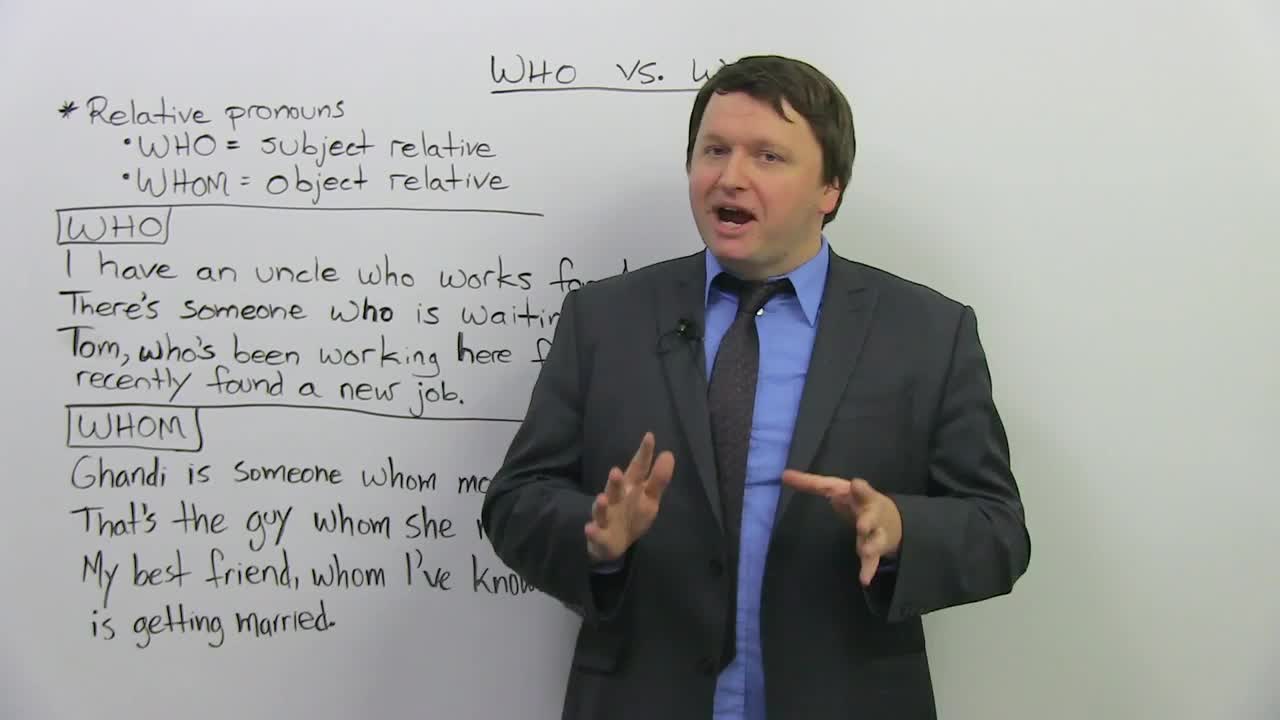
Now, what this means is who is a subject relative pronoun, whom is an object relative pronoun.
What does this mean?
Well, this means that when you use who in a sentence to give more information about something, you are using it to give more information about a subject.
When you use whom, you're using it to give more information about the object of a sentence.
So, let's look at some examples first with who.
Number one, I have an uncle who works for Apple.
Number two, there is someone who is waiting for you.
Number three, Tom, who has been working here forever, recently found a new job.
What do they all have in common?
Well, they all have a subject, a person who you're giving more information about.
So i'm going to mark things up a little bit so you can see how this works.
I have an uncle who works for apple, who are you giving more information about in this sentence.
You are giving more information about your uncle, so you have who and who relates to an uncle.
Now, this uncle is doing an action.
The uncle works for Apple.
So if you have a subject, you're giving more information about the subject and the subject is doing an action after who, then you use who.
All right?
I have an uncle who works.
He works for Apple.
Next, there is someone who is waiting for you, so we have who.
Who does who relate to?
Who relates to someone?
A mystery person.
So, there's someone who is waiting for you.
Yes, we are giving more information about someone, and the someone is doing an action.
Here, they are waiting.
So, I have someone, there is someone who is waiting.
They are the ones who are doing the action.
Tom, who has been working here forever, recently found a new job.
So we have who.
I'm just going to mark who's who has been working.
And yes, we are talking about tom and we are saying that tom has been working here.
So if the subject of the sentence is doing the action here, then You need to use who.
Whom.
Three sentences.
Gandhi is someone whom most people admire.
That's the guy whom she married.
Three, my best friend whom I've known for 10 years is getting married.
So, what's the difference between these sentences and the sentences with who?
Hmm.
Gandhi is someone whom most people admire.
Yes, the sentence is... about Gandhi.
We are talking about Gandhi in this sentence.
But also important, is Gandhi doing an action in this sentence?
Or is he receiving an action in this sentence?
Here we have.
Gandhi is someone whom most people admire.
The sentence is actually talking about the people who admire Gandhi.
The people are doing an action to Gandhi, and Gandhi is receiving the action in this sentence.
So here And this is true in most cases after whom you usually have someone who does the action to someone else.
So, Gandhi is someone whom most people admire.
Next, that's the guy whom she married.
We see whom.
Who does whom relate to?
Yes, we are talking about the guy, but the guy is receiving the action.
He's actually an object here because she married him.
Now I don't mean that the man is an object and the woman is an object in many cases, so I don't mean any of that.
Grammatically, that's the guy whom she married.
The guy is receiving the action of marriage from her.
And finally, my best friend whom I have known for 10 years is getting married.
Here we have whom.
Who are we talking about?
Okay.
My best friend, yeah.
But my best friend is receiving an action here.
I have known my best friend.
Okay?
So here I'm saying I have known my best friend.
I have known him or her.
Okay?
So if this person that you want to talk about is receiving some kind of action, like Gandhi, is someone whom most people admire.
That's the guy whom she married.
My best friend, whom I've known for 10 years, is getting married.
If you have these cases, you must use whom.
A very easy trick, quick and easy to remember.
In most cases, when you use who, you're going to use a verb after it.
Okay?
So, he's someone who works all the time.
They are a couple who is very happy.
And whom, most of the time, you are going to have a pronoun, a person, someone's name after it.
So, he is someone whom many people respect, or she's someone whom I love.
Now I say most cases because in the passive voice you could also say Gandhi is someone whom is admired, and obviously we're saying by many people in this situation.
Okay, I'm going to go to the next room and we're going to look at quantifiers with who or whom and we're going to look at questions with who or whom.
Come with me.
Oh, you guys are already here.
Perfect.
All right, so next we're going to talk about who and whom with quantifiers.
Now, don't let the word quantifiers scare you.
Quantifiers just mean words that talk about quantity, like many, or numbers like one two three four, five or some or most or 20.
It can be anything that involves numbers and quantity and size.
Okay?
So, here I have two sentences.
First, my students, most of whom are from Brazil, have a test today.
Next, there are 20 people at the party, 16 of whom i know now here, most of whom are from brazil, 16 of whom i know.
These are actually adjective clauses that include quantifiers in them, an expression of quantity, And the first thing I want to do is explain the formula to you.
So, when you use this construction, you need your subject.
You need a subject like my students or 20 people at the party.
So, after that, you need quantifier.
For quantifier, I'm just going to put Q. plus of, plus whom, plus other info.
I'm just going to put other info.
So it's always most of whom, some of whom, three of whom, two of whom, 30% of whom.
And you'll also notice I'm always saying whom, whom, whom, whom.
This is one case where you always have to say whom.
Okay?
You cannot say, most of who.
It's always most of whom, three of whom, etc.
So, let's look at these one more time.
My students, most of whom are from Brazil. have a test today.
They have a test today.
And next, there are 20 people at the party, 16 of whom I know.
So, I know 16 people at the party, and the party has 20 people.
So just remember, when you have this construction, you need to use whom.
And there is actually a lesson on this on my engVid channel, so you can check that out too if you want more detailed explanation.
And finally, questions.
Now, questions are tricky and all of this is tricky actually, but questions in particular, because very few people, especially native speakers, use whom in a question form most of the time because they don't know the rule.
And the rule is followed in the same way, like I explained at the beginning, where who is subject relative?
Whom is object relative?
So I have four questions.
Let's look at the first one.
Who saw the accident?
These are all correct, by the way.
There are no mistakes in these questions.
Who saw the accident?
You're asking a question about who saw, who did the action of seeing.
So here it's obvious, you must use who, because the who, let's say his name, is Marcus, And I say Marcus saw the accident.
Marcus is the person who saw the accident.
He did the action.
So in the question, who did the action?
Who saw the accident?
Next, whom did she pick for the job?
Now, here we have to use whom because she, the boss, is picking them.
Okay?
So if I say, she picked Jack.
And Jack is the person who got the job.
Okay.
Jack is the one whom she picked.
She picked him.
So here...
Again, we don't know whom she picked.
She did the action to this person.
So, whom did she pick for the job?
Next, do you know who won last night?
So, I'm watching a soccer game, I'm watching a hockey game, and you know...
I watched it, my friend did not watch it.
And he says, hey, you saw the game last night.
Do you know who won?
So here obviously, the team who won is the team who did the action of scoring and winning, so we have to use who.
And finally, do you know whom she was talking about?
So, she was talking about someone else.
We don't know who, and again, the correct way to say it is in this situation whom she was talking about, because she is giving us more information.
We don't know whom she did the action of talking about to.
I'm sorry, it's very complex.
So, honestly, guys, in most cases, most native speakers just say who, especially in questions.
So if you say who and you're a new English learner, Do not worry, because almost no one will know that you're making a mistake.
And even though it is technically a grammar mistake, it's so commonly used and accepted that it's not really a mistake.
As a grammar teacher, I'm telling you that.
What's more important?
The fact that you speak correct English, or the fact that you speak English that other people are using all around you and you want to interact with those people.
Both are important.
Correct English, but it's more important that you are using the English that native speakers are using.
So that's a lot of information today and I hope that I was able to erase some of your doubts, some of your confusion about this very complex topic.
And if you want to test your understanding and if you want to know for sure that you know the difference between who and whom, as always, you can check out the quiz on wwwengvidcom.
And if you like this video, don't forget to comment on it.
Like it, subscribe to the channel and check me out on Facebook and Twitter.
I've got a lot of stuff on there pictures of me with lightsabers and stuff like that so maybe you'll like that.
And if you want to support engVid, don't forget to donate to the site.
Until next time, thanks for clicking.
And I will see you later.
Bye.