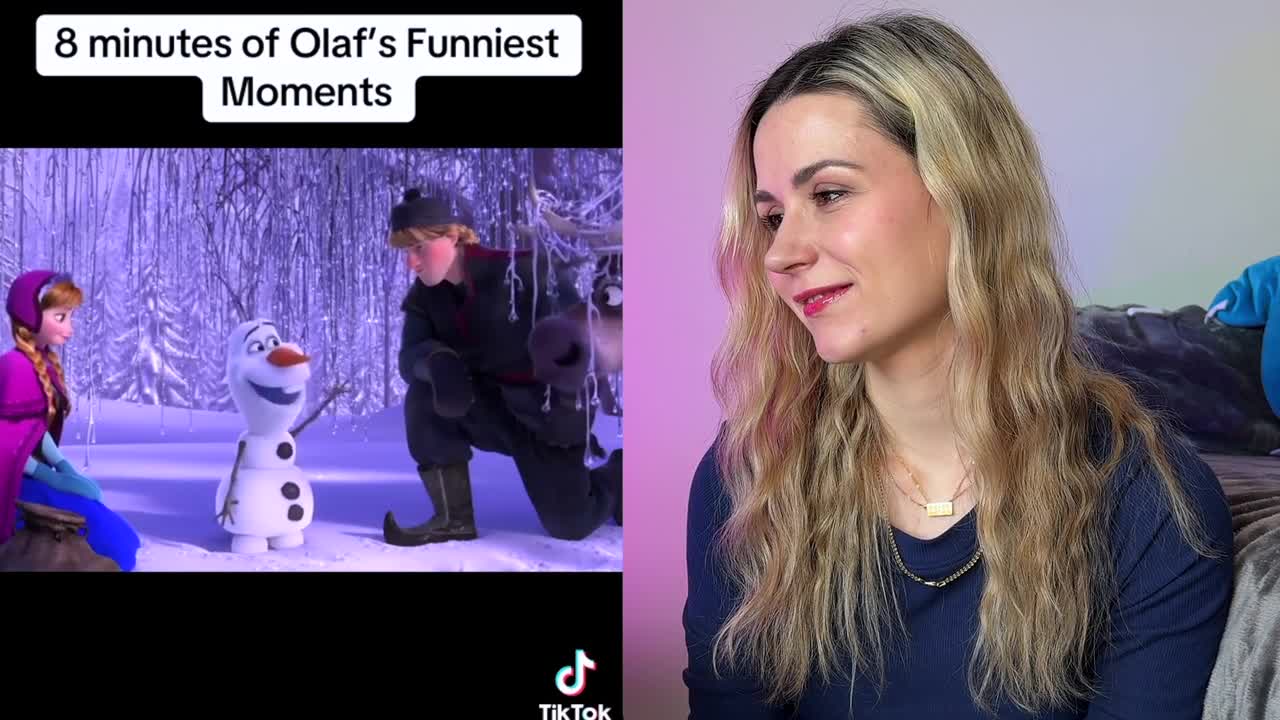
Hey guys, I hope you're doing amazing and welcome to another video where we learn English with movies.
So today we're learning with Frozen.
I absolutely love this movie.
I've watched it like five times already.
I assume you know the drill by now, so let's jump right in.
And as usual, we'll watch some fragments first and then we'll break them down.
Oh, I love it even more.
All right, let's start this thing over.
Hi everyone, i'm olaf and i like warm hugs, olaf.
That's right olaf, and you are um, i'm anna, and who's the funky looking donkey over there?
That's sven uh-huh.
And who's the reindeer?
Sven build you.
Yeah, why do you know where she is?
Yeah, why do you think you could show us the way?
Yeah, why does this work?
Ow, stop it Sven, try and focus here.
Oh, I am gonna talk to my sister.
That's your plan.
My ice business is riding on you.
Talking to your sister?
Yep, so you're not at all afraid of her.
Why would I be?
Oh boy.
I'll meet you guys at the castle!
Stay out of sight, Olaf!
I will!
Hello!
I'm just living the dream, Anna.
Oh, how I wish this could last forever.
Tell me, you're older and thus all-knowing.
Do you ever worry about the notion that nothing is permanent?
Hey, Olaf, maybe just one of you should do it.
I agree.
She's a little pitchy.
All right, so let's begin.
So there's this scene where Olaf is introducing himself and then he's like waiting and asking, and you are.
Oh, I love it even more.
All right, let's start this thing over.
Hi, everyone.
I'm Olaf and I like warm hugs.
Olaf?
That's right!
Olaf!
And you are...?
So this is a polite way to ask someone to say their name when they haven't introduced themselves yet.
It is very natural, very casual, and used a lot.
It's like a short, casual way of asking what's your name, who are you, or saying you haven't introduced yourself yet.
Did Elsa build you?
Yeah, why?
Do you know where she is?
Yeah, why?
Do you think you could show us the way?
Yeah.
Why?
How does this work?
Ow.
Stop it, Sven.
Try and focus here.
This one is interesting and I don't know if you registered it, but Elsa, Elsa Anna asked did Elsa build you?
Here, build means create or put together.
Elsa creates Olaf piece by piece, snow magic, shape.
So english naturally uses build.
But why do we say build a snowman specifically?
Because again, a snowman is made step by step, assembled from parts snowballs arms face, shaped and structured.
So in english when something is assembled, we usually use the word Build.
So build a house, build a robot, build a sand castle, build a snowman.
It's about the process, not tools.
Now, can we say make a snowman?
Yes, we absolutely can.
Both are correct.
The difference here is very subtle.
Build a snowman is more common and sounds more natural, whereas make a snowman is still correct, but just like more general.
Okay, so think of it like this.
Make a It's like very broad.
Create anything.
Whereas build means to create by putting parts together.
Native speakers prefer build for snowmen because it feels more specific.
Oh, I am going to talk to my sister.
That's your plan?
My ice business is riding on you talking to your sister?
Yep.
My eyes business is writing on you talking to your sister.
So here we have this nice little phrase, writing on.
So what does this mean?
Depends completely on.
Or is at risk because of.
Or will succeed or fail based on this one thing.
So what christoph is basically saying?
If you don't talk to your sister, my eyes business could fail okay.
So again, what right on means?
In general, when something rides on something else, it means the outcome depends on it.
It's often used when something is important, when there's pressure and the stakes are high.
And here's a couple of examples My job is writing on this presentation, which means if the presentation goes badly, I could lose my job.
Everything is writing on this exam.
This exam is extremely important.
Our vacation is writing on this weather.
So this means if the weather is bad, our vacation won't happen.
And this phrase in general just adds a bit of drama or urgency.
Yep.
So you're not at all afraid of her?
Why would I be?
Okay, interesting part here.
Kristoff asks, so you're not at all afraid of her?
And then Anna answers, why would I be?
And this is a very interesting but very common answer to a question like this.
Why do people say why would I be exactly like this?
Because it is short for a longer conditional sentence that native speakers automatically understand.
The full idea in the speaker's head is something like why would i be afraid?
Or why would i be afraid if there's no reason?
Or let's say why would i be afraid given the situation?
English just drops the obvious part, and this is called ellipsis, which means leaving words out because they're already understood.
So what is the grammar behind this question?
In English what is used to talk about imagined situations, logical outcomes and conditions.
Okay, so why don't we say something like why am i or why should i be?
Because those mean different things.
Why am i?
Assumes you are afraid.
Why should i be?
Asks for a reason and it is like more neutral.
Whereas why would i be afraid?
Says there is no logical reason for me to be afraid.
I'll meet you guys at the castle.
What do you think we're gonna be talking about here?
We're gonna be talking about this little word at and its usage.
So in English at is used when we talk about a specific point or location where something happens, especially for a meeting point.
Here the castle is the meeting place, not something you're entering or moving through, just the spot where people come together.
When people say i'll meet you at the castle, it means somewhere outside the castle, near the entrance, somewhere around it like general location.
You're not focusing on inside, just where the meeting happens.
Why not in or to
I'll meet you in the castle means inside the castle, right?
Somewhere within the castle.
It's a different meaning.
To the castle.
I'll meet you to the castle.
This is incorrect.
To is for movement, not meeting.
So you can say something like I'm going to the castle and meet me at the castle.
Okay, and now this is a very common pattern in English.
We almost always say meet me at the park, meet me at the station, meet me at the restaurant or meet me at the entrance.
It's a fixed natural pattern.
A simple way to remember at is a meeting point, location.
In is inside a place.
And to is movement direction.
I'm just living the dream, anna.
I'm just living the dream, so living the dream.
This is a very, very common phrase that is used a lot in casual conversation.
So it has a literal genuine, positive meaning, which is someone is truly happy and very satisfied.
For example, i get to teach english and watch disney movies for work.
I'm living the dream now.
There's also another sarcastic meaning, and it's very common and this is actually how it's used most of the time.
So someone might say this phrase when they are, you know tired overworked, rest or dealing with something annoying.
So someone might say something like well, it's monday, i spilled coffee on myself and my wi-fi isn't working, so i'm living the dream, meaning my life is not that great right now.
It's funny because the phrase sounds positive, but the situation clearly is.
It is very, very common at work, in casual conversations, in sarcastic replies and in social media captions.
Oh, how I wish this could last forever.
So here we will talk about grammar just a little bit.
So the sentence is about wanting something that is not realistic or possible.
We'll talk about the structure of this whole sentence and especially the word wish.
So we use the word wish when talking about something we want, something that isn't true right now, or something we know probably won't happen.
For example, you could say something like, I wish I lived closer, or I wish it wasn't raining.
I wish today could last forever.
All of these are about non-reality.
Now, why do we use the word could here?
Could here does not mean ability.
It means if it were possible or in an ideal world, this could last forever.
This means this lasting forever is not realistic, but i wish it were.
English uses could to soften the idea and make it hypothetical.
Can we use can here instead of could and say i wish this can last forever?
No, this is incorrect, because wish pushes the sentence into unreal, imaginary time and english responds by shifting verbs into a past or conditional form.
So we get can could will, would is were.
This is called a subjective, unreal structure.
But don't worry about the name.
This is just about the feeling older and thus all-knowing.
Do you ever worry about the notion that nothing is permanent?
You're older, thus all-knowing.
So here, thus.
This is a very interesting word and it is fairly commonly used.
It means so.
Therefore, or because of that, why would we use thus instead of so?
Well, because it sounds more formal, and sometimes we need to sound more formal.
Also, it sounds a bit dramatic or ironic, right?
Dramatic, as in this situation.
And it's very often used humorously in casual speech because it sounds very fancy.
Let's compare.
You're older, so you know everything.
It sounds normal casual, but you're older, thus all-knowing.
Well, this sounds playful, mock serious.
Hey, Olaf, maybe just one of you should do it.
I agree.
She's a little pitchy.
She's a little pitchy.
So what does the word pitchy mean?
Pitchy is a very common word when people talk about singing or music.
It means slightly off key or not hitting the right notes consistently.
This word comes from the word pitch, which means how high or low a sound is.
So the word pitch can be used outside music and it is also used when talking about english pronunciation, especially in teaching, and you might have heard this in fact, i'm sure that you've heard about pitch when it comes to english pronunciation.
So this means how your voice goes up and down.
This is like part of intonation.
It helps you show emotions, it helps you ask questions and make statements and emphasis.
For example, you can ask someone really Like going up with your voice.
Or you can say, really going down.
See the difference?
Same word, different pitch, different meaning.
Okay guys, that'll be it for this video.
I really hope you enjoyed it because I did.
And, as usual, thank you for watching and subscribing, supporting this channel.
Don't forget to hit all the buttons and please don't forget to drop your suggestions for future videos.
If you have your favorite movies that you would like me to break down, please drop them in the comment section and I'll see you in the next one bye.