
[Mastering English Pronunciation Through Popular Tongue Twisters]-[Improve your Accent: Tongue Twisters]
📋 Summary
Mastering English Pronunciation Through Popular Tongue Twisters
In this lesson, host Alex explores the utility of tongue twisters as a powerful tool for linguistic development. While often dismissed as mere games, tongue twisters are "short phrases or short little stories" designed to challenge the speaker by repeating "problem sounds or the same groups of sounds." By engaging with these exercises, learners and even native speakers can enhance their "pronunciation, enunciation, and ability to speak more fluently."
The Strategic Value of Tongue Twisters
Alex highlights three primary reasons to incorporate these exercises into a daily routine:
- Engagement: They are inherently "fun."
- Challenge: They provide a rigorous test of oral motor skills.
- Clarity: They improve public speaking skills, making the speaker "more understandable to a general audience."
Deep Dive into Four Essential Exercises
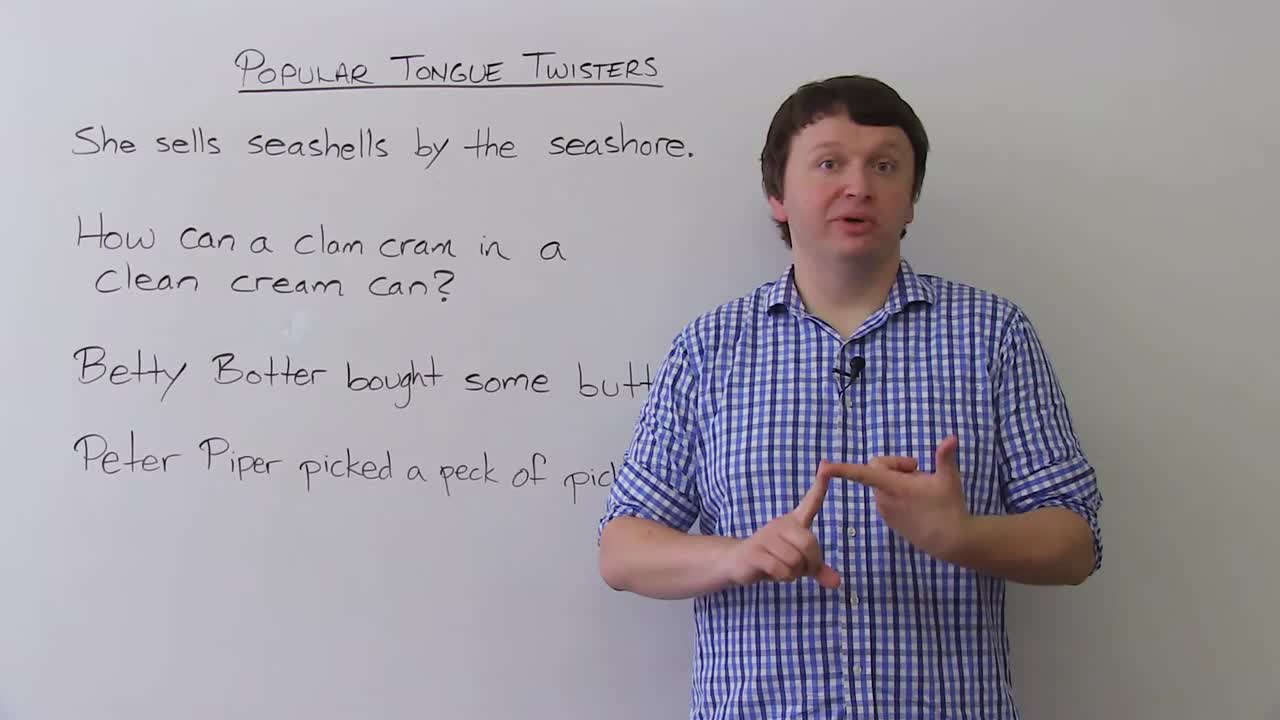
1. The SH-S Distinction: "She Sells Seashells"
This classic exercise focuses on the complex transition between the "SH" and "S" sounds. Alex notes that the difficulty lies in the alternating sounds, requiring precise control of the tongue and breath. Consistent repetition of "She sells seashells by the seashore" helps bridge the gap between these similar phonemes.
2. Mastering L and R: "How Can a Clam Cram"
Many learners, particularly those from Japanese or Korean linguistic backgrounds, struggle with the distinction between the "L" and "R" sounds. This tongue twister is specifically engineered to isolate these sounds in a repetitive context. By practicing "How can a clam cram in a clean cream can?" learners can train their ears and mouths to notice and produce the distinct differences between these two consonants.
3. Vowel Precision: "Betty Botter"
Focusing on vowel clarity, "Betty Botter bought some butter" is highlighted for its mastery of the "ah" and "eh" sounds. Alex emphasizes the importance of mouth positioning, advising listeners to "open your mouth more on botter and bot" to ensure the vowel sounds are distinct and accurate rather than muffled.
4. Consonant Articulation: "Peter Piper"
Perhaps the most iconic English tongue twister, "Peter Piper picked a peck of pickled peppers" is essential for mastering the "P" sound. Alex points out that speakers—particularly those from Spanish-speaking backgrounds—often have issues with the "P" sound, sometimes confusing it with a "B." The focus here is on the crispness of the "picked" and "pickled" sounds, ensuring the speaker avoids "peacled" or "peaked" pronunciations.
Methodology for Improvement
Alex provides a clear roadmap for success when practicing these drills:
- Start Slowly: Do not rush. "First make sure that you can actually pronounce the sounds" in isolation.
- Incremental Progress: Once the individual sounds are mastered, "work your way through it, repeating it, getting faster."
- Consistent Practice: Improvement is a cumulative process. By revisiting these phrases, learners can eventually achieve the speed and fluidity required to speak with confidence and clarity in professional or public speaking contexts.

Deep Learning with ListenLeap


