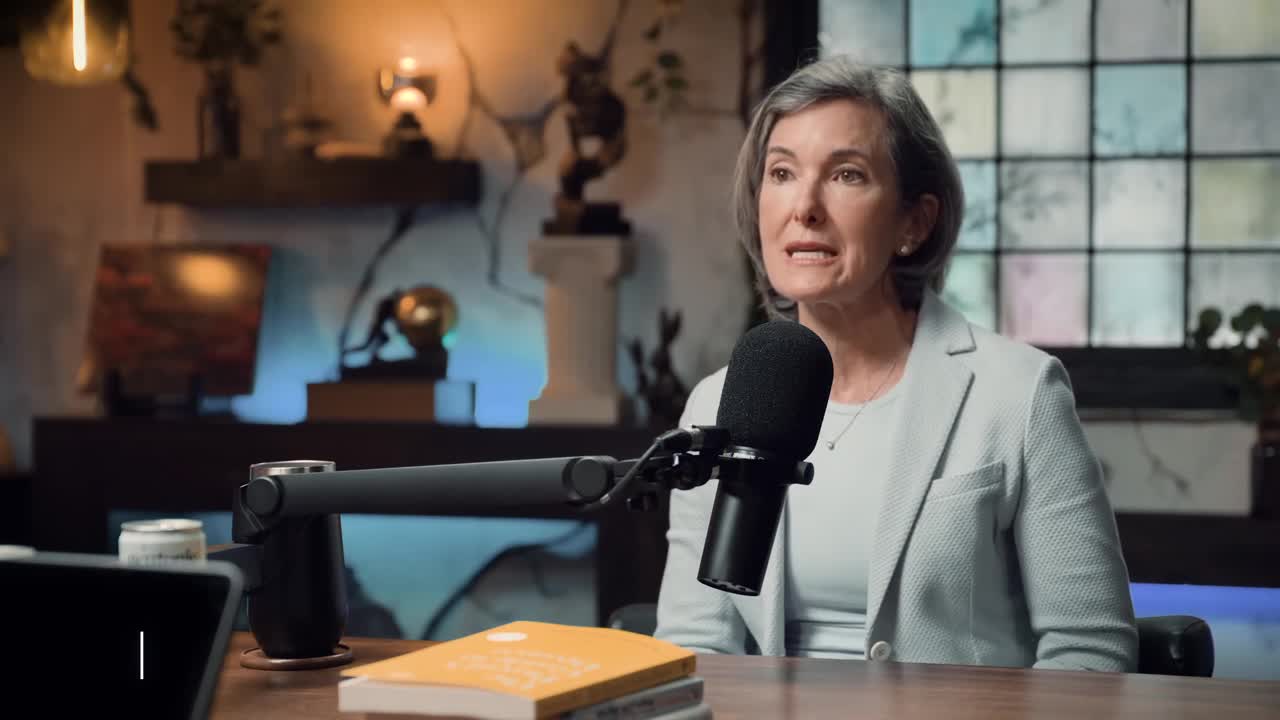
Talk to me about daycare.
What's the problem with daycare?
Well daycare, as I said, it's basically separating babies from their primary attachment figures, putting them in institutional settings with ratios of no less than five to one, usually eight to one.
Caregiver to child ratio.
You're basically sending that child's cortisol levels.
The research shows that salivary cortisol levels go through the roof.
So babies go into high stress states.
Now they're separated from their mother's bodies and they're separated from the person in the world who's meant to make them feel safe.
They're in a loud, overstimulating setting with babies crying and caregivers transient caregivers alternating and some being absent, and it's a new caregiver because they're always out sick.
It's the worst possible caregiving situation for a child.
There are so many better.
If you have to work, the best is a mother or father, whoever's the primary attachment figure.
The next best is kinship bonds, which are family or extended family members who have a more similar investment to children emotionally.
The next best would be a single surrogate caregiver or a nanny or a babysitter who's going to be an alternative attachment figure to that baby which will provide them with some sense of security and care for them in your home.
And if you can't afford that, then share a caregiver.
That's a big thing in California, where they We'll split the cost of one caregiver so that caregiver is now taking care of two or three children.
You have now reduced the ratio and that child is being cared for in your home.
And you have agency over that.
Basically private daycare where you don't have to travel.
And it's in your home.
And so you have agency over who that person is, how they care for your child.
You can put cameras in your house if you want.
You can see what they do.
You can observe them.
You know who's taking care of your children.
And your child isn't going into this like high stress state of screaming, crying.
If you go into a daycare center, you would cry.
I always say to parents you drop them off.
And you have this schizoid response where you shut down what you're feeling and go to work.
But if you knew what happened in those daycare centers, if you heard those babies cry, What does happen?
What happens in daycares?
Crying babies.
Because the bottom line is, if I handed you eight babies and you're one person could you soothe all those babies in distress at the same time?
I'm not convinced I could soothe one of them.
Okay.
Now I'm giving you eight.
And so what's happening is those one person cannot you know, parents who have attachment disorders of their own think oh, it's better for somebody else to care for my child, because I'm not a good, I can't handle it without thinking who's this person that I've just handed my baby to, and how are they gonna care for five to eight children and soothe them when they're in distress?
And so parents, just it's like they shut down a part of their, It's like they shut down their empathy.
It's like they have a schizoid response with empathy, where they cannot see their baby's vulnerability or their baby suffering.
What are your favorite studies that show how we shouldn't ignore early attachment in childhood?
John Bowlby is the father of attachment.
You need go no farther than John Bowlby, but you could look at all of what they call the stranger situation studies, which they've been doing since the 1960s.
They have repeated this experiment over and over.
In fact, I was...
There's a researcher named Beatrice Beebe in New York.
She's very famous.
And I was in some of her videos because when I was a young social work student I did some volunteering in a stranger situation study.
Again, this situation is repeated over and over and over again.
It's the most well-known attachment security study.
And it sort of goes something like this.
The mother and baby are playing in a room.
A stranger walks in.
The mother walks out of the room.
The mother walks back in and there's a reunion.
It's sort of they look at the baby's reactions.
They look at the interaction between the mother and the baby, the interaction between the stranger and the baby.
They look at the reunion between the mother and the baby.
So this is something that's done over and over.
We have so much longitudinal research on attachment security, going back to the 60s, so much research to show that attachment security, If you're not securely attached at 12 months, then 72 of those babies 20 years later will not be securely attached.
And that insecure attachment is tied to depression, anxiety, borderline personality disorder.
So we have the research.
The research has been there for many years.
Now we have the neuroscience research and the epigenetics research to support the attachment research.
Square this circle with the heritability of attachment style for me.
The heritability of attachment style No.
So it's generational expression.
So I sort of balk at the idea of inheritance.
It's inheritance of acquired characteristics.
So you don't inherit it genetically.
You inherit sensitivity genetically, but you inherit through acquired characteristics, meaning your environment.
A mother who is insecurely, anxiously attached. will more likely produce an anxiously attached baby.
A mother who is avoidantly attached will more likely produce an avoidantly attached baby.
A mother who has a disorganized attachment and is a borderline personality disorder kind of patient will more likely produce a child who has a disorganized attachment and probably a borderline personality disorder.
So, we call it generational expression of mental illness.
So, inheritance of acquired characteristics.
I guess it's interesting to think about predisposition versus predetermination with stuff like this.
The raw materials are there.
I've always thought this about, I'm a big Plowman fan.
I think he's one of the best researchers of all time.
He's one of the fifth most cited psychologist in the 20th century.
Uh, this, the guy that kind of the grandfather of behavioral genetics, I think he rules.
And um, when I think about the first few years of a child's life, it's such a weird confluence of what were the raw materials that you were made of.
Yeah.
How are they expressed in the people who made who, who gave you them?
They are expressed in behavior yeah, and that behavior happens to be the environment.
It would be like it would be like a cow that cuts its own leg off to then cook it in a stew.
You know, like the very thing that it's made of is the thing that's creating it.
And that's a fucking horrific analogy.
But It seems so unfair.
This is what I sort of came back to when I started to think deeply about behavioral genetics and attachment style that you have presumably an anxiously attached mother, has the raw materials to be anxiously attached and then is presenting in an anxiously attached way.
Yeah.
Which means that the child that has the raw materials to be anxiously attached gets that reinforced.
And all of this happens pre-verbal.
All of this happens before you can even remember.
I can't remember anything basically before age...
Nine or ten?
Really spotty memories.
So you know the song from Hamilton, you want to be in the room where it happens?
The room where it happens is zero to three.
Hmm.
That's what it means to be in the room where it happens.
And no one wants to talk about the room where it happens, because they can't remember it consciously, because it's pre-conscious memory, but it's what shapes your personality.
So nature versus nurture is always an interesting question, because we are born with a constitution.
Meaning constitution is the amount of aggression we're born with.
Babies are all born aggressive.
Was it the most aggressive people on the planet, three-year-olds?
So, well, no, actually, babies are born dysregulated and babies are all born aggressive.
So, you know, people get it wrong.
People think that babies are born regulated and we dysregulate them by neglecting them or abusing them.
No, actually, babies are born dysregulated.
With highs and lows.
I mean, if you ever just observe a baby infants that are newborn infants they will go from being happy one second and zero to 60 in three seconds.
Boy, they'll be screaming.
Just the most bipolar little blob.
Polypolar little blobs.
Okay.
But they're not blobs.
They're incredibly sort of present, but they have no emotional regulation.
And it is by that skin-to-skin contact, that calm, soothing tone of voice.
Of the primary attachment, figure.
Every time the baby's in distress, the mother soothes the baby.
The way I would describe it is babies are born like sailing a sailboat in the Pacific in a storm.
This is how babies are born.
By having a mother, physically and emotionally present in those first three years, who is calm and present and loving and soothing.
You don't want to get the baby flatlining.
That's not what we call homeostasis.
We call homeostasis more like sailing in the Caribbean on a sunny day.
There's waves, but, you know, you can manage them.
And then, you know, they're kind of manageable and pleasant.
That's where you want to get the baby.
But you cannot do that if you throw your baby into a daycare setting, if you disappear 10 hours a day and go to work and the one person that's meant to help them to learn these things they're not learning.
So we have children who are going into primary school years and then adolescence, completely dysregulated, which is why they're all breaking down in this mental health crisis.
It's not a mystery, but you have to go back to the room where it happens.
But aggression Aggression is one of the things that you're born with constitutionally.
In the old days, you used to go into a hospital, into a maternity ward.
Thank goodness John Bowlby got rid of the maternity wards.
John Bowlby went into the hospitals in the UK and he said, no, no, no.
Those babies, they need to lie in with their mothers.
They need to be, they've come out of their mothers.
What was a maternity ward?
It was a room where they took the babies from the mothers, so the mothers could rest and they took them.
So now nurses who they didn't recognize this were just mammals, didn't recognize the smell or the voice.
Couldn't find their mother's eyes, because they saw their mother's eyes when they were born, because they would show you the baby.
Here's your baby.
Now, bye.
And they would take the baby away, put it in this maternity room with other screaming, crying babies.
And the mother is sleeping and they're telling the mother this is normal.
I mean, like cuckoo, right?
So he said, wait a second.
You know, he studied cultures all over the world.
He wrote a big book like this called Detachment, which I recommend everyone who has a baby to read.
And another book like this is big, like this called Separation, where he studied cultures all over the world.
Universal.
The idea that attachment security is critical to a baby's emotional regulation and conditioning.
Before we continue, as you're probably aware, I'm not a massive drinker, at least not anymore.
But even if you, too are not drinking, sometimes you just want something cold, frosty and tasty without the fear of a hangover the next day, which is why I'm such a huge fan of Athletic Brewing Co.
Thank you very much.
Their non-alcoholic brews taste just as good as the real thing.
They've got IPAs, hazy goldens.
They're so good that you'll forget that there's no alcohol in them, until you wake up the next day feeling fantastic.
It means that you can enjoy the ritual without the wreckage.
No hangover, no 3 a.m. panic, no wasted Sunday recovering from Saturday.
That is why I partnered with them.
You can find Athletic Brewing Co.'
's best-selling lineup at grocery or liquor stores near you.
Or, best option, get the full variety pack of four flavors shipped right to your door.
Right now get up to 15 off your first online order by going to the link in the description below or heading to athleticbrewingcom slash modernwisdom and using the code modernwisdom at checkout.
That's athleticbrewing.com slash modernwisdom and modernwisdom.
At checkout.
Nearby at Terms and Conditions Apply.
Athletic Brewing Company.
Fit for all times.