Welcome to Spotlight Advanced.
I'm Alice Irizarry.
And I'm Andrew Deavis.
Spotlight uses a special English method of broadcasting.
It is easier for people to understand no matter where in the world they live.
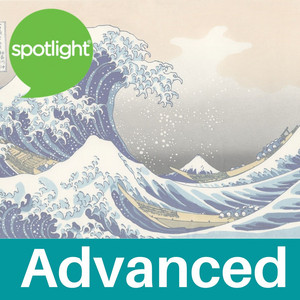
A great wave rises in the ocean.
Three small wooden boats float below it.
There are people in these boats, but we cannot see many of them.
The ocean waves are so high.
These block the sailors from being seen.
The sailors we can see hold on for their lives.
Far past the sailors a mountain rises.
There is snow at its top.
The mountain is the same colour as the waves.
It even looks as if it is one of them.
But it is solid, unmoving.
This is a description of a famous painting.
It is called The Great Wave off Kanagawa by Katsushika Hokusai.
Great Wave is an excellent example of a Japanese art style called ukiyo-e.
This name translates to pictures of the floating world.
These pictures are a style of printed art.
Today's spotlight is on the floating world of Japanese printmaking.
Ukiyo-e is a unique style of art from Japan.
Japanese artists created its images through a method called woodblock printing.
To create a wood block print, an artist would first paint an image.
Another person would cut the image into a piece of wood.
Then they would cover the image in paint.
They would place paper on top of the wood.
Then they would press down.
This would copy the image from the wood to the paper.
It was a low-cost way to create many versions of a single image.
Japan was not the only country to use woodblock printing.
Many other cultures also used this kind of printing, but the conditions that created ukiyo-e were special.
What historians today call ukiyo-e began during Japan's Edo period.
This was a period of time between 1603 and 1868.
During this period, strong military leaders called shoguns ruled Japan.
These rulers stopped foreigners from entering the country.
People from other countries could not trade with Japan, and Japanese people could not leave their country.
The Edo period was a time with few wars and many people made their way to the Japanese capital.
The name of the capital was Edo.
In its time, Edo became the most populated city in the world.
By 1700, one million people lived in Edo.
Traders or merchants who lived there became wealthy.
Some became so wealthy that they did not need to work.
They spent their time in the Edo Entertainment District.
These were areas filled with theaters, places to eat, and places to buy sex.
People from Edo called these areas ukiyo.
It meant the floating world.
Asai Ryōi was a Japanese writer who lived during the Edo period.
He wrote about these places in his book Tales from the Floating World.
Living only for the present.
Enjoying the moon, the snow, the flowering trees, and the leaves.
Singing songs, drinking alcohol, enjoying yourself, just floating, unconcerned by thoughts of poverty carefree, like a vegetable carried along with the river current.
That is what we call ukiyo.
These wealthy traders wanted art to make their homes beautiful, but they did not want traditional Japanese art.
They wanted art that looked like their lives.
They wanted art that reminded them of the Ukiyo.
Artists began to meet this demand.
At first, these artists painted views of the Ukiyo, but they soon found printing much easier.
They could make hundreds of copies of the same picture and they could sell these prints at a price most traders could pay.
Hishikawa Moronobu was one of the first artists of Ukiyo-e.
Moronobu's style was special, and the subjects of his prints were different.
Before.
Artists often painted the lives of nobles and warriors, but Moronobu's work showed real life in the entertainment districts.
He painted beautiful women playing instruments.
His woodcuts showed actors from kabuki theater performances.
These prints showed sumo wrestlers, sex workers, and tea house mistresses.
But Moronobu did not make his prints realistic.
The prints did not look like a photograph.
These showed a special style.
Most other ukeyo-e artists followed Moronobu's example.
They printed views from life and from history.
But they also improved on his method.
One of the most important improvements was the use of line.
Line is one of the basic elements of art.
It is the part that gives a piece of art its shape.
The line in Moronobu's art often curved or flowed.
Later artists expanded this element.
They filled their prints with graceful, curving lines.
Soon Ukiyo-e began to change.
More people became interested in this form of art, and new masters of the art form appeared.
Katsushika Hokusai was one of these masters.
Hokusai's work was similar to Moronobu's in some ways, but printers of his period used more colors.
These prints were also more detailed.
Hokusai himself studied art from Europe and the Americas.
He used many of their methods in his work.
He played with light and darkness.
These methods made his art seem more real.
Hokusai also showed different subjects than earlier printers.
His Great Wave is an excellent example.
Before Hokusai, Ukeyo-e artists mostly created work about the Ukiyo.
But Hokusai's work showed the beauty of nature.
He painted work showing mountains, animals, and the sea.
Hokusai's work was so popular that other painters followed his example.
Ukiyo-e changed art, both in and out of Japan.
It influenced many artists in the Western world.
Artists such as Vincent van Gogh and Claude Monet took inspiration from what they saw.
French artist Henri de Toulouse-Lautrec's posters show this Japanese style.
These artists contributed to Art Nouveau, an artistic movement.
It started in France.
Its painters took Ukiyo-e's bent lines, but they used these lines in a new way.
By 1890 Ukiyo-e's popularity had decreased in Japan.
The country permitted trade with other countries in 1868.
This brought new technology and new ideas.
These ideas grew popular.
Many believed that ukiyo-e was old-fashioned.
People still produced ukiyo-e, but it was no longer a part of the larger culture.
But ukiyo-e's influence is still strong.
Its style changed Western art.
Prints like The Great Wave off Kanagawa still inspire artists.
And in some places, people still learn the traditional way.
Nakayama Maeguri is the director of the Adachi Institute for Woodblock Prints.
This organization still uses ukiyo-e methods.
It also creates new woodblock art.
Nakayama spoke to Nippon.com about the future of ukiyo-e.
We are trying to show people how ukiyo-e can make our lives better.
We produce woodcut prints from works by present artists.
This is one important way of making ukiyo-e seem more contemporary in the 21st century.
What is your favorite style of art?
How would you describe it?
You can leave a comment at www.spotlightenglish.com.
You can also find us on YouTube Facebook, Instagram and X.
You can also get our programs delivered directly to your Android or Apple device through our free official Spotlight English app.
The writer of this program was Dan Christman.
The producer was Michio Osaki.
The voices you heard were from the United Kingdom and the United States.
All quotes were adapted for this program and voiced by Spotlight.
This program is called Images of the Floating World.
We hope you can join us again for the next Spotlight program.
Goodbye.