This episode is about to be very weird and meta because I'm going to be discussing a
life lesson that I learned from making this podcast.
And the reason why this is going to be weird and meta is because I rarely discuss what goes
into making this podcast.
As a listener or follower or whatever, you just see the final product.
And in a way that's by design because nobody needs to see the inner workings of what
it takes to make entertainment, if you will.
So I keep that away on purpose until today, apparently.
Before we can get to the life lesson, we must go back in time to the inception of this
podcast.
It actually started in 2018, 2019 when I started my first podcast called Stupid Genius,
which only lasted a year or two.
And it was basically a show where I would take a scientific question like, why do we
yawn or why do we sweat or why is the sky blue?
And then I would hypothesize what I think the answer is.
And then at the end, the answer would be revealed.
And it'd be sort of this game of how close could I get to the actual scientific answer.
And then at the end of the episodes, I would sort of just riff on my personal life, like
what was going on, what's been on my mind, et cetera.
And I very quickly fell out of love with the structure of that podcast.
I didn't like doing the exact same thing every episode, it just felt boring to me at a certain
point.
And so I got the idea to start a new podcast where I could take my favorite part of Stupid
Genius, which was the end of the episodes when I would just riff about whatever the fuck
I wanted.
And I turned it into a show itself.
And then anything goes was born, a show where I could talk about anything.
Limboa's entire case is a place where you can see the universe, one by one, and
one by one.
And it's a place where you can see the world.
And it's a place where you can see the world.
And it's a place where you can see the world.
And then at the end of the episodes, I would hypothesize what I think the answer is.
And then at the end of the episodes, I would hypothesize what I think the answer is.
And then at the end of the episodes, I would hypothesize what I think the answer is.
And then at the end of the episodes, I would hypothesize what I think the answer is.
And then at the end of the episodes, I would hypothesize what I think the answer is.
And then at the end of the episodes, I would hypothesize what I think the answer is.
Anything goes for me started as this low pressure place where I could just talk about
whatever I wanted to a much smaller audience than what I had on YouTube, Instagram, etc.
It was honestly more like a hobby for me than anything.
The whole thing was very intuitive.
I would just talk about whatever was on my mind that week.
I mean, similar to what I do now, but it was much more casual.
I didn't really write out outlines or anything like I do now.
I write out outlines for my episodes now so that things feel more cohesive and less jumbled.
It was a very casual fun thing for me.
And by some miracle, anything goes started to succeed a bit more.
And I wanted people's choice award and all of a sudden people are listening to anything
goes.
And it didn't really feel like that for a long time.
And it was weird for me because this was just sort of my little side hobby.
This wasn't something I really was putting a lot of thought and effort into.
And it was kind of a shock to the system when it started succeeding in a way.
And from there, I became a partner with Spotify, a company that I had admired in the podcast
space for such a long time because they're really pushing the podcasting world forward
by supporting podcasters, etc.
Now all of a sudden, I have a deal with them as well.
And I started to feel the pressure like, oh my God, this can't just be my little side
hobby anymore, that's just a fun, low pressure place for me to shoot the shit.
This needs to be something more now.
Why?
Because it's getting attention.
I need to live up to this level of attention.
And I'm somebody who's very prone to imposter syndrome, which means I don't think I deserve
the things that I have.
So I tend to have a more chaotic response to success than other people.
Some people are like, oh, this is awesome.
Okay, great.
I'm just going to keep doing what I'm doing.
But because I have imposter syndrome and I feel like, oh, I don't deserve the success
that I have, I tend to feel pressured to then live up to that praise to that success.
And that can cause me to derail from what's working and try to elevate things in a way
that at times doesn't feel like me to try to match the praise that I'm being given.
And so that very much happened to me with anything goes.
I had this intense imposter syndrome identity crisis about anything goes.
And I made the decision to elevate the show, if you will.
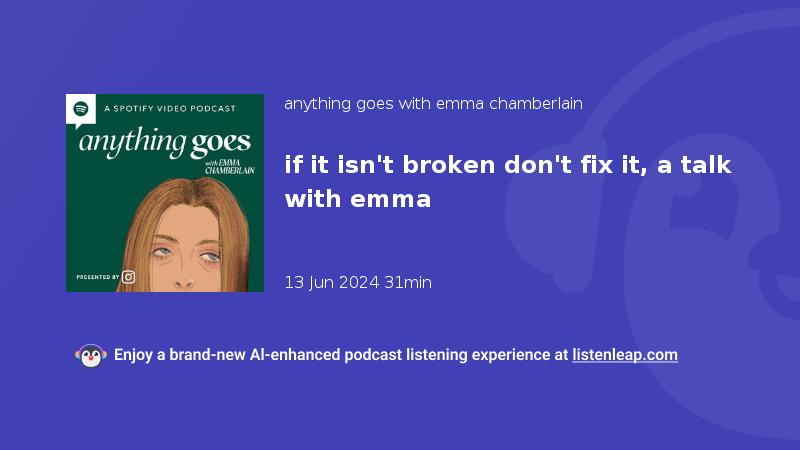
I changed the podcast art from a little doodle of me sitting in bed with my cats to this
gorgeous, crispy photo of me looking in a mirror with a new, more mature font and all
of these, you know, different things.
I wanted the show to look shaker.
I started recording in a small little studio in my house.
I made a little studio with a little couch bed thing.
And I had my whole recording set up and I had a camera set up because in addition to
this new sort of studio situation at home, I also wanted to do video episodes so that
you could watch the podcast as well as listen to it to make the experience more dynamic,
to also elevate the show.
And in addition to that, I started having guests on the show.
A lot of specialists in various fields, also some celebrities, also some family members,
also some friends.
And in general, I just started discussing more meaningful topics to me.
And I will say the more meaningful philosophical topics that I started discussing were partially
caused by this desire to make the show more meaningful, give it more gravity in a way.
You know, instead of talking about things that were more surface level, I wanted to talk
about deeper things to make the show feel more elevated.
But also, I think that I was also going through sort of an existential crisis in my life
at the same time.
So I think the switch in subject matter kind of had a dual cause.
And it's sort of hard to pinpoint why that happened.
But I definitely think a large portion of why I shifted the subject matter to being
more serious, more philosophical, more meaningful was definitely because I felt a pressure
to.
I felt like if I don't make things more serious, then people won't take me serious.
And I won't live up to the level of praise that the show's been getting.
But what's interesting is I expected making all of these changes to make me feel more confident
in anything goes, make me feel like I've earned the praise that I had received.
But what happened was the opposite.
I felt misaligned with the identity of the show.
And it didn't really feel me anymore.
And I was proud of certain parts of the show.
Like, you know, there were certain maybe more meaningful, deeper episodes that I was
really, really proud of.
And they really felt like me.
And I was just enjoying talking about these things.
But there were also times when I would make maybe a more meaningful philosophical episode.
And it was sort of forced in a way.
I was trying to upkeep this level of conversation.
And my heart wasn't always in it.
And I don't know.
It was sort of like 75, 25.
Like 75% of the time I was like, yeah, this feels really good actually.
But then 25% of the time I was like, this really feels off.
And again, I think that part of that is because I was forcing myself to make things more
meaningful.
But then I also think it was because at the same time I was going through this existential
crisis in my life where I was disconnected from myself for a period of time, which happens
to literally everyone in their 20s.
If I talk to any elder in my life about their 20s, all they'll discuss with me is their
various existential crises, et cetera.
Like that, it's so common.
So I remain unfazed by that fact.
But it did impact some of the episodes.
They didn't feel quite right.
They didn't feel quite me.
And I also started to notice that recording episodes by myself with the camera on was
starting to psych me out.
Like for some reason, I was having a negative psychological reaction that I did not anticipate
to having the camera on for all of my episodes.
I had lost this feeling of intimacy with the microphone.
What I loved so much about podcasting when I first started was the fact that there was
no camera on me was the fact that I was just talking into a microphone like I was talking
on the phone with a family member or a friend or whoever.
I had lost that feeling of being on the phone because the camera was on.
And similar to like being on FaceTime versus talking on the phone, I recently experienced
somewhat of a long distance friendship, shall we say.
And I was talking to this person a lot on FaceTime, right?
And it was kind of nerve-wracking.
Like, I always was thinking about like, oh my god, what do I look like?
The lighting in my room has to be good.
And there were all these added thoughts that went into my conversations on FaceTime.
And then at one point, we both decided we should just talk on the phone instead.
Like why are we FaceTime?
I mean, this is just annoying.
And I found that our conversations got better because we were eliminating all these variables
that were causing, I assume, both of us to overthink these surface level elements of our
conversation.
You know, the lighting, what we're doing, like I like the fact that I can be on the phone
with somebody and my lights can be out and I can be laying flat in bed and they wouldn't
know any different versus having the camera on being on FaceTime.
And me feeling like, okay, I can't lay down in bed flat with the light off.
That's weird.
They see that.
Do you see what I'm saying?
So it's the same vibe with podcasting I found.
Taking the camera on for solo episodes for me, it just doesn't work as well.
I don't feel as disarmed.
I don't feel as open.
I'm thinking about too many other things.
I'm distracted by the bright light that's in my face when I'm talking.
I'm concerned about whether or not the video camera's turning on or off.
I miss the simplicity of just talking into our microphone and not being what a podcast
is.
And I realized that the desire to elevate in that way didn't really make sense for my solo
episodes.
For interviews, sure.
I don't mind having the camera on.
For some reason, the conversation that I'm having with the person I'm having a conversation
with is distracting enough that I'm not paying attention to the cameras.
But I mean, I also think too that my interviews, I do at the Spotify studios and there's other
people taking care of the cameras and the lighting and all these things.
So I'm not really paying attention to it.
But anyway, I realize that that desired elevate didn't really make sense for me at all.
And when it comes to having guests on, I do love talking to people.
And so I think that's a part of anything goes that I want to keep going.
But I even have my doubts about how I want to do that.
And I'm still sort of figuring that part out.
That's the least figured out piece out of everything.
And all of this to say, I realize that I had tried to fix something that was not broken.
And that brings us to the quote that came to my head when I realized all this, which
is if it ain't broken, don't fix it.
Irvine broke, don't fix it, whatever.
We've all heard the quote.
We've all probably pinned it on Pinterest at least once in our lives.
If it ain't broken, don't fix it, whatever.
We've heard this.
We know this.
But I think in the case of my podcast, this was very true.
It wasn't broken.
It wasn't broken at all.
But I tried to fix it anyway.
And it led me to a much more confusing place.
However, I don't regret any of it.
I don't regret any of the changes that I made.
And the reason for that is because I would not have learned this lesson otherwise.
I let my imposter syndrome get the best of me.
And I let my imposter syndrome let me do things that were not organic to me.
And the only way to learn from that was to pay the price.
What was that price?
Number one, feeling uncomfortable and dissatisfied in the creation of it on a daily basis, not
feeling fulfilled by it.
That was one price I paid.
Another price I paid was receiving more criticism about my podcast.
Some of it fair, some of it unfair as with most internet criticism.
But I got a lot of criticism on the show for a period of time.
And that was really uncomfortable for me and challenging for me.
And again, some of it was completely valid and very helpful and very constructive.
Some of it was just mean.
But both sides of the criticism both apply as a negative consequence to my action.
And last but not least, I felt embarrassed.
I felt embarrassed in almost like, oh my God, well, I made this choice to pivot the show
to this new sort of thing.
I'm embarrassed to turn back and put it back to what it was because it's almost an admission
of failure.
And very quickly, I came to the conclusion that that was what I must do.
And when I closed my eyes and thought about reverting the show back to what it once
was, it felt good.
Like, you know, when you, how do I explain this?
It's so abstract.
You know, when you're trying to make a decision and you're trying to tap into your gut,
and so you imagine what it'd be like to do something.
And you see how your body reacts.
Some of you may do this.
Some of you may not.
If you don't do this, I recommend it because it's very helpful.
When I sat and imagined me creating the show in the way that I used to, much more light-hearted,
recording in my bed, as I always did, turning the camera off, having guests on the show
when it feels right, taking away the structure and just letting it be what it needs to be
every week, whatever, whatever my hard desires every week, just taking the pressure off,
taking the structure off.
I felt this like warm feeling inside, this good, warm feeling, this excited feeling.
And when I imagined continuing doing what I was doing, it felt stiff and cold and hard.
Now, that method only works when you take all external opinion out of things.
Okay?
You cannot consider what people are going to think, what people are going to say.
In order to truly tap into your gut, I think that you have to only consider the action,
not the reaction that will come with it, if that makes sense, to truly decide what the
best next move is.
And so I came to the conclusion that I want to return back to what it used to be.
Now it's not going to be exactly the same because I'm as a person different than I was
a few years ago when I was making a more casual version of anything goes, a more relaxed
version of anything goes, but a lot of things are going to go back to how they used to be.
For example, I'm changing back to my old podcast art.
The instead of the glossy image of me looking in a mirror, we're going back to the little
hand drawn doodle of me sitting in bed with my microphone and my cats.
Pretty much what the show is 90% of the time, except for when I have guests on.
I'm a subject matter perspective, I'm internally making the decision to talk about whatever
the fuck I want, whether it's surface level and stupid and dumb or something really deep
that's been on my mind for the past month, whatever, taking the pressure off to make it all
meaningful, to make it all deep or something.
You might have noticed over the last few months that all of my solo episodes are just audio,
no video.
That was something that I integrated a few months ago.
It's been amazing.
That has helped so much with me feeling reconnected with the process.
And when it comes to having guests on, I'm just trying to be as intuitive as possible
about who those people are and what those conversations are like.
And I'm still sort of figuring out what that's going to look like because I don't know yet.
And maybe at some point I'll decide, I actually don't really like having guests on the show.
And it's not really something that's working for me.
And I couldn't figure it out.
And it just doesn't work.
And blah, blah, blah.
All of this to say, I learned from this that in many scenarios in life, if it isn't broken,
don't fix it.
And I used to have sort of an aversion to this quote because I really didn't believe
it to be true.
I think there are times when things aren't broken, but you should fix them.
But as with all one-liner quotes, there's always nuance.
And you can't take it at face value.
Like this quote doesn't really make sense when something in life is technically intact,
not broken.
But you're still striving for more.
There's an internal hunger for more.
And that internal hunger is not rooted in what other people are saying or the success
or lack thereof that you're experiencing.
It's rooted in gut instinct, in genuine passion, in desire for more.
Just because something isn't broken doesn't mean that there isn't more out there to strive
for.
It comes down to where your motivation is coming from.
If your motivation to fix what is not broken is simply the desire to find personal fulfillment,
then I think it's fully rational and fair to fix something that's not broken.
But I think that this quote does apply very well to a similar situation with a different
motivation.
There are many times in life when we feel the desire to fix something that's not broken
because of external forces, you know, success or the lack thereof, other people's opinions,
societal beliefs that are being forced upon us at times.
And that's when I think that this quote really applies is when we're trying to fix something
that's not broken for someone other than ourselves.
And it's very hard to figure out when that's happening because we can lie to ourselves
very effectively and convince ourselves that we're doing things for us.
But if we were to dig deeper into the thing that we're trying to fix, we would discover
that we actually don't want to fix it.
We're fixing it for someone or something else.
In the case of my podcast, it was because I was trying to elevate the show in a way that
would match the level of success that I had reached with it.
And in addition to that, I wanted people to take the show seriously.
So I felt like it needed to have more depth and more meaning in order to gain that respect
from people, which was not true at all.
There's so many gray areas with this because the quote, if it's not broken, don't fix it.
To me, can at times be almost a limiting belief?
And that's my hesitation to like, I don't know, get it fucking tattooed on my body somewhere
or something or say it too loosely because I do think that at times it can actually be
a limiting belief.
It can be like, no, you should settle for things that are working in your life because it's
not broken.
There's nothing really wrong with it.
But then that limits you, that prevents you from going out and striving for bigger,
striving for better.
And at times that can be a really great thing.
But I would say majority of the time when we want to make a big change, we want to
fix something that's not broken.
A lot of times it is because we're not making that choice for us.
We're making that choice for someone else, something else.
And that's when it's bad.
A good example of a scenario where the quote does apply would be maybe in a romantic relationship.
And you're actually really happy in this relationship.
The relationship is good.
The partner checks all of your boxes, they're supportive, they're honest, they're loving,
they're kind, they're smart, they're hardworking, like they check all the boxes.
But maybe when you look around and you see your friends' relationships, you see something
that you wish you had.
Maybe one of the couples that your friends with laughs a lot more than you and your significant
other.
Maybe another couple that you know seems to have just this like air of deep romance that
you wish you had with your partner.
And you're comparing yourself to these other couples and it makes you look at your own
situation, though it being very much not broken and judge it irrationally.
If you were to know the full truth of those other relationships, you wouldn't want to be
in those relationships probably.
You don't have a full picture, you don't have all the information.
And you're irrationally comparing your situation, which is actually quite good to these other
situations that you don't know the full story about.
Or maybe in this healthy relationship, you feel actually pretty satisfied with it, but
your family has their doubts about it because your significant other maybe doesn't have
a super high paying job.
And they're like, you need to be pursuing a future with somebody who has promising financials.
And now all of a sudden, you're judging your situation because of your family's opinions,
not because of your own.
Whereas if you were to reflect inward on your relationship, you actually don't care about
their financials.
They're doing just fine and you're doing just fine.
And you're happy with the amount of money that you're making together and you're excited
to grow in your jobs together side by side over the next few years.
You see what I'm saying?
But now all of a sudden, you're judging your situation because of what your family
said and you're wondering, oh, well, what else could be out there?
Could I find an anesthesiologist who's just as thoughtful and just as caring and just
as honest and just as awesome as my partner now?
Probably.
And you start to fall into the grass as always greener dilemma.
The grass is always greener.
I don't know, I would say that that's an example when you might try to fix something that's
not broken because of external forces.
An example of when the quote might not apply in a similar scenario would be, let's say,
you're in a relationship and it's okay.
Like, you know, you don't fight with your partner.
You get along pretty well.
They have quite a few traits that are good.
They also have quite a few traits that are not your favorite, you know.
They're bad at communicating.
They can sometimes be judgmental of me, blah, blah, blah.
But I can deal with those things.
This relationship is not broken.
It's intact and it's functioning and it's doing okay.
We don't have any major issues.
But internally, you know that you're not getting your needs met.
There's more out there.
There's more out there to strive for.
It can be hard to analyze the situation because it's not broken.
There is nothing obviously wrong.
Yeah, maybe there are a few traits that aren't quite right, but they're not deal breakers.
They're not things that you can't deal with.
On paper, the relationship is not broken.
But in your heart, in your gut, you know that there's more out there for you.
It can be a very hard, scary situation to manage because the answer is not obvious.
If nothing is obviously wrong and you can't pin it as being broken, it's so much harder
to make a decision.
And it's in those moments that you need to ask yourself and yourself only, do you want
to fix this even though it's not broken?
And by fix it, I mean, ending the relationship and finding something new, fixing your love
life, if you will, even when it's not broken.
It's incredibly challenging because no relationship is perfect.
But if in your heart of hearts, you know that there's more out there for you, you might
go and fix something that's not broken.
Do you see what I'm saying?
Hopefully those were good examples and they might have been horrible.
And so in some ways, from this experience, I learned that if it isn't broken, I shouldn't
try to fix it for the most part.
In some situations, it would be nice if quotes like that,
could apply to everything in life.
So you could just, I don't know, start to build sort of a manual for how to live your
life.
Unfortunately, that is not how that works.
But I think that it was an important lesson to pay attention to why I'm making the changes
in my life that I'm making and who therefore, because if they're not being made for me,
and they're being made for someone or something else, and that is never the right reason
to make a decision, we do need to be selfish in a way.
And honestly, that's like probably the best piece of advice I've ever been given.
And I don't even remember who gave it to me, probably my dad, which is you have to make
decisions for you.
And what that means is you have to make decisions that lead you to a happier life, to a more
fulfilled life.
Not a happy life, because life is full of ups and downs, but a happier life and a more
fulfilled life where you feel connected to what you're doing and inspired by what you're
doing.
And my God, we're constantly being faced with the pressure to make decisions for other
people or for other things.
Like there are things that you can do to guarantee success in life.
But are those actions going to make your life happier or more miserable?
For example, being a doctor is going to make you a lot of money.
But do you have a passion for medical science?
Do you want to go to school for 10 years?
Is it worth it for you?
Is that your passion?
Like, you know what I'm saying?
Or would you rather take a risk and maybe major in something that guarantees less success,
like maybe going into journalism?
But that's something that you're passionate about.
That's something you want to study.
That's something you want to go do.
Do you see what I'm saying?
So we're constantly being faced with more guaranteed success or more happiness in life.
We're constantly being faced with pleasing ourselves versus pleasing the people around
us.
We want to impress the people around us.
But if the actions that it takes to impress those people leads us to unhappiness, that's
not good.
You give them saying, we're constantly fighting to listen to our own intuition.
But at the end of the day, we have to make decisions for us, for our soul, not to get spiritual,
but for our soul in a way.
Maybe that's a better version of the quote.
Maybe it's a more obvious meaning.
Instead of saying, do things for you.
Do things for your soul.
Maybe that's better.
Maybe that's what the quote should be.
Anyway, well, that's all I have for today.
That was just a real jumble of God knows what.
So hopefully you understood what I said and got something from it, whether it was just
background noise while you fold your laundry or it was something that really resonated with
you today.
I hope that you enjoyed it regardless.
I appreciate you more than you know for listening.
New episodes every Thursday and Sunday of anything goes if you want to tune in.
Hang out with me some other time video episodes are exclusively on Spotify.
Check out anything goes on social media at anything goes check out me on social media at Emma
Chamberlain.
Check out my coffee company chamberlaincoffee.com or at Chamberlain coffee on social media
platforms.
You can find us in stores.
Check out the store locator on chamberlaincoffee.com or order directly to your door on Chamberlaincoffee.com.
That's all I have for today.
Thank you all for listening and hanging out.
I hope that you enjoyed it and I just love you all and I hope that you know that you're
loved by me and many others.
Okay, that's all I have to say.
Talk to you later and bye.